


Gone are the days when people used money from their wallets to execute or transact any business. In today’s digital era, the mode of financial system too has undergone a great change. Cryptocurrencies are digitalized forms of currency that allow you to execute your business smoothly through software application services with least hassles. Whether you are novice or veteran businessman, it is essential for you to understand the difference between custodial vs non-custodial wallet.
Before you know the difference between custodial and non-custodial wallets, the first thing you need to know is crypto wallets. They play an indispensable role in financial mode—how you can execute your trade or get accustomed to decentralized applications, that govern your private keys and ensure the security of your funds.
In this blog, you’ll learn about custodial wallets, including their advantages and disadvantages, real-world applications, and how they fit into modern platforms that rely on cryptocurrency trading and stock-trading software development.
What Is a Crypto Wallet?
As mentioned above, a crypto wallet is a digital tool, using which you can manage cryptocurrencies–sending, receiving and storing them. It is quite different from traditional wallets that fail to store physical money. It stores your private keys that allow you to access blockchain-based assets.
What Are Different Types of Crypto Wallet?
- Custodial Wallet
- Non-Custodial Wallet
There is a huge uproar about custodial vs non-custodial wallet regarding their responsibility, convenience, security and control.
A custodial wallet is a form of crypto wallet that involves a third party, who manages your private keys on your behalf. When you are using this wallet, you trust a person who can safeguard your crypto assets, as banks look after their customers’ funds. You can get this wallet from centralized exchanges, trading platforms, and brokerage apps.
All you need to do is open an account, complete verification process, and have access to its assets through login credentials.
What Is A Non-Custodial Wallet?
A non-custodial wallet is also a form of crypto wallet, where you have control over your private keys. No third party can have access to your funds. So, you can get full autonomy and ownership over your assets. It is an indispensable thing of Web3 ecosystems and decentralized finance, integrated into applications through blockchain-based platforms and custom mobile application development. Some of its examples include hardware wallets, mobile self-custody wallets, browser-based web3 wallets, and open-source crypto wallets. It allows you to interact directly with NFT marketplaces, DeFi protocols, decentralized exchanges, and blockchains.
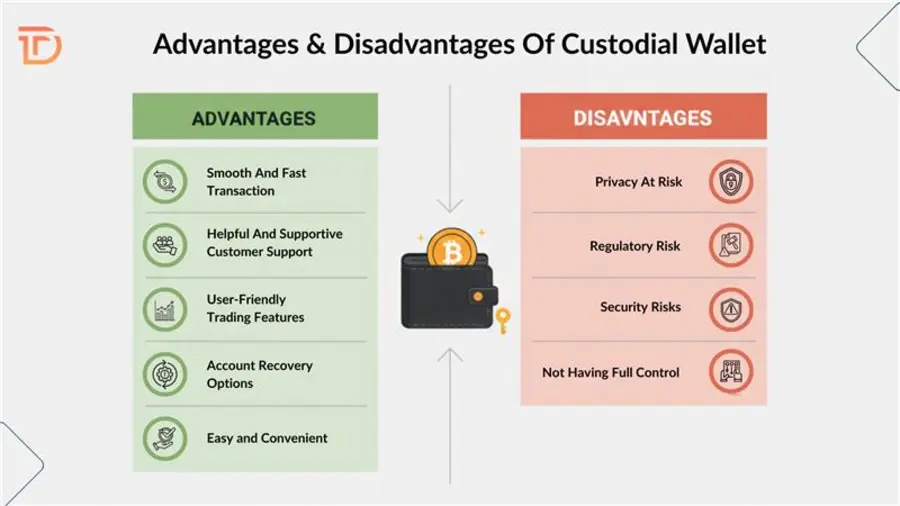
Advantages Of Using Custodial Wallet
- Smooth And Fast Transaction: Your business transaction is fast and smooth, you do not need to worry about any ambiguities involved therein.
- Helpful And Supportive Customer Support: Custodial wallet providers are ready to help you whenever you have any problems related to custodial wallet.
- User-Friendly Trading Features: You do not need any training to use this wallet as it has user-friendly features, and you can use them independently for your investment activities.
- Account Recovery Options: In case you forget or lose access to your account, you get account recovery options from your service provider.
- Easy and Convenient: Using custodial wallet is quite easy and convenient. You do not need any technical knowledge about blockchain operations or private keys.
Disadvantages Of Custodial Wallet
- Privacy At Risk: Since it has limited privacy, your privacy is at risk. It requires only KYC verification, so your anonymity is reduced.
- Regulatory Risk: Your fund is at risk of being frozen, as it has internal platform issues or regulatory actions.
- Security Risks: Centralized platforms are prone to hackers, who can cause significant loss to you.
- Not Having Full Control: You do not have full control over your private keys. This deprives you of control over your own assets.
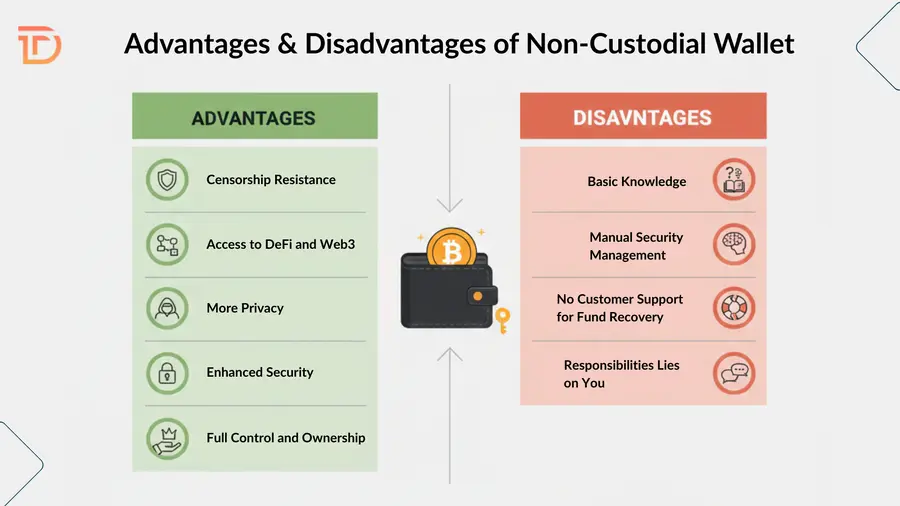
Advantages of Non-Custodial Wallet
- Censorship Resistance: Your assets have strong censorship resistance. This means third parties cannot freeze them.
- Access to DeFi and Web3: You get access to direct interaction with NFTs, staking platforms and decentralized applications.
- More Privacy: In comparison to a custodial wallet, this wallet gives you more privacy. It does not require your personal information or KYC.
- Enhanced Security: In a non-custodial wallet, your funds are not stored on centralized servers. So, you are not at risk of large-scale hacks.
- Full Control and Ownership: You do not need to depend on intermediaries for controlling your private keys and assets.
Disadvantages of Non-Custodial Wallet
- Basic Knowledge: This wallet requires a basic understanding of blockchain concepts and security practices.
- Manual Security Management: You need to ensure safe and secure storage of backups and recovery phrases.
- No Customer Support for Fund Recovery: It does not have central authority for restoration of access.
- Responsibilities Lies on You: In case you lose private keys or seed phrases, then you have permanent loss of your funds.
Custodial vs Non-Custodial Wallet: Key Differences
To know more about key differences between custodial vs. non-custodial wallet, look at the following table:
| Feature | Custodial Wallet | Non-Custodial Wallet |
|---|---|---|
| Private Key Ownership | Platform-controlled | User-controlled |
| Security Responsibility | Platform | User |
| Ease of Use | High | Moderate |
| Privacy | Limited | High |
| DeFi Access | Limited | Full |
| Risk of Account Freeze | Yes | No |
What Role Does Custodial Wallet Play In Trading Platform?
A custodial wallet has its dominance over centralized exchanges and platforms made through custom trading platform.
Its appeal lies in instant trades, seamless onboarding, and high liquidity. It offers operation efficiency and integration with analytics, charts, and trading tools.
What Role Does Non-Custodial Wallet Play In Decentralized Ecosystems?
Non-custodial wallet plays the role of kingpin in decentralized cryptocurrency trading platforms.
It lets you execute business without seeking intervention from intermediaries, maintain the sovereignty of your business, take part in decentralized governance, and have access to global financial services.
How To Choose The Right Wallet For Business Transaction?
Choosing between custodial and non-custodial wallets depends on your objectives and goals.
For Choosing Custodial Wallet, Consider The Following Tips:
- If you are novice to crypto
- If you execute business on centralized platforms quite often
- If you want to have recovery options
- If you want convenience over full control
For Choosing Non-Custodial Wallet, Consider The Following Tips:
- If you give importance to decentralization and ownership
- If you use Web3 or DeFi applications
- If you give priority to security and privacy
- If you want censorship-resistant financial access
Many people employ a hybrid approach. They use custodial wallets for trading purposes and non-custodial wallets for long-term storage.
What Roles Does Software Development Play In Crypto Wallets?
Both custom mobile application and blockchain engineering empower modern wallets. API integrations, encryption, UI/UX design, and compliance framework ensure reliability of wallets. In the same way, cryptocurrency trading software development integrates wallets into trading ecosystems, which allows seamless asset management, reporting, and order execution.
What Is The Future Of Custodial And Non-Custodial Wallets?
Since blockchain is becoming popular day by day, the future of both custodial and non-custodial wallets seems to be bright. Enthusiastic entrepreneurs are aiming high with these wallets. Innovations, such as account abstraction, multi-signature authentication and contract wallets integrate the convenience of custodial wallets with the control of non-custodial solutions. Businesses that are making investment in custom trading development are offering flexible wallet options to cater to users’ needs.
Briefly Put!
Whatever your choice between custodial vs non-custodial wallet, it is a matter of control versus convenience. The former simplifies crypto access and trading, while the latter empowers you with decentralization and full ownership. Before you choose any of these wallets, get sufficient information about them in terms of their advantages and disadvantages.
Whether you are an individual investor or the owner of a business organization, we at Dreamer Technoland can help you build your own cryptocurrency trading software with an integrated crypto wallet.