


In today’s tech-friendly era, sophisticated technologies have evolved, and they play an indispensable role in various sectors. Embedded software development is one of them. Whether it is IoT, healthcare, automotive, or manufacturing, it has carved a niche for itself in all sectors. In the New Year—2026–embedded development demands seamless integration, higher performance, scalability, security, real-time responsiveness and security. To meet these challenges, our team wholly depends on software development tools that streamline workflows, ensure authenticity, and accelerate time to market.
This blog familiarizes you with what embedded software development is, what process it involves, what modern developments have occurred in this field, and the most important tools used in embedded software development and IoT solutions in this new year.
What Is Embedded Software Development And What Are Its Varied Applications?
Embedded software development is a software development which works on hardware units to carry out various functions within a system. Quite dissimilar to outdated application software, it has hardware and works under strict conditions, such as processing power, limited memory, and requirements of real-time performance.
Embedded software development finds its applications in IoT sensors, automotive control units, medical devices, smart home devices, etc. In the New Year, it has crossed the limit of firmware programming and includes cloud connectivity, cybersecurity, edge computing, AI integration, and RTOS (real-time operating systems).
Different Types Of Embedded Software Tools
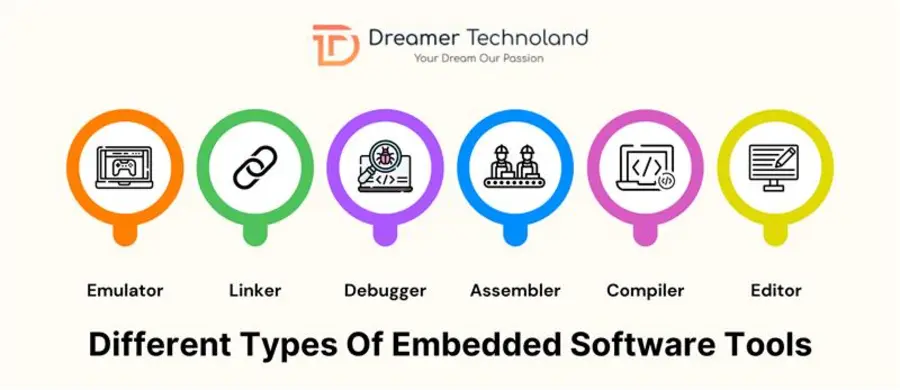
- Emulator: This tool stimulates software performance and checks how the code works in a real-time environment. With these tools, programmers can change values to know the working of code. After checking the code, tester can embed them on the device.
- Linker: This tool combines all the modules together to create a single program. GNU ld is one of these tools.
- Debugger: This tool is used for testing purposes. It passes through the code and removes errors and bugs. In fact, it pinpoints the lines where issues are spotted so that programmers can fix them quickly. It works on Windows, Linux, and Mac OS X operating systems.
- Assembler: This tool converts home-written code into machine language. It is extensively used for Linux operating systems.
- Compiler: This tool converts the code into low-level machine language code, which only machines can understand not humans.
- Editor: This tool is used for writing source code in programming languages, such as C and C++. Geany is a good example of this tool. Its basic functions include code navigation, auto-closing of XML and HTML tags, snippets, symbol name auto-completion, code folding, and syntax highlighting.
How Is Embedded Software Development Considered In 2026?
In 2026, embedded software development is more sophisticated, functional, and connected than ever before. It finds its extensive usage in DevOps for embedded systems, AUTOSAR and functional safety compliance, cybersecurity-by-design, IoT and cloud-native integration, edge AI and machine learning and software-defined vehicles. To support these advancements, developers use modern embedded software that is scalable, robust, and compatible with complex hardware architectures.
How Does Embedded Software Development Process Work?
The embedded software development process works on a systematic system that ensures safety, reliability, and performance. It involves various phases: 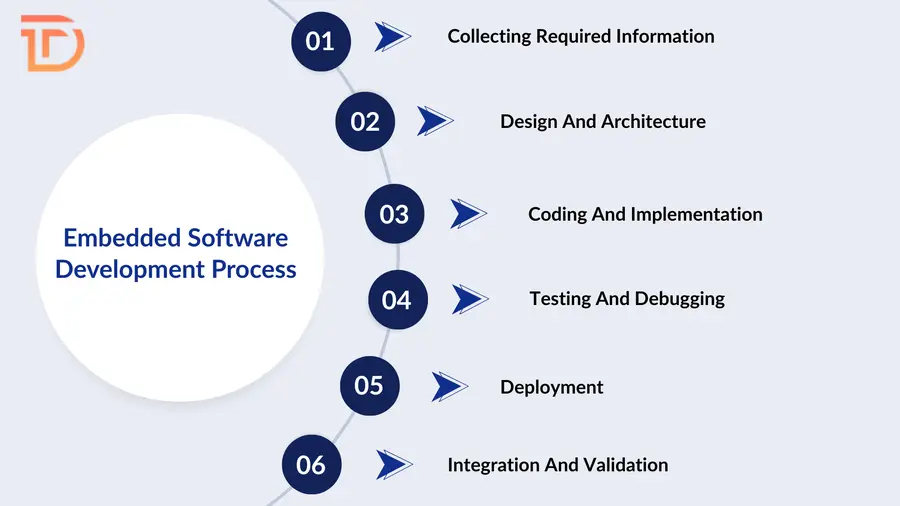
- Collecting Required Information: During this phase, team considers information about the products, features, and non-functional aspects such as safety, power, and real-time performance.
- Design and Architecture: The developing team takes architectural decisions based on requirements, considering overall system structure, roles of various software components, and their interactions. They make designs for software modules, including data structure, interfaces, and algorithms.
- Coding and Implementation: This involves developing system software using various languages–Python, Rust, C++, and C.
- Testing and Debugging: It ensures correctness, time accuracy, and reliability while using simulators, debuggers, and hardware-in-the-loop testing.
- Deployment: The team loads the software onto the hardware platform before applying configuration settings. As soon as deployment is complete, the team test it.
- Integration and Validation: It involves integrating software with hardware and then validating real-time performance.
Each of these phases depends on specialized embedded software development to remove ambiguities, simplify the process, and improve overall efficiency.
Which Embedded Software Development Tools Have Been Launched In 2026?
Security And Compliance Tools
At present, cybersecurity has become a must in view of increasing cybercrime. These tools secure boot, firmware encryption, vulnerability scanning, and adhere to ISO 26262 and IEC standards. Just to name a few tools, they include Coverity, Cppcheck, and Parasoft. They find their applications in automotive embedded software development and IoT devices.
Testing And Validation Tools
Testing plays a very important role, as it ensures safety, stability, and adherence to standards. These tools include unit testing frameworks, hardware-in-the-loop testing, static code analysis tools, and functional safety testing tools. Some of them are QA-MISRA, Parasoft C/C++test, and Klocwork Insight.
Version Control And DevOps Tools
Embedded development follows DevOps practices. The key tools include Git, GitLab CI/CD, Jenkins, and Bitbucket. Version control and automation improve code quality and collaboration across teams providing software development services.
Simulation And Emulation Tools
Simulation minimizes the development of risks by allowing testing before hardware availability. These tools include QEMU, Proteus, MATLAB/Simulink, and virtual hardware platforms. They play a pivotal role in automotive embedded software development, where reliability and safety matters.
Debugging And Profiling Tools
Basically, developers use these tools in debugging embedded systems to control hardware-level behavior. They include JTAG and SWD debuggers, logic analyzers, oscilloscopes, and trace tools. They help spot timing issues, performance bottlenecks, and memory leaks, which are embedded in software development projects.
Real-Time Operating Systems
The role of RTOS is to manage memory, scheduling, tasks, and communication in real-time environments. Leading RTOS in the new year include FreeRTOS, Zephyr, VxWorks, QNX, and ThreadX. Generally, the RTOS tools find their applications in industrial automation and automotive embedded software development.
Compliers And Toolchains
Efficient compilation is very important for improving memory usage and performance in embedded systems. Key toolchains include GCC for embedded systems, LLVM/Clang, ARM compiler, and RISC-V toolchains. These sophisticated toolchains specifically support real-time constraints, security features, and multi-architecture consistency, which are important for automotive embedded software development.
Integrated Development Environments
IDEs are the foundations of embedded development. They provide various things—debugging, coding, and project management capabilities. Generally, popular IDEs of 2026 include eclipse embedded CDT, Keil MDK, IAR embedded workbench, and visual studio code with embedded extensions. These tools support integration with CI/CD pipelines, advanced debugging, and multi-core architecture.
Different Categories Of Key Tool
- Over-the-air (OTA) update platform
- Functional safety and cybersecurity tools
- CAN, LIN, FlexRay, Ethernet Tools
- AUTOSAR Classic and Adaptive Platforms
Automotive embedded systems require standard-compliant embedded software development tools that ensure performance, safety and reliability.
How Is Embedded Software Development Related To IoT Solution Development?
IoT solution development depends on embedded systems for communication, processing, and sensing. Key tools required for IoT include low-power optimization tools, cloud integration SDKs, edge AI frameworks, and secure communication stacks. So, the role of embedded software teams is to balance security, power efficiency, and performance while allowing cloud connectivity.
What Role Do Embedded Software Development Services Play?
Professional embedded software development services help you cope with complex hardware ecosystems, scalability challenges, and regulatory requirements. By leveraging these services, you will certainly be able to build complete digital ecosystems, from device firmware to cloud platforms.
Embedded systems hardly work in isolation. By and large, they associate with cloud platforms, mobile apps, and enterprise software. Custom software development services allow seamless integration between digital platforms and embedded devices that ensure real-time data exchange, analytics and monitoring, remote device management, and scalable system architecture.
What Is The Future Of Embedded Software Development?
In time to come, embedded software development is likely to evolve with various features–AI-powered embedded systems, software-defined hardware, digital twins, autonomous systems, and industry 4.0 and smart manufacturing. The development practices and tools will determine the success of embedded software development in today’s fast changing era.
Briefly Put!
In the New Year—2026—embedded software development is more developed, connected, and complex than ever before. Gathering complete information about embedded software development, becoming familiar with its process, and leveraging the tools are important for building a strong working system.
We, at Dreamer Technoland, empower developers to deliver high-performance, scalable and secure solutions, from automotive embedded software development to IoT solutions. By availing our embedded software development services, you can bring in innovation and stay ahead of the pack in today’s tech-friendly era.