


Every startup begins with a strong belief that their idea will work. Founders invest time, money, and energy into building a product they believe people need. However, when it comes to software-driven startups, the journey is far more complex than it appears.
Many startups do not fail because they lack effort. They fail because they build the wrong product, build it incorrectly, or build it at the wrong time. According to a report by CB Insights, 42% of startups fail due to no market need, which clearly shows how closely product success is tied to execution.This is where software development failures become a major concern. It is not just about bugs or system crashes. It is about understanding users, making the right decisions, and building solutions that actually solve problems. If any of these areas go wrong, even a great idea can fail.
To truly understand this topic, we need to go deeper into how software development works in startups and where things start to break.
Actual Software Development Failure Rate in Startups
The software development failure rate is not limited to projects that completely fail. In reality, failure happens in different forms, and many startups do not even realize it early.
A product can launch successfully but still fail if users do not adopt it. Similarly, a platform may gain users initially but collapse later due to poor scalability or performance issues. These situations are also considered failures because they do not meet business goals.
Industry research from the Standish Group’s CHAOS report shows that only around 31% of software projects are fully successful, while the rest are either challenged or fail completely. This highlights how common failure is, even beyond startups.
To understand this better, here is how failures typically appear in real scenarios:
| Type of Failure | What Happens in Reality | Business Impact |
|---|---|---|
| Silent Failure | Product launches but users do not engage | No growth or revenue |
| Delayed Failure | Product works initially but fails to scale | System breakdown and churn |
| Budget Failure | Development exceeds planned cost | Financial instability |
| Strategic Failure | Wrong features or direction | No product-market fit |
This clearly shows that failure is not always visible at the beginning. Many startups continue operating without realizing that their product is already failing.
Why Do Most Startups Fail in Software Development?
There is no single reason behind failure. Instead, multiple small mistakes build up and create major problems over time.
- Lack of Market Validation
Many startups start building products without confirming whether users actually need them. Founders rely on assumptions instead of real feedback, which creates a gap between the product and market demand.
When validation is missing, even well-developed software fails to attract users. This is one of the biggest contributors to software development failures, because the issue is not technical but strategic.
- Early Overdevelopment
Startups often try to build a complete product with many features from the beginning. This approach increases development time, cost, and complexity.
A smarter approach is to begin with MVP development, where only essential features are built first. This allows startups to test their idea quickly and improve it based on real user feedback.
- Early Technical Decisions
Technology choices made in the early stages have long-term effects. If the architecture is not scalable or flexible, the system may fail as the number of users grows.
Research shows that fixing issues later in development can cost up to 10 times more than addressing them early. This makes early technical planning extremely important.
- Poor Communication
In many startups, there is a gap between what founders want and what developers build. Requirements are not clearly defined, which leads to confusion and repeated changes.
Over time, this reduces productivity and increases frustration within the team, affecting the overall quality of the product.
- Poor Budget Plan
Software projects often exceed initial estimates. Studies suggest that large IT projects exceed budgets by an average of 45%, which can be difficult for startups to handle.
When funds run out before the product becomes sustainable, the startup is forced to shut down.
How Many Startups Fail in the First 5 Years and What Does It Mean?
Understanding
- Build Their Core Product
- Validate Their Business Model
- Try to Achieve Product-market Fit
If mistakes happen during this phase, recovery becomes difficult. This is why early decisions in software development play a major role in long-term success.
Difference Between Product Failure and Development Failure
Many people confuse product failure with development failure, but they are not the same.
Product failure happens when the idea itself does not solve a real problem or does not attract users. Development failure happens when the idea is good, but execution is poor.
For example, a startup may have a strong idea but fail due to poor performance, bugs, or scalability issues. On the other hand, a technically perfect product can still fail if users do not need it.
Understanding this difference helps startups focus on both strategy and execution instead of just one area.
Key Reasons Businesses Fail in Software Development
When analyzing the Reasons Businesses Fail to Develop Software Successfully, it becomes clear that failures are caused by a mix of technical and business issues.
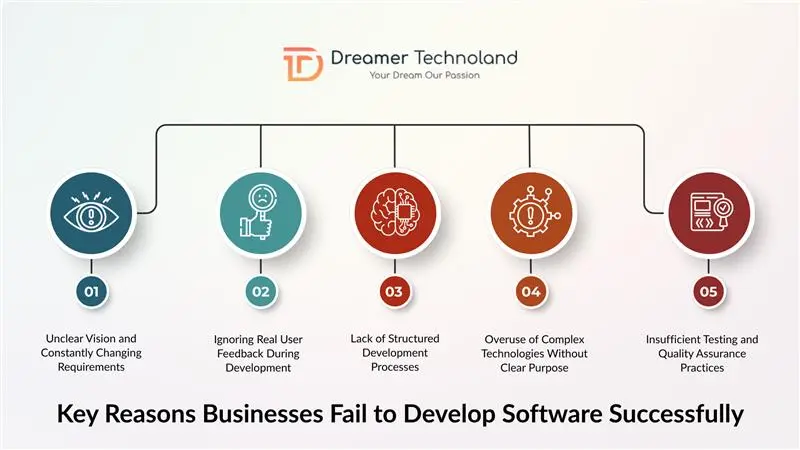
- Unclear Vision & Changing Requirements
Many startups begin without a clear roadmap. As ideas change frequently, development becomes unstable, which leads to delays and confusion across teams.
- Ignoring Real User Feedback
Businesses often depend on internal assumptions instead of real-world input. This results in products that do not match user expectations or solve meaningful problems.
- Lack of Structured Development
Without proper planning and workflows, teams struggle to manage priorities, timelines, and quality standards effectively.
- Overuse of Complex Technologies
Startups sometimes adopt advanced tools without understanding their need. This increases development complexity and makes maintenance more difficult over time.
- Insufficient Quality Testing
Releasing software without proper testing leads to bugs, crashes, and poor performance, which directly impacts user trust and retention.
Early Warning Signs of Software Failure in Startups
Many startups fail slowly before they fail completely. Recognizing early signs can help prevent bigger problems.
- Users Sign Up but Don’t Engage
This often indicates that the product is not delivering enough value or is difficult to use.
- Frequent Changes, No Clear Results
Constant pivots usually show a lack of clarity in vision or understanding of the market.
- Extended Timelines, No Progress
Delays often point to poor planning, unclear requirements, or technical challenges.
- Scaling Brings More Technical Issues
Performance problems and bugs suggest that the system is not built to scale properly.
- Rising Costs Without Growth
This indicates inefficiency in development and poor resource management.
How to Ensure Software Development Success for Startups?
Achieving success in software development requires a combination of planning, execution, and continuous learning.
Step 1: Validate the Problem Before Building the Solution
Startups should focus on understanding real user problems through interviews, surveys, and research before writing any code.
Step 2: Start Small and Improve Continuously
Building a basic version of the product helps in testing ideas quickly and making improvements based on real feedback.
Step 3: Choose the Right Development Partner
Working with an experienced software and app development company for startups can reduce risks and improve execution quality.
Step 4: Adopt an Iterative Development Approach
Agile methods allow teams to build in stages, test regularly, and adapt based on feedback.
Step 5: Focus on Long-term Scalability and Performance
Even in early stages, the system should be designed to handle future growth without major changes.
How Technology Helps Businesses Succeed in a Competitive Market?
Understanding How Technology Helps Businesses Succeed is essential for modern startups.
Technology enables businesses to operate efficiently and scale faster. For example, automation reduces manual effort, while data analytics helps in making better decisions.
Studies show that companies using data-driven strategies are 23 times more likely to acquire customers and 19 times more likely to be profitable. This highlights the importance of using technology effectively.
Additionally, many startups benefit from the Benefits of Offshore Software Development, which include cost savings, access to global talent, and faster development cycles.
What Is the Role of Software Development in Startup Growth?
Professional software development services provide expertise and structure that startups often lack internally.
These services help in planning, designing, building, and maintaining software efficiently. For instance, working with a reliable software development company in australia or other experienced providers ensures better project management and technical quality.
This support becomes especially important when startups are scaling and need stable systems to handle increased demand.
Key Challenges Startups Face in Software Development
Even with the right strategy, startups face multiple challenges during development.

- Limited Budget and Resources
Startups often operate under financial pressure, which makes it difficult to invest in experienced talent and advanced tools.
- Difficulty Hiring Skilled Developers
Finding developers who understand both technical and business needs can be challenging for early-stage companies.
- Balancing Change and Stability
As the business evolves, requirements change, which can disrupt development timelines and increase complexity.
- Balancing Development Speed & Quality
Launching quickly is important, but rushing development can lead to poor performance and user dissatisfaction.
- Scalability and Technical Challenges
As user numbers increase, maintaining performance, security, and reliability becomes more difficult.
Conclusion
The high startups failure rate shows that building a successful software product is not easy. However, failure is not random. It happens due to clear and avoidable reasons such as lack of validation, poor planning, and weak execution.
Startups that focus on understanding users, making informed decisions, and building scalable solutions have a much higher chance of success.
In the end, success in software development is not about building more features. It is about building the right product in the right way and continuously improving it based on real-world feedback.
FAQs
Q. What is the main reason behind software development failures?
A. The most common reason is lack of market validation, where startups build products without confirming real user demand.
Q. How many startups fail in the first 5 years?
A. Around 70% of startups fail within the first five years due to issues like poor planning, lack of demand, and financial challenges.
Q. How can startups reduce the software development failure rate?
A. They can validate ideas early, start with a basic product, use agile methods, and improve continuously based on user feedback.
Q. Why is MVP development important for startups?
A. It helps test ideas quickly with minimal investment and allows startups to learn from real users before scaling.
Q. How does technology help businesses succeed?
A. Technology improves efficiency, supports better decision-making, and enables scalability, which helps businesses grow faster.