

Fleet management is becoming more complex as businesses try to control costs, improve safety, and deliver faster services at the same time. Many traditional fleet systems depend heavily on cloud processing, which can sometimes slow down decision-making and reduce efficiency in daily operations.
According to Grand View Research, the global Edge AI market was valued at USD 20.78 billion in 2024 and is expected to reach USD 66.47 billion by 2030, growing at a CAGR of 21.7%. This strong growth clearly shows that industries such as transportation and logistics are rapidly adopting real-time AI technologies to improve daily operations.
Edge AI technology helps fleet systems process important data directly inside vehicles and smart devices instead of sending everything to distant servers.
Because of this, fleet managers can receive faster insights, take quicker actions, and manage their operations in a more smooth and controlled way.
What Is Edge AI Technology in Fleet Management?
Edge AI technology in fleet management means using artificial intelligence directly on devices such as vehicle sensors, GPS trackers, cameras, and onboard systems. Instead of sending all the collected data to the cloud for analysis, the system processes useful data at the vehicle level or near the data source.
In very simple words, the vehicle becomes smart enough to understand what is happening in real time without waiting for outside processing.
For example, if a driver suddenly brakes or drives in an unsafe way, the system can detect the behavior instantly and generate alerts without delay.
This is where edge ai telematics and AI and Telematics work together to give real-time insights for better fleet control. This local processing makes the entire fleet system faster, more responsive, and easier to manage on a daily basis.
Why Is Real-Time Data Processing Important in Fleet Management?
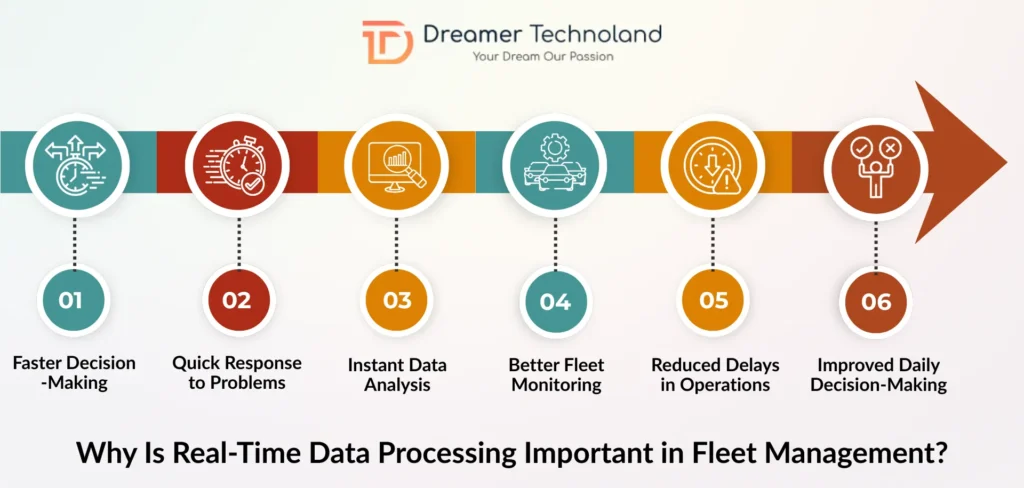
- Faster Decision-Making: Real-time data processing helps fleet managers make quicker and more accurate decisions without waiting for delayed information.
- Quick Response to Problems: When fleet data is processed slowly, managers may not be able to respond to route delays, unsafe driving, or vehicle issues on time.
- Instant Data Analysis: Edge AI technology analyzes data immediately at the source, which helps fleet managers stay informed at all times.
- Better Fleet Monitoring: With faster data processing, businesses can monitor vehicle movement, driver behavior, and overall performance without any waiting time.
- Reduced Delays in Operations: Faster insights help companies reduce delays and maintain better control over their fleet operations.
- Improved Daily Decision-Making: This also shows the role of AI in fleet management, as real-time data helps improve faster and smarter daily decision-making.
How Does Edge AI Improve Driver Safety and Monitoring?
Driver safety is one of the most important parts of fleet management because unsafe driving can lead to accidents, losses, and operational problems. Edge AI improves driver safety by continuously monitoring driving behavior through smart cameras and sensors installed inside the vehicle.
The system can identify risky actions such as over-speeding, harsh braking, distracted driving, and signs of driver fatigue in real time. Since the analysis happens instantly inside the device, alerts are generated immediately and sent to fleet managers without delay.
This allows managers to take timely action and guide drivers toward safer driving habits. Over time, this leads to fewer accidents, better driver accountability, and improved safety standards across the fleet.
How Does Edge AI Reduce Operational Costs for Fleet Businesses?
Operational costs are a major concern for fleet-based businesses because fuel, maintenance, and daily operations require significant spending. Edge AI technology helps reduce these costs by improving efficiency and reducing unnecessary resource usage across the fleet.
It improves route planning using real-time data, which helps reduce fuel consumption and travel time. It also detects vehicle issues at an early stage, which prevents costly breakdowns and expensive repairs in the future. In addition, it reduces the amount of data sent to the cloud, which can lower storage and processing costs.
For better clarity, here is a simple comparison:
| Factor | Traditional Fleet Systems | Edge AI-Based Fleet Systems |
|---|---|---|
| Data Processing | Mostly cloud-based and slower | Instant local data processing |
| Fuel Usage | Less optimized route planning | Real-time route optimization |
| Maintenance Style | Reactive and delayed maintenance | Predictive and timely maintenance |
| Internet Dependency | Highly dependent on constant internet | Lower dependency on continuous connectivity |
| Operational Costs | Higher long-term costs | More controlled and cost-efficient operations |
Because of these improvements, businesses can manage their fleets more efficiently while keeping costs under better control.
What Is the Role of Edge AI in Predictive Maintenance in Fleet Management?
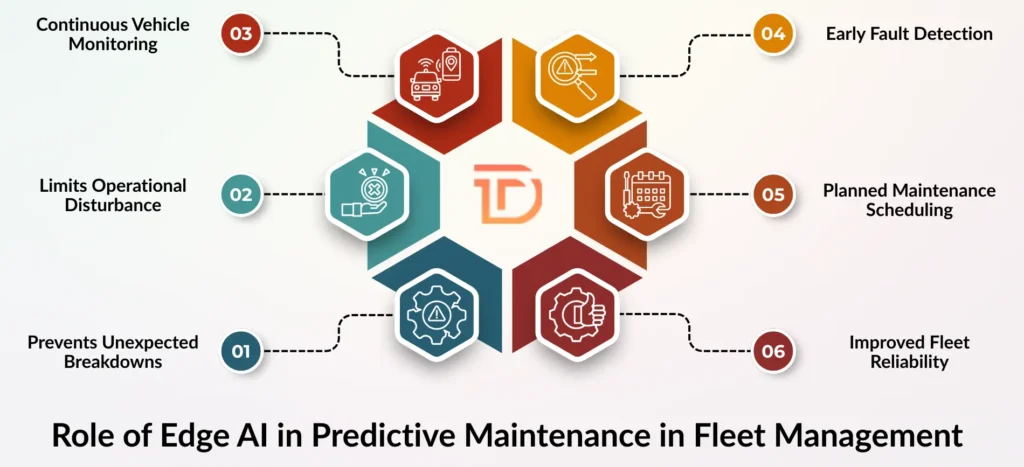
- Prevents Unexpected Breakdowns: Unexpected vehicle breakdowns can cause serious delays, missed deliveries, and higher repair costs for fleet businesses.
- Limits Operational Disturbance: Traditional maintenance methods usually focus on fixing problems after they happen, which can disturb daily operations and increase downtime.
- Continuous Vehicle Monitoring: Edge AI continuously monitors vehicle health data such as engine condition, temperature levels, battery status, and tire pressure.
- Early Fault Detection: If the system detects any unusual pattern or early sign of a fault, it sends an alert to the fleet manager immediately.
- Planned Maintenance Scheduling: This allows companies to plan maintenance before a major breakdown happens, which helps avoid sudden delays and operational issues.
- Improved Fleet Reliability: As a result, businesses can reduce downtime, extend vehicle lifespan, and maintain smoother and more reliable fleet operations.
How Does Edge AI Enhance Route Optimization and Fuel Efficiency?
Route planning plays a very important role in fleet performance because poor routes can increase fuel costs and delivery delays. Edge AI analyzes real-time traffic updates, road conditions, and travel patterns directly within the system.
Since the data is processed instantly, drivers receive updated route suggestions without any delay during their journey. This helps them avoid heavy traffic, reduce idle time, and reach destinations faster in a more efficient way.
Better route planning leads to lower fuel consumption, faster deliveries, and improved customer satisfaction. This is another example of how AI and Telematics together improve daily fleet performance in a simple and practical way.
Why Is Data Security and Privacy Better with Edge AI in Fleet Operations?
- Growing Data Security Needs: Data security is becoming more important as fleet management systems collect large amounts of operational and location data.
- Risk in Traditional Systems: Traditional systems often send most of the data to cloud servers, which can increase the risk of data leaks and unauthorized access.
- Local Data Processing: Edge AI technology improves data security by processing sensitive information locally on the device instead of sending everything over the internet.
- Reduced Cyber Risks: Since less data is transferred to external servers, the chances of cyber threats and data breaches are greatly reduced.
- Better Data Control: Local data processing gives businesses stronger control over their operational data and privacy.
- Useful for Daily Fleet Operations: This is especially useful for logistics and transport companies that handle sensitive tracking and operational data every day.
What Technology Is Used in Fleet Management?
Many people often ask what technology is used in fleet management to improve efficiency and control. Modern fleet management mainly uses GPS tracking, IoT sensors, telematics systems, cloud platforms, and artificial intelligence tools.
Today, telematics in modern fleet management plays a key role by collecting real-time vehicle data such as location, speed, fuel usage, and driver behavior. When this data is combined with edge ai telematics, fleet managers can get instant insights without waiting for cloud processing.
This clearly explains the role of AI in fleet management, as smart technologies help businesses monitor vehicles, improve safety, and manage operations in a more effective way.
What Are the Key Use Cases of Edge AI in Fleet Management?
Edge AI is used in several practical areas of fleet management to improve efficiency, safety, and operational control. Its real-world uses are simple to understand and highly useful for daily fleet operations.
Here are some key use cases:
| Use Case | How Edge AI Helps in Fleet Management |
|---|---|
| Real-Time Fleet Tracking | Provides instant location updates and movement insights |
| Driver Behavior Monitoring | Detects unsafe driving patterns in real time |
| Smart Telematics Systems | Processes vehicle data quickly for better insights |
| Accident Risk Alerts | Sends immediate warnings during risky situations |
| Vehicle Health Monitoring | Continuously tracks vehicle performance and condition |
These use cases show how edge ai technology adds intelligence to fleet systems without making them difficult to use or understand.
How Does Edge AI Help Fleet Managers Make Faster and Better Decisions?
Fleet managers are responsible for monitoring vehicles, ensuring safety, and managing daily operations efficiently. Delayed or incomplete data can make decision-making difficult and less effective in fast-moving operations.
Edge AI provides real-time insights and alerts that help managers stay updated about every important activity within the fleet. With accurate and instant data, managers can identify issues, monitor driver behavior, and take corrective actions more quickly.
Because decisions are based on real-time information, they become more reliable and practical. This helps improve overall fleet productivity and operational control in a simple and effective manner.
Why Is Edge AI Important for Scalable and Future-Ready Fleet Management?
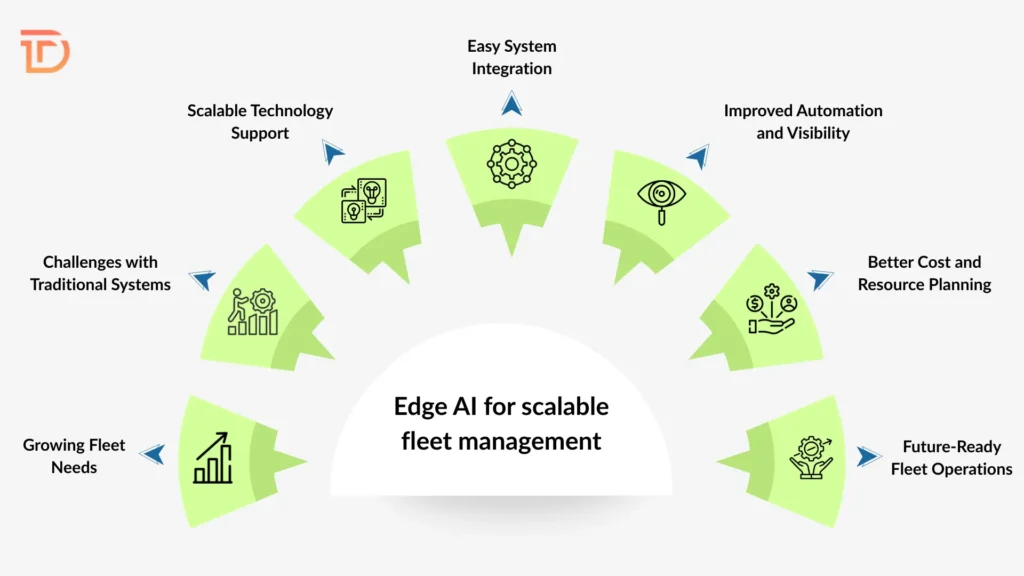
- Growing Fleet Needs: As businesses grow, their fleet size and operational needs also increase over time, which makes management more complex.
- Challenges with Traditional Systems: Managing a large fleet with traditional systems can become difficult, slow, and time-consuming for daily operations.
- Scalable Technology Support: Edge AI technology offers a scalable solution that grows along with business needs without making fleet management complicated.
- Easy System Integration: It can easily integrate with IoT devices, telematics platforms, and custom fleet management software development solutions.
- Improved Automation and Visibility: Automation powered by smart AI systems improves visibility and reduces manual work across the fleet.
- Better Cost and Resource Planning: Companies can track performance, manage resources more efficiently, and plan fleet management development cost with more clarity and confidence.
- Future-Ready Fleet Operations: This makes fleet management more future-ready, flexible, and easier to handle for long-term business growth.
Conclusion
Edge AI technology is helping fleet management become faster, safer, and easier to manage in daily operations. It allows vehicles and systems to process data in real time, which improves driver safety, route planning, and vehicle maintenance.
Because of this, businesses can reduce costs, avoid delays, and run their fleet in a smoother and more controlled way. With the right support from a trusted technology partner like Dreamer Technoland, companies can use simple and effective Edge AI solutions to improve fleet performance, safety, and overall operational efficiency without making their systems complex.
FAQs
Q. What is the main purpose of Edge AI in fleet management?
A. The main purpose of Edge AI in fleet management is to process data in real time inside vehicles and devices, which helps improve safety, decision-making, and operational efficiency.
Q. Is Edge AI difficult to use for non-technical fleet businesses?
A. No, modern Edge AI solutions are designed to be simple and user-friendly, so even non-technical businesses can easily understand insights and manage their fleet operations.
Q. How does Edge AI help in reducing fuel costs?
A. Edge AI improves route planning and reduces idle time by using real-time data, which directly helps in lowering fuel consumption and overall operational costs.
Q. Does Edge AI require constant internet connectivity to work?
A. Edge AI does not fully depend on constant internet connectivity because it processes important data locally on devices for faster and more reliable performance.
Q. Can Edge AI be integrated with existing fleet management systems?
A. Yes, Edge AI can be integrated with modern fleet management systems and telematics platforms, making it a flexible and scalable solution for growing fleet businesses.