
Every startup eventually reaches a defining moment in its growth journey. The team realizes that spreadsheets, disconnected tools, and temporary workarounds are no longer enough to support operations, customer experience, or scalability. That is when the biggest technology question appears: should you build your own software from scratch or buy an existing solution and move faster?
The decision sounds simple initially, but in reality, it impacts your startup’s speed, scalability, competitive advantage, operational efficiency, and even investor confidence. According to Grand View Research, the global custom software development market was valued at over USD 43 billion in 2024 and is projected to grow rapidly through 2030 due to rising demand for tailored digital solutions. This clearly shows that businesses are increasingly moving beyond one-size-fits-all software.
In this blog, we will break down the entire build versus buy decision for startups, explain when each approach makes sense, compare costs and scalability, highlight common mistakes, and help founders choose the right technology strategy for long-term success.
What Does “Build Vs Buy” Really Mean For Startups?
The build versus buy debate refers to one of the most important software decisions startups make during their growth journey.
What Does “Build” Mean?
Building means creating custom software specifically designed around your startup’s workflows, customer experience, and business goals. This usually involves hiring developers or partnering with a custom software development company to create a fully tailored product.
With custom development, startups gain:
- Full ownership of the product
- Complete feature flexibility
- Custom integrations
- Better scalability control
- Competitive differentiation
However, building requires higher investment, longer development timelines, and technical expertise.
What Does “Buy” Mean?
Buying means using ready-made SaaS platforms or off-the-shelf software solutions that already exist in the market.
Examples include:
- CRM platforms
- Accounting tools
- Project management software
- Email marketing platforms
- Customer support tools
Buying allows startups to:
- Launch quickly
- Reduce upfront costs
- Avoid technical maintenance
- Access ready-made integrations
The downside is limited customization and dependence on third-party vendors.
The Grey Area: Low-Code And No-Code Platforms
Modern startups are also using low-code and no-code tools to create lightweight applications without deep engineering involvement. These platforms help validate ideas quickly before investing heavily in development.
The right decision depends entirely on your startup stage, product complexity, scalability goals, and competitive strategy. There is no universal answer because every startup operates differently.
How Startups Are Approaching Software In 2026
Software adoption among startups has evolved dramatically in recent years.
Today, most early-stage startups begin with SaaS tools because they reduce development time and allow founders to focus on validating their business model. According to SEO Scale Up, nearly all modern organizations now use at least one SaaS application as part of their operations.
At the same time, demand for custom software is growing rapidly as startups scale and require better flexibility, deeper integrations, and stronger competitive differentiation. Industry reports show that the custom software market is expanding aggressively because businesses increasingly want software tailored to their exact needs.
Several trends are shaping startup software decisions in 2026:
- SaaS adoption remains dominant during early stages
- AI is making custom software development faster and more affordable
- Startups are moving away from fragmented software stacks
- Low-code platforms are accelerating MVP launches
- Investors increasingly value proprietary technology assets
The reality is that most startups are no longer choosing only one approach. Instead, they combine both build and buy strategies depending on the problem they are solving.
When Buying An Existing Software Solution Makes Sense
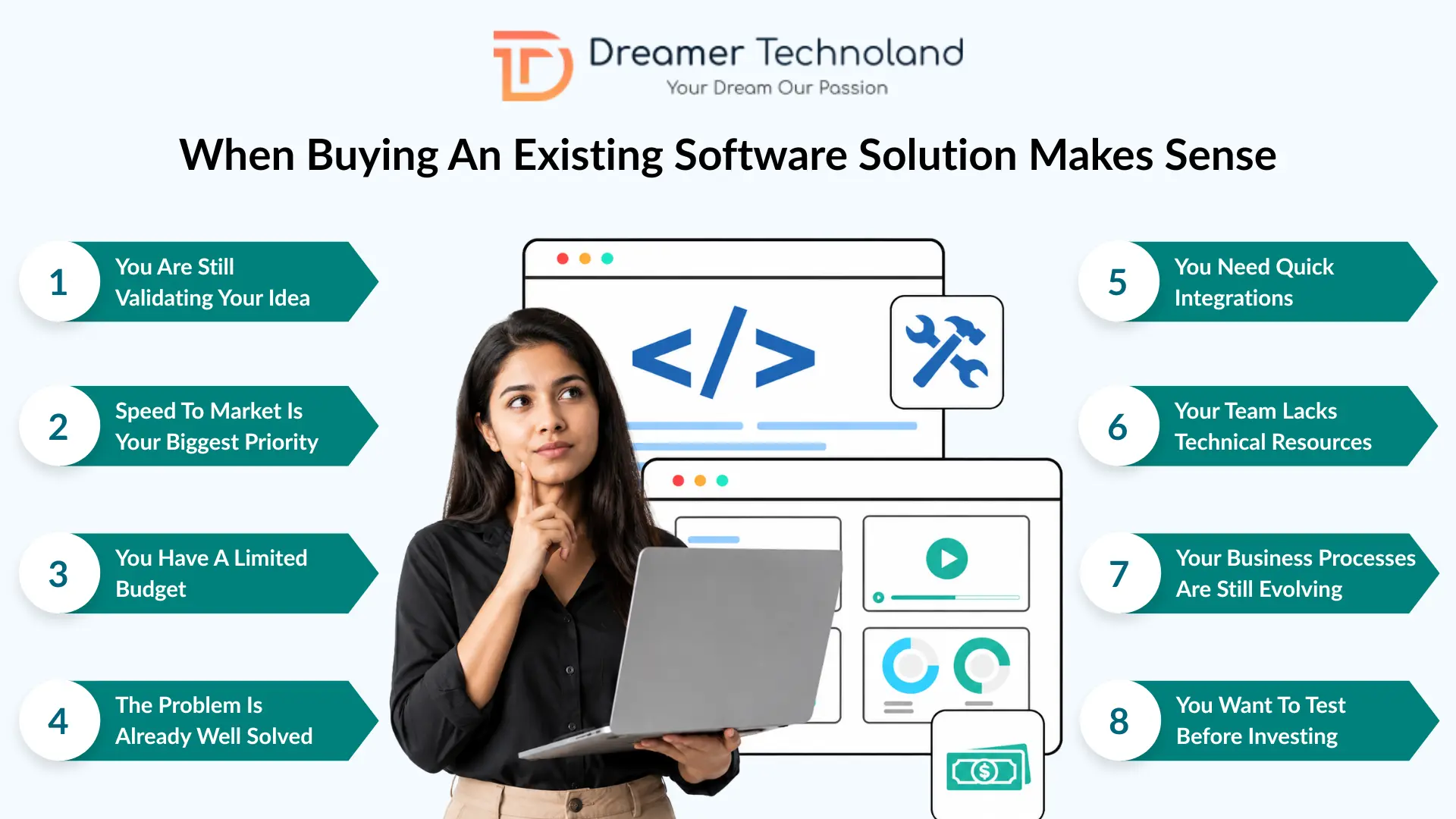
- You Are Still Validating Your Idea
If your startup is still testing product-market fit, buying existing tools is usually the smarter option. There is no reason to spend months building software before validating customer demand.
- Speed To Market Is Your Biggest Priority
SaaS solutions can often be deployed within hours or days. If launching quickly matters more than deep customization, buying helps you move faster.
- You Have A Limited Budget
Early-stage startups typically operate with tight budgets. Buying ready-made software preserves runway and reduces initial engineering expenses.
- The Problem Is Already Well Solved
Functions like accounting, HR management, CRM, or email marketing already have mature software solutions available. Building these systems from scratch rarely creates additional business value.
- You Need Quick Integrations
Most SaaS platforms provide pre-built integrations and APIs that save months of development effort.
- Your Team Lacks Technical Resources
Without strong engineering capabilities, maintaining custom software becomes risky and expensive. SaaS tools reduce technical complexity significantly.
- Your Business Processes Are Still Evolving
Startups often change workflows rapidly during early growth stages. Buying flexible tools helps businesses adapt faster without rebuilding software repeatedly.
- You Want To Test Before Investing
Many startups use SaaS platforms first to understand customer behavior before investing in fully customized systems later.
When Building Custom Software Is The Right Move
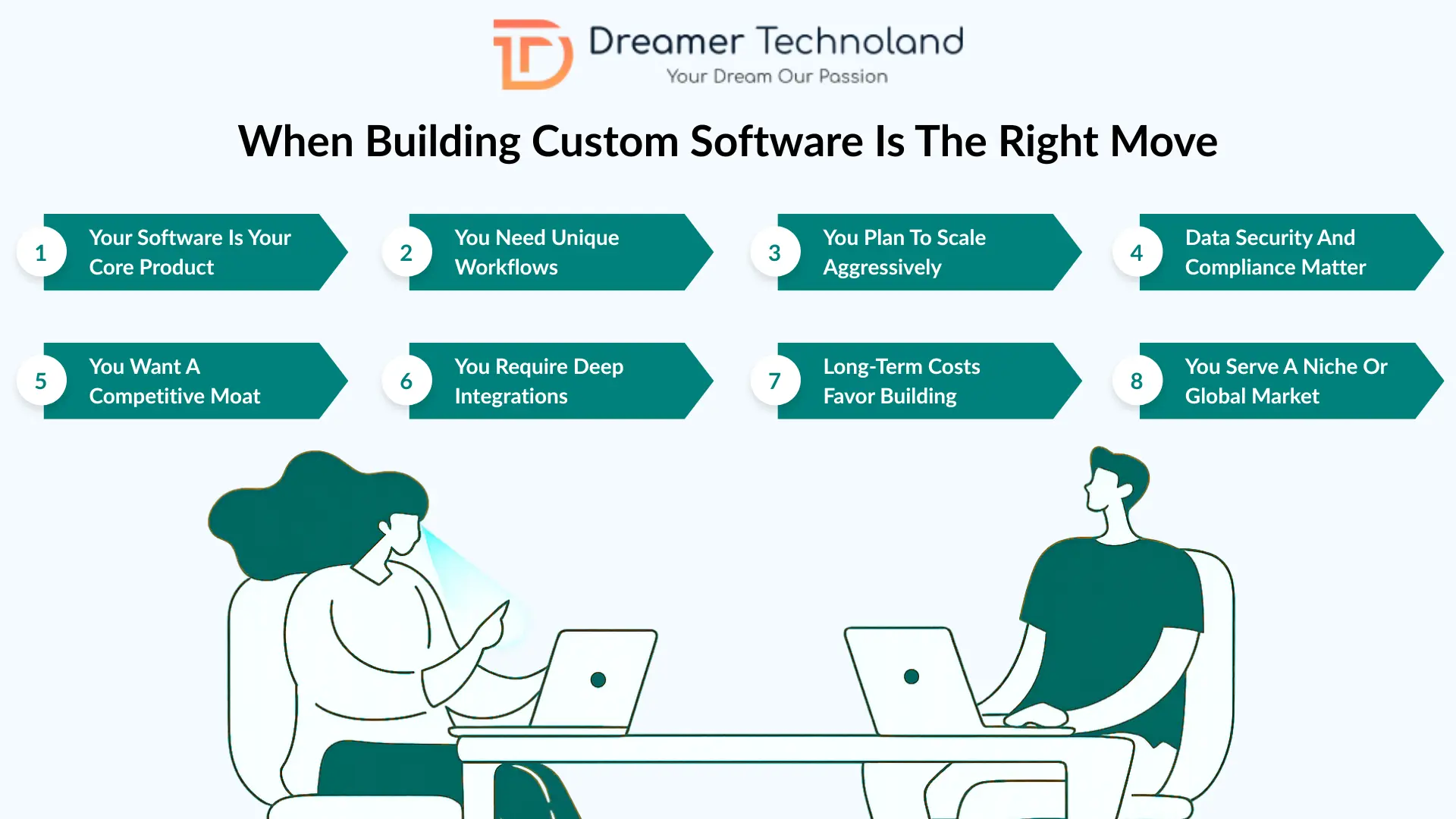
- Your Software Is Your Core Product
If your software itself creates the competitive advantage, building becomes essential. Companies cannot rely on generic tools for proprietary innovation.
- You Need Unique Workflows
Some startups operate with specialized business models that existing software cannot support effectively.
- You Plan To Scale Aggressively
Off-the-shelf software often becomes restrictive at scale. Custom systems provide better performance and long-term flexibility.
- Data Security And Compliance Matter
Industries like fintech, healthcare, and legaltech require stricter control over infrastructure, security, and compliance standards.
- You Want A Competitive Moat
Proprietary software creates stronger differentiation and makes replication harder for competitors.
- You Require Deep Integrations
Complex startups often need custom APIs and advanced integrations that generic SaaS platforms cannot provide efficiently.
- Long-Term Costs Favor Building
Monthly SaaS subscriptions can become extremely expensive as teams grow. Over time, custom software may become more cost-effective.
- You Serve A Niche Or Global Market
Unique customer requirements often require specialized experiences that generic tools cannot deliver.
Build Vs Buy: Complete Comparison
| Factor | Build Custom | Buy Off-The-Shelf |
|---|---|---|
| Deployment Time | Weeks To Months | Hours To Days |
| Upfront Cost | High | Low To Medium |
| Customization | Fully Flexible | Limited |
| Scalability | Highly Scalable | Vendor Dependent |
| Data Ownership | Full Control | Limited Control |
| Competitive Advantage | Strong | Minimal |
| Maintenance | Internal Or Partner Managed | Vendor Managed |
| Integrations | Fully Custom | Pre-Built APIs |
| Analytics | Customized | Standard Reports |
| Innovation Speed | Team Dependent | Vendor Roadmap |
The Smart Middle Ground: Combining Build And Buy
Interestingly, most successful startups today use a hybrid strategy instead of choosing only one path.
For example:
- Use Stripe for payments but build custom checkout experiences
- Use Twilio for messaging but create custom communication workflows
- Use AWS for infrastructure but develop proprietary applications
This approach allows startups to:
- Reduce development time
- Lower operational costs
- Focus engineering resources on core differentiators
- Scale efficiently
Many modern startups buy commodity software while building features that directly impact customer experience and competitive positioning.
6 Critical Questions Every Startup Must Answer
- What Is Your Core Competitive Advantage?
If your competitive edge depends on software innovation, building custom software is often necessary.
- How Fast Do You Need To Launch?
Urgent launches usually favor buying. Long-term strategic products may justify custom development.
- What Is Your Funding Stage?
Pre-seed startups often benefit more from buying tools, while funded startups may justify custom investment.
- What Technical Resources Do You Have?
A strong engineering team makes custom development more practical and manageable.
- What Are Your Future Scalability Needs?
Think beyond your current user base. Can your chosen solution handle 10x growth?
- What Are Your Security Requirements?
Regulated industries may require custom infrastructure for compliance and data control.
5 Costly Mistakes Startups Make
- Building Too Early
Many startups invest heavily in software before validating market demand, leading to wasted resources.
- Buying Too Many Tools
Overusing SaaS platforms creates fragmented systems, disconnected data, and operational inefficiencies.
- Underestimating Development Costs
Custom development requires realistic budgeting for infrastructure, maintenance, and scaling.
- Ignoring Scalability
Some startups choose tools that work initially but fail during rapid growth phases.
- Vendor Lock-In
Depending entirely on one software vendor can create future migration and data portability problems.
How Successful Startups Approached The Decision
| Startup | Decision | Outcome |
|---|---|---|
| Airbnb | Built Custom Booking System | Created Strong Competitive Advantage |
| Slack | Combined Existing Protocols With Custom Layers | Faster Launch And Rapid Scaling |
| Uber | Built Proprietary Dispatch Infrastructure | Achieved Operational Efficiency |
| Notion | Developed Fully Custom Platform | Created Highly Differentiated Product |
| Freshworks | Started With SaaS Tools Then Transitioned | Scaled Into A Billion-Dollar Company |
How Much Does Custom Software Development Cost For Startups?
The cost of startup software varies depending on complexity, features, integrations, security requirements, and scalability expectations.
| Project Type | Estimated Cost | Timeline |
|---|---|---|
| MVP Development | ₹3L – ₹8L | 6–10 Weeks |
| Mid-Level Custom App | ₹8L – ₹20L | 12–20 Weeks |
| Enterprise Platform | ₹20L – ₹50L+ | 20–36 Weeks |
| SaaS Product Build | ₹15L – ₹40L | 16–28 Weeks |
Why Choose Dreamer Technoland For Startup Software Development?
At Dreamer Technoland, we help startups make smarter technology decisions based on scalability, business goals, and long-term growth strategies.
Why Startups Work With Us
- Proven expertise building startup-focused digital products
- Rapid MVP development for faster market validation
- Strong UI/UX design focused on customer engagement
- Full-stack development across web, mobile, and cloud
- Transparent processes with full IP ownership
- Long-term technology partnership beyond launch
Whether you need to validate an idea quickly or build a scalable enterprise platform, our team delivers customized software solutions designed around your business objectives.
You can also explore our related insights:
- Why Startups Fail In Software Development
- Custom Software Vs SaaS
- SaaS Development Cost Guide
- Custom Software Development Cost
Conclusion
The build versus buy decision is not about choosing the universally better option. It is about choosing the right strategy for your startup’s current stage, future growth plans, operational complexity, and competitive goals.
Buying software offers speed, affordability, and convenience during early stages. Building custom software provides scalability, differentiation, and long-term control when your business grows.
The smartest startups think strategically instead of emotionally. They evaluate where customization truly matters and where existing tools already solve the problem effectively.