


Most people use application software every day without even thinking about it. When you write a document, check sales reports, send emails, attend online meetings, or manage customer records, you are using application software. It quietly supports almost every task inside a modern business. In 2026, businesses are relying on software more than ever because speed, automation, and better customer experience have become essential for growth. According to Statista, global enterprise software revenue continues to grow steadily, showing how strongly companies depend on digital tools to improve operations and stay competitive.
This is why application software development has become so important. Businesses need the right software not just to complete tasks, but to improve productivity, reduce manual work, and support long-term success. In this blog, we will explain the 7 main types of application software and how each one helps businesses work smarter in 2026.
What Is Application Software and Why Does It Matter?
Application software is software created to help users perform specific tasks. Unlike system software, which helps the computer run properly, application software focuses on the work people do every day, such as writing reports, creating spreadsheets, preparing presentations, browsing websites, editing media, and managing customer information.
For example, when a company creates invoices, tracks employee attendance, stores client records, or prepares a sales presentation, it is using application software. These tools make work easier, faster, and more accurate.
In 2026, businesses need stronger productivity, better decision-making, and smoother customer experiences. This is why application software matters so much. It reduces repetitive manual work, improves team collaboration, supports automation, and helps companies stay competitive in a fast-moving digital market.
Many businesses also invest in custom software development when ready-made software cannot fully support their workflow, industry needs, or future growth plans.
What Are the 7 Main Types of Application Software?
Application software can be divided based on the type of work it performs. While there are many categories, seven major types are most commonly used across industries because they support the most important business functions.
| Type of Application Software | Main Purpose | Common Business Use |
|---|---|---|
| Word Processing Software | Creating and editing text documents | Reports, contracts, proposals |
| Spreadsheet Software | Managing calculations and data analysis | Budgeting, reporting, forecasting |
| Presentation Software | Creating visual presentations | Meetings, training, sales pitches |
| Database Software | Organizing and storing business data | Customer records, inventory |
| Multimedia Software | Creating and editing media content | Marketing, branding, training |
| Web Browsers | Accessing websites and online tools | CRM access, meetings, operations |
| Enterprise Software | Managing large-scale business operations | HR, finance, supply chain |
Each type serves a different purpose, but together they help businesses improve productivity, communication, and operational efficiency.
How Does Word Processing Software Help Businesses?
Word processing software is one of the most commonly used application software types because every business depends on written communication. It helps users create, edit, format, and manage text-based documents such as reports, contracts, invoices, proposals, meeting notes, and company policies.
Without proper documentation, even strong business operations can become disorganized. This is why word processing software remains one of the most important tools in every workplace.
- Better communication
Well-structured documents improve professionalism and create stronger communication with clients, employees, and stakeholders. A clear proposal builds trust, while an organized report helps managers make better decisions. Good documentation also reduces confusion and improves accountability across teams.
- Faster daily work
Templates, formatting tools, spell check, and document automation help employees save time while maintaining consistency and quality. Instead of creating every document from the beginning, teams can work faster and focus on more valuable tasks.
- Easy collaboration
In 2026, cloud-based word processing tools allow multiple people to work on the same document in real time. This is especially useful for remote teams and hybrid workplaces where collaboration must happen smoothly across different locations.
Why Is Spreadsheet Software Important for Data Management?
Spreadsheet software helps businesses organize information in rows and columns while also performing automatic calculations and analysis. It is widely used by finance teams, HR departments, sales managers, and operations teams because it supports both daily work and long-term planning.
From tracking monthly expenses to managing inventory costs, spreadsheet software helps turn raw numbers into useful business decisions.
| Business Area | How Spreadsheet Software Helps |
|---|---|
| Finance | Budget planning, expense tracking, forecasting |
| Sales | Revenue reports, target tracking, performance analysis |
| HR | Payroll calculations, attendance records |
| Operations | Inventory management, supplier tracking |
- Better financial planning
Businesses can track income, expenses, and forecasts in one place, making financial planning more reliable. This helps management make smarter decisions and reduces the risk of overspending.
- Stronger reporting
Charts, formulas, and dashboards make reporting faster and easier to understand. Leaders can quickly identify growth opportunities and performance gaps without waiting for manual reports.
- Improved operational control
Stock levels, supply movement, and team productivity can be monitored more clearly, helping businesses improve efficiency across departments. In 2026, businesses rely heavily on data-driven decisions, which makes spreadsheet software one of the most valuable operational tools.
How Does Presentation Software Improve Business Communication?
Presentation software helps businesses explain ideas clearly through visual slides instead of relying only on long text-heavy documents. It is commonly used for investor meetings, client proposals, project updates, sales presentations, employee training, and strategic planning.
Today, people understand visual information faster than plain text. This is why strong presentations often create stronger business outcomes. For example, a sales team can explain a business proposal more effectively with charts and visuals, while HR teams can improve onboarding through structured training sessions.
- Better client presentations
When proposals are supported by clear visuals, clients understand the value faster. This improves trust and increases the chances of successful business deals.
- Stronger employee training
Training sessions become more effective when employees can see structured steps, examples, and visual explanations instead of reading long manuals.
- Faster leadership communication
Management teams can present goals, performance reports, and business strategies more clearly, helping departments stay aligned and focused. In 2026, faster communication and stronger engagement make presentation software more important than ever.
Why Do Businesses Need Database Software?
Database software helps businesses store, organize, manage, and retrieve large amounts of structured information. As companies grow, managing customer records, employee details, invoices, transactions, and inventory manually becomes risky and inefficient.
Database software improves security, speed, and accuracy. It also helps businesses avoid duplicate records, reporting mistakes, and operational delays.
| Database Use | Business Benefit |
|---|---|
| Customer records | Faster service and better customer support |
| Employee data | Improved HR operations and payroll management |
| Inventory details | Better stock control and supply chain planning |
| Financial records | Stronger reporting and compliance support |
Instead of searching through files manually, teams can access the right information quickly and make faster decisions.
This becomes especially important in industries like healthcare, education, finance, and e-commerce, where data accuracy directly affects business performance.
How Does Multimedia Software Support Modern Business Growth?
Multimedia software helps businesses create and manage videos, graphics, animations, audio files, and visual content. In 2026, digital marketing depends heavily on visual engagement because customers respond more strongly to attractive and interactive content.
Whether it is a product demo, a brand campaign, or employee training material, visual content improves attention and trust.
- Stronger marketing
Promotional videos, product demonstrations, and customer testimonials improve visibility and help build trust. Businesses that use visual storytelling often create stronger customer engagement and better conversion rates.
- Better branding
Graphic design tools help companies maintain a consistent brand identity across websites, advertisements, social media, and presentations. Strong branding improves recognition and long-term customer trust.
- Higher engagement
Creative content performs better across digital platforms because it captures attention quickly. This helps brands grow faster in highly competitive markets. As online competition increases, multimedia software becomes a major part of business growth strategies.
Why Are Web Browsers Essential for Daily Business Operations?
Web browsers are application software used to access websites, cloud platforms, and browser-based business tools. Today, most workplace activities happen online, from emails and meetings to customer support and project management. Businesses use browsers every day, often without realizing how critical they are to productivity.
- Access to cloud tools
Teams use browsers to access CRM systems, accounting dashboards, project management platforms, and internal portals without installing heavy software on every device. This improves flexibility and reduces technical complexity.
- Support for remote work
In 2026, remote and hybrid work models continue to grow. Browsers make location-independent work easier by allowing secure access from anywhere.
- Better scalability
Companies using web app development services often prefer browser-based systems because they are easier to update, maintain, and scale compared to traditional desktop software.This makes web browsers one of the most important tools in every modern workplace.
What Are the Key Features of Modern Application Software in 2026?
In 2026, businesses expect software to do much more than basic task management. Modern application software must be secure, flexible, and ready for long-term growth. Choosing software without understanding these features often creates expensive long-term problems.
| Key Feature | Why It Matters |
|---|---|
| Cloud accessibility | Supports remote work and flexibility |
| User-friendly design | Improves adoption and productivity |
| Strong security | Protects sensitive business data |
| Integration support | Connects existing business systems |
| Automation | Saves time and reduces manual work |
| Scalability | Supports future business growth |
- Cloud accessibility
Employees should be able to access systems and files from anywhere across multiple devices. This improves flexibility and supports remote work environments.
- User-friendly design
Simple navigation improves adoption and reduces training time. If software feels too complicated, employees often avoid using it.
- Strong security
Software must protect customer information, financial records, and sensitive business data from growing cyber threats. Security is now a core business requirement.
- Integration support
Modern tools should connect smoothly with CRM systems, payment platforms, analytics tools, and other business systems to avoid workflow disruptions.
- Automation
Tasks like invoicing, reporting, and follow-ups should happen faster with less manual effort. Automation improves both speed and accuracy.
- Scalability
As businesses grow, the software should support larger teams and changing operational needs without requiring complete replacement. These features define what businesses look for when choosing software solutions today.
How Can Businesses Choose the Right Application Software?
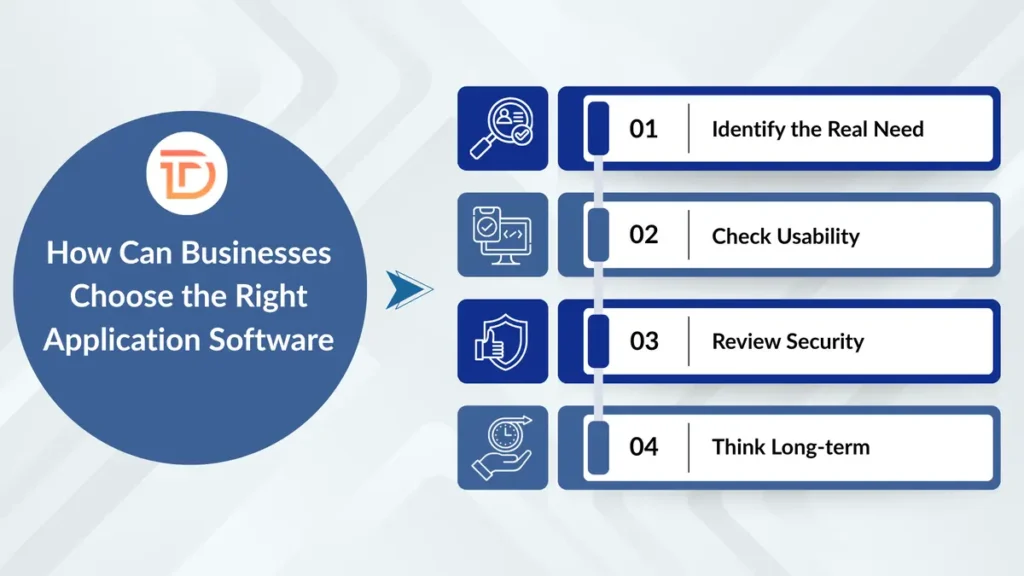
Choosing the right software should always begin with understanding the actual business problem that needs to be solved. Many businesses make the mistake of choosing software based only on cost, but low-cost tools often create bigger long-term problems when they cannot support growth.
- Identify the real need
Businesses should first define what problem the software needs to solve. Without this clarity, software investment often becomes wasteful.
- Check usability
If employees find the software difficult to use, productivity suffers and adoption becomes weak.
- Review security
This is especially important for finance, healthcare, education, and customer-focused businesses where compliance matters.
- Think long-term
The software should support future growth instead of creating limitations after a few years.
The best software is not simply the cheapest option. It is the one that supports both present efficiency and future business success.
Why Do Businesses Choose Dreamer Technoland for Software Solutions?
Many businesses realize that standard software tools do not fully match their workflows, customer expectations, or long-term operational goals. This is where the right technology partner becomes important.
Dreamer Technoland and Dreamer Technoland help businesses build practical, scalable, and business-focused solutions instead of forcing them to adjust around limited software systems.
Whether a company needs enterprise platforms, browser-based systems, or advanced application software development, the focus should always be on usability, performance, and measurable growth.
A strong technology partner helps businesses move beyond basic tools and create solutions that improve productivity, customer experience, and long-term profitability. This makes software investment more strategic and much more valuable in 2026.
Conclusion
Application software helps businesses work faster, smarter, and more efficiently. From creating documents and managing financial data to handling customer records and running enterprise-wide systems, each type of software supports an important part of business success.
Understanding the 7 main types of application software helps businesses make better technology decisions and improve overall performance. In 2026, businesses that choose the right software gain a stronger competitive advantage. The goal is not simply to use software, but to use the right software that supports growth, scalability, and long-term success.
FAQs
Q. What is application software in simple words?
A. Application software is software designed to help users perform specific tasks such as writing documents, managing data, creating presentations, browsing the internet, or handling business operations.
Q. What are the 7 main types of application software?
A. The 7 main types are word processing software, spreadsheet software, presentation software, database software, multimedia software, web browsers, and enterprise software.
Q. Why is application software important for businesses in 2026?
A. In 2026, businesses need faster operations, automation, stronger customer experiences, and better decision-making. Application software helps achieve all of these goals efficiently.
Q. How is application software different from system software?
A. Application software helps users complete tasks, while system software manages the computer’s internal functions such as the operating system and hardware support.
Q. When should a business choose custom software instead of ready-made software?
A. A business should choose custom software when standard solutions do not fully support its workflow, security needs, industry requirements, or future growth plans.