

Retrieval-augmented generation (RAG) solves a problem every custom AI project runs into sooner or later: a language model that sounds confident but doesn’t actually know your business. Instead of retraining a model on private data, RAG pulls relevant information from your own documents and systems the moment someone asks a question. The result is a model that answers using your facts, not just what it memorized during training.
According to Gartner, more than 80% of enterprises are expected to use generative AI APIs or deploy generative AI-enabled applications by 2026, a sharp rise from current adoption levels. That curve signals a real opportunity: businesses that ground their AI in accurate, current data will outperform those still relying on generic chatbots.
By the end of this guide, you’ll understand the full RAG framework, from vector databases to model selection, so you can plan an implementation built for production, not just a demo.
What Makes Retrieval-Augmented Generation Essential for Custom AI Applications
Retrieval-augmented generation earns its place in nearly every serious AI roadmap for one simple reason: it closes the gap between what a model knows and what your business actually needs it to know. A generic model trained on public internet text has no idea what’s in your support tickets, your contracts, or last week’s inventory report. Retrieval-Augmented Generation in AI changes that by connecting the model to your live data sources before it generates an answer.
Think of it as giving the model a research assistant instead of asking it to work from memory alone. When someone asks a question, the system first searches your knowledge base, pulls the most relevant passages, and feeds them to the model alongside the question. The model then writes an answer grounded in those specific passages, not in whatever it absorbed during training months or years earlier.
This matters more as businesses move from chatbot demos to production tools that customers and employees actually rely on. A support bot that cites your current return policy beats one that guesses. A properly built RAG setup gives you that accuracy without retraining a model every time your policies change.
The Core Problem: Why Standard LLMs Fall Short Without RAG
Standard large language models carry a built-in expiration date. Every model has a training cutoff, which means it knows nothing about events, prices, or policies that came after that date. Ask a vanilla model about your product catalog from last quarter and it will either admit ignorance or, worse, make something up that sounds plausible.
That second failure mode, hallucination, is the real business risk. A model confidently inventing a refund policy or a compliance clause can cost real money and real trust. Large Language Model applications built without a retrieval layer have no way to check their own answers against a source of truth, and they can’t tell you where an answer came from, which makes auditing almost impossible.
Custom AI application development teams solve this by pairing the model with a retrieval step that fetches current, verified information before generation happens. This turns a static, memory-bound tool into a system that can cite its sources and stay current without constant retraining. For regulated industries, that source attribution isn’t a nice-to-have; it’s often a requirement. RAG gives you both the fluency of a large language model and the accountability compliance teams actually demand.
Core RAG Techniques for Building Knowledge-Grounded Systems
Most retrieval-augmented generation projects rely on one of five core techniques for connecting search to generation, and together they define what people mean by a RAG framework. Some approaches retrieve once and generate; others loop between searching and writing until the answer holds up. Picking the right technique depends on how complex your questions are and how much latency your users will tolerate.
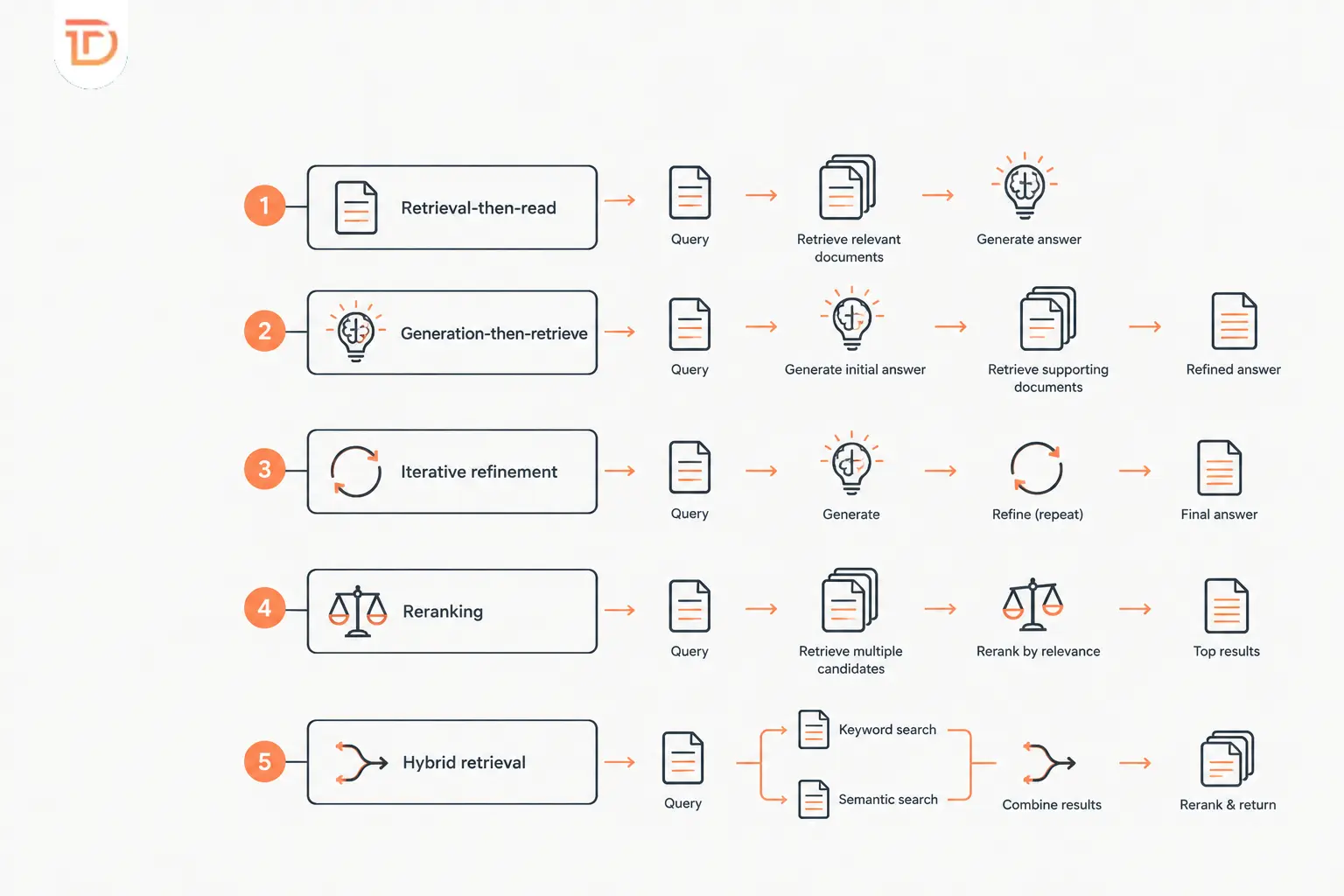
- Retrieval-then-read: This is the default pattern most teams start with. The system searches your vector index for the most relevant chunks, then hands them to the model in a single pass to generate the answer. It’s fast and predictable, which makes it the right starting point for FAQ bots and document search tools where questions are usually straightforward and don’t need multiple rounds of searching.
- Generation-then-retrieve: Here the model first drafts a rough answer or a search query based on its own reasoning, then retrieves supporting documents to refine or verify that draft. This works well when the raw question is vague or conversational, because the model’s first pass helps clarify exactly what to search for before pulling real data from your index.
- Iterative refinement: Instead of one retrieval pass, the system loops: retrieve, generate a partial answer, check what’s missing, then retrieve again. This suits multi-part questions where a single search won’t surface everything needed. It costs more in latency and compute, so reserve it for complex research or legal-style queries where accuracy outweighs speed.
- Reranking: After the first retrieval pass pulls a batch of candidate documents, a reranking model scores them for actual relevance to the question and reorders them. This catches cases where keyword or vector similarity ranks a document high even though it doesn’t answer the question, and it meaningfully improves final answer quality for users.
- Hybrid retrieval: This combines keyword search, which is good at exact terms, product codes, and names, with vector search, which is good at meaning and paraphrase. Most production systems end up here, because real user questions mix exact terms with loose, conversational phrasing, and neither search method alone catches both reliably.
Vector Databases: The Infrastructure Layer for Retrieval-Augmented Generation
Every RAG system needs somewhere to store the numerical representations of your documents, and that’s the job of a vector database. When you convert text into embeddings, you need a way to search millions of those vectors in milliseconds and find the ones closest in meaning to a user’s question. This search layer is what makes LLM integration practical at scale; without fast vector search, retrieval becomes slow enough that users notice the delay. The right choice depends on your data volume, your team’s infrastructure comfort, and whether you need a managed service or full control over deployment.
| Tool | Use Case Strength | Deployment Model |
|---|---|---|
| Pinecone | Managed, low-ops scaling for production apps | Fully managed cloud |
| Milvus | Large-scale, high-throughput enterprise search | Self-hosted or managed |
| Weaviate | Built-in hybrid search and schema flexibility | Self-hosted or cloud |
| Qdrant | Fast setup, strong filtering for smaller teams | Self-hosted or cloud |
| pgvector | Adds vector search to existing Postgres databases | Self-hosted, extension-based |
FAISS and Chroma remain popular for prototypes and smaller projects, where teams want to test retrieval quality before committing to production infrastructure.
RAG Frameworks and SDKs That Accelerate Development
Building a RAG pipeline from raw code is possible, but most teams reach for a framework instead, because orchestration, prompt templates, and retrieval logic are hard to get right from scratch. The options below cover most Enterprise RAG solutions in production today, each with a different sweet spot.
- LangChain: The most widely adopted framework for chaining retrieval, prompting, and generation steps together. Its large component library makes it a fast way to prototype, though teams often simplify its abstractions once they move toward production use.
- LlamaIndex: Built specifically around data ingestion and indexing, LlamaIndex handles document loading, chunking, and query routing with less setup than general-purpose frameworks. It’s a strong choice when your main challenge is organizing messy or varied source data.
- Claude Agent SDK: Anthropic’s SDK gives developers structured tools for building agents that reason over retrieved context and call external tools. It fits teams already standardized on Claude models and wanting tighter control over tool use.
- OpenAI Agents SDK: OpenAI’s framework supports multi-step agents with built-in retrieval, function calling, and handoffs between specialized agents. Generative AI application development teams often use it when the rest of the stack is already OpenAI-centric.
- Google ADK: Google’s Agent Development Kit focuses on building and deploying agents within Google Cloud’s ecosystem, with native ties to Vertex AI search and retrieval tools. It suits teams already invested in Google’s infrastructure.
- LangGraph and MCP: LangGraph adds stateful, graph-based control over multi-step agent workflows, while the Model Context Protocol standardizes how agents connect to external tools and data sources. Together, they power most agentic RAG systems running today.
Embedding Models: Choosing the Right Foundation for Your Retrieval Pipeline
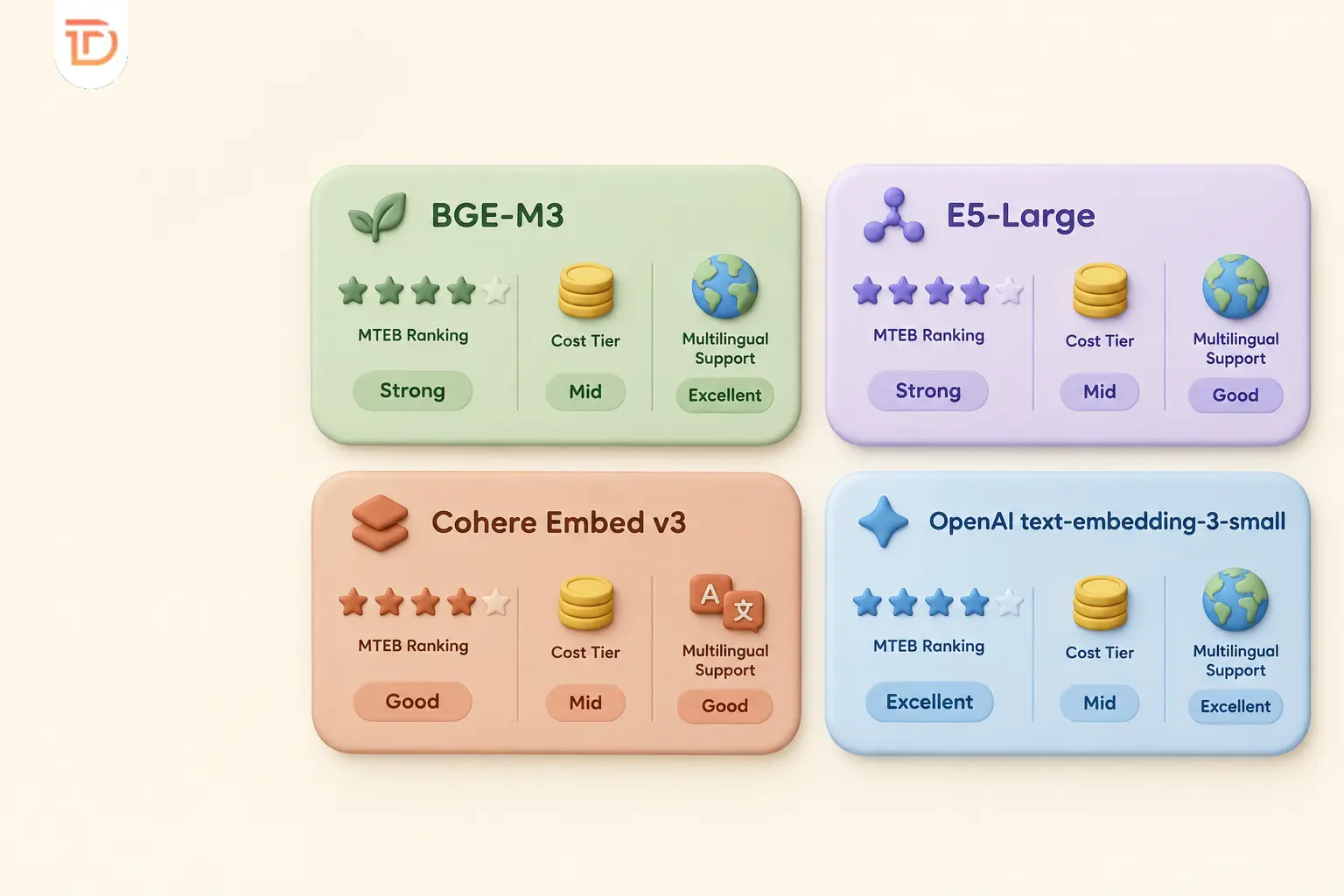
Embeddings are the translation layer that makes retrieval-augmented generation projects possible: they convert sentences, paragraphs, and whole documents into numeric vectors that capture meaning rather than exact wording. Two sentences that use different words but mean the same thing end up close together in vector space, which is what lets semantic search find relevant answers even when a user’s phrasing doesn’t match your documents exactly. Choosing an embedding model affects retrieval quality more than most teams expect, because a weak model will quietly miss relevant documents no matter how good your vector database or language model is. Cost, language coverage, and benchmark performance all factor into this decision, especially for businesses serving customers across multiple languages or regions.
| Model | MTEB Ranking | Cost Tier | Multilingual Support | Best For |
|---|---|---|---|---|
| OpenAI text-embedding-3 | Strong general performance | Mid | Good | General-purpose production use |
| Google Gemini Embedding | Competitive, Google-ecosystem tuned | Mid | Good | Teams on Google Cloud or Vertex AI |
| Cohere Embed v4 | Strong on enterprise benchmarks | Mid to high | Good | Enterprise search and retrieval |
| Qwen3 Embedding (8B) | Ranked #1 on MTEB multilingual leaderboard | Low to mid, open-source | Excellent | Multilingual and open-source deployments |
For businesses operating across non-English markets, that multilingual ranking matters more than raw benchmark scores on English-only tasks alone.
Selecting the Best LLMs for Your Retrieval-Augmented Generation Stack
Matching Model Capability to Retrieval Needs
Your retrieval-augmented generation stack is only as good as the model sitting at the center of it. Picking an LLM isn’t about finding the single “best” model; it’s about matching capability to how you’ll use retrieved context. A model with a short context window forces you to trim retrieved passages aggressively, which risks cutting relevant detail. A larger context window lets you pass more retrieved chunks, but it also raises cost per query and can slow response times. Instruction-following quality matters just as much: a model that ignores retrieved context and answers from its own memory defeats the entire purpose of the setup, and this ranks among the most common RAG implementation challenges teams face during testing.
Closed Models Versus Open-Source Alternatives
Closed models like GPT-4, Claude 3.5, and Gemini generally lead on instruction-following and reasoning quality, and they’re the safer default for customer-facing applications where mistakes carry real cost. Open-source alternatives like Llama, Qwen, and Mistral cost less per query and let you run inference on your own infrastructure, which matters for data residency or privacy requirements. Many teams run closed models in early testing to validate that the architecture works, then shift high-volume, lower-risk queries to a fine-tuned open-source model once the system proves out. The right call depends on your latency budget, your privacy obligations, and how much reasoning depth your actual use case demands.
Building Your RAG Team: Roles, Skills, and Hiring Strategies
RAG projects fail more often from missing skills than from bad technology choices. A strong team needs these five roles covered, even if one person wears two hats on a smaller build.
- Data Engineer: Responsible for getting your documents, databases, and knowledge sources into a clean, structured state before anything gets indexed. This role needs strong ETL skills and patience, since messy source data is the single biggest cause of poor retrieval quality.
- ML/Vector Engineer: Owns the embedding pipeline, vector database setup, and retrieval tuning. This person needs hands-on experience with AI and Machine Learning Solutions, vector search tools, and benchmarking retrieval accuracy against real user queries.
- Prompt Engineer: Designs how retrieved context gets formatted and passed to the model, and tests how the model behaves under edge cases. Good prompt engineers iterate constantly, checking that the model reliably uses retrieved facts instead of ignoring them entirely.
- Solution Architect: Makes the big calls on system design: which vector database, which LLM, how retrieval connects to existing systems, and how the whole pipeline scales over time. This role needs to see the full picture, not just one layer of the stack.
- Domain Expert: Brings the subject-matter knowledge that makes evaluation possible. Without someone who actually knows what a correct answer looks like in your industry, nobody on the technical team can judge whether the system’s outputs are actually right.
Build Your Custom Retrieval-Augmented Generation System With Dreamer Technoland
Choosing how to build a RAG system, and who builds it, isn’t a decision to rush. Get the architecture wrong early and you’ll spend months unwinding bad choices in your vector database or data pipeline, often after the system is already live.
Why Dreamer Technoland Approaches RAG Differently
Dreamer Technoland treats retrieval-augmented generation as an engineering problem first, not a plug-in feature. We’ve worked through the real friction points: data too messy to chunk cleanly, retrieval that returns the wrong passages, and models that quietly ignore the context they’re given. That hands-on experience with actual RAG implementation challenges, not just theory, shapes how we scope every project from day one.
What We Actually Build
Our team designs full retrieval-augmented generation systems end-to-end: data ingestion and chunking, vector database setup, embedding model selection, LLM integration, and evaluation pipelines that catch quality issues before your users do. For Australian businesses, we build with the Privacy Act 1988 and the APP 1.7 to 1.9 automated decision-making transparency rules in mind, and for regulated financial clients, we factor in APRA CPS 230 obligations from the ground up. This is custom development work, shaped around your data and your compliance needs, not a licensed product dropped into your stack. We also deliver Custom Software Development Services for teams that need the RAG system wired into existing internal tools and workflows.
Contact Dreamer Technoland today for a free RAG architecture consultation.
FAQ Section
Q. What is the difference between RAG and fine-tuning?
RAG retrieves current information at query time without changing the model’s weights, while fine-tuning retrains the model on new data permanently. RAG suits fast-changing information and source attribution; fine-tuning suits teaching a model a fixed style, tone, or skill it lacks.
Q. How long does RAG implementation take?
A working proof of concept typically takes four to eight weeks. A production-grade system with proper evaluation, security review, and integration into existing tools usually takes three to six months, depending on data readiness and how many systems it connects to.
Q. What are the main RAG implementation challenges?
Messy or unstructured source data, irrelevant passages in retrieval, models ignoring retrieved context, and measuring answer quality at scale are the most common challenges. Security, access control, and keeping the knowledge base current add ongoing work after launch.
Q. Can I use open-source models with RAG?
Yes. Open-source models like Llama, Qwen, and Mistral work well in RAG pipelines and cost less per query than closed models. They also let you run inference on your own infrastructure, which helps with data residency and privacy requirements.
Q. What compliance considerations apply to RAG systems?
In Australia, RAG systems handling personal data fall under the Privacy Act 1988 and APP 1.7 to 1.9 transparency rules for automated decisions. Financial institutions must also factor in APRA CPS 230, effective July 2025, for operational risk.