

CRM for insurance is the system that gives agents, brokers, and agency owners one place to track every client, every policy, and every renewal date. Instead of juggling spreadsheets, email threads, and sticky notes, teams work from a single source of truth. That shift changes how fast agents respond and how well they serve policyholders.
CRM Software Market Research
According to Statista, the global CRM software market is projected to pass $145 billion by 2029, with insurance ranked among the fastest-growing adopter industries. That growth signals something real: insurers who delay CRM adoption risk losing policyholders to competitors who respond faster and personalize better.
This blog walks through exactly how CRM for insurance changes agent-client relationships, daily operations, and long-term growth. You’ll get a clear look at the features that matter most, the challenges worth planning for, and the metrics that prove the investment is working.
How CRM for Insurance Is Revolutionizing Agent-Client Relationships
Every renewal call either builds trust or breaks it, and the difference usually comes down to how well an agent knows the client sitting across from them. CRM for insurance replaces guesswork with context, pulling policy history, claims records, and past conversations into one screen agents can check before they ever pick up the phone.
From Guesswork to Genuine Personal Service
Agents using a modern system built for crm for insurance agents stop treating every client the same way. The platform flags which policyholders are underinsured, which ones sit close to a renewal date, and which ones recently filed a claim. That means an agent opens a conversation with real context, not a generic script pulled from memory. Clients notice the difference right away: fewer repeated questions, faster answers, and recommendations that actually fit their situation instead of whatever product the agent happens to be pushing that week. This is what separates a transactional policy sale from a relationship that lasts years.
Follow-Up That Actually Happens on Schedule
Most lost renewals don’t happen because a client found a cheaper price elsewhere. They happen because nobody followed up at the right moment. CRM systems automate that follow-up: birthday messages, renewal reminders, claims check-ins, and policy review nudges go out on schedule without an agent needing to remember any of it. Real-time data access means agents walk into every call already prepared, and that preparation is what turns a one-time policyholder into someone who renews for a decade.
The Insurance Industry’s Digital Transformation Moment
Insurance has spent decades running on paper files and phone calls, but that model is breaking down fast. Policyholders now expect the same speed and personalization they get from their banking app or their favorite retailer, and agencies that can’t match that pace start losing renewals to competitors who can.
Industry research suggests a large majority of US insurers have already rolled out AI tools in at least one part of their business, and CRM is often the platform where that AI actually lives. This isn’t a future trend anymore; it’s already reshaping how claims get processed and how leads get worked. Insurers that treat CRM for insurance as a core system, not a side tool, report stronger customer loyalty because every interaction feels personal rather than scripted.
The operational payoff runs just as deep. Automated task assignment cuts the manual work agents used to do by hand, and real-time analytics give managers visibility into what’s actually happening across the book of business. Decisions get made on data instead of hunches. For agencies still running on spreadsheets and disconnected tools, this is the moment the gap between digital-first competitors and everyone else starts widening in ways that are hard to close later.
Core CRM Capabilities Reshaping Insurance Operations
Not every CRM built for general sales teams can handle what insurance actually needs. The best crm for insurance agents looks nothing like a generic contact manager; it’s built around policies, claims, and compliance from the ground up. Here’s what separates a purpose-built system from a repurposed one.
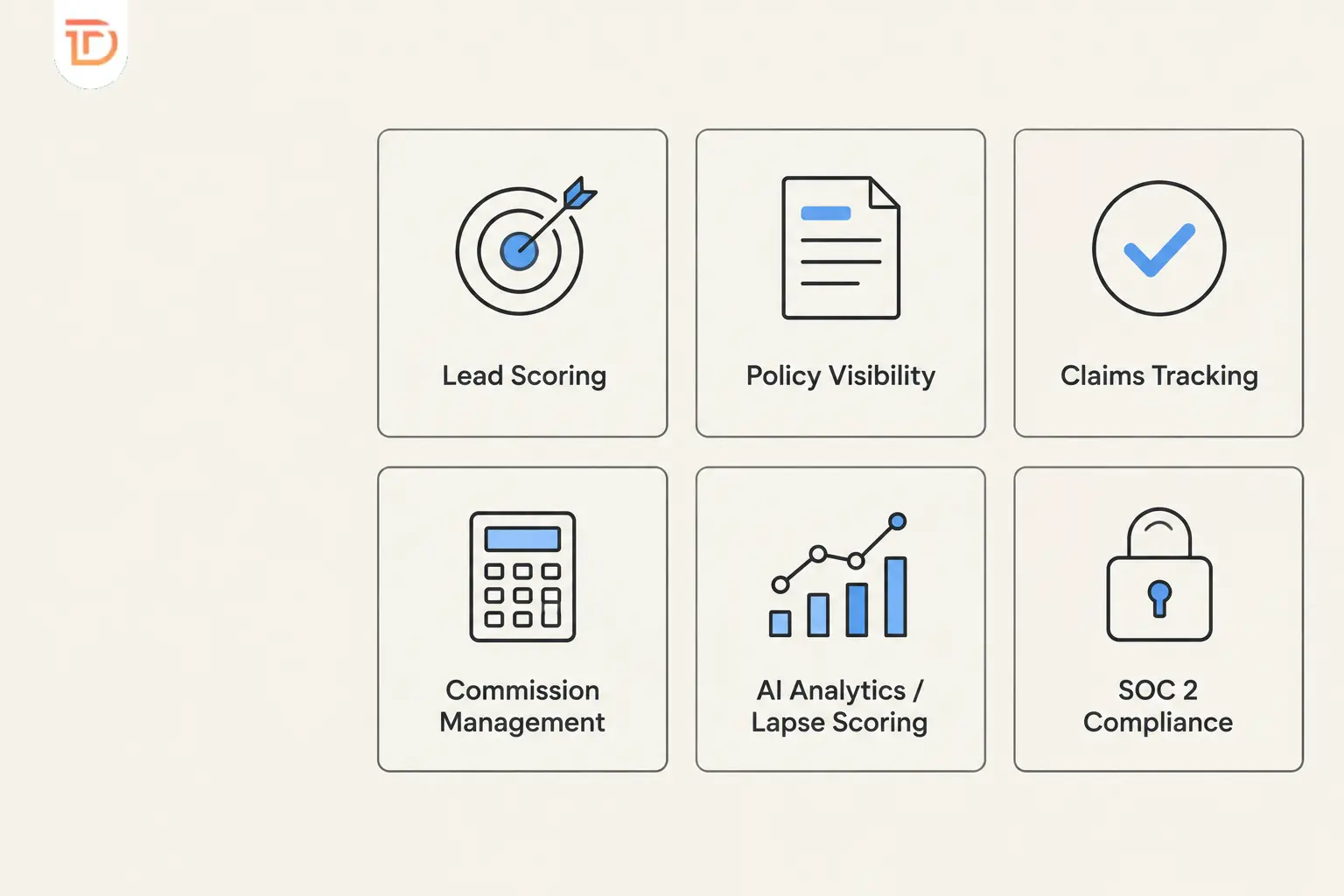
- Lead and pipeline management: The system scores leads by conversion likelihood so agents spend time on prospects most likely to buy, instead of working every lead with equal effort. This alone can shorten the sales cycle noticeably.
- Policy visibility: Agents see every active policy, its coverage details, and its renewal date in one view, instead of searching through separate policy admin screens for basic information.
- Claims tracking: Claims status updates flow into the same record the agent already uses, so there’s no need to call a separate department just to answer a client’s question.
- Commission management: The system calculates and tracks commissions automatically across carriers and policy types, cutting down the manual reconciliation that eats up admin hours every month.
- AI analytics with predictive lapse scoring: The CRM flags policyholders likely to let coverage lapse before it happens, giving agents a window to intervene with a renewal conversation or a better offer.
- SOC 2 Type II compliance with role-based access: Sensitive client and policy data stays locked behind permissions that match each employee’s actual role, with immutable audit logs tracking who accessed what and when.
Before choosing a platform, it helps to understand Custom CRM Development Cost and how each of these capabilities affects the final price tag.
Automating Customer Lifecycles in Insurance Management
A policyholder’s journey doesn’t end at the sale, but too many agencies treat it that way. CRM for insurance brokers automates the stages that used to depend on someone remembering to follow up, which means fewer policies slip through the cracks between purchase and renewal.
- Policy issuance workflows: New policies move through underwriting-to-activation steps automatically, cutting the back-and-forth between agent and carrier.
- Automated renewal reminders: Clients get notified before a policy lapses, not after, giving agents time to re-engage before the coverage gap happens.
- Claims process automation: Digitized claims intake cuts paperwork and routes files to the right adjuster without manual handoffs.
- Real-time claims analytics: Trend data on claims volume and type helps agencies spot patterns early and adjust underwriting or pricing decisions.
- Retention campaign triggers: The system flags at-risk policyholders for targeted outreach, rather than waiting for a cancellation notice to react.
- Cross-sell and upsell prompts: Life events like a new car or home trigger automatic suggestions for additional coverage at the right moment.
For agencies managing dozens of carrier relationships, this kind of automation isn’t a nice-to-have. It’s what keeps a growing book of business from turning into an administrative bottleneck that slows down every agent on the team.
Data Analytics and Predictive Insights Within Insurance CRM Systems
A CRM that only stores data is only half useful. The real value shows up when the system turns that data into predictions an agent can actually act on, before a problem becomes a lost customer.

Turning Customer Behavior Into Early Warnings
Platforms built with AI and machine learning analyze customer interactions, past feedback, and policy history to flag risk before it turns into churn. Predictive lapse scoring looks at payment patterns, engagement levels, and claims history to estimate which policyholders are most likely to cancel in the next renewal cycle. That gives agents a ranked list to work from instead of guessing who needs a call this week. The same engine studies claims data across the whole book of business, surfacing trends in claim type, frequency, and cost that help underwriting teams adjust pricing before losses pile up.
Dashboards That Replace Monthly Reports
Real-time dashboards pull all of this into a single view that updates as new data comes in, instead of waiting for a static report at month-end. Managers see retention risk, claims trends, and agent performance side by side, which speeds up decision-making across the agency. The business impact is concrete: fewer policyholders lapse unnoticed, claims teams resolve cases faster because patterns get caught early, and retention campaigns target the right people instead of blasting the entire client list with the same generic message.
Integration Challenges and Implementation Considerations for Insurance CRM
Buying CRM software is the easy part. Making it actually talk to the systems an agency already runs on is where most projects run into trouble, and where budgets quietly double.
- Legacy system connections: Policy administration platforms, billing systems, and underwriting tools weren’t built to share data easily, and connecting them usually takes custom integration work rather than a simple plug-in.
- Data migration risk: Years of policy history, claims records, and client notes need to move without errors or duplicates, and a rushed migration creates data quality problems that follow the agency for years.
- Customization requirements: Insurance workflows vary by line of business, so a CRM built for life insurance rarely fits property and casualty without real configuration work.
- Realistic timelines: Custom CRM builds for insurance typically run four to nine months depending on integration scope, and agencies that expect a faster rollout often end up cutting corners that cause problems later.
- Integration architecture over platform choice: The platform’s feature list matters less than whether its architecture can actually connect cleanly to claims, billing, and underwriting systems. Agencies evaluating Custom CRM Software Solutions should prioritize this question before anything else.
The platform you choose matters less than how well it connects to everything you already run. Get the integration architecture wrong, and even the best software becomes another disconnected tool your team avoids using.
ROI and Performance Metrics That Matter for Insurance CRM Adoption
Spending money on CRM for insurance agency operations only makes sense if someone is tracking whether it’s actually working. These are the numbers that tell you the truth.
- Customer acquisition cost: This tracks how much it costs to convert a lead into a policyholder. A well-tuned CRM should push this number down over time through better lead scoring and faster follow-up.
- Policy retention rate: This measures how many policyholders renew each cycle. Since automated renewal reminders and lapse scoring exist specifically to protect this number, it’s one of the clearest signs the system is earning its cost.
- Claims processing time: Faster claims resolution, driven by digitized intake and automated routing, directly affects customer satisfaction and the likelihood a client stays past their next renewal.
- Agent productivity: Track how many policies each agent handles and how much time they spend on admin work versus actual client conversations. Automation should shift that balance noticeably.
- Customer lifetime value: This shows the total revenue a policyholder generates across every renewal and cross-sell. Agencies tracking this alongside retention get a clearer picture of long-term ROI.
- Total cost of ownership: This isn’t just the license fee; it includes every cost tied to running the system over time.
| Cost Component | What It Covers |
|---|---|
| Licensing or development | Base software cost or custom build investment |
| Integration | Connecting to policy, claims, and billing systems |
| Data migration | Moving historical records without loss or error |
| Training and support | Getting agents proficient and keeping the system running |
| AI and API consumption | Ongoing costs for predictive features and third-party connections |
Compliance, Security, and Data Protection in Insurance CRM Platforms
Insurance data isn’t just customer information; it’s medical history, financial records, and claims details that regulators take seriously. A CRM that handles this carelessly doesn’t just risk a data breach. It risks the agency’s license to operate.
Why Access Controls Can’t Be an Afterthought
SOC 2 Type II compliance should be a baseline requirement, not a bonus feature, because it proves a vendor’s security controls hold up over time, not just at a single audit. Role-based access control limits who can see what: an underwriter doesn’t need visibility into another agent’s commission structure, and a claims adjuster doesn’t need full access to billing records. Immutable audit logs track every action taken inside the system, which matters when regulators or internal compliance teams need to reconstruct exactly what happened with a specific client record.
Encryption and Regulatory Alignment
Data encryption, both at rest and in transit, protects client information from exposure even if a breach attempt succeeds elsewhere in the stack. State insurance regulations vary, and agencies operating across multiple states need a system flexible enough to meet each one’s specific requirements around data handling and disclosure. This is exactly the kind of groundwork that Custom Software Development Services exist to handle properly, building compliance into the architecture from day one instead of bolting it on after a regulator asks questions. Ongoing compliance monitoring matters just as much as the initial setup, since regulations and threats both keep shifting.
How Dreamer Technoland Can Help You Build a Custom CRM for Insurance
Choosing between an off-the-shelf CRM and a custom build isn’t a decision to rush. Off-the-shelf tools rarely fit insurance workflows without heavy workarounds, and generic developers often underestimate how deep the integration work with policy, claims, and billing systems actually goes.
Dreamer Technoland approaches insurance CRM projects with that integration complexity front and center, not as an afterthought discovered halfway through development. We build systems that connect cleanly to the tools an agency already runs, so agents aren’t stuck switching between five different screens to serve one client. Our team designs the compliance and access control layers into the architecture from the start, which matters far more in insurance than in most other industries.
Whether you need a web-based platform for your office team or Mobile App Development Services so field agents can work from a phone between client visits, we build it around your actual workflow. Our API Integration Services connect your CRM to carrier systems, billing platforms, and underwriting tools without forcing your team to re-enter the same data twice.
Contact Dreamer Technoland today for a free CRM consultation.
FAQ Section
Q. What is CRM for insurance?
CRM for insurance is software that centralizes client data, policy details, claims history, and communication records for agents and brokers. It replaces spreadsheets and disconnected systems with one platform that tracks relationships from the first lead through every renewal.
Q. What are the best CRM platforms for insurance agents?
The best options combine lead scoring, policy visibility, claims tracking, and compliance features like SOC 2 Type II certification. Whether off-the-shelf or custom, the right choice depends on your agency’s size, carrier relationships, and how deeply it needs to integrate with existing systems.
Q. How much does a CRM for insurance cost?
Off-the-shelf configuration typically runs $30,000 to $60,000, while custom-built systems with deep integrations range from $100,000 to $500,000 or more. Cost depends heavily on how many systems it needs to connect to and how much customization the workflow requires.
Q. How long does it take to implement insurance CRM?
Custom CRM builds for insurance typically take four to nine months, depending on integration scope with policy administration, claims, and billing systems. Off-the-shelf configurations move faster but often require ongoing workarounds for insurance-specific workflows later.
Q. Is custom CRM worth it for small insurance agencies?
It depends on growth plans and integration needs. Small agencies with simple workflows may do fine with off-the-shelf tools, but agencies planning to scale or needing specific carrier integrations often find custom development pays off within a few years.