


When a business starts growing, managing customers becomes more complex than expected. Leads come from different channels, sales teams work on multiple deals, and customer interactions happen across emails, calls, and platforms. At some point, things start slipping through the cracks.This is when businesses begin to consider building a CRM system. However, one question immediately comes up: how much will it actually custom crm development cost?
The truth is, there is no fixed answer. The custom CRM development cost depends on several real-world factors such as business size, feature requirements, technical complexity, and long-term goals. According to Statista, the global CRM market is expected to cross $145 billion by 2029, which clearly shows that companies are increasingly investing in better customer management systems.So instead of looking for a single number, it is more useful to understand what actually drives the cost and how you can control it.
What is Custom CRM?
To understand cost properly, you first need clarity on What is Custom CRM Software?
Custom CRM is a system built specifically for your business operations. It is not a generic tool with fixed features. Instead, it is designed around how your teams work, how your sales pipeline flows, and how you manage customer relationships.
For example, a real estate company may need lead tracking based on property types, while an eCommerce business may need customer segmentation based on purchase behavior. A ready-made CRM may not support these needs efficiently.
When businesses decide to build a custom CRM software, they are essentially creating a system that fits their workflow instead of adjusting their workflow to fit the system. This improves productivity, reduces manual work, and makes processes more predictable.Over time, this level of customization becomes a competitive advantage.
Why Businesses Choose Custom CRM Over Ready-Made Tools?
At first glance, ready-made CRM tools seem like a cost-effective solution. They are easy to start with and require minimal setup. However, as businesses grow, limitations start becoming visible.
Understanding Why Businesses Invest in CRM Development? requires looking beyond the initial convenience.
- Mismatch Between Tool & Workflow
Most off-the-shelf CRMs are designed for general use. As a result, businesses often need to adjust their processes, which reduces efficiency and creates unnecessary steps.
- Rising CRM Subscription Costs
What starts as a low monthly fee can become expensive as team size increases and advanced features are required.
- Limited System Integration
Businesses often use multiple tools such as ERP systems, marketing platforms, and analytics tools. A custom CRM can integrate seamlessly, while ready-made tools may not.
- Restricted Future Growth
As business needs evolve, companies may find it difficult to adapt pre-built systems without major limitations.
Because of these reasons, many businesses shift towards custom development, even if the initial cost is higher.
What Does Market Research Tell Us About CRM Costs and ROI?
Looking at Market Research gives a clearer picture of why CRM investment is considered valuable.
Research shows that businesses using CRM systems effectively can improve sales productivity by up to 34% and customer retention rates significantly. In addition, companies that rely on data-driven decision-making are far more likely to grow consistently.
However, cost varies depending on what you build.
A small CRM system with basic features may cost around $15,000 to $25,000. A more advanced system with automation, reporting, and integrations can range between $30,000 and $80,000. Enterprise-level systems, especially those handling large-scale data and multiple departments, can exceed $100,000.
These numbers highlight an important point. CRM development is not just an expense. It is an investment that directly impacts revenue and efficiency.
Custom CRM Development Cost Breakdown
To make better decisions, it is important to understand the Custom CRM Development Cost Breakdown in detail.
| Component | What It Involves | Why It Matters |
|---|---|---|
| UI/UX Design | Designing dashboards, workflows, and user experience | Affects usability and adoption |
| Frontend Development | Building user interfaces | Ensures smooth interaction |
| Backend Development | Core system logic and database management | Drives performance and functionality |
| Integration | Connecting third-party tools | Enables automation and data flow |
| Testing | Identifying bugs and performance issues | Ensures reliability |
| Maintenance | Ongoing updates and improvements | Keeps system relevant |
Each of these stages contributes to the final cost. Skipping or under-investing in any stage can lead to long-term issues.
CRM Development Cost by Region
| Region | Hourly Rate (USD) | Impact on Budget | Key Considerations |
|---|---|---|---|
| USA | $80 – $150 per hour | High cost | Strong expertise, better communication, higher project cost |
| Europe | $60 – $120 per hour | Medium to high | Good quality, balanced cost, strong technical skills |
| India | $20 – $50 per hour | Cost-effective | Lower cost, skilled developers, requires clear communication |
Many businesses choose a balanced approach. They work with global teams or partners such as a custom software development company in Australia to ensure both quality and cost efficiency.
CRM Development Cost Affecting Factors
Understanding CRM development cost affecting factors becomes easier when you look at real scenarios instead of just theory.

- Feature Depth & Customization Level
A simple contact management system costs much less than a CRM with automation, analytics, and AI-driven insights. Each added feature increases development effort.
- Scalability Requirements
If your CRM needs to handle thousands of users or large datasets, the architecture must be more robust. This increases both development and infrastructure cost.
- Integration Complexity
Connecting multiple tools such as payment systems, marketing platforms, and analytics tools requires additional development time.
- Technology Choices & System Design
Choosing scalable and modern technologies may increase initial cost, but it reduces long-term risks and maintenance expenses.
- Experience Level of the Development Team
While experienced developers charge more, they often complete projects faster and with fewer errors.
Types of CRM Systems
Different CRM types serve different purposes, and each type affects cost differently.

- Operational CRM
This type focuses on automating sales, marketing, and customer service processes. It is relatively simpler but still requires structured workflows and automation logic.
- Analytical CRM
This system focuses on data analysis and reporting. It processes large volumes of customer data, which requires advanced infrastructure and increases development cost.
- Collaborative CRM
This type improves communication between teams. It often involves integrations and real-time data sharing, which adds complexity.
Choosing the right type depends on your business goals, and this decision directly impacts your budget.
How Long to Build a Custom CRM?
Time plays a major role in determining cost.
- A basic CRM with limited features usually takes 2 to 4 months
- A mid-level CRM with integrations and automation takes 4 to 8 months
- A complex CRM system may take 8 months or more
In real-world projects, delays often happen due to unclear requirements or frequent changes. This is why proper planning is essential.
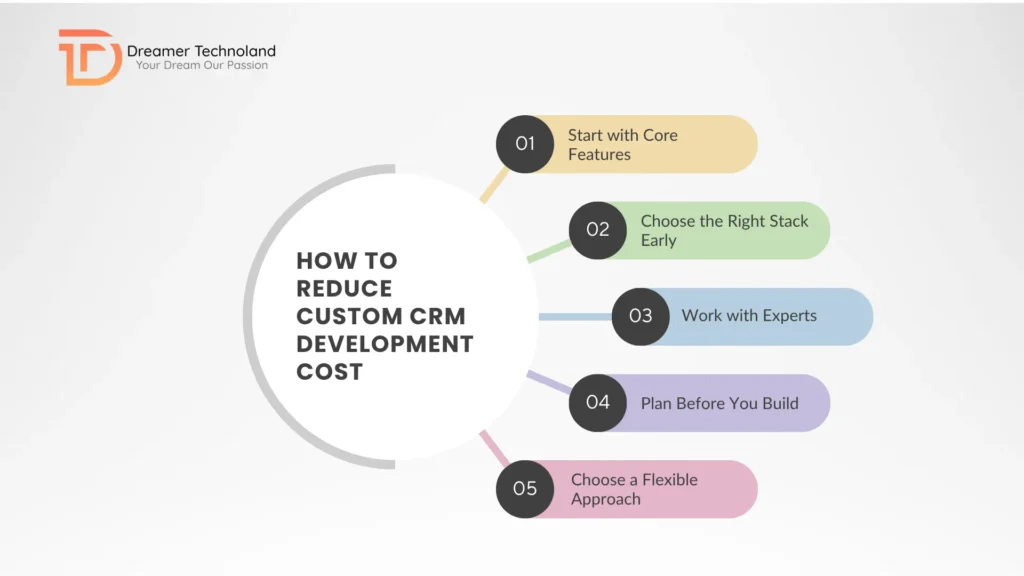
How to Reduce Custom CRM Development Cost?
Understanding How to Reduce Custom CRM Development Cost? is essential for smart decision-making.
- Start with Core Features
Starting small allows businesses to test the system and expand later based on real needs.
- Choose the Right Stack Early
Efficient technology reduces development time and long-term maintenance costs.
- Work with Experts
A skilled team reduces errors, rework, and delays, which ultimately saves money.
- Plan Before You Build
Clear planning prevents unnecessary changes and keeps the project on track.
- Choose a Flexible Approach
Offshore or hybrid models can help reduce costs without affecting quality.
How We Help You Build a Scalable, Cost-Effective CRM?
Choosing the right partner can make the entire process smoother and more predictable.
Dreamer Technoland focuses on understanding your business needs before starting development. This ensures that the CRM system is built with a clear purpose and aligned with your goals.
They provide Custom Software Development Services that cover everything from planning and design to development and ongoing support.
Choose Dreamer Technoland: Your Ideal CRM Development Partner
With the right approach, businesses can avoid common mistakes and build systems that scale efficiently. Dreamer Technoland helps you achieve this by combining technical expertise with a practical understanding of business needs.
Hidden CRM Development Costs Businesses Overlook
Many businesses focus only on initial development cost. However, hidden costs can significantly impact the total investment.
- Ongoing Maintenance & Updates
CRM systems require regular updates to remain secure and efficient.
- Employee Training & Adoption Time
Teams need time to learn the system, which affects productivity initially.
- Infrastructure & hosting Expenses
Cloud services and servers add to operational costs.
- Future Upgrades & Feature Expansion
As the business grows, additional features become necessary.
Conclusion
Understanding the custom CRM development cost is about more than just numbers. It is about making informed decisions that support long-term growth.
From understanding What is Custom CRM Software? to analyzing cost factors, timelines, and hidden expenses, every element plays a role in shaping the final investment.
Businesses that focus on real needs, plan carefully, and choose the right development partner are more likely to succeed and get the best return on their investment.
FAQs
Q. What is the average CRM software development cost?
A. It usually ranges from $15,000 to over $100,000 depending on features and complexity.
Q. How long does it take to build a custom CRM?
A. It typically takes between 2 to 8 months depending on project scope.
Q. Is custom CRM better than ready-made tools?
A. Yes, it offers better flexibility, scalability, and long-term value.
Q. What factors affect CRM development cost the most?
A. Feature complexity, integrations, scalability, and developer expertise have the biggest impact.
Q. How can businesses reduce CRM developmentcost?
A. They can start with core features, plan clearly, and work with experienced teams.