



AI remodeling estimating software is changing how contractors price jobs, turning a process that used to take days into one that takes hours. Instead of manually measuring drawings and building spreadsheets line by line, contractors now feed photos, plans, or rough sketches into a system that calculates costs automatically.
According to a McKinsey study, AI-based forecasting can cut cost overruns on residential construction projects by up to 20 percent, and commercial projects using AI-based estimating tools hit budget accuracy within a 5 percent margin of error. That kind of precision used to require an estimator with twenty years of field experience. Now it’s available to any remodeling firm willing to adopt the right tool.
This blog walks through exactly how that shift happens: what AI construction estimating software actually does behind the scenes, how it compares to manual methods, and what kind of results remodeling contractors are already seeing on real projects.
Why AI Remodeling Estimating Software Is Reshaping Contractor Workflows
Walk into any remodeling business that’s switched to AI home remodeling estimating software and you’ll notice something right away: estimators aren’t buried in spreadsheets anymore. The job used to mean hours spent measuring square footage from blurry site photos, cross-checking supplier price sheets, and building cost breakdowns by hand before a single bid went out the door.
That workflow doesn’t scale, and it never did. AI construction estimating software changes the math entirely by handling the repetitive parts, measurement, material pricing, labor calculation, so your team spends time on strategy instead of data entry. The result isn’t just faster estimates. It’s the ability to bid on more jobs without hiring more estimators, which is the actual competitive edge contractors are chasing right now. That shift matters most when bid deadlines are tight and competitors are already submitting faster quotes.
The Hidden Costs of Manual Estimating in Home Remodeling
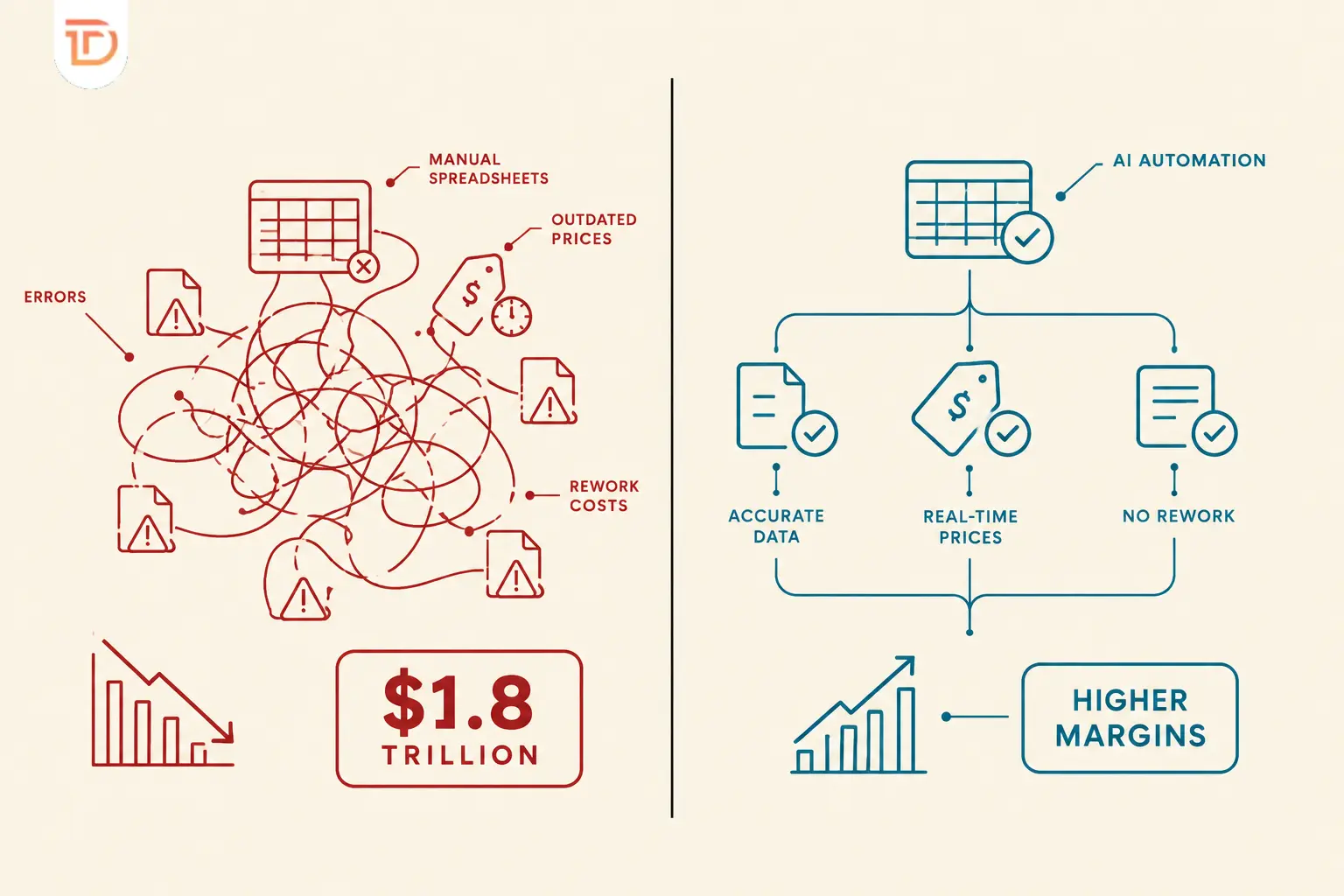
Manual estimating doesn’t just cost time, it costs money you never see leave the business. Picture a four-day estimate process: by the time the bid is ready, the client has already signed with a competitor who turned a quote around in 24 hours. That’s not a hypothetical. It’s the default outcome for firms still building estimates in spreadsheets, because speed wins jobs just as often as price does.
Then there’s the error problem. A missed measurement, an outdated material price, a formula that didn’t update correctly, any one of these can turn a profitable job into a loss. Industry research shows bad data costs the global construction industry over 1.8 trillion dollars annually in rework and budget overruns, and a large share of that traces back to estimates built on outdated or incomplete information. For a remodeling contractor running on tight margins, one bad estimate can erase the profit from three good ones.
AI-powered home remodeling cost estimation fixes this at the source by pulling current material prices and standardized labor rates into every quote, so pricing stays consistent no matter who on the team builds the estimate. Inconsistent pricing is one of the quietest ways firms lose money, because it’s rarely obvious until you compare estimates side by side months later.
The real cost of manual estimating isn’t the hours spent on each quote. It’s the jobs you never bid on because the process took too long to make it worthwhile.
How AI Construction Estimating Software Powers Faster, Smarter Estimates
Manual estimating assumes prices stay still long enough to quote accurately, and that assumption broke years ago. Construction material prices moved by more than 35 percent between 2020 and 2023 because of supply chain disruptions and inflation, which means an estimate built on last month’s lumber price can be wrong before the client even reads it. AI construction estimating software solves this by pulling current market data into every calculation instead of relying on a price list someone updated manually weeks ago.
Here’s the part that actually changes outcomes: automated cost estimation doesn’t just plug in new numbers, it tracks the pattern behind them. If drywall prices have been climbing for three months straight, the system factors that trend into the estimate rather than treating today’s price as a fixed number. That’s a level of responsiveness no spreadsheet, and frankly no single estimator tracking dozens of material categories by memory, can match consistently.
The complexity AI handles well goes beyond pricing. Labor rates vary by region, project type, and crew specialization, and material quantities shift the moment a client changes a single finish or layout detail. Recalculating all of that by hand, every time a scope changes, is exactly the kind of repetitive work that eats an estimator’s week. AI remodeling estimating software absorbs that complexity instantly, which is why firms using it can turn around revised quotes the same day a client asks for a change, instead of pushing the conversation to next week.
From Photo Capture to Detailed Estimate: The AI-Driven Process
The workflow starts the moment someone uploads a photo, a hand sketch, or a set of drawings into the system, no special equipment or training needed. From there, AI-powered material takeoff takes over: the software scans the image, detects dimensions and square footage automatically, and identifies the quantities of material each section of the job will need.
Platforms like IntoAEC combine this with 2D takeoff, reading drawings directly to pull areas, dimensions, and quantities without anyone tracing lines on a screen or re-entering numbers into a spreadsheet. Once quantities are set, the system runs cost calculations against current rates and builds a structured estimate with line items and rate breakdowns ready to send.
What used to mean a week of back-and-forth between field measurements and spreadsheet formulas now happens in one pass, and when the client asks for a drawing revision, the system updates the estimate instead of sending someone back to redo the math.
Real-World Impact: How One Remodeling Contractor Cut Estimating Time by 60 Percent
A remodeling contractor based in Austin, Texas, gives a clear picture of what this shift looks like in practice. Before adopting AI-based tools, the firm’s estimating process took four full days from first site visit to final quote, which meant every bid competed against a clock as much as against other contractors.
After switching to labor cost estimation software paired with automated material takeoff, that same process dropped to under one day, a 60 percent reduction in turnaround time. That speed didn’t just save hours, it changed what the business could do with its week. Monthly bid submissions rose from eight or ten to fourteen or sixteen, meaning the same estimating team was now covering nearly double the opportunity without adding headcount.
The win rate tells the rest of the story. Before the change, the contractor closed roughly one in five bids submitted. Within six months of adopting the new workflow, that number climbed to one in three, a sign that faster estimates weren’t coming at the cost of accuracy. If anything, consistent pricing built on current rates made the bids more competitive, not less.
Six months is a short window for that kind of shift. It shows what happens when an estimating bottleneck gets removed instead of worked around: more bids, better win rates, and an estimating team doing a stronger job of winning work instead of racing to keep up with paperwork.
Five Game-Changing Benefits of AI Estimating for Remodeling Firms
The advantages stack up fast once a remodeling firm makes the switch, and they show up in the numbers within the first few bidding cycles.
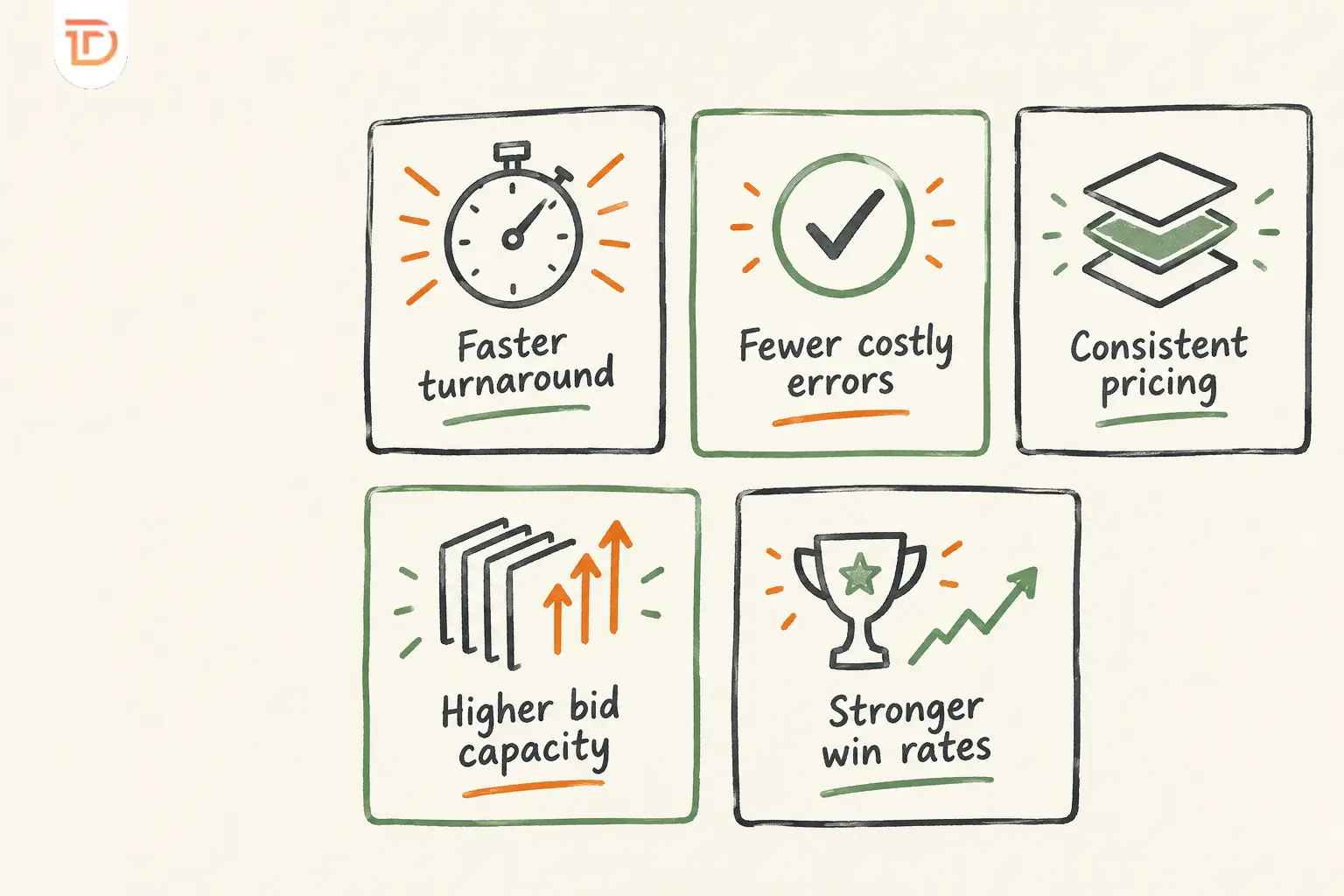
- Faster turnaround: estimates that took days now take hours, start to finish
- Fewer costly errors: automated calculations remove manual math mistakes from every quote
- Consistent pricing: every estimator works from the same current material and labor rates
- Higher bid capacity: teams submit more bids per month without hiring more estimators
- Stronger win rates: faster, more accurate quotes win more jobs against competing bids
AI Doesn’t Replace Estimators, It Unlocks Their Competitive Edge
The fear is understandable: if a system can generate an estimate in minutes, what’s left for the person who used to spend hours building one? The answer is better use of that same person’s judgment. AI software handles the measuring, pricing, and calculating; the estimator decides which jobs to pursue, how to position a bid against competitors, and how to handle the client conversation when a scope gets complicated.
That’s work a tool can’t do. Client relationships, reading a difficult jobsite, knowing when a quote needs padding for risk, none of that comes from a dashboard. Firms that treat estimating software for contractors as a tool for their estimators, not a replacement for them, are the ones seeing the biggest gains in both speed and bid quality.
How Dreamer Technoland’s AI Estimating Platform Transforms Home Remodeling Projects
Choosing an estimating platform feels risky when your bidding process is already working well enough to get by, and the last thing you want is a tool that adds complexity instead of removing it. Dreamer Technoland built its estimating platform specifically around the gap most remodeling contractors run into: generic estimating tools built for new construction don’t handle the irregular scopes, mixed material lists, and frequent change orders that define remodeling work.
The platform pairs AI remodeling estimating software with full user control, so your team reviews and adjusts every automated calculation before it goes out the door, instead of trusting a black box. It reads drawings and photos, pulls current material and labor rates, and builds a structured estimate that fits directly into the bidding workflow you already run, no retraining your whole team from scratch.
If estimating speed and accuracy are holding back how many jobs you can bid on each month, that’s worth a direct conversation. Contact Dreamer Technoland today for a free estimating software demo.
FAQ Section
Q. How accurate are AI estimates compared to manual estimates?
AI estimates typically land within a tighter margin of error because they pull current material and labor rates automatically, removing outdated pricing and manual math mistakes. Manual estimates depend on memory and available price sheets, which often lag real market conditions by weeks.
Q. Can AI estimating software integrate with existing contractor tools?
Most AI estimating platforms connect with existing project management, accounting, and bidding software contractors already use, so you’re not replacing your entire workflow. Integration typically covers exporting estimates, syncing material rates, and pulling drawings from your existing file storage.
Q. What’s the typical ROI for AI estimating software?
Contractors typically recover the cost through faster bid turnaround and higher win rates rather than direct savings alone. Firms that cut estimating time by half or more often see bid volume and win rates rise within the first six months of adoption.
Q. Do I need special training to use AI estimating tools?
Most platforms are built for contractors, not engineers, so basic training usually takes a few hours rather than weeks. Your team uploads photos or drawings and reviews the generated estimate, a smaller learning curve than most spreadsheet-based systems require.
Q. Will AI estimating software work for small remodeling jobs, not just large projects?
Yes. AI estimating tools handle small kitchen or bathroom remodels just as well as larger whole-home projects, since the system scales to the scope you upload rather than requiring a minimum project size to generate an accurate estimate.