



Every business running software today depends on some way to store and verify information, and the debate around blockchain vs traditional databases really comes down to one question: who do you trust to keep that record straight? A traditional system hands that job to a central administrator. Blockchain spreads it across a network of computers that all have to agree before anything gets written.
According to Statista, global spending on blockchain solutions is projected to reach nearly $19 billion by 2024, a sign that companies across finance, supply chain, and healthcare have stopped treating this as an experiment. That kind of spending signals a real opportunity for businesses willing to figure out where blockchain actually earns its place against the databases they already run.
This blog breaks down where blockchain technology pulls ahead of traditional systems, where it genuinely doesn’t, and how to decide which one your business needs right now.
Benefits of Blockchain Technology Over Traditional Systems
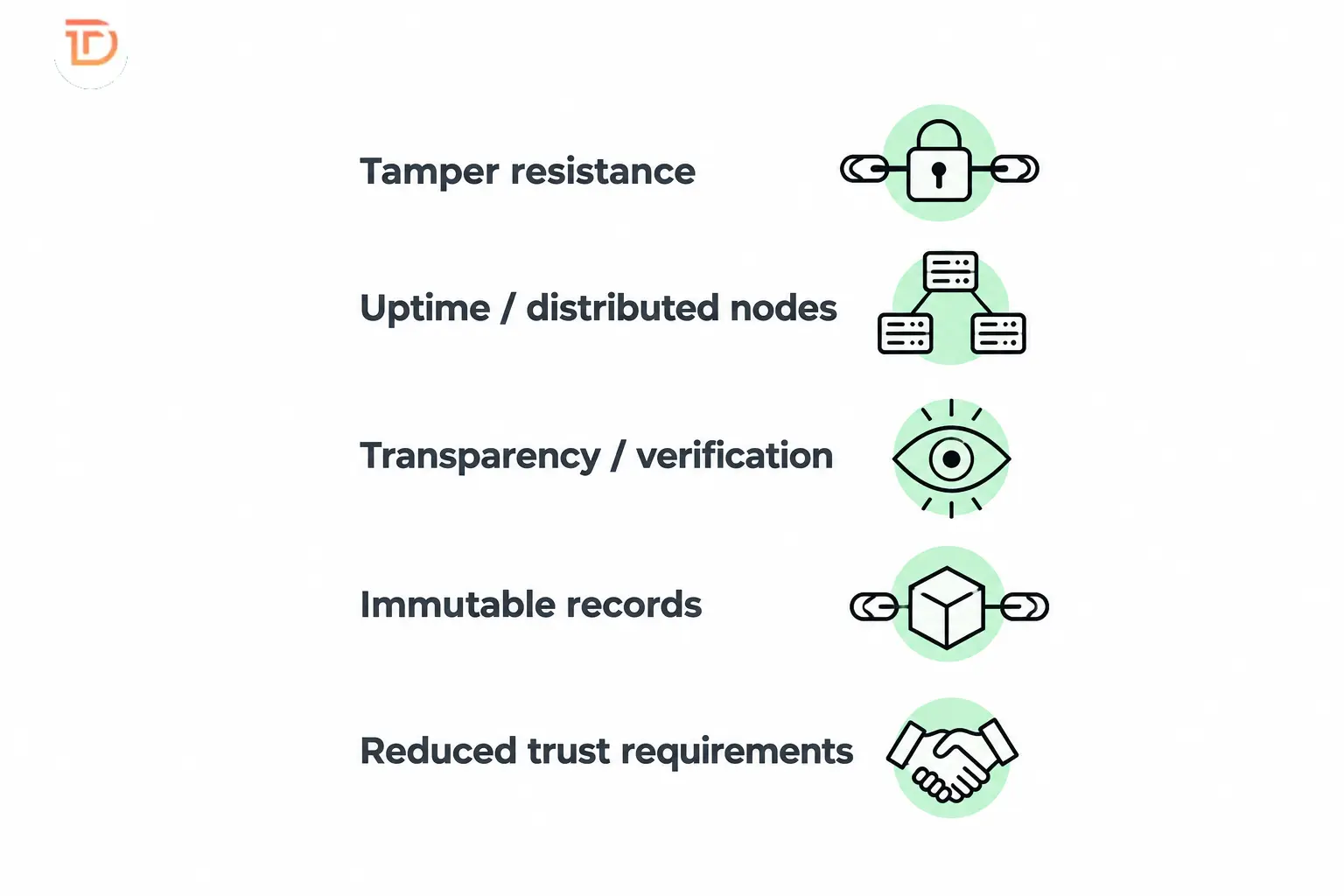
Security breaches and quiet data tampering cost businesses real money and real trust, and the architecture you build on decides how exposed you are to both. Traditional databases put a huge amount of faith in whoever holds administrator access, while blockchain spreads that risk across thousands of independent nodes that all have to agree before a record changes. Here’s where that structural difference actually shows up when you put it to work:
- Tamper resistance that holds up under pressure: Altering a single confirmed block on a blockchain requires control over a majority of the network, known as a 51% attack, while a traditional database only needs one administrator with the right credentials to run an update or delete command whenever they choose.
- Uptime that doesn’t depend on one server room: Blockchain networks stay operational through distributed nodes, so if dozens of machines go offline the rest keep validating transactions without interruption, while traditional databases depend on centralized servers and need separate backup systems to avoid downtime from a single failure.
- A ledger anyone can actually check: Every transaction on a public blockchain stays visible and verifiable to anyone on the network, while traditional databases put that visibility entirely in the hands of whoever administers the system, including what gets shown to outsiders and what doesn’t.
- Historical records that genuinely stay put: Once a block gets confirmed and added to the chain, rewriting it means redoing every block that followed across every node on the network, which makes blockchain records far harder to quietly edit than rows in a traditional database table.
- Less dependence on blind trust in one party: The Cambridge Analytica situation showed exactly what happens when one company controls a huge database of personal information with little outside oversight, something a transparent, distributed ledger structure is specifically built to prevent.
These are exactly the advantages businesses look for when they bring in blockchain integration services to handle sensitive records, cross-party transactions, or anything where a single point of failure simply isn’t acceptable. None of this makes traditional systems obsolete, but it explains why the blockchain vs traditional databases debate keeps tilting toward distributed ledgers for regulated industries and multi-party deals that can’t rely on one company’s full control.
Role of blockchain in software development
Building software around blockchain means rethinking parts of the architecture that developers have treated as settled for decades. The biggest shift comes from smart contracts, which are self-executing programs that live directly on the chain and run automatically once their conditions are met. Traditional databases have no native equivalent to this. A database can store the terms of an agreement, but it can’t enforce them on its own, someone still has to write application code on top of it and trust that code to behave correctly every single time it runs.
This difference is exactly why blockchain application development has become its own specialty rather than a side skill picked up by traditional software teams. Developers working in decentralized finance build lending and trading platforms where smart contracts move funds without a bank or clearing house sitting in the middle. Supply chain teams use the same logic to track a product from factory floor to store shelf, with each handoff recorded on-chain so no single party can quietly edit the history later. Tokenization projects, where real assets like property, art, or equity get represented as digital tokens, depend entirely on this kind of enforceable, shared record that a conventional database was never designed to provide on its own.
None of this means a company rips out its existing systems and starts from scratch. Most organizations run blockchain components alongside infrastructure they already have, using it only where shared trust actually matters and keeping everything else on the databases that already work fine for them. Teams building this kind of hybrid setup often look to partners offering enterprise software solutions who know how to connect blockchain components to the legacy systems a business already depends on, instead of forcing an all-or-nothing rebuild that most companies can’t afford and don’t actually need.
Benefits of blockchain technology
Cost and trust are the two things that actually move a CFO to approve a blockchain project, not the technology itself. When a business removes a middleman from a transaction, whether that’s a bank processing an international payment or a broker verifying a shipment, it cuts both the fees and the time that middleman used to add. Supply chain companies now use blockchain to confirm where a product came from without paying a separate auditor to check every link in the chain, and finance teams use it to settle transactions that used to take days down to a matter of hours.
Real adoption numbers back this up. Companies like Pfizer, Walmart, Ford, Visa, Shell, Siemens, and Lufthansa have all put blockchain to work somewhere in their operations, and industry estimates suggest close to 90% of U.S. businesses have implemented blockchain in some capacity, even if that’s a pilot program rather than a full rollout. The U.S. currently leads global blockchain investment with roughly 51% of total funding worldwide, with China at 18% and the U.K. at 4%, which tells you fairly clearly where the money and the confidence are concentrated right now.
Healthcare organizations use blockchain to keep patient records auditable without handing full access to any one party, while financial firms use it to cut fraud risk by making transaction histories harder to quietly alter after the fact. Businesses building these kinds of systems from scratch often start with web application development that connects a blockchain backend to a front end their staff and customers can actually use without needing to understand how a distributed ledger works underneath it. The appeal isn’t the technology for its own sake, it’s fewer intermediaries, cleaner audit trails, and fewer places for fraud to hide.
Blockchain vs Traditional Databases: Core Architectural Differences
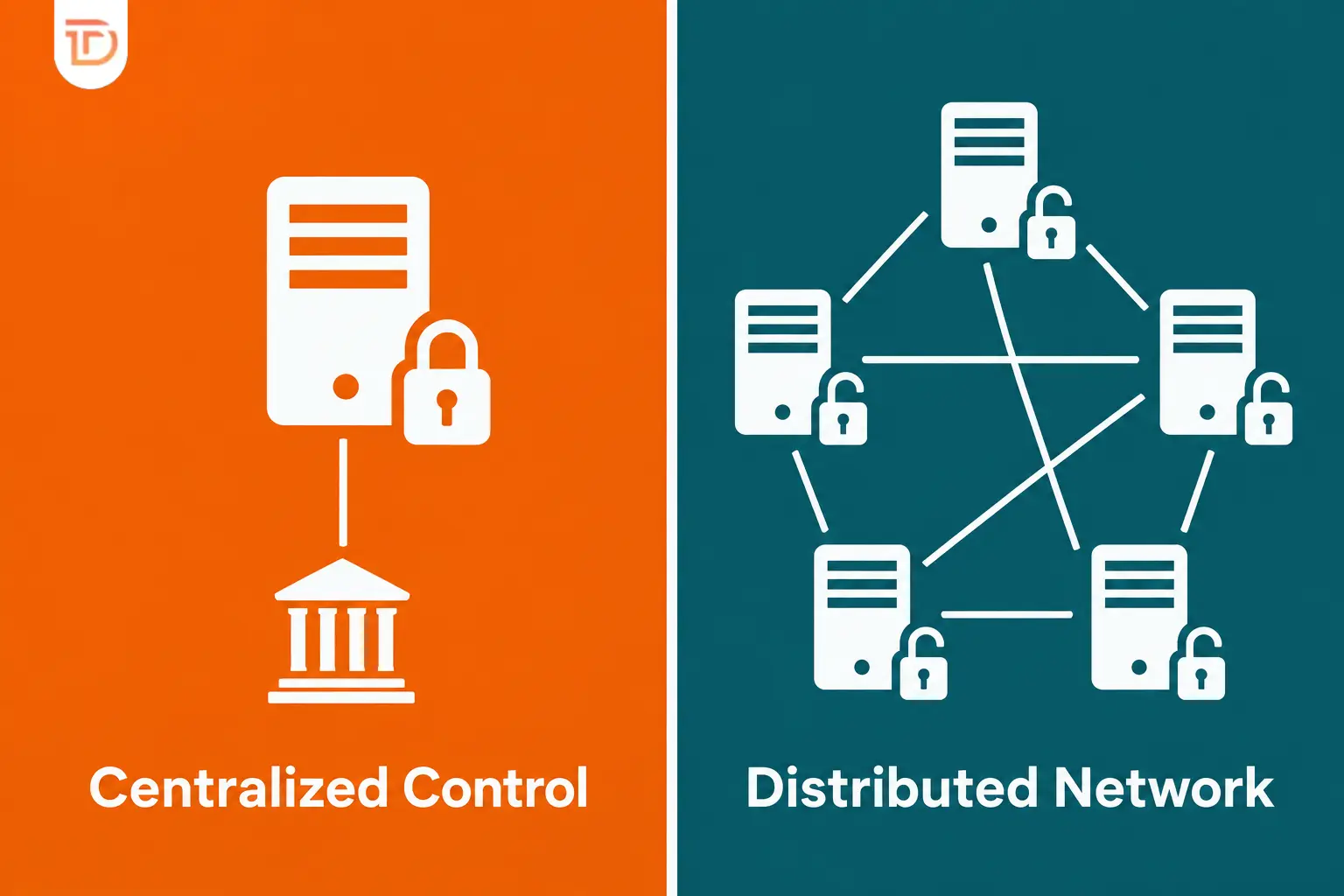
The real difference in blockchain vs traditional databases starts with who’s in charge of the record, not how fast it runs or how polished the interface looks. A traditional database sits on a centralized client-server setup, where one organization owns the hardware, controls who gets access, and can change, delete, or lock data whenever it decides to. Blockchain flips that structure entirely. Instead of one server holding the master copy, a blockchain network spreads identical copies of the ledger across thousands of independent computers, called nodes, each one checking the others’ work before anything gets confirmed. This hands-off, distributed design is the defining trait of blockchain technology compared with anything built on a single company’s servers.
Most businesses running today’s software are using familiar centralized technology such as MySQL, PostgreSQL, Microsoft SQL Server, Oracle Database, or MongoDB, all of which depend on a single administrator or IT team managing permissions from one place. That setup works well when there’s one trusted party everyone agrees to rely on, like a company managing its own internal inventory. Blockchain was built for the opposite situation, where multiple parties need to share a single source of truth without any one of them controlling it outright. Consensus mechanisms, the rules nodes use to agree a transaction is valid, replace the administrator’s authority with a majority-agreement process before data gets grouped into a block and chained to the ones before it.
This is exactly why picking the wrong setup gets expensive fast. A business that needs a shared, tamper-resistant record across several outside partners will struggle if it tries to force that use case onto a traditional centralized database, and a business that just needs fast internal data management will waste time and money standing up a blockchain network it doesn’t need. Companies serious about getting this right usually start by learning how to choose Private blockchain development company partners who understand both sides well enough to recommend the architecture that actually fits, not just the one that sounds more modern. Getting this decision right the first time saves a lot of rebuilding later, because migrating from one model to the other after launch is far more disruptive than choosing correctly up front.
Performance, Speed, and Scalability: Trade-offs Between the Two Approaches
Speed is where traditional databases still win outright, and anyone telling you blockchain is faster across the board hasn’t tested either one under real load. A traditional database processes a transaction the moment it’s written, with no need to check in with anyone else first. Blockchain networks can’t move that fast by design, because every transaction needs network-wide agreement before it’s considered final, and that consensus step adds latency that depends heavily on which blockchain you’re running, which is the central trade-off behind every blockchain vs traditional databases performance discussion.
| Attribute | Traditional Database | Blockchain |
|---|---|---|
| Transaction Speed | Near-instant, no network agreement needed | Slower, depends on the consensus mechanism and network size |
| Scalability Approach | Vertical scaling (bigger servers) or sharding | Horizontal scaling across nodes, often limited by consensus overhead |
| Consensus Requirement | None, a single administrator approves changes | Required from a majority of network nodes before confirmation |
| Uptime Model | Dependent on centralized servers and backups | Distributed across nodes, resilient to individual node failure |
| Data Modification | Direct create, read, update, delete (CRUD) access | Extremely difficult once a block is confirmed and chained |
Neither column is the automatic right answer. A ticketing system processing thousands of bookings a second needs the raw speed of a traditional database, while a multi-party trade finance platform needs the shared trust blockchain provides, even if that means waiting a few extra seconds for confirmation. The smart move is matching the trade-off to what actually breaks your business if it goes wrong: slow transactions, or a record nobody fully trusts.
Key Considerations When Choosing Between Blockchain and Traditional Systems
Choosing between blockchain and a traditional system isn’t a technology question first, it’s a business question dressed up as one. Get the framework wrong and you either overbuild a solution nobody needed or underbuild one that can’t handle the trust problem you actually have. These are the factors that should drive the decision, not whatever happens to be trending in tech news this quarter.
- Trust Model Requirements: If every party in a transaction already trusts one central authority, like a bank trusts its own internal ledger, a traditional database handles that fine. If multiple outside organizations need to share a record without any single one controlling it, blockchain solves a problem a centralized database structurally can’t.
- Performance Needs: Applications processing thousands of transactions per second with low tolerance for delay, like payment processing or real-time analytics, usually belong on a traditional database. Blockchain’s consensus requirement makes it a poor fit when raw speed is the main thing your business gets judged on.
- Regulatory Environment: Industries under heavy audit requirements, like finance and healthcare, often benefit from blockchain’s built-in, hard-to-alter transaction history, which can make compliance reporting more straightforward. A traditional database can meet the same requirements, but it usually needs extra logging and audit tools bolted on separately.
- Cost Tolerance: Blockchain integration carries setup costs that traditional database projects typically don’t, including network design, node infrastructure, and specialized development time. Businesses need to weigh that upfront investment against the long-term savings from removing intermediaries and manual reconciliation work.
- Team Expertise: Blockchain application development is still a specialized skill set, and finding developers fluent in smart contracts and consensus design costs more than hiring for a conventional database stack. Businesses without that expertise in-house should budget for either training or an experienced outside partner.
- Scalability Goals: If growth means adding more internal users to one system you control, traditional databases scale predictably with more server capacity. If growth means onboarding more outside partners into a shared, trustless network, blockchain’s horizontal, node-based model fits that pattern better over time.
- Data Ownership Model: A business that needs to retain full control over who sees and edits its data should stick with a traditional database, since blockchain’s transparency works against that goal. Companies pursuing broader digital transformation solutions across multiple partners often find shared ownership is actually the point, not a drawback.
With over 300 million people and roughly 85 million wallet users already active in blockchain networks worldwide, the ecosystem has matured enough that neither option is the automatically “safe” choice anymore. It genuinely comes down to fit.
How Dreamer Technoland Can Help You Build a Blockchain-Enhanced System
Deciding whether your next system needs blockchain or just a well-built traditional database is a tough call to make alone, especially when most vendors have an incentive to push whichever one they already specialize in. Dreamer Technoland works through that trade-off honestly, because a mismatched architecture costs you far more down the road than an honest “you don’t need this” conversation costs us now.
Our team has worked on both sides of this divide, building standard database-driven applications and custom blockchain integration services, which means our recommendation comes from hands-on experience with both, not a sales pitch for one. We start every project with an assessment of where decentralization and immutability actually add value to your business, then design the architecture, build the smart contracts if they’re genuinely needed, and connect everything to the legacy systems you’re already running.
If your business is weighing blockchain against the system you already have, we can help you figure out which one earns its place before you spend a dollar building it. Contact Dreamer Technoland today for a free blockchain readiness consultation.
FAQ Section
Q. What is the main difference between blockchain and traditional databases?
Traditional databases store data on a single server controlled by one administrator, who can edit or delete records at will. Blockchain spreads identical copies across many independent nodes that must agree before any change is accepted, making the record far harder to alter.
Q. Is blockchain faster than traditional databases?
No. Traditional databases process transactions instantly since there’s no need for network agreement. Blockchain requires consensus from multiple nodes before confirming a transaction, which adds latency. Databases win on raw speed; blockchain trades speed for shared trust and tamper resistance.
Q. Can blockchain replace traditional databases entirely?
Not realistically. Most businesses still need fast, centralized systems for routine operations like inventory or customer records. Blockchain works best alongside traditional databases, handling the specific parts of a business, like multi-party transactions, where shared trust matters more than raw speed.
Q. What are the security advantages of blockchain over traditional databases?
Blockchain requires control of the majority of the network, a 51% attack, to alter confirmed data, while a traditional database can be changed by a single administrator with access. This distributed structure makes blockchain significantly harder to tamper with quietly.
Q. When should I use blockchain instead of a traditional database?
Choose blockchain when multiple outside parties need to share a record without one of them controlling it, or when an auditable, tamper-resistant history matters more than transaction speed. For internal, single-authority systems, a traditional database usually works better and costs less.