


Hospitals and clinics collect huge amounts of patient data every single day, but most of it sits unused across separate systems. The importance of business intelligence in healthcare comes down to one fact: it turns scattered records into decisions staff can act on immediately. Without it, doctors and administrators rely on gut feeling. With it, they work from real numbers.
According to Grand View Research, the global healthcare analytics market crossed USD 34 billion in 2023 and keeps climbing at a fast pace. That growth points to a real opening: organizations that adopt business intelligence now get ahead on cost control, patient outcomes, and compliance before regulators force their hand.
This blog walks through exactly how business intelligence changes daily hospital operations, which tools make it work, and what to watch for before you spend a single rupee on it. You’ll finish knowing if your organization is ready to make the move.
Business intelligence tools for hospitals
The importance of business intelligence in healthcare becomes obvious the moment you watch a hospital try to run without the right tools. Staff pull reports by hand, data sits locked inside separate systems, and nobody gets a full picture of what’s happening across departments. Business intelligence tools fix this by pulling everything, EHR records, lab results, billing data, pharmacy logs, claims, and CRM activity, into one connected view anyone on the leadership team can read.
Hospitals typically run on ten or more separate systems: encounter management, lab software, pharmacy platforms, membership databases, finance tools, claims processing, billing engines, CRM software, EMR systems, and hospital management software. Each one holds a piece of the patient story, but none of them talk to each other on their own. BI tools sit on top of all of it and connect the pieces into a single source of truth that every department can trust.
Core Capabilities Worth Knowing
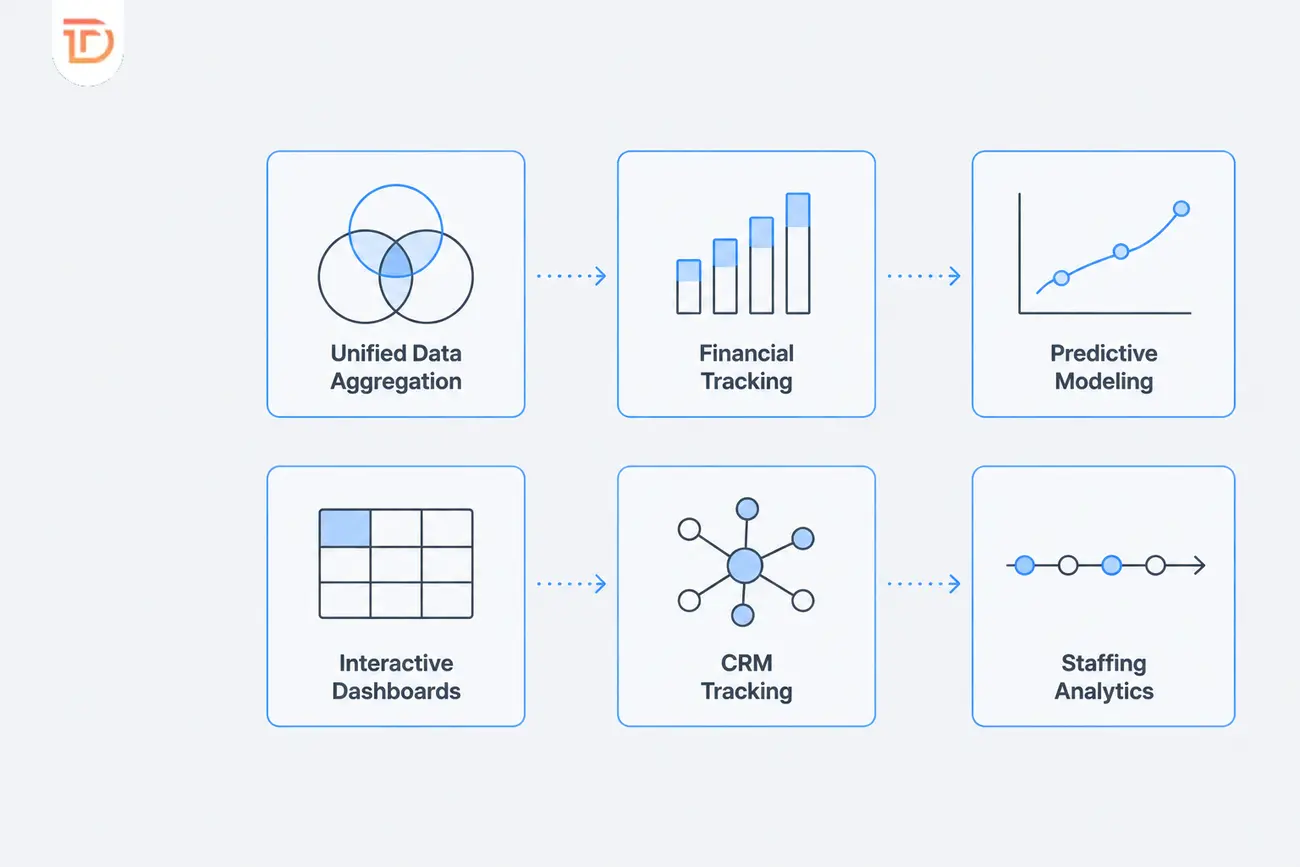
- Unified data aggregation: Combines EHR records, lab systems, pharmacy software, and billing platforms into one connected dashboard.
- Financial and claims tracking: Monitors billing cycles, insurance claims, and reimbursement timelines to catch revenue leaks early.
- Predictive modeling tools: Flags patients at high risk of readmission or complications before symptoms escalate.
- Interactive reporting dashboards: Turns raw numbers into visual reports doctors and administrators read in seconds.
- CRM and patient engagement tracking: Tracks appointment history, communication logs, and satisfaction scores in one record.
- Staffing and resource analytics: Matches bed availability and staff schedules against patient inflow to cut wait times.
Most hospitals group these capabilities under three broad tool categories. Here’s how each one plays a different role in the same system:
| Tool Category | Primary Function | Example Output |
|---|---|---|
| Analytics platforms | Crunch clinical and financial data at scale | Cost-per-patient trends |
| Dashboard software | Display data visually for fast reading | Real-time bed occupancy view |
| Predictive modeling tools | Forecast risk before it becomes a crisis | Readmission risk score |
The importance of business intelligence tools shows up clearly once a hospital tries to scale without them. Manual reporting breaks down fast when patient volume grows, and decisions start lagging behind what’s actually happening on the floor. Platforms built for BI in healthcare industry solve this by giving every department the same real-time view, from the ER to the billing office.
Benefits of business intelligence in healthcare
Adopting business intelligence in healthcare isn’t a nice-to-have anymore. It produces results boards can measure in dollars saved, hours cut, and patients kept healthier, and that’s exactly why hospital leadership asks for it by name now.
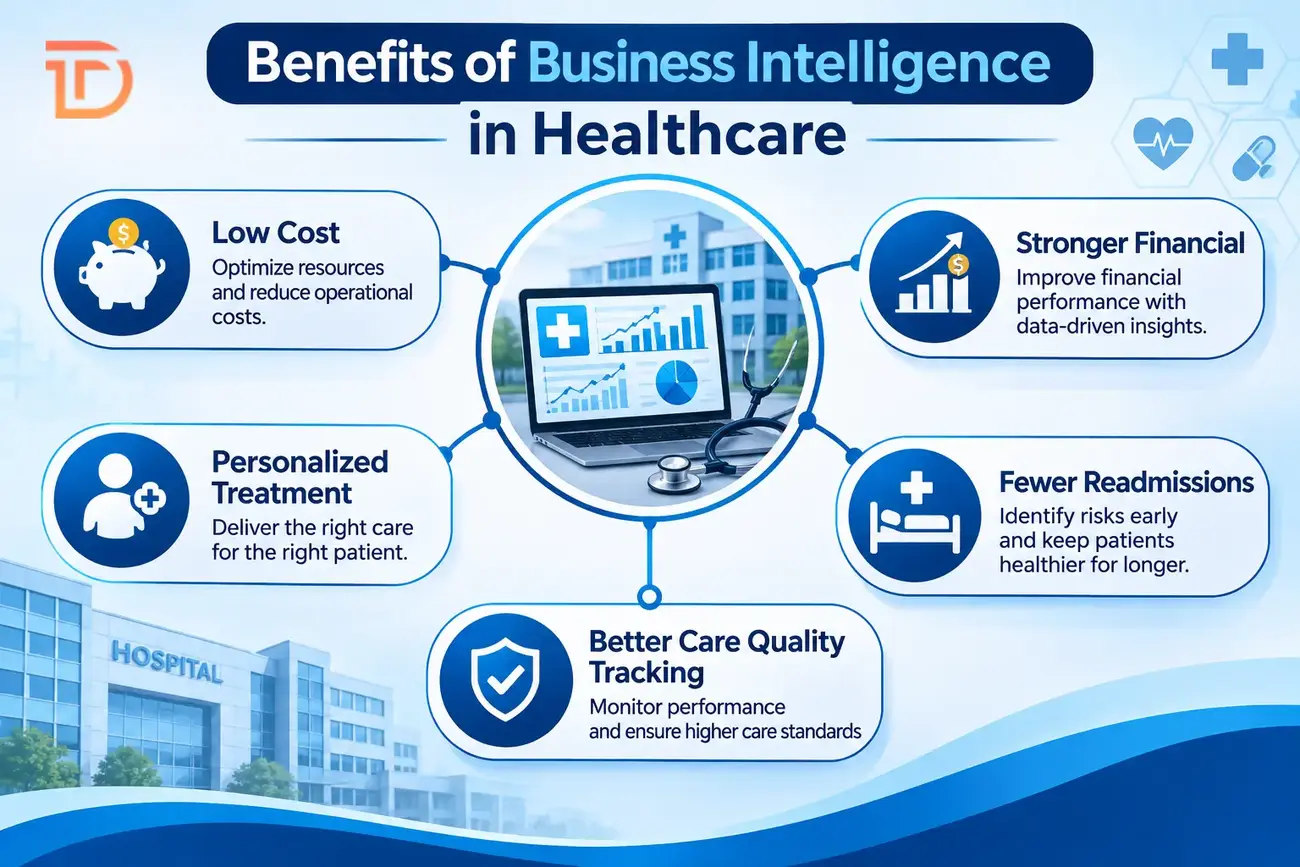
- Lower operating costs through smarter resource allocation: BI systems show exactly where money leaks out of daily operations, from idle equipment to overstaffed shifts during slow hours. Hospitals that track this data in real time cut waste without cutting care quality. Administrators move budget toward departments that actually need it instead of guessing at annual review time.
- Stronger financial visibility across billing and cash flow: Billing delays quietly drain hospital revenue every month, and most finance teams only catch the pattern after it’s already cost them money. BI dashboards track claims status and payment cycles as they happen, not weeks later. That visibility speeds up cash flow and flags denied claims before they pile up.
- Personalized treatment plans built on patient history: Doctors treat patients better when they see full medical history, including family history, in one place instead of piecing it together from paper files. BI tools surface patterns a single chart review would miss, like inherited risk factors or past reactions to treatment. That context shapes decisions at the point of care, not after the fact.
- Fewer readmissions and shorter wait times: Hospitals lose money and reputation every time a patient bounces back within 30 days of discharge. BI tools flag high-risk patients before they leave, so care teams schedule follow-ups that actually prevent the return visit. The same data shows exactly where bottlenecks slow down admissions and discharges.
- Better care quality tracking against industry benchmarks: Providers that track performance against HEDIS standards, the quality measures set by the National Committee for Quality Assurance, know exactly where they stand against peers. BI dashboards pull this scoring automatically instead of leaving it to a manual audit once a year. That ongoing visibility makes accreditation reviews far less stressful.
Data-driven decision-making in healthcare
Every healthcare decision used to rest on a clinician’s memory and a stack of paper charts. That approach doesn’t scale once a hospital serves thousands of patients a month, and it never scales across an entire health network.
From Guesswork to Evidence
Healthcare business intelligence solutions give leaders a way to watch patient diagnoses, service usage, and disease patterns as they develop, not months after the fact. Administrators track which treatments actually work, which ones cost more without improving outcomes, and where clinical performance slips below standard. That shift captures the importance of business intelligence in healthcare: it turns raw numbers into decisions that save lives, not just money.
The shift matters most in disease management and outcomes tracking, where small adjustments compound into big results over time. A hospital that spots a treatment pattern failing early corrects course before it affects hundreds of patients instead of a handful. That kind of early correction rarely happens with quarterly reports and manual spreadsheets.
Predicting Risk Before It Happens
Picture a patient discharged after heart surgery. BI models trained on prior readmission data flag this patient as high risk based on age, prior visits, and recovery pace. Care teams then schedule a follow-up call within 48 hours instead of waiting for a crisis to bring the patient back to the ER.
This kind of prediction only works when the underlying data gets presented clearly enough for a nurse or case manager to act on it fast. That’s exactly why Data visualization services matter as much as the analytics engine behind them. A chart nobody understands doesn’t change a single outcome, no matter how accurate the model behind it is.
Common Challenges in Implementing Healthcare BI Systems
Business intelligence sounds simple in a sales pitch, but the importance of business intelligence in healthcare only becomes real once a hospital pushes through five common walls during rollout.
- Data silos and fragmentation: Most hospitals run lab, billing, pharmacy, and EMR systems that were never built to talk to each other. Pulling data from ten disconnected systems into one BI platform takes real integration work, not a quick plug-in. Skipping this step leaves dashboards showing an incomplete picture.
- Data quality and standardization issues: A BI system is only as good as the data it reads, and healthcare data arrives messy: duplicate patient records, inconsistent coding, and missing fields. Cleaning and standardizing this data before it hits a dashboard takes more time than most teams budget for.
- Regulatory compliance and privacy concerns: Patient data carries legal weight that other industries don’t deal with. Every BI system touching clinical records has to meet HIPAA requirements and similar regional rules, which shapes how data gets stored, accessed, and shared across the organization.
- High implementation and infrastructure costs: Standing up a full BI system, from data warehousing to dashboard licensing to staff training, costs more upfront than most budgets expect. Hospitals that treat this as a quick software purchase usually run out of budget halfway through the rollout.
- Skills gap and the need for trained personnel: Dashboards don’t run themselves. Hospitals need staff who understand both clinical workflows and data analysis, and that combination is hard to hire for. Without trained personnel, expensive BI platforms end up underused within a year of going live.
Best Practices for Healthcare BI Adoption
None of the challenges above are reasons to skip business intelligence. They’re reasons to plan the rollout properly, and hospitals that get this right tend to follow a fairly consistent playbook.
- Secure executive sponsorship first: Leadership buy-in decides whether a BI rollout gets funded past the pilot stage.
- Start with one high-impact use case: Prove value on readmission tracking or billing before expanding to every department.
- Build a data governance framework early: Set clear rules for who owns, cleans, and approves data before dashboards go live.
- Invest in staff training from day one: Dashboards only help if clinical and admin staff know how to read and act on them.
- Treat security and compliance as non-negotiable: Bake HIPAA and regional privacy rules into the system design, not as an afterthought.
- Choose a platform built to scale with you: Working with partners offering Custom software development services lets hospitals customize BI systems instead of forcing their workflow into generic software.
Hospitals that follow this order, sponsorship, a focused pilot, governance, training, security, and scalable technology, tend to get a working BI system live within months instead of years. Skipping steps to save time usually costs more later in rework, and that rework almost always lands on the same budget line leadership was trying to protect in the first place.
How Dreamer Technoland Can Help You Develop Healthcare Business Intelligence Systems
Picking the right partner to build a healthcare BI system feels risky, especially when patient data and compliance sit on the line. Most generic software vendors don’t understand clinical workflows well enough to build something doctors will actually trust and use daily.
Dreamer Technoland works specifically with healthcare clients who need systems built around real clinical and financial data, not templated dashboards pulled from a generic industry pack. That means understanding how lab results, billing cycles, and patient records actually move through a hospital before writing a single line of code.
Our team builds custom dashboards, designs data warehouses that connect fragmented hospital systems, and models healthcare data in a way that respects healthcare app development cost constraints without cutting corners on compliance. Every system we build accounts for HIPAA and regulatory standards from the first design sprint, carrying the same rigor we apply to QMS for Medical Devices projects into BI architecture.
FAQ Section
Q. What is business intelligence in healthcare?
Business intelligence in healthcare means using software tools to pull data from EHRs, billing, labs, and claims into dashboards that show real-time insight. It helps hospitals track costs, patient outcomes, and compliance instead of relying on manual reports or guesswork.
Q. Why is business intelligence important for hospitals?
It replaces fragmented, manual reporting with real-time dashboards connecting clinical, financial, and operational data. Hospitals use it to cut costs, predict readmission risk, speed up billing cycles, and track care quality against recognized benchmarks like HEDIS.
Q. How much does a healthcare BI system cost to build?
A: Costs vary widely based on data sources, system integrations, and compliance requirements. Small pilot dashboards start modest, while full enterprise rollouts covering EHR, billing, and claims integration cost significantly more. Get a specific estimate based on your current systems.
Q. What data sources feed into a healthcare BI dashboard?
Healthcare BI dashboards typically pull from EHRs, lab systems, pharmacy software, billing platforms, claims data, CRM tools, and hospital management systems. Connecting these sources gives administrators and doctors one full, real-time view of operations and patient care.
Q. Is healthcare BI compliant with HIPAA?
Yes, when built correctly. Healthcare business intelligence solutions must bake HIPAA and regional privacy rules into data storage, access controls, and reporting from the design stage, not add them later. Compliance-ready architecture protects patient data while enabling useful analytics.