

Search for a private blockchain development company, and you get pages that all sound the same. Each one promises security, scalability, and full-cycle delivery. Very few tell you how to separate a team that has shipped from a team that has only pitched.
That matters more here than in regular software. The permissions model, the consensus protocol, and the split between on-chain and off-chain data get locked in during the first few weeks. Get one wrong and you face a full migration instead of a quick patch.
Teams that choose on price and a polished demo often spend the second half of the year rebuilding. It happens quite often. You can skip that part. Below you will find what to verify, which questions to ask, what a realistic budget looks like, and the signs that mean you should walk away. Use it to start private blockchain development on solid ground.
Private Blockchain Development: Quick Selection Guide
Short on time? Here is the version to forward to your team.
- Pick a partner on live production work and security judgment, not on a slick deck.
- Match the framework to the job: Hyperledger Fabric for multi-party workflows, R3 Corda for financial agreements, and Hyperledger Besu for EVM tooling.
- Plan for $40,000 to $300,000+, depending on scope, and confirm what the quote includes.
- Get code ownership, audit reports, and post-launch support in writing.
- Walk away from guaranteed ROI and fuzzy answers about consensus.
What is Blockchain?
Blockchain is a shared ledger that many parties write to and none can quietly rewrite. Each block contains the hash of the block before it. Change old data, and the chain breaks.
A private blockchain limits who can join. Every node belongs to a known, approved organization. Banks, hospitals, and logistics networks pick this model for that control.
Private Blockchain vs Public Blockchain
The gap between private blockchain vs public blockchain shapes your vendor shortlist, so see it side by side.
| Factor | Private blockchain | Public blockchain |
|---|---|---|
| Access | Invite only, identities verified | Open to anyone |
| Consensus | Raft, QBFT, BFT variants | Proof of Work, Proof of Stake |
| Data visibility | Channels and private data collections | Visible to every node |
| Governance | Set by consortium members | Set by the protocol community |
| Best for | Regulated, multi-party workflows | Open tokens and public dApps |
Most enterprise use cases land on the private side. Regulators and partners want to know who touches the data.
Why is choosing a Private Blockchain Development Company Different?
Standard software vendors ship features. A private blockchain vendor designs a trust model. That difference changes how you should evaluate them.
How Private Blockchain Works for Businesses
Take Hyperledger Fabric as an example. It is written in Go, licensed under Apache-2.0, and has roughly 16,700 GitHub stars and 579 contributors. A certificate authority issues identities to each organization. A client sends a transaction proposal. Endorsing peers run the chaincode and sign the result. An ordering service, usually Raft, sequences the transactions. Peers then validate and commit them.
That flow shows how private blockchain works for businesses: known parties, agreed rules, and a shared record nobody edits alone.
What Goes On-Chain and What Stays Off
Keep the ledger lean. Store transaction state, ownership records, and document hashes on-chain. Keep contracts, invoices, and personal data in an encrypted off-chain store such as PostgreSQL or object storage, and anchor each file with its hash. A vendor who cannot draw this line clearly will struggle with both performance and compliance.
Where Vendors Get It Wrong
- Permissions. Default roles rarely match real hierarchies such as admin, auditor, and partner. Teams end up writing their own access layer.
- Upgrades. Immutability makes chaincode upgrades and data migration risky without a plan.
- Integration. The ledger must connect to your ERP, identity provider, and reporting stack.
Here is what a sound permissions model looks like in a trade finance network. Banks endorse and view transactions. Suppliers can only submit invoices. Auditors get read-only access. An endorsement policy such as “two of three organizations must sign” then guards every state change.
Why You Should Choose a Reputable Private Blockchain Development
The benefits of private blockchain for businesses only appear when the build is done well. Here are the benefits of private blockchain for businesses in short:
| Benefit | What it looks like in practice |
|---|---|
| Shared audit trail | Every party sees the same record, so reconciliation drops |
| Controlled privacy | Channels limit data to the parties who need it |
| Faster settlement | Fewer manual checks between partners |
| Predictable performance | Known validators and tuned throughput |
A reputable team protects those gains. Here is what they bring.
- Expertise & Experience: Ask for live networks, not demos. A team that has run a four-organization Fabric network already knows what breaks when the fifth partner joins.
- Custom Solutions: Templates rarely fit. Good teams write chaincode in Go or Java, design the role model around your workflow, and build APIs on top.
- Post-Launch Support: Nodes need patching. Certificates expire. Fabric moves to new LTS versions. Confirm who monitors peers and orderers and how fast they respond.
- Quality Assurance & Testing: Look for unit tests on the chaincode, integration tests on a full test network, and load tests with Hyperledger Caliper before go-live.
- Cost-Effectiveness: A low quote that skips testing and audit costs more after launch. Rebuilding a consensus layer is expensive.
- Compliance: GDPR and immutable ledgers clash. A capable partner keeps personal data off-chain and stores only hashes on the ledger. They also plan for HIPAA, data residency, and auditor access.
- Innovation & Adaptability: Frameworks keep moving. Newer Fabric releases add BFT ordering, and Besu supports QBFT. Ask how the team plans upgrades and cross-network integration.
Easy Steps to Choose a Reliable Private Blockchain Development Company
Follow these steps to find the right private blockchain development partner:
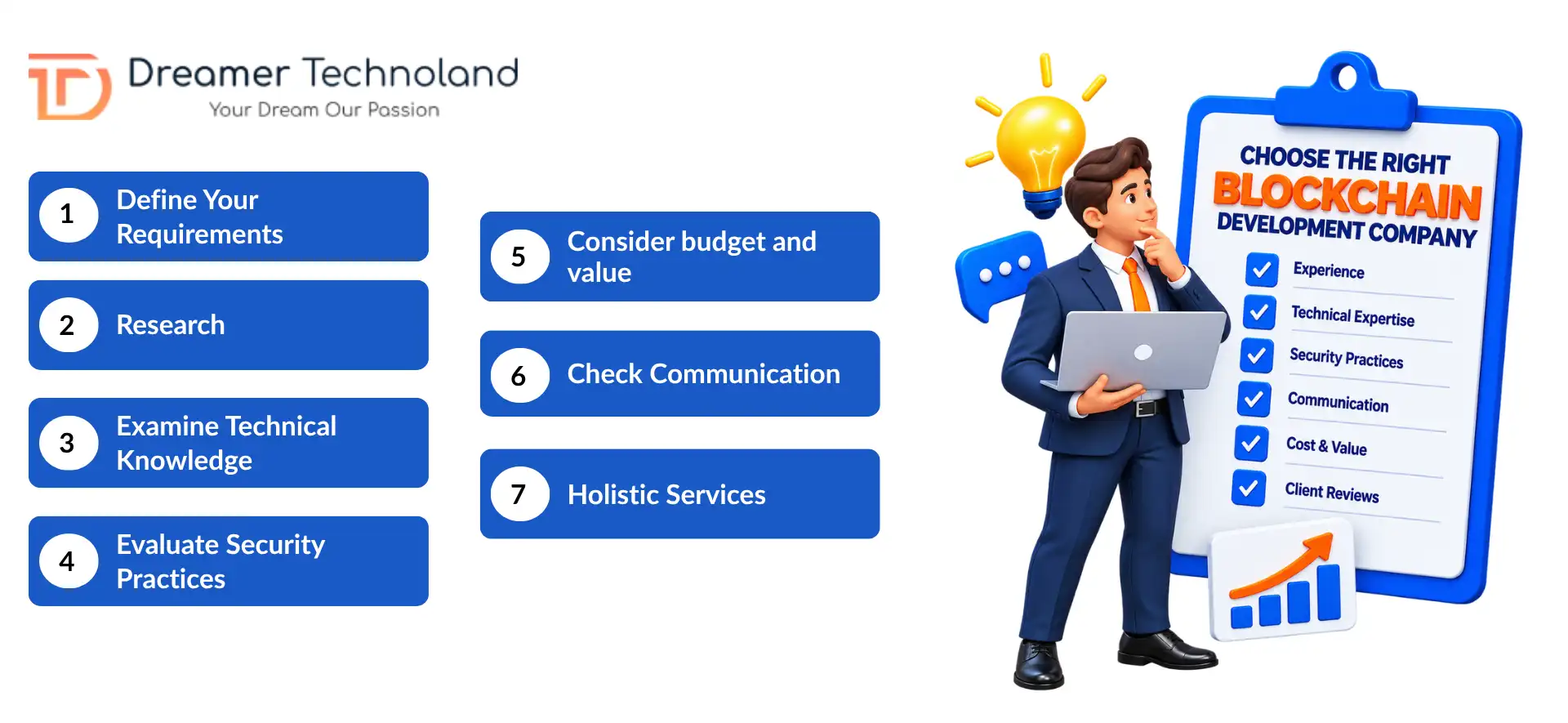
- Define Your Requirements: Write a one-page brief. List participants, data types, expected transaction volume, regulators, and systems to integrate. Vendors respond better to specifics.
- Research: Shortlist three to five firms. Verify live deployments, read case studies, and check open-source activity on GitHub. Call two past clients and ask what happened after launch.
- Examine Technical Knowledge: Ask which framework fits and why. The answer should reference your requirements, not a default.
Consensus deserves its own question. Raft tolerates crashed nodes and works when members broadly trust each other. BFT protocols such as QBFT also tolerate malicious nodes, which suits consortia with competing members.
Framework Languages Consensus Fits when Hyperledger Fabric Go, Java, Node.js chaincode Raft ordering, BFT in newer releases Multi-org workflows with private channels Hyperledger Besu Java client, Solidity contracts QBFT, IBFT 2.0, Clique You want EVM tooling with permissioning. R3 Corda Kotlin, Java Notary-based Agreements between known financial parties - Evaluate Security Practices: Ask about key management with HSMs, certificate authority setup, chaincode review, and penetration testing. Request a sample audit report.
Additionally, go one level deeper. In Fabric, that means membership service providers, mutual TLS between nodes, private data collections, and endorsement policies. Ask how private keys are generated, who can access them, and how a compromised certificate gets revoked.
- Consider budget and value: Compare total cost across build, testing, audit, and support. The cheapest quote often leaves one of these out. The cost section below gives ranges.
Score each shortlisted vendor with weights like these:
Criterion Weight Security process 25% Live production track record 25% Framework fit 20% Post-launch support 15% Cost transparency 15% - Check Communication: Expect sprint demos every two weeks, a shared backlog, a named tech lead, and time-zone overlap with your team.
- Holistic Services: Your partner should cover the full private blockchain development process, not only the coding:
- Discovery and use-case validation
- Architecture and framework selection
- Build: chaincode or smart contracts, APIs, admin dashboards
- Testing and security review
- Deployment and node onboarding
- Monitoring and support
Discovery usually takes one to two weeks. Testing should never be squeezed to hit a launch date. Any team that can explain how to build a private blockchain should walk you through these stages in order. Prefer a firm that also offers custom software development services, since the apps around the ledger matter as much as the chain.
Top Questions to Ask While Hiring Private Blockchain Development?
Ask these questions before making a final decision:
- Technical
- Which framework would you pick for us, and why not the others?
- How do you handle chaincode upgrades and data migration?
- How will personal data stay off-chain?
- Delivery
- Which networks are live today? How many organizations and nodes?
- How will you connect the ledger to our ERP?
- Where will nodes run (AWS, Azure, or on-premise), and who manages them?
- Can you outline how to build a private blockchain for our use case, step by step?
- Commercial
- Who owns the source code?
- What does support cover in the first 90 days?
- What went wrong on your last project, and how did you fix it?
The last question tells you the most. Honest answers signal real experience. Also ask them to describe one real chaincode upgrade they handled. Specific details, such as migration scripts and rollback plans, separate practitioners from presenters.
Red Flags To Watch For
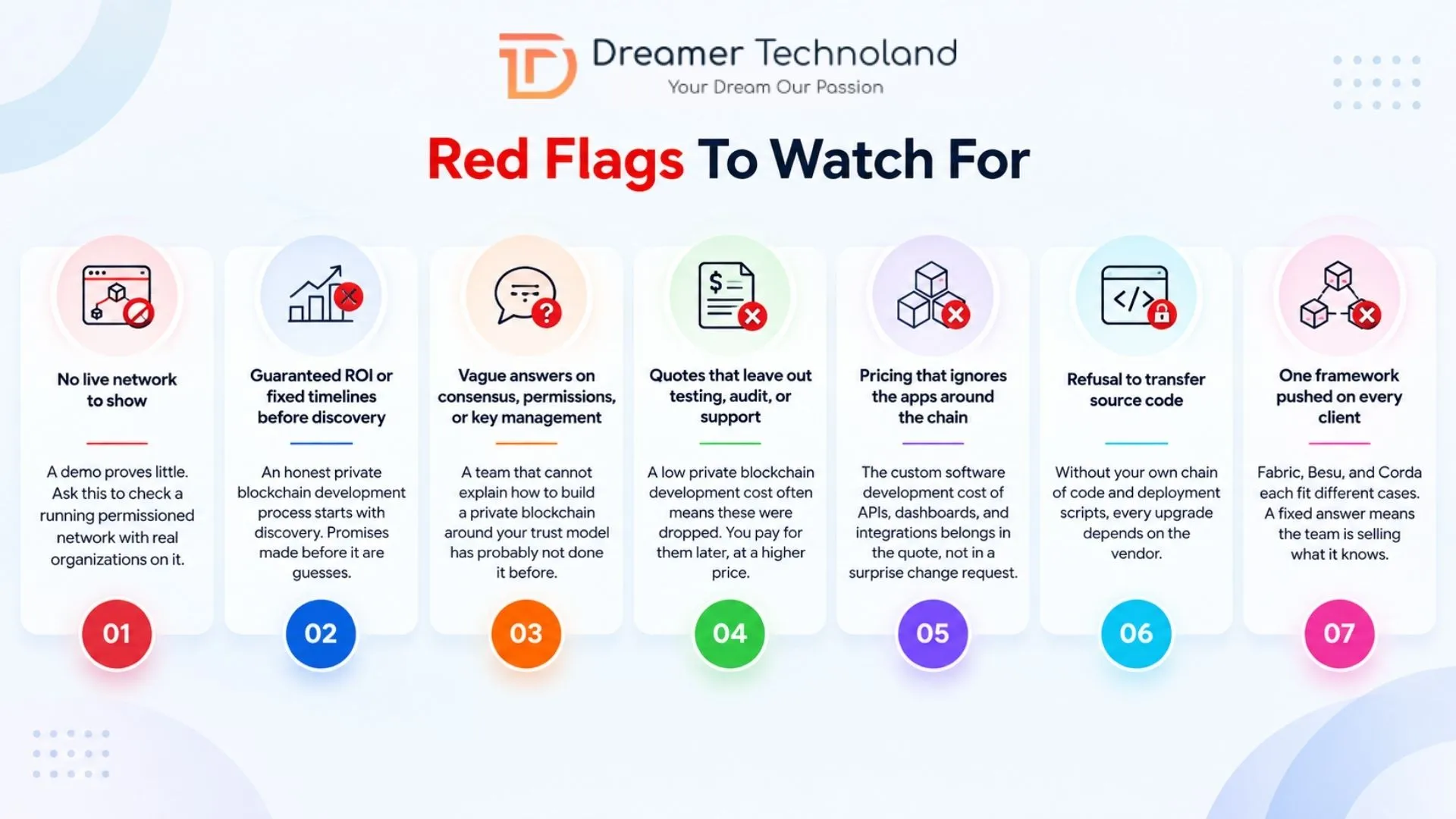
Here are some warning signs that are strong enough to end the conversation. Watch for these.
- No live network to show.
A demo proves little. Ask this to check a running permissioned network with real organizations on it.
- Guaranteed ROI or fixed timelines before discovery.
An honest private blockchain development process starts with discovery. Promises made before it are guesses.
- Vague answers on consensus, permissions, or key management.
A team that cannot explain how to build a private blockchain around your trust model has probably not done it before.
- Quotes that leave out testing, audit, or support.
A low private blockchain development cost often means these were dropped. You pay for them later, at a higher price.
- Pricing that ignores the apps around the chain.
The custom software development cost of APIs, dashboards, and integrations belongs in the quote, not in a surprise change request.
- Refusal to transfer source code.
Without your own chain of code and deployment scripts, every upgrade depends on the vendor.
- One framework pushed on every client.
Fabric, Besu, and Corda each fit different cases. A fixed answer means the team is selling what it knows.
How Dreamer Technoland Delivers Private Blockchain Solutions
We treat Private Blockchain Solutions as software projects with a ledger at the center. Discovery comes first, then architecture, then build and test in short sprints. We sign an SLA before kickoff, and you receive full ownership of the code.
Our custom software development services cover the applications, APIs, and integrations around the network. To validate an idea before a full build, our product development services include MVPs and prototypes, which suits a proof of concept.
Integration is where many projects struggle. The Carey Bros case study shows how we replaced an outdated MS Access system with a web and mobile platform for estimating, scheduling, daily logs, and subcontractor management. The same discipline applies when a ledger sits beside legacy systems.
After launch, we provide three months of complimentary support for bug fixes, performance tuning, and minor updates.
Key Takeaways
- Judge vendors on live networks, security process, and code ownership.
- Choose the framework after defining participants, privacy needs, and integrations.
- Budget $40,000 to $300,000+ for private blockchain development, and price the surrounding apps too.
- Ask hard questions early. Walk away from vague answers.
- Pick a partner who supports the network after launch.
Planning a private blockchain project? Our team is happy to review your use case, suggest a framework, and outline a realistic scope. Talk to Dreamer Technoland when you are ready to compare notes.
FAQs on Private Blockchain Development
Q. How does private blockchain work for businesses?
Approved organizations run nodes on a shared ledger. Identities are verified, transactions follow agreed rules, and consensus such as Raft or QBFT confirms them. Only permitted parties see the data, which suits regulated workflows.
Q. How much time does private blockchain development take?
The private blockchain development process depends on scope. For example, a proof of concept takes about four to six weeks. However, a production network with integrations usually takes three to six months. Meanwhile, consortium platforms with compliance work can run six to twelve months.
Q. How much does blockchain development cost?
Private blockchain development costs mostly land between $40,000 and $300,000+, based on scope, integrations, and audits. Add ongoing support of roughly 15% to 20% of build cost each year.
Q. What is the difference between private blockchain vs public blockchain?
Public networks are open to anyone and expose data to all nodes. A private network admits vetted participants and restricts data visibility. Enterprises choose private for control, privacy, and predictable performance.