

The global online grocery market is on track to hit $2,158.53 billion by 2030, growing at a 25.3% CAGR, and that kind of growth doesn’t happen without real money moving into new apps and platforms. If you’re thinking about building one, you’re not early. But you’re not late either.
Here’s the catch: most founders budget for the app they can see (the ordering screen, the delivery tracker) and miss the systems running underneath it. Backend architecture, integrations, and security often cost more than the interface ever will.
This blog breaks down what a grocery delivery app actually costs in 2026, tier by tier, feature by feature, so you can budget with your eyes open instead of guessing.
Grocery Delivery App Costs: What to Know
Grocery Delivery App Development Cost in 2026 typically falls between $40,000 and $400,000 for a standard build, with enterprise-grade platforms running $600,000 or more once you add automation, multi-warehouse logistics, and custom recommendation engines. Timelines stretch just as wide. A lean MVP can launch in 4 to 6 months, while a full enterprise system can take 12 to 18 months or longer to get right.
Here’s the honest part: there’s no single number that applies to every business. Your cost depends on how many features you build, which platforms you target, where your development team is based, and how much of the backend you build from scratch versus reusing existing tools.
By the end of this guide, you’ll know exactly what drives that cost up or down, and how to plan a budget that matches your actual business goals instead of a rough guess pulled from a sales call.
Key Cost Factors at a Glance
Before you get into feature lists and quotes, it helps to see the full shape of what you’re paying for. A grocery app’s cost isn’t just developer hours; it’s a stack of decisions that each carry their own price tag.
- Design complexity: Custom UI and branded screens cost more than template-based layouts
- Backend architecture: The engine handling orders, inventory, and vendors drives a large share of total spend
- Third-party integrations: Maps, payments, and messaging tools each add setup and ongoing fees
- Security implementation: Data protection and compliance work scales with how much user and payment data you handle
- Platform choice: Cross-platform builds cut costs 30 to 40% compared to separate native iOS and Android apps
- Maintenance and hosting: Ongoing server and upkeep costs continue long after launch
Understanding Grocery Delivery App Development Scope
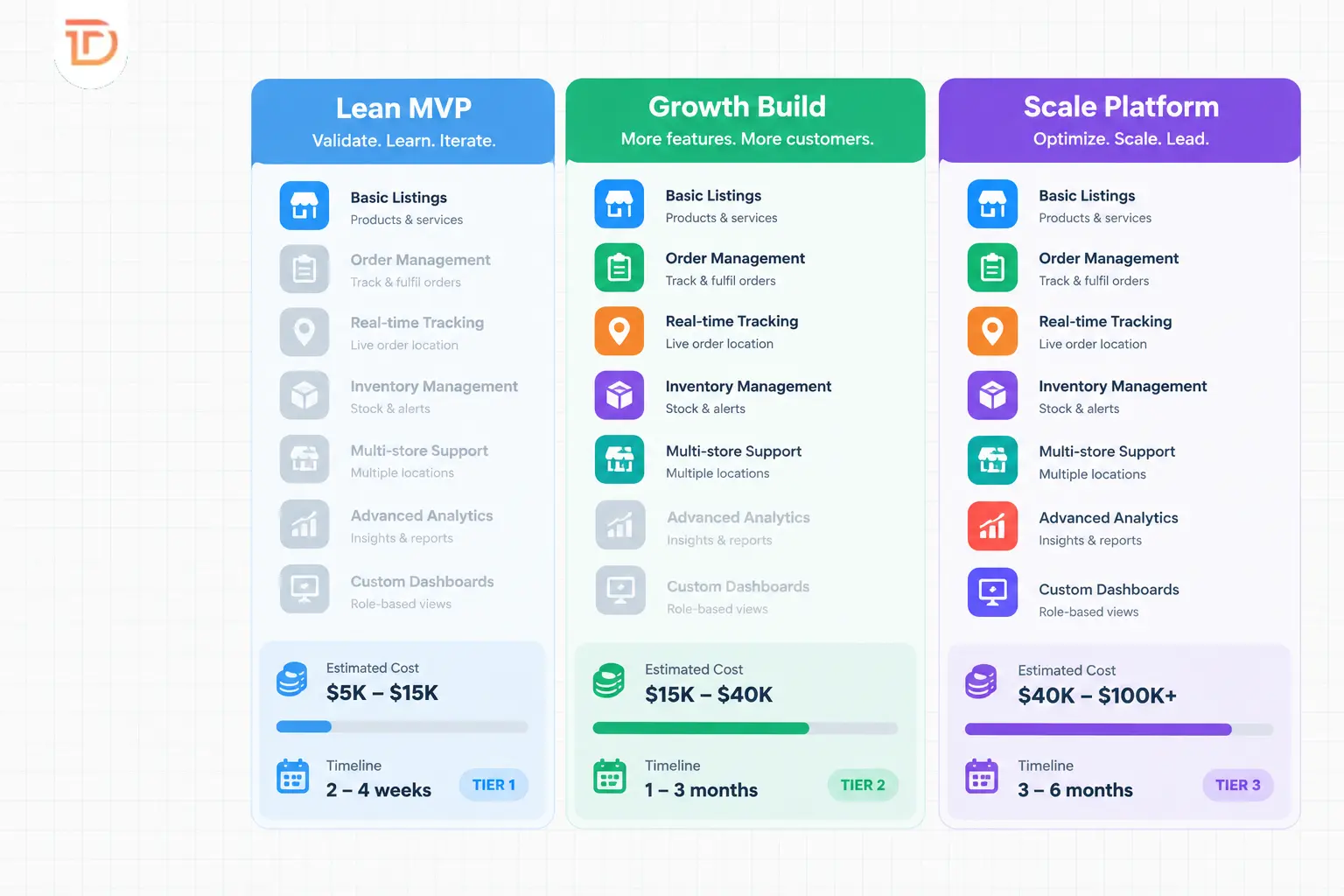
Founders often ask for “an app like Instacart” without realizing that phrase can mean three very different products at three very different price points. Knowing which tier you actually need keeps you from overbuilding or underbuilding before you’ve proven the model works.
- Lean MVP: This tier covers product listings, manual order handling, basic payment collection, and a simple admin dashboard, enough to test demand in one city without heavy automation. Cost typically runs ₹3.5 to 6 lakh (roughly $6,000 to $12,000), with launch in 2 to 3 months.
- Growth Build: Here you add real-time order tracking, a delivery partner app, wallet features, and a more capable admin panel that supports multiple stores. This tier runs ₹8 to 14 lakh and takes 3 to 5 months, and it’s where most serious regional players start.
- Scale Platform: This is the multi-vendor marketplace tier: automated order assignment, advanced inventory sync across warehouses, loyalty programs, and analytics dashboards built for multi-city operations. Expect ₹18 to 28 lakh and a 4 to 6 month build, sometimes longer if you’re layering in quick-commerce style fulfillment.
Your scope decision should match your business stage, not your ambition. A city-by-city launch with a Growth Build beats a half-finished Scale Platform every time.
Why Businesses Invest in Custom Grocery Delivery Solutions
If you’re competing in grocery delivery, a generic white-label solution boxes you into someone else’s roadmap. You can’t change the checkout flow, add a loyalty program, or connect your own warehouse system without waiting on a vendor’s release schedule. Custom development gives you control over every part of the customer journey. And in a market where quick commerce players like Zepto and Gopuff are promising 10 to 15 minute delivery windows through micro-fulfillment centers, that control becomes a competitive weapon rather than a nice-to-have.
The financial case holds up too. US online grocery revenue is projected to cross $45 billion by 2029, with an estimated 138 million people already shopping for groceries online, so the market rewards apps that can move fast and hold onto customers. A well-scoped Growth Build costing around ₹11 lakh can recover its full investment in 2 to 3 months once daily orders hit around 300, at a blended margin of ₹55 to 75 per order. That’s a real payback window, not a hopeful projection.
Custom builds also let you connect grocery operations to systems you already run, the same logic that applies when businesses look into food delivery app development cost in india, restaurant management software development and want their ordering app talking directly to kitchen or inventory software. Choosing a cross-platform framework like Flutter instead of building native apps separately can save close to ₹3.8 lakh and 6 to 8 weeks, letting you launch a full quarter earlier and capture an estimated 22% first-mover retention advantage before competitors catch up.
Breaking Down the Major Cost Drivers for Your Project
Every grocery app quote is really a sum of separate cost centers, and understanding each one tells you what you’re actually paying for instead of accepting a single lump figure.
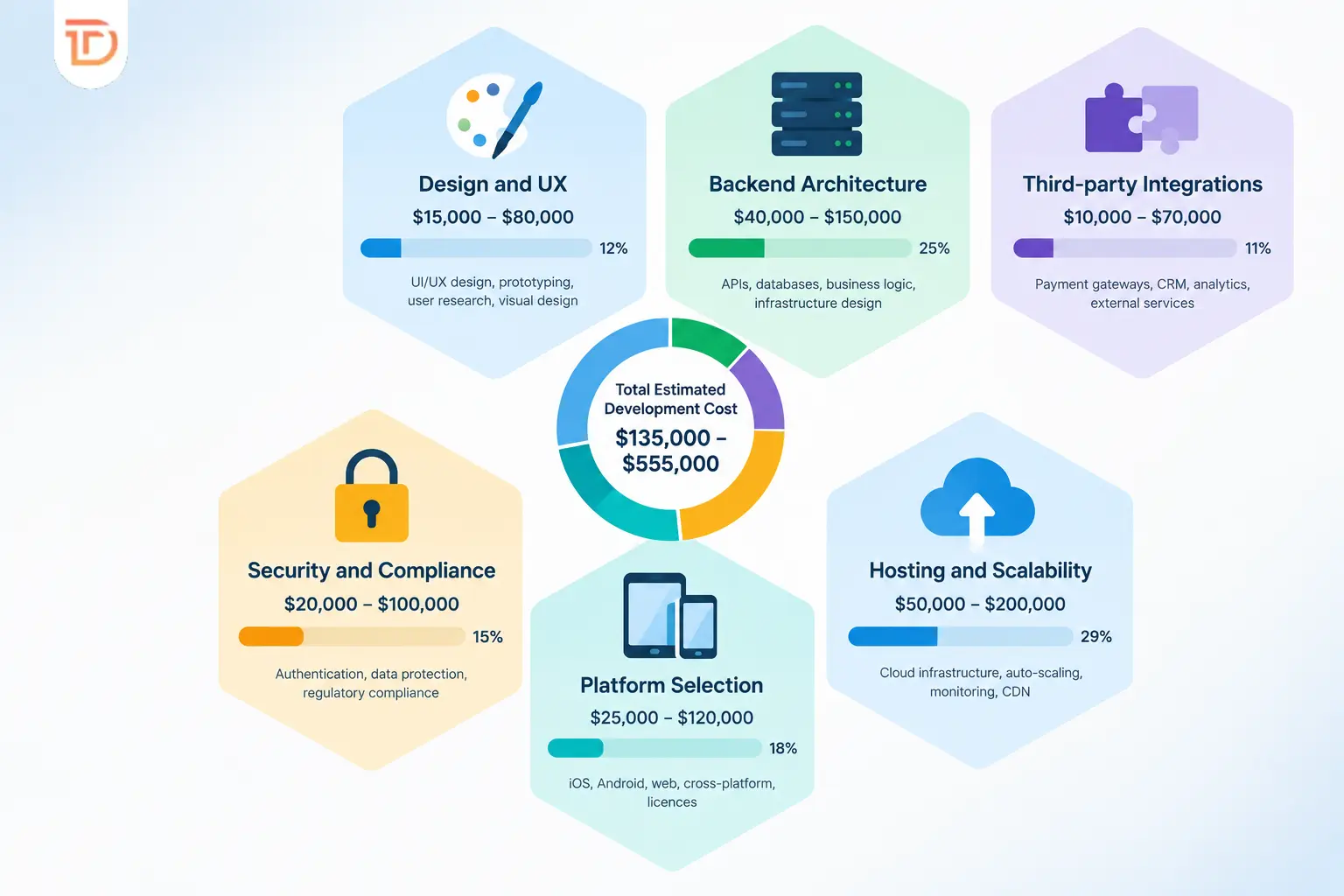
- Design and user experience. Custom screens, branded checkout flows, and store browsing layouts cost $5,000 to $60,000 depending on how much you customize versus reuse existing design patterns. Rushed design here shows up later as high cart abandonment.
- Backend architecture. This is the system managing orders, inventory sync, vendor accounts, and delivery logic, and it typically runs $5,000 to $100,000. It’s the least visible part of the app and the most expensive to fix after launch.
- Third-party integrations. Maps, payment gateways, and SMS or push notification services add $5,000 to $100,000 combined. Google Maps API alone can run ₹5,000 to 22,000 monthly, and payment gateways typically charge 1.8 to 2.4% per transaction.
- Security and compliance. Encrypting payment data and meeting regional data laws costs $10,000 to $150,000 depending on how many markets you operate in. Skipping this early almost always means a costly rebuild later.
- Platform selection. Building native apps for iOS and Android separately costs more than a cross-platform build, which can reduce spend by 30 to 40%. Most growing businesses choose cross-platform first and go native only once scale demands it.
- Hosting and scalability. Monthly hosting runs $500 to $5,000 for a growing platform, climbing past $10,000 for enterprise-scale traffic. This cost grows with your order volume, not your feature list.
Grocery Delivery App Cost Breakdown by Complexity Level
Cost ranges only make sense when they’re tied to what you’re actually building. Here’s how the three common tiers break down, so you can match your ambitions to a realistic budget before you start collecting quotes.
| Complexity Level | Development Cost Range | Timeline | Key Features | Team Size |
|---|---|---|---|---|
| MVP | $35,000 to $50,000 (₹5,00,000 to ₹12,00,000 in India) | 2 to 3 months | Basic search, ordering, payment, order tracking | 4 to 6 members |
| Mid-Level | $100,000 to $270,000 (₹12,00,000 to ₹25,00,000 in India) | 4 to 6 months | Multi-vendor support, analytics, customer loyalty programs | 6 to 10 members |
| Enterprise | $270,000+ (₹25,00,000 to ₹50,00,000+ in India) | 6 to 9+ months | Quick-commerce logistics, AI recommendations, advanced third-party integrations | 10 to 15+ members |
An MVP proves demand before you commit real money to a full build. Mid-level apps are where most regional grocery businesses land, since they need multi-vendor flexibility without full quick-commerce infrastructure. Enterprise builds are for businesses competing directly with players like Instacart or Zepto, where 10-minute delivery promises and AI-driven personalization aren’t optional extras. They’re the product.
Don’t pick a tier based on what sounds impressive. Pick it based on what your delivery model and customer base actually need right now, and plan your next tier as a phase two, not a day-one requirement.
Critical Questions to Ask Before Budgeting Your Grocery Delivery App
A budget built on assumptions falls apart the moment real requirements surface. Answering these questions before you talk to a development team keeps your quote grounded in what you’re actually building.
- Are you launching in one city or planning multi-city scale?
A single-city launch needs far less infrastructure than a platform built to sync inventory across regions from day one. Building for scale too early inflates cost before you’ve proven demand.
- Will you run a single-store model or a multi-vendor marketplace?
Multi-vendor setups need automated order assignment, vendor dashboards, and commission logic, all of which add real development time. Single-store apps are simpler and cheaper to launch.
- Will deliveries run on your own fleet or through a third-party logistics partner?
Your own fleet needs a dedicated delivery partner app and route management tools. Third-party logistics cuts app complexity but adds ongoing service fees.
- What payment methods do your customers expect?
Supporting wallets, UPI, and multiple card networks costs more to build and maintain than a single payment gateway. Since development labor makes up 55 to 65% of your budget, every added integration matters.
- What compliance rules apply in your operating region?
Data protection and food safety regulations vary widely and affect both design and backend cost. Sorting this out early avoids expensive rework after launch.
- Does the app need to connect to inventory, POS, or accounting systems you already run?
Integration work here can be a small addition or a major cost driver depending on how outdated those existing systems are.
Common Cost Pitfalls and Budget Red Flags
The most expensive mistakes in grocery app development rarely show up in the initial quote. They surface months later, after launch, when the bills you didn’t plan for start arriving.
- Ignoring hidden operating costs: Founders often budget for the build and forget maintenance, hosting, and customer acquisition. Maintenance alone typically runs 15 to 25% of your initial build cost every year, and customer acquisition can cost $15 to $25 per user.
- Choosing the wrong tech stack early: Picking a stack because a developer knows it, rather than because it fits your scale plans, leads to expensive migrations later. Ask what happens to cost if your order volume triples.
- Letting scope creep in mid-project: Adding “just one more feature” during development is how a ₹6 lakh MVP quietly becomes a ₹15 lakh build. Lock your feature list before development starts, not during it.
- Underfunding security from the start: Treating compliance and data protection as an afterthought means paying for it twice, once poorly and once properly. Legal and compliance work alone can run $5,000 to $25,000 upfront.
- Underestimating real-time feature complexity: Live tracking and instant notifications look simple on screen but require serious backend work to run reliably at scale. Teams that underprice this feature pay for it in performance issues later.
- Skipping infrastructure planning for growth: Advanced platforms can need ₹2 to 5 lakh or more in monthly infrastructure scaling once user volume climbs. Plan for this before you need it, not after your servers start struggling.
Maintenance should sit at 15 to 25% of your build cost every year, budgeted before you spend a rupee on marketing. Most businesses see ROI within 6 to 18 months, but only if the app stays stable enough to keep the customers marketing brings in.
How Dreamer Technoland Delivers Grocery Delivery Apps That Fit Your Budget
You need an app that competes with well-funded players, but you’re working with a real budget and a real deadline, not an unlimited runway. That tension is exactly what most development conversations get wrong, either overselling scope you don’t need yet or underbuilding the backend you’ll need in six months.
Dreamer Technoland builds grocery delivery apps in phases, starting with a lean MVP and scaling toward a full multi-vendor platform only once your order volume justifies it. We lean on cross-platform frameworks like Flutter where they make sense, which can save real money and get you to market a quarter earlier than a native-only build. Our team has worked across food and grocery delivery projects, including the kind of scoping decisions covered in our work on food delivery platforms, so we know where costs quietly creep in.
Every project starts with transparent scoping, not a fixed quote pulled from a template. Contact Dreamer Technoland today for a free consultation on your grocery delivery app budget.
Frequently Asked Questions
Q. What’s the cheapest way to launch a grocery delivery app?
Start with a lean MVP covering product listings, manual order handling, and basic payments. This tier runs ₹3.5 to 6 lakh and launches in 2 to 3 months, letting you test demand before investing in automation, multi-vendor features, or advanced tracking systems.
Q. How long does development typically take?
A basic MVP takes 2 to 3 months, a mid-level multi-panel app takes 3 to 5 months, and an advanced multi-vendor platform can take 4 to 6 months or longer. Timeline depends heavily on feature scope and integration complexity.
Q. What’s included in ongoing maintenance costs?
AMaintenance covers bug fixes, security patches, server upkeep, and feature updates, and typically runs 15 to 25% of your original build cost every year. Skipping this budget line is one of the most common reasons apps degrade after launch.
Q. Can I start with MVP and scale later?
Yes, and it’s the recommended approach. Most successful businesses launch a Lean MVP, validate demand in one city, then invest in a Growth Build or Scale Platform once order volume and revenue justify the added backend complexity.
Q. Why does cross-platform cost less than native?
Cross-platform frameworks like Flutter let one codebase run on both iOS and Android, cutting development time. This approach can save around ₹3.8 lakh and 6 to 8 weeks compared to building two separate native apps from scratch.