



According to McKinsey’s November 2025 research, 88% of organizations now use AI regularly in at least one business function, up from 78% just a year earlier. Only a third have scaled past pilot projects, though. That gap points to a real opening: businesses that understand which machine learning model actually fits their problem move from testing to results while competitors stay stuck guessing.
But here’s the catch. Most founders treat machine learning as one technology with one set of rules. It’s really a collection of different approaches, each built for different data, budgets, and outcomes. Pick the wrong type and you’ll burn months and money before anyone notices the mistake.
Machine Learning Models and Their Real-World Impact
Machine learning has moved out of research labs and into everyday business decisions faster than most leaders expected. Think about it: Netflix recommending your next show, banks flagging suspicious transactions as they happen, hospitals scanning X-rays for early warning signs. All of it runs on machine learning models working quietly behind the interface. The term itself dates back to the early 1960s, when computer scientist Arthur Samuel first used it to describe programs that improve through experience rather than fixed rules.
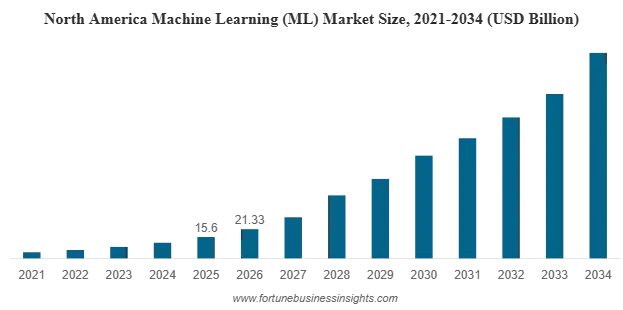
What’s changed is the scale and variety. McKinsey puts AI adoption at 88% of organizations now, yet most haven’t scaled past early experiments (sound familiar?). Part of the reason is that machine learning isn’t a single tool. It’s a set of different types of machine learning models, each suited to a different kind of problem and a different kind of data. And the market reflects that spread: the global machine learning market is projected to grow from around $65 billion in 2026 to over $432 billion by 2034, according to Fortune Business Insights. That growth touches every model category covered in this blog.
By the end, you’ll know exactly how machine learning models work, where each type fits, and how to pick one without guessing.
Why Machine Learning Model Selection Matters for Your Business
Choosing the wrong model type doesn’t just slow a project down. It quietly burns through budget before anyone realizes the approach was wrong for the problem. Say a retailer tries to predict customer churn with a clustering model. They’ll get patterns, not predictions, because clustering groups similar customers rather than forecasting who’s about to leave. That mismatch between problem and model is one of the most common and most expensive errors businesses make with applications of machine learning in business.
Model selection depends on three things: how much labeled data you actually have, what kind of outcome you need (a category, a number, or a pattern), and how much time and budget you can commit to training and tuning. Get these three right and you’re already ahead of most teams. Businesses using this reasoning correctly are already seeing it pay off, too. McKinsey research suggests that companies embedding machine learning deeply into their operations report profit gains of 3 to 15 percent above industry averages, driven by sharper demand forecasting, fraud detection, and personalized recommendations.
Getting model selection right isn’t a technical detail, it’s a business decision that determines whether your investment turns into usable predictions or wasted compute cycles. The next sections break down the main categories so you can match the right model to the right problem from the start.
Supervised Learning Models: Classification and Regression Explained
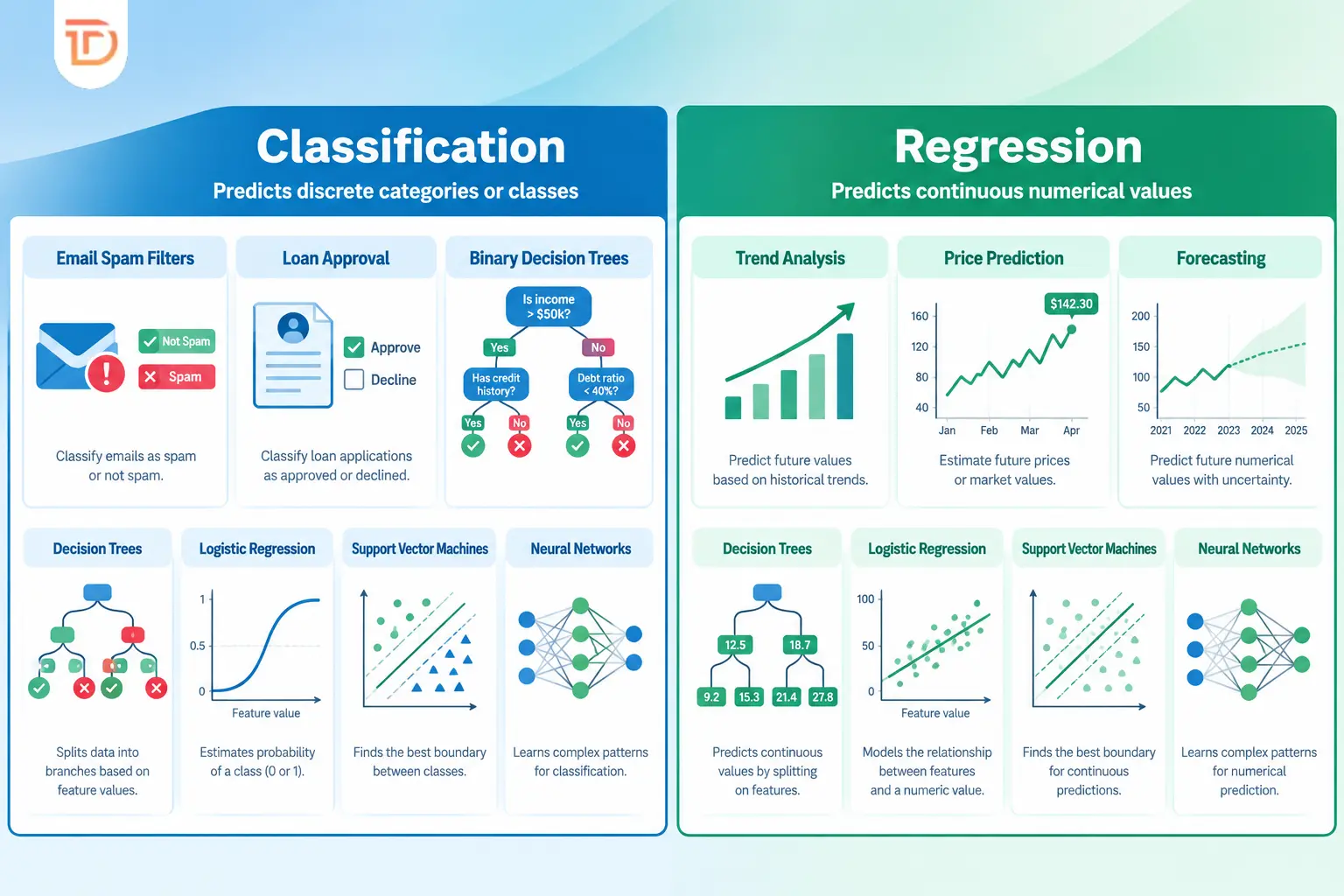
Supervised learning is the starting point for most business applications of machine learning, and for good reason: it learns from examples where the answer is already known. You feed the algorithm labeled data, meaning each input comes with a correct output attached, and it learns to map one to the other. Simple enough, right? Once trained, it predicts outcomes on new, unseen data using the patterns it picked up.
Supervised models split into two broad types. Classification models sort data into categories, such as flagging an email as spam or not spam, or deciding whether a loan applicant is likely to default. Regression models predict a continuous number instead of a category, like forecasting a house’s resale value or next quarter’s sales volume. Common algorithms include decision trees, logistic and linear regression, support vector machines, and neural networks, each with its own trade-off between speed, accuracy, and interpretability.
You’ll see these real-world machine learning examples constantly in fraud detection, credit scoring, and customer churn prediction. In some medical applications, models now detect certain diseases with accuracy that matches or beats human specialists. But here’s the catch: supervised learning needs a lot of accurately labeled data to perform well. Building that dataset is often the most expensive and time-consuming part of the whole project. More than the modeling itself, usually.
Unsupervised Learning Models: Clustering and Dimensionality Reduction
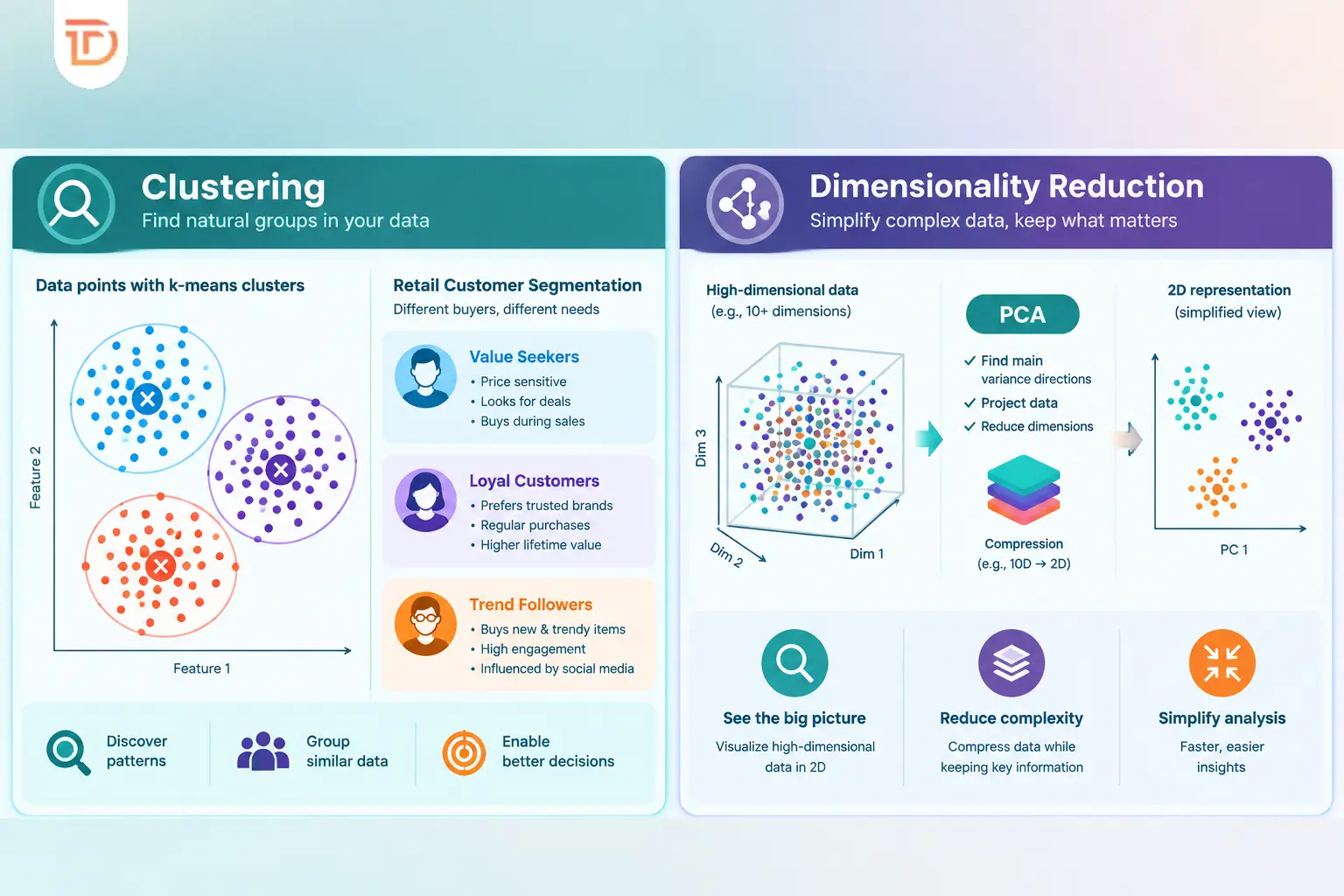
What do you do when you have data but no labels telling you what the “right answer” looks like? That’s the problem unsupervised learning solves. Instead of learning from known outcomes, these models dig through raw, unlabeled data to find structure on their own, grouping similar items together or spotting patterns a human analyst might miss entirely.
Clustering is the most common type. It groups data points that share similar characteristics, with algorithms like k-means and hierarchical clustering doing the heavy lifting. Retailers use it for customer segmentation, grouping shoppers by behavior rather than guessing at demographics.
Then there’s dimensionality reduction, the second major type. It shrinks the number of features in a dataset while keeping the useful information intact, which makes huge datasets easier to visualize and process. Principal component analysis (PCA) is the standard tool here, often used before feeding data into other models to speed up training.
Market basket analysis, data compression, and anomaly spotting in transaction records are other places unsupervised models earn their keep. The biggest advantage is cost: you skip the expensive labeling process entirely. But interpreting the groups a model finds often takes a trained eye, since the algorithm doesn’t explain why it grouped things the way it did. This is exactly the kind of pattern discovery that good data analytics services are built to translate into decisions a business can actually act on.
Semi-Supervised and Reinforcement Learning Models
Not every business problem fits neatly into “fully labeled” or “completely unlabeled” data. Semi-supervised learning sits in between, using a small set of labeled examples alongside a much larger pool of unlabeled data. That makes it a practical choice when labeling everything by hand would be too slow or too expensive. Medical imaging is a common example: a radiologist might label a few hundred scans, and the model generalizes that knowledge across thousands more. Speech recognition systems use a similar approach to cut down on manual transcription work.
Reinforcement learning works on an entirely different principle. Instead of learning from a fixed dataset, an agent learns by taking actions in an environment and receiving rewards or penalties based on the outcome, gradually improving its strategy over time. Game-playing AI, robotics, autonomous vehicles, and recommendation-timing optimization all rely on this trial-and-error approach. Worth separating semi-supervised from self-supervised learning too: semi-supervised still needs some human-labeled data, while self-supervised learning generates its own labels from the structure of the data itself.
Gartner projects that by 2027, more than 80% of smartphone owners will use apps powered by on-device machine learning, much of it built on these more specialized training methods. Building and training these models well usually calls for the kind of depth you’d expect from dedicated AI development services.
Deep Learning and Neural Network Models
Deep learning is what happens when neural networks grow multiple hidden layers deep, giving them the ability to recognize complex patterns that simpler models can’t touch. Each layer picks up a slightly more abstract feature of the data. That’s why these models excel at tasks involving images, speech, and language rather than neat rows of spreadsheet data.
Different architectures handle different jobs. Convolutional neural networks (CNNs) specialize in image processing, which is why they power computer vision in autonomous vehicles. Recurrent neural networks (RNNs) handle sequential data, useful for anything involving order and timing. Transformers, the architecture behind most modern language models, process text and speech at a scale that older designs simply couldn’t manage.
You can see deep learning at work every day. Voice assistants like Siri, Alexa, and Google Assistant use it for speech recognition, while Netflix and Spotify use it to build the recommendation engines behind their “suggested for you” sections. In healthcare, deep learning models now analyze medical images with accuracy that rivals trained doctors.
Deep learning delivers real accuracy gains on messy, unstructured data, but it demands large datasets and serious computing power, so it’s rarely the right starting point for a business testing an early idea. Before committing to it, weigh whether a simpler model could get you 80% of the result for a fraction of the training cost and time.
Ensemble Methods and Hybrid Model Approaches
Any single model has blind spots. Ensemble methods exist specifically to cover them. Instead of betting everything on one algorithm, ensemble approaches combine the predictions of several models to produce a result that’s more accurate and more stable than any one model alone. Random forests combine many decision trees, gradient boosting builds models sequentially where each one fixes the errors of the last, and techniques like bagging and stacking blend different model types entirely.
Hybrid approaches take this further by mixing learning styles altogether, combining supervised, unsupervised, or reinforcement techniques within a single system to tackle problems too complex for one method alone. Fraud detection systems often combine several classifiers running in parallel, credit scoring platforms lean on ensemble techniques to reduce false approvals and false rejections, and recommendation engines frequently blend content-based and collaborative filtering to cover both new users and long-time customers.
The upside is clear: better accuracy, less overfitting, and stronger performance on data the model hasn’t seen before. The trade-off is complexity. Ensembles are harder to interpret, cost more to run, and take longer to build and tune correctly. That’s exactly why high-stakes production systems, fraud detection, credit scoring, autonomous vehicles, and predictive maintenance among them, lean so heavily on ensembles despite the added overhead. Getting this right usually means working with a team that has built production-grade machine learning development services before not one encountering ensemble architecture for the first time on your project.
Choosing the Right Model Type for Your Machine Learning Project
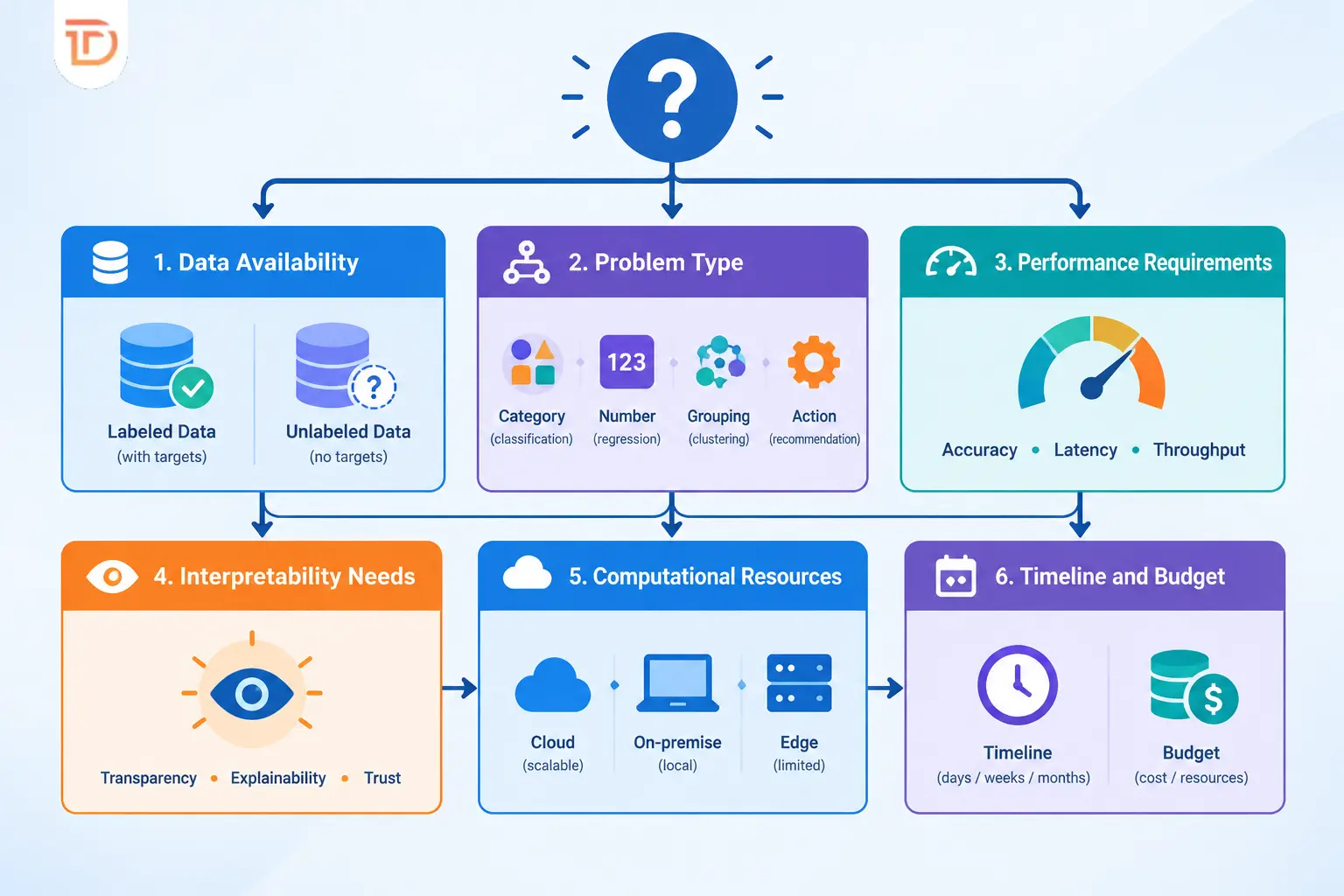
Picking a model type isn’t a guessing game. It’s a structured decision built on a handful of concrete factors. Get this step wrong and everything downstream, from accuracy to compliance, gets harder to fix later.
Work through these factors before committing to a direction:
- Data availability: Do you have labeled data, unlabeled data, or a mix? This alone rules out entire categories of models before you even start.
- Problem type: Are you predicting a category, a number, a grouping, or an optimal action over time? Each maps to a different model family.
- Performance requirements: Decide upfront whether raw accuracy or prediction speed matters more for your use case.
- Interpretability needs: Regulated industries often need explainable models, not black-box ones, especially where decisions affect customers directly.
- Computational resources: On-device models need to stay lightweight, while cloud-based models can afford to be heavier and more complex.
- Timeline and budget: Simpler models ship faster; complex ones need more time, more data, and more tuning before they’re production-ready.
Once you’ve mapped these factors, define the problem clearly, check your data readiness, confirm compliance requirements like GDPR or India’s DPDP Act, and prototype two or three model types before picking one for good. This is where custom software development services and solid machine learning development expertise work together, turning a tested prototype into a system that actually holds up in production.
Performance Metrics and Model Evaluation Considerations
A model that looks good in testing can still fail in production. That’s why evaluation metrics matter as much as the model choice itself. Different model types need different yardsticks. Classification models are judged on accuracy, precision, recall, and F1-score, while regression models rely on MAE, RMSE, and R-squared to measure how far predictions land from actual values. Clustering models use metrics like the silhouette score to check whether groupings actually make sense.
Cross-validation and a proper train-test split protect against a model that memorizes its training data instead of learning to generalize, a problem known as overfitting. Getting the balance right, known as the bias-variance trade-off, is where a lot of projects stumble: too simple, and the model misses real patterns; too complex, and it fits noise instead of signal.
But business-aligned metrics matter just as much as statistical ones. ROI, time-to-prediction, and latency often decide whether a technically accurate model is actually usable in daily operations. And the pace of change keeps raising the stakes here: the global machine learning market is growing at a 36.08% CAGR between 2024 and 2030, expected to reach $503.40 billion according to Statista. That growth brings constant model drift as data shifts. Retraining and ongoing performance tracking aren’t optional. They’re part of running machine learning in data analytics responsibly over the long term.
Why Dreamer Technoland Helps Teams Build and Deploy the Right Machine Learning Models
Picking the correct model type is hard enough on paper. It gets harder once you have to build, train, and maintain it in a live business environment. McKinsey’s own research shows that only a third of organizations using AI have scaled past the pilot stage, which tells you the gap isn’t ambition. It’s execution.
Dreamer Technoland closes that gap by handling the full path from problem definition to production deployment through dedicated machine learning development services, backed by AI development services, automation work through AI automation solutions, and custom software builds that hold up under real traffic. The team runs model selection consultations, validates prototypes against your actual data before committing to a build, and keeps compliance in view from day one. For businesses exploring newer use cases, generative AI development services and ongoing data analytics support round out the offering, so your model keeps performing after launch, not just during the demo.
Contact Dreamer Technoland today for a free model selection consultation.
FAQ Section
Q. What is the difference between supervised and unsupervised learning?
Supervised learning trains on labeled data where the correct answer is known, used for predictions like classification or regression. Unsupervised learning works with unlabeled data, finding hidden patterns or groupings on its own, such as customer segmentation or anomaly detection.
Q. How do I choose between classification and regression models?
A: It depends on the output you need. Use classification when predicting a category, like spam or not spam. Use regression when predicting a continuous number, like price or sales volume. The business question you’re answering determines which one fits.
Q. What are ensemble methods and when should I use them?
Ensemble methods combine multiple models, like random forests or gradient boosting, to improve accuracy and reduce errors. Use them for high-stakes problems like fraud detection or credit scoring, where a single model’s blind spots could cost real money.
Q. Why is deep learning better than traditional machine learning?
Deep learning isn’t always better; it excels at unstructured data like images, speech, and text because of its layered neural networks. Traditional machine learning often performs just as well on structured data with far less computing cost and training time.
Q. How often should I retrain my machine learning model?
It depends on how fast your data changes. High-velocity environments like fraud detection may need monthly retraining, while stable use cases can go longer. Ongoing monitoring tells you when performance drifts enough to justify a retrain.