



Python data analysis is the process of cleaning, exploring, and interpreting raw information using Python’s code libraries, and it sits at the center of nearly every working AI system today. Without this step, machine learning models have nothing reliable to learn from. It’s the quiet work that happens before any algorithm gets credit for being “smart.”
A 2023 Statista survey of software developers found that Python ranked as one of the most used programming languages among data professionals worldwide, with adoption figures well above 50% among those building AI and machine learning systems. That kind of adoption signals a real opportunity: businesses that invest in Python-based data analysis now are building on the same foundation as the industry’s most successful AI products.
This blog breaks down exactly how python data analysis supports AI and machine learning, from the tools involved to the techniques that separate a working model from a failed one. You’ll walk away knowing what to ask your development team before your next AI project starts.
Python Data Analysis for AI and Machine Learning
Python data analysis is not a side task in AI development; it’s the groundwork that decides whether the entire system works. Every machine learning model, no matter how advanced the algorithm behind it, is only as good as the data it learns from. If that data is messy, incomplete, or poorly understood, the model inherits those flaws and repeats them at scale. This is why experienced AI teams spend more time analyzing data than writing model code, and why rushing past this stage is one of the most expensive mistakes a business can make in an AI project.
Think of raw data as unrefined material. A spreadsheet full of customer transactions or sensor readings means nothing to a machine learning model until someone shapes it into a usable form. This is where python for data analysis earns its reputation. Python gives analysts a direct way to inspect data, spot patterns, flag inconsistencies, and reshape information into a structure that algorithms can actually use. That transformation, from scattered raw numbers to organized, meaningful input, is what turns a pile of data into a working AI asset.
Businesses that skip or shortcut this stage usually find out the hard way, when their AI model performs well in testing but fails in the real world. The gap between a demo and a product that actually holds up almost always traces back to how carefully the data was analyzed before training ever began.
Why Python Data Analysis Dominates the AI and ML Landscape
Ask any data science team why they chose Python over other languages, and you’ll hear some version of the same answer: it’s easier to read, faster to build with, and backed by a library for nearly every task imaginable. That combination is rare, and it’s the main reason Python in AI and machine learning has become close to the default choice rather than one option among many.
Python’s syntax reads almost like plain English, which means teams spend less time fighting the language and more time solving the actual data problem in front of them. That matters more than it sounds. A data scientist who isn’t wrestling with complicated code can focus on understanding the business question the data is supposed to answer. On top of that, Python’s open-source community has spent over a decade building and refining libraries specifically for data work and machine learning, which means most problems a team runs into have already been solved by someone else and shared publicly.
This is also why so many companies turn to outside AI development services rather than building Python expertise from scratch internally. The language’s popularity means there’s a deep pool of talent trained on it, documentation is extensive, and the tooling keeps improving because so many people depend on it daily. For a business deciding how to build its first AI product, that kind of ecosystem support reduces risk in ways a newer or more specialized language simply can’t match yet.
Core Python Libraries and Tools for Data Analysis in AI
A business evaluating an AI vendor should know what’s actually running under the hood, because the libraries a team uses say a lot about how disciplined their process is. Python’s strength in AI work doesn’t come from the language alone; it comes from a set of purpose-built Python data analysis tools that handle specific jobs extremely well, and most serious AI projects use several of them together.
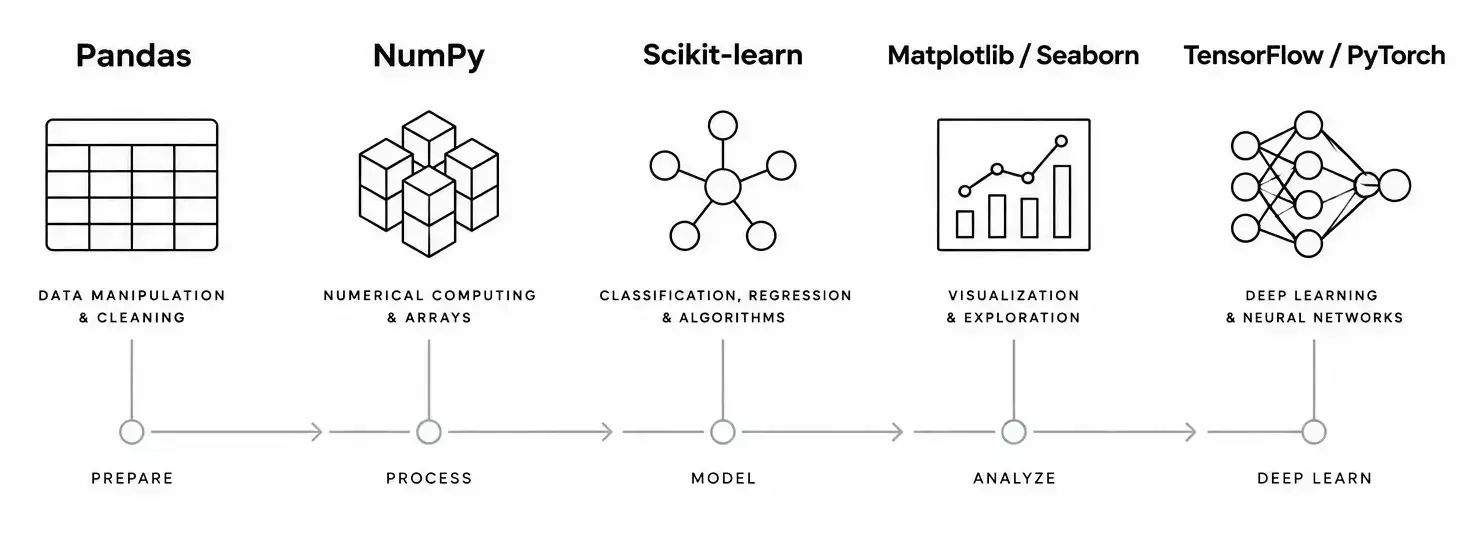
Pandas handles structured data, letting analysts load, filter, group, and reshape information stored in tables, spreadsheets, or databases. NumPy works underneath a lot of this, managing the number-crunching and array operations that make large calculations fast rather than painfully slow. Once the data is clean and organized, Scikit-learn provides ready-to-use algorithms for classification, regression, and clustering, which means teams aren’t building machine learning logic from zero every time. For visual inspection, Matplotlib and Seaborn turn columns of numbers into charts and graphs that make patterns and outliers obvious to the human eye, something raw tables rarely do well.
When projects move into deep learning territory, such as image recognition or natural language tasks, TensorFlow and PyTorch take over, handling the heavier computational work neural networks require. These tools aren’t competing with each other so much as covering different stages of the same pipeline: Pandas and NumPy prepare the data, Scikit-learn and the deep learning frameworks build the models, and Matplotlib or Seaborn help the team verify that what they built actually makes sense before it ships.
A team that only knows one or two of these tools will hit a wall eventually. Real AI projects move between structured data analysis, statistical modeling, and deep learning, often within the same pipeline, and that requires fluency across the full toolset, not just familiarity with one corner of it.
How Python Data Analysis Powers Machine Learning Workflows
Every machine learning project follows a sequence, and skipping steps in that sequence is how projects quietly fail months before anyone notices. The workflow starts with data ingestion, pulling information in from databases, APIs, spreadsheets, or sensors, and this stage alone can expose problems like duplicate records or formatting mismatches that would otherwise corrupt everything downstream.
Once the data is in one place, exploration begins. This is where an analyst looks at distributions, checks for missing values, and asks whether the dataset actually represents the real-world problem the business is trying to solve. Data analysis for machine learning isn’t just about tidying numbers; it’s about catching the kind of bias or gap in the data that, left unnoticed, would teach a model the wrong lesson entirely. A fraud detection model trained mostly on one type of transaction, for example, will struggle badly with transaction types it rarely saw during training.
After exploration comes transformation, where raw values get converted into the format a model actually needs, whether that’s scaling numbers, converting categories into numeric codes, or combining fields into new, more useful variables. Only after all of this does model training begin, and by that point, the quality of the earlier analysis has already set the ceiling on how good the final model can possibly be. Businesses working with machine learning development services should expect their vendor to walk them through each of these stages individually, not jump straight to “we trained a model.” If a vendor can’t explain how they explored and transformed your data, that’s a warning sign worth taking seriously before the project moves any further.
Key Capabilities That Make Python Data Analysis Essential for AI Development
What actually makes data analysis useful for AI isn’t the code itself; it’s the specific capabilities that code unlocks. Python for AI development earns its place because it gives teams a direct way to perform statistical analysis, something every credible machine learning project depends on to confirm that patterns in the data are real and not just coincidence or noise.
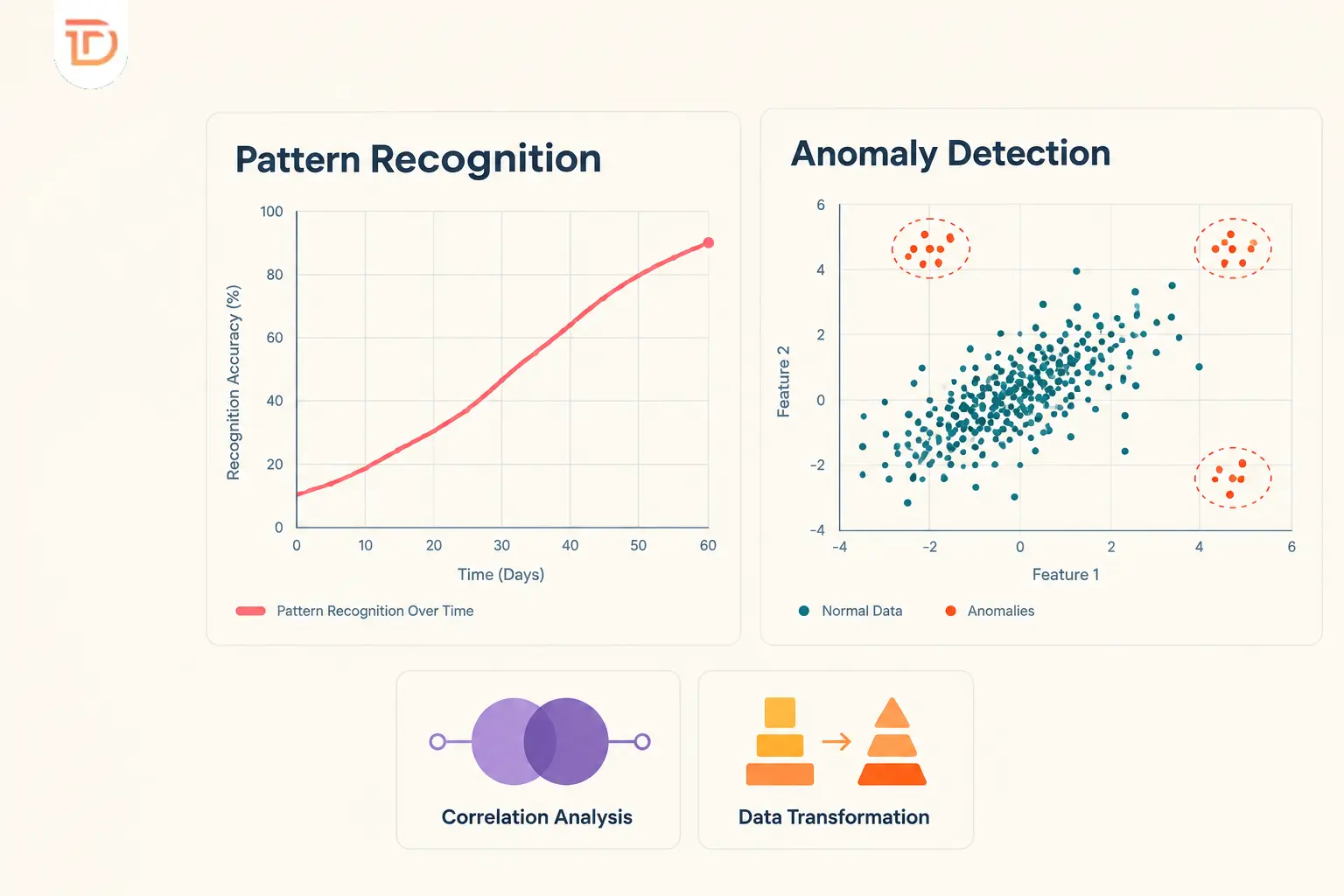
Pattern recognition is another core capability, and it’s what allows a team to notice, for instance, that certain customer behaviors consistently precede a cancellation, long before that pattern becomes obvious through manual review. Closely related is anomaly detection, which flags data points that don’t fit expected patterns at all, a capability that powers everything from fraud alerts to equipment failure warnings in manufacturing settings. Correlation analysis builds on this further, helping teams understand which variables actually move together and which only appear related by chance, a distinction that matters enormously when a business is deciding which factors to feed into a predictive model.
Data transformation capability rounds this out, giving analysts the flexibility to reshape messy, inconsistent information, whether it’s text, numbers, dates, or images, into formats a model can actually process. Trend identification then lets teams track how these patterns shift over time, which matters for anything forecasting-related, from sales projections to demand planning.
The real advantage here isn’t any single capability on its own; it’s that Python lets a team move between statistical checks, pattern detection, and data reshaping without switching tools or languages. That flexibility is what keeps AI projects moving on schedule instead of stalling every time the data throws up a new problem.
Data Preprocessing and Feature Engineering: Critical Steps in Python-Based ML
If there’s one stage that founders underestimate the most, it’s preprocessing. Teams get excited about the model, the algorithm, the eventual output, and treat the unglamorous work of cleaning data as a formality. It isn’t. Data preprocessing in machine learning determines whether a model has a fighting chance at accuracy, and no amount of algorithm tuning later can fix a dataset that went into training poorly prepared.
Preprocessing covers several specific jobs: removing duplicate or corrupted records, handling missing values in a way that doesn’t distort the dataset, and converting categorical information (like “yes/no” or product categories) into a numeric form models can actually read. Scaling matters too, since a model can get confused if one variable ranges from zero to ten and another ranges into the millions; without adjustment, the model may wrongly treat the larger numbers as more important simply because of their size.
Feature engineering goes a step further, creating new variables from existing ones that carry more useful signal than the raw data alone. A timestamp, for example, isn’t very useful to a model on its own, but extracting the day of the week or hour of day from it often reveals patterns a raw date field hides completely. This is detailed, iterative work, and it’s exactly the kind of process a team offering custom AI development should be able to explain clearly, step by step, rather than glossing over as a background technical detail. Businesses that ask pointed questions about preprocessing before signing a contract tend to end up with far more reliable models than those who don’t.
Python Data Analysis Techniques for Model Training and Optimization
Training a model isn’t a one-shot event; it’s a cycle of testing, adjusting, and testing again, and the techniques used during this cycle decide whether the final model is trustworthy or just lucky on one dataset. Python data analytics techniques give teams a structured way to check a model’s work rather than taking its first result at face value.
Cross-validation is one of the most important of these techniques. Instead of training a model on one chunk of data and testing it once, cross-validation splits the data into multiple groups and tests the model repeatedly across different combinations, which gives a far more honest picture of how it will perform on data it hasn’t seen before. Hyperparameter tuning follows a similar logic, systematically testing different settings for a model (how fast it learns, how complex it’s allowed to get) to find the combination that produces the most reliable results rather than just guessing.
Performance metrics analysis is where teams measure specific numbers, accuracy, precision, recall, depending on what the business actually cares about, because a model that’s 95% accurate overall can still fail badly on the 5% of cases that matter most, like rare fraud cases or medical red flags. Regularization assessment helps catch overfitting, which happens when a model memorizes the training data instead of learning the broader pattern, performing great in testing and poorly in the real world. Underfitting, the opposite problem, shows up when a model is too simple to capture what’s actually going on in the data.
A model that looks perfect during development but performs unevenly after launch almost always has an overfitting or data bias problem that proper validation technique would have caught earlier. This is the difference between a model that works in a demo and one that holds up in production.
Real-World Applications: Python Data Analysis Transforming AI Solutions
Abstract explanations only go so far, so it helps to look at where Python machine learning applications are already changing how industries operate day to day. In healthcare, data analysis helps diagnostic tools scan medical images and lab results, flagging patterns that might indicate disease earlier than a routine check might catch it, though human review still confirms the final call. In finance, forecasting models built on carefully analyzed historical data help institutions predict cash flow trends and assess lending risk with far more precision than manual review ever allowed.
Recommendation systems, the kind that suggest products, shows, or songs, rely entirely on analyzing patterns in user behavior data to predict what someone is likely to want next. Fraud detection systems work on a similar principle in reverse, analyzing transaction patterns to flag activity that breaks from a customer’s normal behavior, often within seconds of a transaction happening. In manufacturing, predictive maintenance models analyze sensor data from machinery to flag likely equipment failures before they happen, saving companies from costly unplanned downtime.
Natural language processing, which powers chatbots and customer service automation, depends on analyzing huge volumes of text data to understand intent and sentiment. Computer vision applications, used in everything from quality control on factory lines to security monitoring, rely on analyzing image data at scale to identify objects, defects, or unusual activity. Businesses exploring any of these use cases often pair their AI build with data visualization services so decision-makers can actually see what the data analysis is revealing, rather than relying on raw output alone.
Performance Considerations and Best Practices for Python Data Analysis
A model that works perfectly on a sample dataset can fall apart the moment it’s asked to handle a company’s full production data, and this gap is one of the most common reasons AI projects stall after an otherwise promising pilot. Data analysis in artificial intelligence has to account for scale from the start, not as an afterthought once performance problems show up.
Memory optimization matters more than most teams expect, since loading an entire large dataset into memory at once can crash a system that handled a smaller test sample just fine. Experienced teams work around this using chunked processing, loading and analyzing data in smaller batches instead of all at once, which keeps systems stable even as data volume grows. Choosing the right data structure also makes a measurable difference in speed; using Pandas for structured tabular data and NumPy arrays for numerical computation, rather than forcing everything through generic Python lists, speeds up processing considerably on larger datasets.
Parallel processing is another practice worth asking about, since distributing analysis work across multiple processor cores (or even multiple machines, for very large datasets) can cut processing time dramatically compared to running everything sequentially. Beyond raw speed, validation practices matter just as much: checking outputs at each step, testing on holdout data, and catching errors early rather than letting them flow silently through to the final model.
Businesses should ask any AI vendor directly how they plan to handle data volume growth, not just how the current pilot performs. A solution that only works at small scale isn’t a long-term solution at all; it’s a demo waiting to break.
Choosing the Right Python Data Analysis Approach for Your AI Project
There’s no single correct way to approach data analysis for an AI project, and any vendor who proposes the exact same framework regardless of your business is cutting corners. The right approach depends on a handful of concrete factors that should get discussed before any code gets written.
Project scope is the first consideration: a simple classification task needs a far lighter analysis process than a system meant to drive real-time decisions across thousands of transactions a day. Data volume matters just as much, since a dataset with a few thousand rows can be analyzed thoroughly with standard tools, while datasets running into millions of rows often require different libraries and infrastructure to process efficiently. Timeline constraints also shape the decision; a business that needs results in weeks will lean on established, well-tested libraries rather than custom-built analysis pipelines that take longer to validate.
Team expertise plays a bigger role than most founders realize too. A team deeply experienced in one set of tools will naturally produce better, faster results sticking with what they know well rather than switching to unfamiliar tools mid-project just because they’re trendier. Infrastructure constraints, like whether the business has cloud computing resources available or needs everything running on local servers, further narrow down what’s practical. And model complexity itself is a factor: simple statistical models need far less preprocessing rigor than deep learning systems built for AI-powered business solutions handling images, speech, or unstructured text at scale.
The honest answer for most businesses is that a custom approach, built around their actual data and goals, consistently outperforms a one-size-fits-all template, even if it takes a bit longer upfront to get right.
How Dreamer Technoland Leverages Python Data Analysis for Next-Generation AI Solutions
Deciding who to trust with your AI project is genuinely hard, especially when most vendors describe their process in the same vague, confident language regardless of how deep their actual expertise goes. It’s a reasonable thing to be cautious about, given how much a poorly analyzed dataset can cost a business down the line.
What sets Dreamer Technoland apart in this space is a process built around rigorous data work from day one, not just model deployment at the end. The team treats data preprocessing, exploration, and validation as the foundation of every AI engagement, because that’s genuinely where most project outcomes get decided. This isn’t a generic development shop bolting AI onto existing services; it’s a team that has worked through the specific, messy realities of cleaning inconsistent datasets, engineering features that actually improve model accuracy, and validating results before anything goes live for a client.
That approach extends across the full range of custom software development services Dreamer Technoland offers, meaning AI and machine learning work doesn’t happen in isolation from the rest of a client’s technical environment. Every project starts with an honest look at what the data can actually support, not an overpromise about what’s technically possible.
Contact Dreamer Technoland today for a free data strategy session.
FAQ Section
Q: What is Python data analysis and why is it important for machine learning?
A: It’s the process of cleaning, exploring, and structuring data using Python before feeding it into a model. It matters because machine learning accuracy depends entirely on the quality of the data behind it; poor analysis leads directly to unreliable predictions.
Q. Which Python libraries are best for data analysis in AI projects?
Pandas and NumPy handle data cleaning and numerical work, Scikit-learn covers standard machine learning algorithms, and Matplotlib or Seaborn support visualization. For deep learning tasks, TensorFlow and PyTorch are the standard choices most teams rely on.
Q. How does data preprocessing improve AI model performance?
Preprocessing removes errors, fills or flags missing values, and converts data into formats models can read correctly. Without it, models learn from flawed or inconsistent information, which leads directly to inaccurate predictions once deployed in real conditions.
Q. Can Python data analysis handle big data at scale?
Yes, with the right approach. Techniques like chunked processing, parallel computing, and choosing efficient data structures let Python handle large datasets without crashing systems or slowing performance down to unusable levels.
Q. What skills do I need for Python data analysis in AI development?
Core Python programming, familiarity with libraries like Pandas and NumPy, basic statistics, and an understanding of machine learning fundamentals. Experience with data visualization and cleaning messy real-world datasets matters just as much as coding ability.