

Agentic AI in software development means AI that doesn’t just respond to prompts, it plans tasks, writes code, tests it, and corrects its own mistakes without someone approving every step. That’s different from the chatbots and autocomplete tools most engineering teams have used over the past few years.
Gartner predicts that by 2028, roughly a third of enterprise software applications will include agentic AI capabilities, a sharp jump from near zero in 2024. That shift signals a real opportunity: teams that start building agentic workflows now will outpace competitors still relying on manual, step-by-step AI assistance.
By the end of this guide, you’ll know exactly what separates agentic AI from older AI tools, where it fits inside your development process, and what to watch for before handing real tasks to it.
What Is Agentic AI in Software Development
Most people hear “AI coding tool” and picture something that finishes a sentence of code or answers a question in a chat window. Agentic AI in software development is a different animal entirely. It’s built around autonomous agents that can perceive a task, decide what needs to happen next, take action on their own, and check whether that action actually worked, all with very little nudging from a human developer.
The difference comes down to behavior over time. A static AI tool waits for your next prompt every single time. An agentic system keeps going. It holds context across multiple steps, adjusts its plan when something doesn’t work, and learns from the outcome of its own actions instead of starting from zero each time. This is what makes AI-powered software development feel less like using a tool and more like delegating a task to a junior engineer who doesn’t need hand-holding.
In practice, this shows up across the full build cycle, from reading requirements and sketching architecture, to writing code, running predictive tests, handling deployment, and feeding results back into the next round of work. Each stage benefits from an agent that remembers what came before it.
Why Agentic AI Is Reshaping Development Workflows Today
Speed used to come at the cost of accuracy. Teams either moved fast and accepted bugs, or slowed down to catch them. Agentic AI breaks that trade-off by handling the repetitive checking work that used to force a choice between the two, which is why adoption inside engineering teams is moving faster than in most other business functions.
Industry surveys consistently show software engineering sitting at the top of agentic AI adoption, with roughly a quarter of engineering teams reporting they’re actively scaling agent use, ahead of IT operations at around 22 percent and service operations near 21 percent. Software engineering also ranks among the top functions reporting real cost savings from the shift, not just time saved.
What changes day to day is the number of manual handoffs. A developer no longer writes code, waits for a reviewer, waits for a tester, and waits for a deployment slot. Agents handle the in-between steps, flag what needs human judgment, and move the rest forward on their own.
The real productivity gain isn’t that AI writes code faster. It’s that developers stop spending half their day on handoffs and status checks, and spend that time on the decisions only a human can actually make.
Core Capabilities and Autonomy Levels in Agentic AI Systems
Not every “agentic” tool on the market actually behaves like an agent. The real capability test comes down to five things: can it plan across multiple steps, reason through a problem it hasn’t seen before, call on outside tools when needed, catch its own errors, and adjust based on feedback without being told exactly how.
This is also the clearest way to understand the agentic AI vs generative AI debate that keeps coming up in client conversations. Generative AI produces an output, a block of code, a summary, an image, and stops there. It has no memory of whether that output worked and no mechanism to fix it if it didn’t. Agentic AI closes that loop. It generates, checks, and revises, often without anyone reviewing the first draft.
Autonomy in these systems isn’t one fixed thing, it exists on a scale:
- Supervised execution: The agent proposes actions, but a human approves each one before it runs.
- Bounded autonomy: The agent executes low-risk tasks on its own and escalates anything outside a defined scope.
- Full autonomy: The agent plans, executes, tests, and redeploys with human review only at major checkpoints.
Most teams adopting this today sit somewhere between supervised and bounded autonomy, which is the practical, lower-risk starting point before trusting agents with production-level decisions.
How Agentic AI Agents Execute Development Tasks
An agent doesn’t just get a prompt and spit out an answer. It goes through something closer to a mini project cycle every time it’s handed a task, which is part of what makes it behave so differently from a simple AI assistant.
First, the agent receives the task and reads the surrounding context, existing code, documentation, open tickets, whatever is relevant. Next comes environment analysis, where it checks what tools, APIs, and systems it has access to before deciding how to approach the work. From there it builds a plan, breaking the task into smaller steps rather than attempting it in one move.
Execution follows the plan, but it’s not blind execution. The agent monitors the result of each action as it happens, checking test outputs, error logs, or system responses in real time. If something doesn’t match expectations, it doesn’t just report failure, it adjusts its approach and tries a revised path before escalating to a human.
This loop of plan, act, monitor, and refine is what lets agents integrate into existing development infrastructure, version control, CI/CD pipelines, ticketing systems, without needing a completely separate workflow built just for them.
Key Differences Between Agentic AI and Traditional AI Tools
The gap between agentic AI and the AI tools most teams already use isn’t about intelligence, it’s about independence. Traditional AI tools are built to respond. You ask, it answers, and the conversation ends there until you prompt it again. Agentic AI is built to act, which means it carries a task from start to finish instead of handing control back after a single output.
This difference shows up clearly once you compare how each type actually behaves on the job.
| Dimension | Traditional AI Tools | Agentic AI Systems |
|---|---|---|
| Autonomy | Needs a prompt for every action | Plans and executes multiple steps on its own |
| Adaptability | Fixed response based on training data | Adjusts approach based on real-time results |
| Execution model | Single-task, one output per request | Multi-step workflow across a full task |
| Error recovery | Flags the error, waits for correction | Detects, diagnoses, and retries automatically |
The practical implication is simple: traditional tools reduce typing time, agentic systems reduce project time. If your team is still treating AI as a faster way to generate code snippets, you’re getting a fraction of the value a properly deployed agentic system can deliver across an entire sprint.
Challenges and Limitations in Agentic AI Implementation
Nobody talks about this part enough: agentic AI fails just as often from people and process problems as it does from technical ones. Going in without a clear eye on these issues is how pilot projects quietly stall out after the first few weeks.
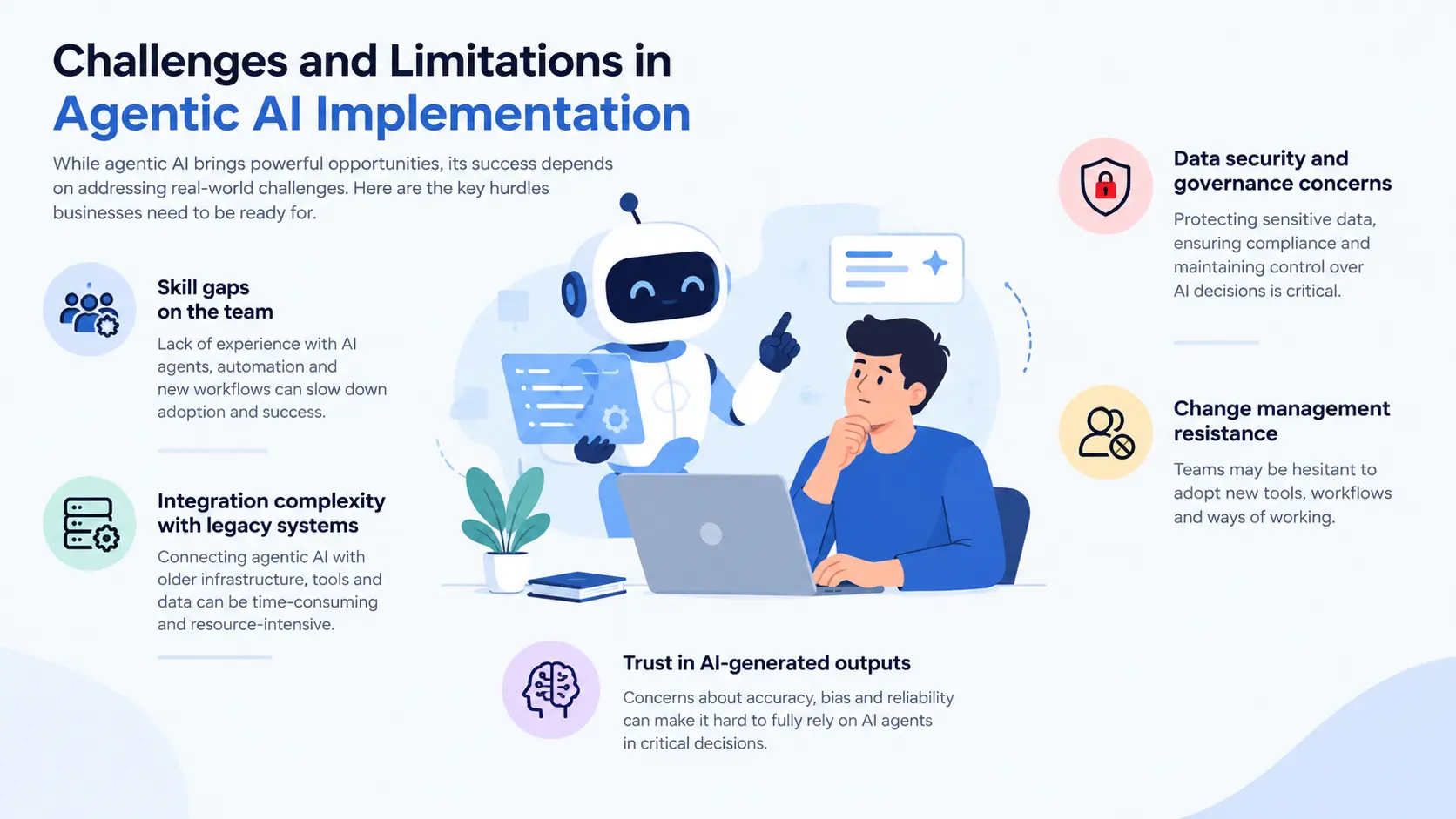
- Skill gaps on the team: Most developers know how to prompt an AI tool, far fewer know how to design, supervise, or debug an autonomous agent that’s making its own decisions mid-task. Training takes real time, not a one-hour workshop.
- Integration complexity with legacy systems: Agents need access to your codebase, your APIs, and your deployment pipeline to actually act. Older infrastructure wasn’t built with that kind of access in mind, and retrofitting it is rarely a quick job.
- Data security and governance concerns: An agent with the ability to act also has the ability to touch sensitive systems or data without a human reviewing every move. That requires permission structures most teams haven’t built yet.
- Change management resistance: Developers who’ve built their whole workflow around reviewing every line of AI-generated code often push back when asked to trust an agent’s judgment on anything higher-stakes.
- Trust in AI-generated outputs: Even when the output is correct, teams hesitate to ship code they didn’t write or fully review line by line, which slows adoption even after the technical pieces work.
None of these problems are reasons to avoid agentic AI. They’re reasons to roll it out in stages, with clear boundaries, instead of handing over full autonomy on day one.
Real-World Applications of Agentic AI in Software Development
This is where the theory stops and the actual payoff starts. Teams aren’t adopting agentic AI in software development because it’s interesting, they’re adopting it because it’s fixing specific, expensive, repetitive problems that used to eat up engineering hours.
Automated bug detection and fixing is one of the clearest wins. An agent can scan a codebase, flag the root cause of a failure instead of just the symptom, and ship a fix for review, cutting the back-and-forth that usually happens between a bug report and a resolved ticket. Intelligent code reviews work the same way, catching style issues, security gaps, and logic errors before a human reviewer even opens the pull request.
Test case generation is where the numbers get hard to ignore. One documented case of AI agent-based testing showed coverage improving from 73 percent to 87 percent on the same codebase, simply because the agent could generate and run edge-case scenarios a human tester wouldn’t have time to write manually.
Beyond testing, agents are handling requirement analysis by turning vague stakeholder notes into structured specs, managing API integration work that used to require manual configuration, and optimizing deployment schedules based on system load rather than a fixed release calendar. Each of these tasks used to need a dedicated person watching it closely. Now it runs with an agent checking its own work.
How Dreamer Technoland Approaches Agentic AI Integration
Bringing agentic AI into a team that’s used to manual review at every step is a bigger change than most vendors admit. It’s not a plug-in, it’s a shift in how work actually gets approved and shipped, and getting that wrong costs more than it saves.
We’ve spent years building software for teams who needed systems that actually held up under real production load, not just demo conditions, and that same discipline carries into how we build agentic systems: staged autonomy, clear checkpoints, and infrastructure that doesn’t break the moment an agent touches it. Our Custom Software Development, AI Development Services work now routinely includes agentic components, from automated testing agents to deployment monitors that adjust on their own.
If you’re weighing whether agentic AI development services are worth the investment for your team, the honest answer depends on your current workflow, not a generic pitch. Contact Dreamer Technoland today for a free consultation session.
Agentic AI in Software Development FAQ
Q. What is the difference between agentic AI and generative AI?
Generative AI produces a single output, like code or text, and stops. Agentic AI takes that output further: it plans, executes multi-step tasks, checks its own results, and adjusts without waiting for a new prompt each time.
Q. How much does agentic AI implementation cost?
Costs vary widely based on how much of your workflow you’re automating, from a few thousand dollars for a narrow pilot to a much larger investment for full-scale agentic deployment across your development pipeline and existing infrastructure.
Q. Can agentic AI replace developers?
No. Agentic AI handles repetitive, well-defined tasks like testing and bug fixes, but it still needs human judgment for architecture decisions, business context, and reviewing higher-stakes code before release. It changes the job, it doesn’t remove it.
Q. How long does it take to implement agentic AI in existing workflows?
A narrow pilot, like automated testing on one project, can be running within a few weeks. Full integration across your development pipeline, with proper governance and staged autonomy, typically takes a few months depending on your existing infrastructure.
Q. What industries are adopting agentic AI fastest?
Software engineering and IT teams currently lead adoption, followed closely by service operations. These functions have the most repetitive, rule-based tasks, which makes them the easiest place to start handing work to autonomous agents.