


AI-powered ecommerce solutions are changing how B2B companies handle orders, pricing, and customer service, moving far beyond the simple product catalogs that once defined online B2B trade. For buyers and sellers used to manual quote requests and spreadsheet-based inventory tracking, this shift changes daily operations, not just the technology stack.
According to BigCommerce research, over half of US consumers have already used tools like ChatGPT or Gemini to browse and buy online, and 95% of ecommerce brands using AI technology report a strong return on investment. For B2B sellers, that signals a narrow window to build buyer trust in AI-assisted purchasing before competitors capture that demand.
This blog walks through the specific technologies behind this shift and the business outcomes they produce, so you can judge where AI-powered ecommerce solutions fit into your own operation.
How AI-Powered Ecommerce Solutions Are Reshaping B2B Commerce
AI-powered ecommerce solutions have moved past the pilot stage in B2B commerce and are now built directly into order systems, pricing engines, and customer support tools used daily by sales and procurement teams. What used to require a phone call, a PDF quote, and a week of back-and-forth now happens through systems that read buyer intent, apply pricing logic, and route approvals automatically. The shift touches nearly every part of the buying journey, from the first product search to the final invoice.
Also Read>>How much do developers charge for an eCommerce website?
This isn’t a feature update bolted onto existing platforms. It’s a structural change in how B2B sellers compete, because buyers now expect the same speed and personalization they get from consumer platforms like Amazon Business, applied to complex, multi-stakeholder purchases. Companies that treat AI as an occasional tool rather than a core capability are already losing ground on response time and order accuracy. The rest of this blog breaks down the specific technologies driving this change, how they reshape B2B workflows end to end, and what the real costs and payoffs look like once you move past the pilot stage.
The Growing Demand for AI-Powered Ecommerce Solutions in B2B Markets
B2B buyers don’t shop like consumers, and that’s exactly why generic ecommerce platforms keep falling short. A single purchase order might involve negotiated contract pricing, multi-level approval chains, bulk quantity breaks, and a dozen SKUs ordered on a recurring schedule. Sellers who still handle this manually watch deals slip to competitors who can generate an accurate quote in minutes instead of days.
This is the gap AI-powered ecommerce solutions are built to close. Buyers now expect the system to recognize their company profile, apply their negotiated rates automatically, and flag reorder points before stock runs low, which is only possible when predictive analytics in ecommerce is working in the background to anticipate demand patterns. Sellers who adopt this early aren’t just speeding up transactions; they’re removing the friction that used to push buyers toward a competitor’s sales rep. The demand isn’t coming from a desire to look modern. It’s coming from buyers who’ve already experienced faster service elsewhere and won’t tolerate a slower one at work.
Core AI Technologies Driving Modern B2B Ecommerce Platforms
Every AI feature a B2B buyer notices, like an instant quote or a smart reorder suggestion, is powered by one of a handful of underlying technologies working together behind the scenes. Understanding what each one actually does helps you ask the right questions when evaluating a platform or a vendor.
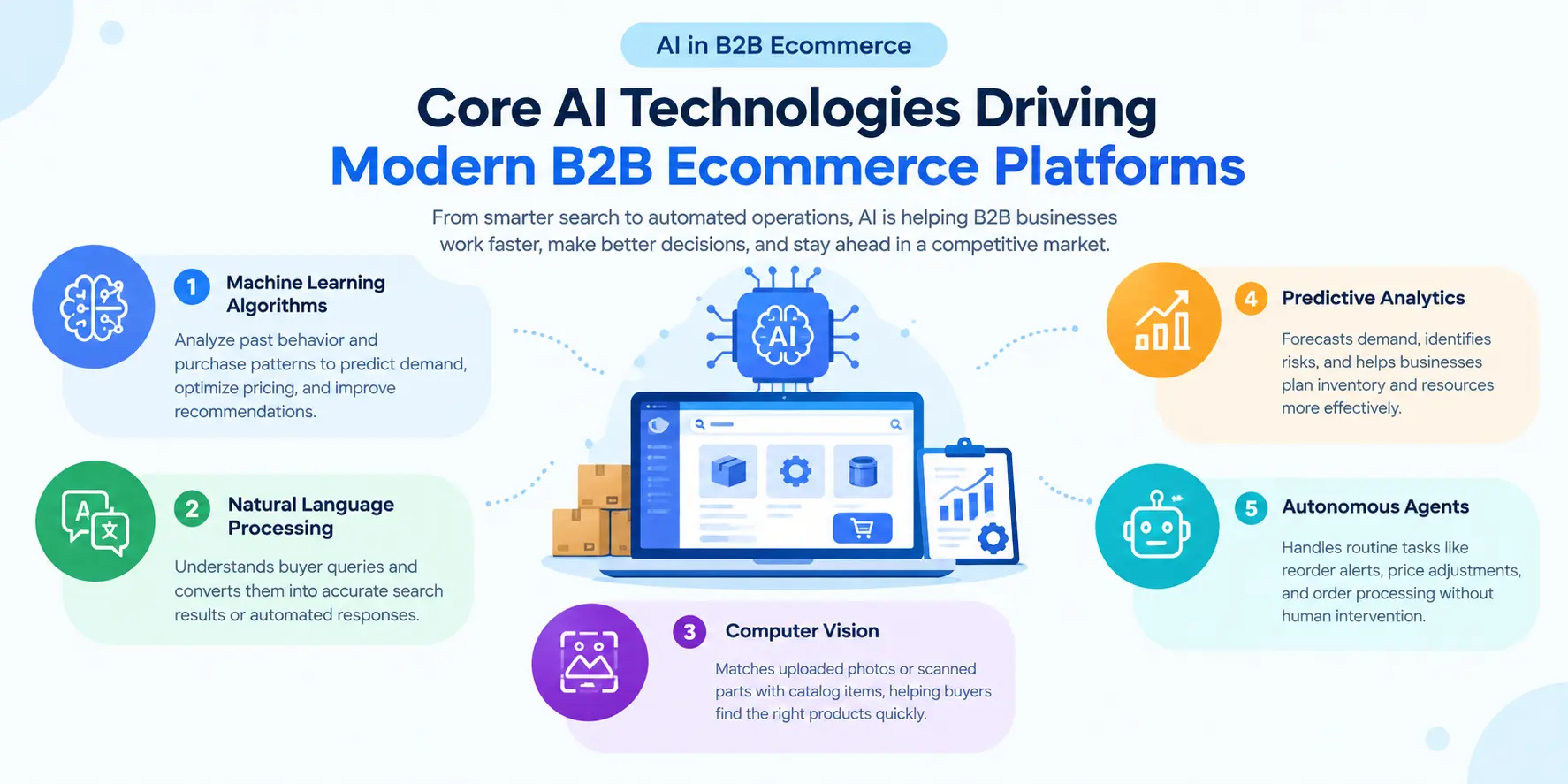
- Machine learning algorithms: These scan years of order history, seasonal trends, and customer behavior to spot patterns a human team would take months to notice, feeding into automated inventory forecasting so stock levels adjust before a shortage hits:
- Natural language processing: This lets buyers type a plain-language question, like whether a part comes in a larger size, and get an accurate answer instead of a generic search result or a dead-end message.
- Computer vision: Image recognition tools match uploaded photos or scanned parts against a catalog, which matters for industrial buyers who often know what a part looks like before they know its SKU.
- Predictive analytics: These models forecast demand spikes, pricing shifts, and even which accounts are at risk of churning, giving sales teams a reason to reach out before a buyer goes quiet.
- Autonomous decision-making agents: Industry projections suggest one in three enterprise software platforms will carry agentic AI capability by 2028, meaning systems that approve routine reorders or adjust pricing within set limits without waiting on a human.
Personalization and Recommendation Engines in AI-Powered Ecommerce
Personalization in B2B looks nothing like a “customers also bought” banner on a retail site. A recommendation engine here has to account for a buyer’s contract terms, their industry category, their past order cadence, and sometimes the specific plant location placing the order, not just browsing history.
Done right, this is where automated B2B order management earns its value. The system can surface a reorder suggestion for a part a buyer ordered 90 days ago, apply the correct contract price without a manual lookup, and flag a cheaper substitute when stock runs low elsewhere. Businesses using AI-driven personalized communications report retention gains of up to 30%, and ecommerce brands running AI tools broadly see over 25% improvement across customer satisfaction, revenue, or cost metrics. For B2B sellers, that translates directly into larger average order values, because a buyer shown the right accessory or bulk discount at checkout is far more likely to add it than one who has to go searching for it.
Automation and Efficiency Gains from AI-Powered Ecommerce Solutions
Every manual step in a B2B order, data entry, invoice matching, payment reconciliation, adds time and a chance for error, and most sales teams don’t realize how much of their week disappears into this kind of work until they measure it. Ecommerce workflow automation takes over the repetitive parts: generating invoices the moment an order is confirmed, matching payments against purchase orders automatically, and routing exceptions to a human only when something actually needs a decision.
The numbers back this up. Sales teams using AI tools report cutting order cycle times by up to 25% and operational costs by as much as 60%, largely because the system handles routine approvals, stock checks, and fulfillment coordination without waiting for someone to open an email. This is also where generic platforms start to show their limits, because off-the-shelf automation rarely accounts for the approval hierarchies or custom pricing rules a B2B seller runs on. Custom B2B ecommerce solutions, AI Chatbots in E-commerce are built to automate around those specific rules instead of forcing a business to simplify its own processes to fit the software.
Integration Challenges and Implementation Considerations
Buying an AI tool is the easy part. Getting it to work inside a B2B operation that’s been running on a decade-old order system, with pricing logic buried in someone’s spreadsheet, is where most projects actually stall. Legacy systems weren’t built to share data the way modern AI tools expect, and connecting them often means custom API work that vendors underestimate in their initial quotes.
Data quality causes just as many delays as the technology itself. An AI model trained on incomplete customer records or inconsistent product data will make bad recommendations with full confidence, which is worse than making no recommendation at all. And none of this works without people on board: sales reps who’ve handled pricing manually for years need training and, frankly, convincing, before they’ll trust a system to quote on their behalf. Treat the rollout as a process change project with a technology component, not the other way around, and the timeline gets more realistic from day one.
Data Security and Compliance in AI-Powered Ecommerce Environments
B2B platforms hold data that’s far more sensitive than a typical retail cart: contract pricing, procurement volumes, and account details that competitors would love to see. Layering AI on top of that data doesn’t just add convenience, it adds a new set of questions about who can access what, and why.
Compliance obligations don’t disappear because a process is automated; if anything, they get more specific. Any platform handling customer data needs to meet GDPR and CCPA requirements for how that data is stored and shared, and payment processing still needs to meet PCI DSS standards regardless of how the order got placed. Because most B2B platforms pull data through ERP and CRM integration, security has to extend across every connected system, not just the ecommerce front end, since a weak link in one system exposes the whole chain. AI models also need their own layer of scrutiny: regular checks for biased pricing recommendations, clear logs showing why a decision was made, and role-based access so sensitive account data isn’t visible to every team member. None of this is optional once sensitive B2B data is involved, and vendors who can’t explain their security approach in plain terms are a signal to look elsewhere.
ROI Metrics and Performance Tracking for AI Ecommerce Systems
Executives greenlight AI projects based on promised efficiency, but the ones who keep funding beyond year one are the ones who can point to actual numbers. Without a defined set of metrics, it’s impossible to tell whether an AI-powered ecommerce solutions investment is earning its cost or just adding complexity to the stack.
| Metric | What It Measures | Typical B2B Target |
|---|---|---|
| Order cycle time reduction | Time from order placement to fulfillment confirmation | 15-25% faster than baseline |
| Cost per transaction | Total operational cost divided by processed orders | 20-40% reduction post-automation |
| Customer lifetime value | Total revenue expected from an account over the relationship | Steady upward trend quarter over quarter |
| Conversion rate improvement | Share of quote requests that convert to paid orders | 10-15% lift from personalization |
| Inventory turnover | How often stock is sold and replaced over a period | Higher turnover with fewer stockouts |
| Order accuracy rate | Percentage of orders fulfilled without errors or returns | 98% or higher |
These numbers only matter if someone’s actually reviewing them on a set schedule. A monthly look at cycle time and accuracy rate tells you whether the automation is holding up as order volume grows, while a quarterly review of lifetime value and conversion rate shows whether personalization is actually changing buyer behavior. Treat the first two quarters after launch as a tuning period, not a verdict, because AI models need real order data to calibrate properly. Businesses that skip this step often abandon a system that was starting to work, simply because they didn’t measure it long enough to see the curve turn upward.
Why Dreamer Technoland Leads in AI-Powered B2B Ecommerce Innovation
Choosing the right partner for AI-powered ecommerce solutions is harder than picking a typical software vendor, because you need a team that understands both the technical side of AI and the operational reality of B2B selling, like approval chains and contract pricing. Get either piece wrong and the system either doesn’t work or doesn’t get used.
Related Article: How to Choose the Best Mobile App Development Company?
Dreamer Technoland works at that intersection daily, building B2B platforms that handle the pricing complexity and multi-stakeholder approvals real distributors and manufacturers deal with, not simplified demo versions built for a sales pitch. Our team has hands-on experience setting up ERP and CRM integration, automated order workflows, and secure data handling inside platforms built for ongoing B2B relationships rather than one-off purchases. We build the AI layer around your existing processes instead of asking you to rebuild your business around the software, which is usually where other implementations run into trouble.
AI-powered Ecommerce FAQ Section
Q. How quickly can AI improve our B2B order processing?
Most B2B sellers see measurable improvement within 60 to 90 days of launch, particularly in quote turnaround and order accuracy. Full ROI, including cycle time and cost reductions, typically becomes clear after two full quarters of real order data.
Q. Do we need to replace our ERP system to use AI ecommerce?
No. Most AI-powered ecommerce solutions connect to your existing ERP and CRM through integration rather than replacing them. The goal is to add intelligence on top of systems you already run, not force a costly platform migration.
Q. What level of data quality is required for AI recommendations?
Your product, pricing, and customer records need to be accurate and consistently formatted before AI can generate reliable recommendations. Inconsistent or incomplete data leads to confident but wrong suggestions, so a data cleanup phase before launch is worth the time.
Q. How do we measure ROI from an AI ecommerce implementation?
Track order cycle time, cost per transaction, conversion rate, and order accuracy rate from day one. Review these monthly for the first two quarters, since that’s typically how long it takes AI models to calibrate against real order patterns.
Q. Is AI-powered personalization suitable for B2B?
Yes. B2B personalization works differently than retail, factoring in contract pricing, reorder cycles, and company profiles instead of browsing history. Done well, it increases average order value and retention without changing how your sales team manages client relationships.