



Robotic automation in manufacturing means using programmable machines, sensors, and software to handle tasks that once needed human hands, from welding car frames to packing electronics. It’s no longer just about replacing manual labor. It’s about building factories that run faster, catch errors before they become expensive, and adjust to demand changes without stopping the whole line. Plants ranging from automotive giants to small contract manufacturers are rethinking how their production floors operate.
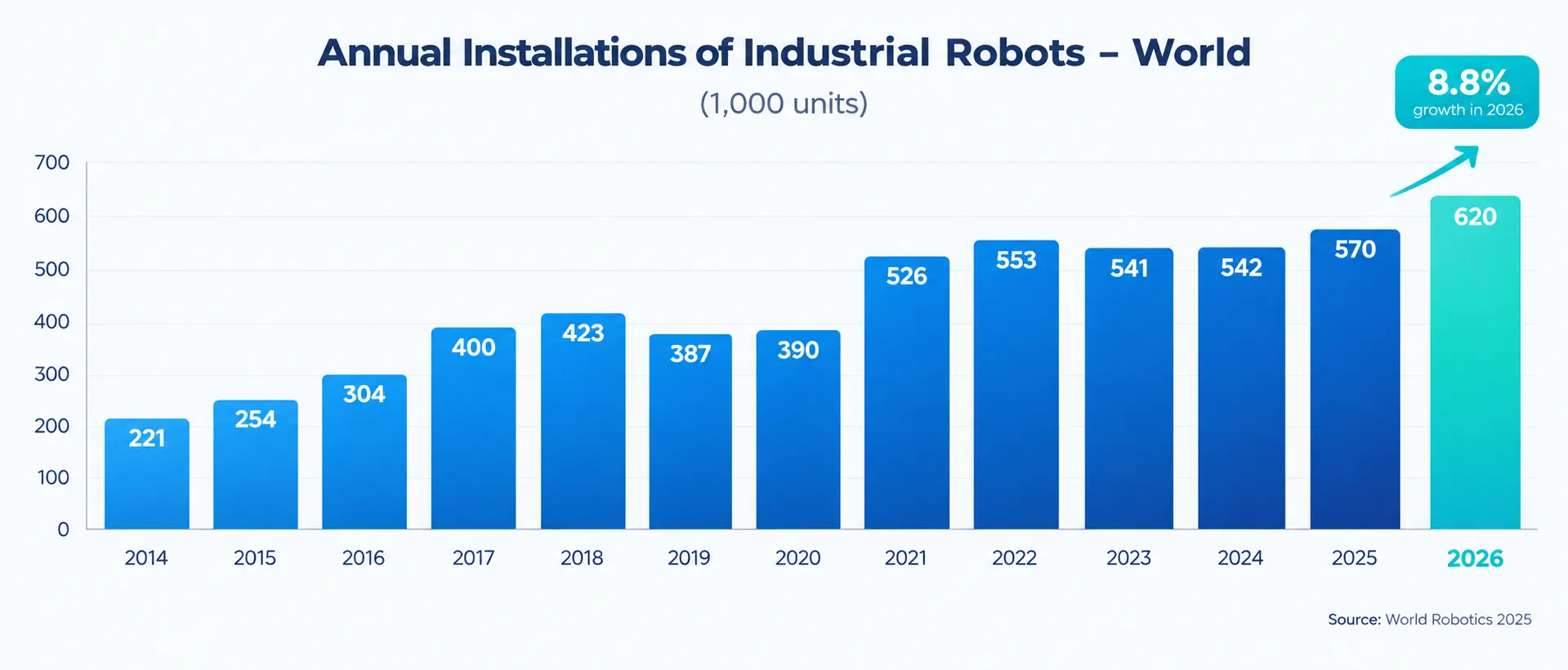
According to the International Federation of Robotics, annual installations of industrial robots worldwide have crossed 500,000 units, with Asia, Europe, and North America all posting record numbers in recent years. That kind of volume signals an opportunity manufacturers can’t afford to ignore. The factories adopting robotic automation in manufacturing now are setting the cost and speed benchmarks their competitors will be forced to match later.
The Rise of Robotic Automation in Manufacturing: Transforming Production
Robotic automation in manufacturing started small: single-purpose arms welding car panels or stacking boxes on a fixed loop, doing one job the same way thousands of times a day. That first wave, which took hold through the 1980s and 90s, was about speed and consistency, not intelligence. The machines couldn’t adapt. If a part shifted position by a few millimeters, the line stopped and a technician had to fix it by hand.
What’s changed is the move from fixed-function robots to systems that sense, learn, and adjust mid-task. Modern production floors use robots that read visual data, detect defects in real time, and reroute workflows without waiting for someone to notice something’s wrong. That’s a different kind of automation entirely, one built on software intelligence rather than mechanical repetition alone.
The effect on production is easy to measure. Factories report faster changeover times between product runs, fewer quality rejects, and output that holds steady even during staff shortages. But the bigger shift is cultural: plant managers now treat the factory floor as a system to improve continuously, not a line to simply maintain. That mental shift, more than any single robot, is what separates older manufacturing from where it’s headed next.
Why AI-Powered Automation Matters in Modern Factories
AI matters in manufacturing because machines that only follow fixed instructions can’t catch problems they weren’t programmed to expect. Add AI, and a robotic arm doesn’t just weld. It also notices when a weld looks slightly off and flags it before the part moves further down the line. That difference shows up directly in uptime, defect rates, and how much human oversight a plant actually needs.
Predictive maintenance is where this pays off fastest. Instead of replacing parts on a fixed schedule, AI models read vibration, temperature, and sound data from machinery to flag failures days before they happen, cutting unplanned downtime noticeably. Quality control benefits too: vision systems trained on thousands of defect images catch flaws human inspectors miss, especially on fast-moving lines.
The applications of robotics in different industries make this easy to see in practice. Automotive plants use AI-guided robots for precision assembly, electronics manufacturers rely on them for micro-soldering, and pharmaceutical companies use them for sterile, error-free packaging. Each sector adapts the same core technology to its own tolerance for error. But the underlying advantage, fewer surprises on the floor, stays consistent across all of them.
Core Technologies Driving Smart Manufacturing Today
Smart manufacturing doesn’t run on hardware alone. It runs on a stack of technologies that have to work together without gaps. IoT sensors sit at the base layer, collecting data from machines, conveyor belts, and even the parts themselves as they move through production. That raw data is useless on its own, which is why it gets fed into machine learning algorithms that spot patterns no human would catch by watching a line in real time.
Cloud computing handles the heavy analysis, running models that forecast demand or detect quality drift across multiple factories at once. Edge computing handles the urgent decisions (the ones that can’t wait for a round trip to a data center), like a robot arm needing to stop mid-motion to avoid a collision. Together, these layers create a factory that reacts in milliseconds instead of waiting for a shift supervisor to notice something’s gone wrong.
None of this works without a solid robotics software development process behind it. Robots on the floor today run on code that gets tested, retrained, and updated continuously, not written once and left alone. And this is also where AI in robotics, machine learning in robotics earns its place: machine learning models inside the robot’s control system are what let it adjust grip pressure, recalculate a path, or flag a defect without a programmer rewriting its instructions every time conditions change.
How Robotic Systems Integrate with AI in Production Lines
Getting a robot and an AI model to work together on the same floor sounds simple until you actually try it. The real complexity sits in how data moves between the two systems, step by step.
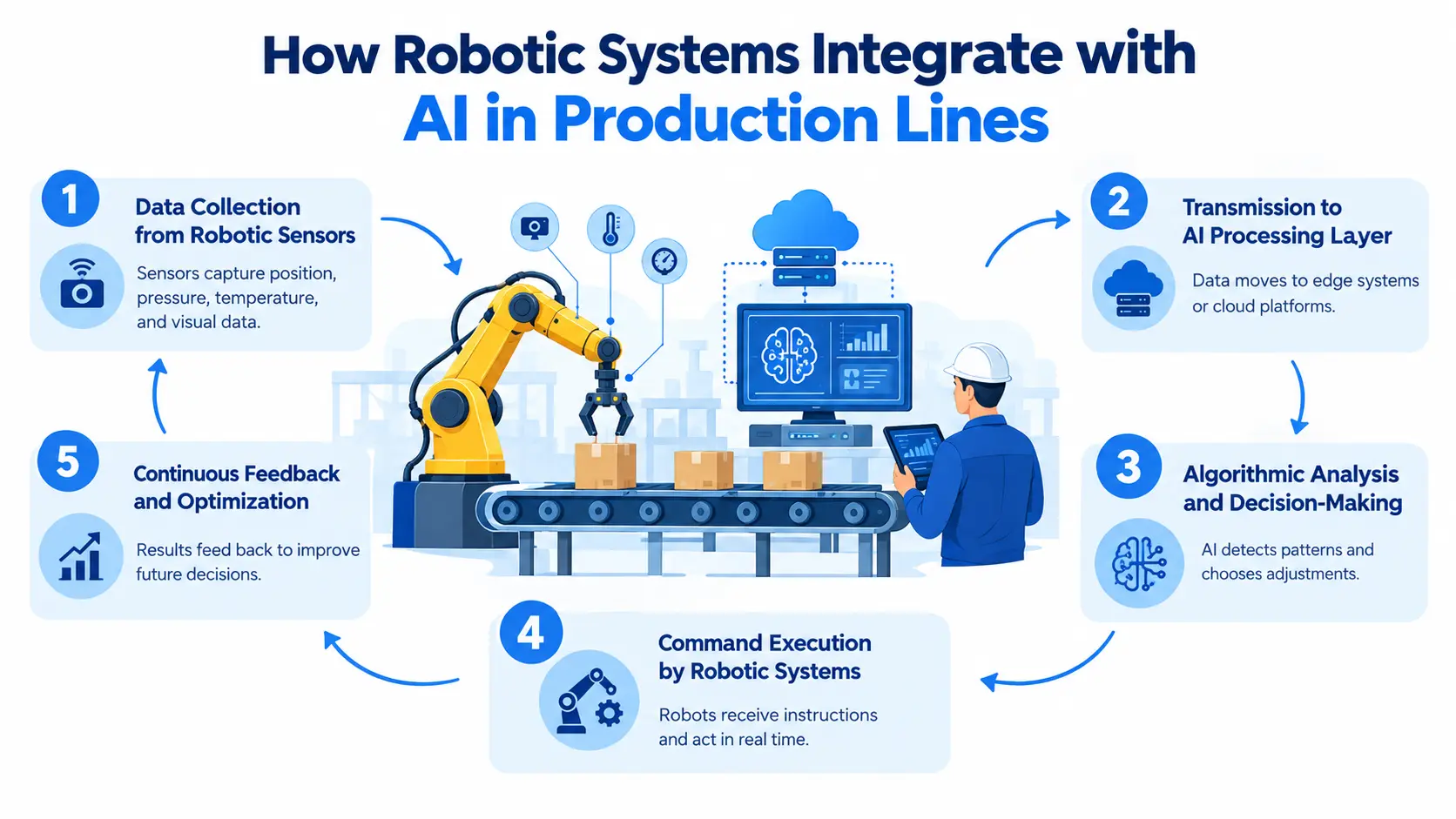
- Data collection from robotic sensors: Every robotic arm, conveyor, and camera on the line generates raw data on position, pressure, temperature, and visual output. This data has no value until it’s captured consistently across every connected device on the floor.
- Transmission to AI processing layer: The collected data travels to local edge systems or cloud platforms where it can be analyzed properly. Fast, reliable transmission matters here because delays translate directly into slower reaction times on the production line.
- Algorithmic analysis and decision-making: AI models compare incoming data against trained patterns to decide if something needs to change, a grip angle, a speed adjustment, a full stop. This is the step where machine intelligence actually earns its keep.
- Command execution by robotic systems: Once a decision is made, the robot receives updated instructions and acts on them in real time, often within milliseconds. Successful robotics system integration in Manufacturing depends entirely on this handoff happening without lag or miscommunication.
- Continuous feedback and optimization: The outcome of each action feeds back into the system, refining future decisions over time. This loop is what makes a robotic line genuinely adaptive rather than just automated on paper.
Investment, ROI, and Cost Efficiency in Factory Automation
Robotic automation in manufacturing isn’t a one-price purchase. The investment scales with the size of the operation and how much of the floor you’re automating. Small manufacturers sometimes assume automation is out of reach financially, but Manufacturing Automation Solutions now come in tiers built for different budgets, from single-cell robotic systems to full-line integrations. Pretty much every ROI conversation starts with the same question: how fast does this actually pay for itself?
The honest answer is that payback periods shrink as scale increases, because labor savings and productivity gains compound faster on larger lines. A small factory automating one process sees a slower return than a large plant automating an entire line, simply because there’s more volume absorbing the fixed cost of the system.
| Factor | Small Factory | Medium Factory | Large Factory |
|---|---|---|---|
| Initial Investment | Lower, single-cell systems | Moderate, multi-station setup | Higher, full-line integration |
| Annual Maintenance | Minimal, basic service contracts | Moderate, scheduled upkeep | Higher, dedicated technical staff |
| Labor Savings | Limited to automated task | Noticeable across shifts | Significant across multiple lines |
| Productivity Gains | Modest | Solid | Highest, continuous output |
| Typical Payback Period | Longer | Mid-range | Shorter |
Choosing the right solution isn’t about picking the biggest package available. It’s about matching the automation level to actual production volume and growth plans. A factory running three shifts a day will recover its investment faster than one running a single shift, so the decision should start with realistic usage numbers, not the most advanced option on a vendor’s list.
Key Challenges and Critical Success Factors for Implementation
Robotic automation in manufacturing fails most often not because the technology doesn’t work, but because the rollout ignores the human and operational side of the change.
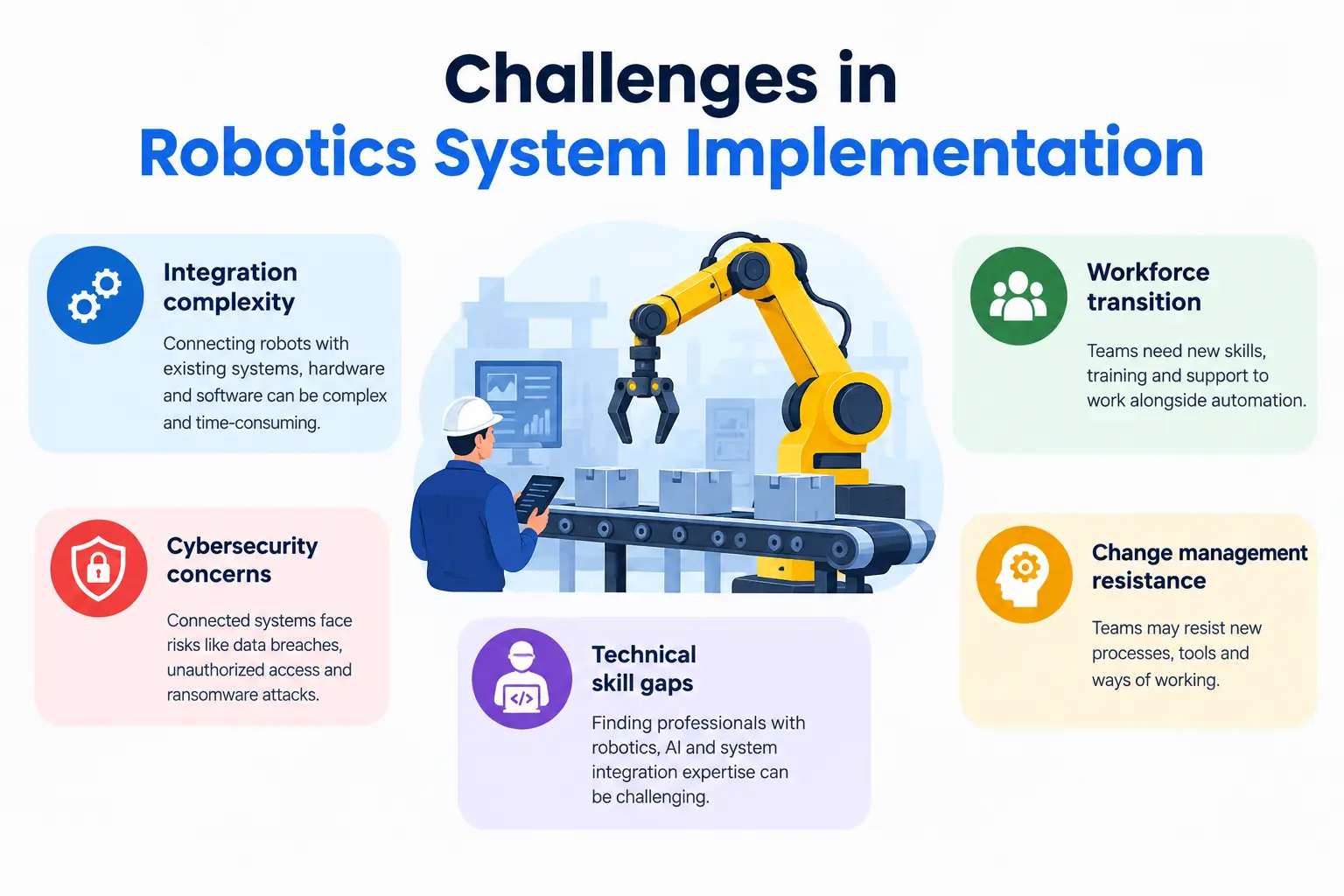
- Integration complexity: Connecting new robotic systems with legacy equipment and software rarely goes smoothly on the first attempt. Working with vendors who specialize in system integration, and piloting on one line before a full rollout, keeps this manageable.
- Workforce transition: Employees worry automation means job loss, and that fear slows adoption more than any technical hurdle. Clear communication about role shifts, paired with retraining programs, turns resistance into buy-in over a few months.
- Cybersecurity concerns: Connected robots and IoT sensors widen the attack surface for a factory’s network. Segmenting operational technology from corporate IT and auditing access regularly closes most of the obvious gaps.
- Technical skill gaps: Many plants don’t have staff trained to maintain or troubleshoot AI-driven robotic systems. Partnering with vendors for ongoing support, while building internal skills gradually, prevents over-reliance on outside help long-term.
- Change management resistance: Even well-planned automation projects stall when middle management doesn’t actively support the shift. Executive sponsorship and a phased rollout, with early wins communicated across the plant, keep momentum alive.
How Dreamer Technoland Enables Smart Manufacturing Excellence
Bringing AI and robotics into a factory that’s been running the same way for years is not a plug-and-play decision. Most manufacturers know the hard part isn’t buying equipment, it’s making it work with what’s already there. Dreamer Technoland has spent years focused specifically on the robotics software development process and AI model building for production environments, not generic software projects adapted after the fact.
That focus shows up in the capabilities we bring to each project: custom AI development for quality control and predictive maintenance, robotics hardware integration with existing production lines, real-time monitoring platforms that give plant managers visibility they didn’t have before, and training programs that get floor teams comfortable with new systems instead of resisting them. We’ve built robotic automation in manufacturing projects around legacy equipment, tight budgets, and skeptical staff. That’s the reality for most factories, not the exception.
Contact Dreamer Technoland today for a free automation readiness consultation.
Robotics in Manufacturing FAQs
Q. How long does it typically take to implement robotic automation in a factory?
Most single-line implementations take three to six months, from planning through testing. Full-facility rollouts with multiple integrated systems often run nine to eighteen months, depending on legacy equipment compatibility and the custom software work required.
Q. What is the average ROI timeline for manufacturing automation investments?
Payback periods typically range from one to three years, depending on factory size, automation scope, and how many shifts the line runs daily. Larger operations recover costs faster since labor savings and productivity gains apply across higher production volume.
Q: How does AI improve robotic precision in production?
AI lets robots adjust their actions based on real-time sensor data instead of following fixed instructions. A robotic arm can correct its grip, angle, or speed mid-task, reducing defects and rework that fixed-function robots can’t catch on their own.
Q. What skills do employees need to work with automated manufacturing systems?
Floor staff need basic data literacy to read dashboards and alerts, plus familiarity with how AI-driven systems flag issues. Technicians need deeper training in robotics maintenance, while supervisors benefit from understanding how to interpret performance analytics.
Q. Can existing factories retrofit robotic automation or do they need to rebuild?
Most factories can retrofit existing lines rather than rebuild from scratch. Modern Manufacturing Automation Solutions integrate with legacy equipment through sensors and middleware, though older machinery sometimes needs upgrades before it can connect to AI systems.