



According to MarketsandMarkets, the AI in the real estate market is projected to grow from $222.65 billion in 2024 to $975.24 billion by 2029, a 34.1% compound annual growth rate. That kind of growth signals a once-in-a-generation shift in how property is bought, sold, and managed. The businesses moving first stand to capture a disproportionate share.
But here’s the catch: most agents and firms don’t know where to start. They assume AI adoption means a massive software overhaul, when in practice it starts with one workflow, one tool, one measurable improvement.
This guide walks through exactly how generative AI in real estate works in practice, from automated listings to predictive market analysis, so you can pick the right starting point for your business.
Getting Started with Generative AI in Real Estate
Real estate has always moved at the pace of paperwork, phone calls, and foot traffic. That’s changing fast. Generative AI in real estate now writes listing descriptions, scores leads, and forecasts neighborhood demand, all in the time it used to take an agent to draft one email.
Industry projections suggest the AI in real estate and construction market is set to grow nearly fourfold within five years. That’s hard to ignore if you’re running a brokerage, a property management firm, or a construction development pipeline. And it isn’t happening because the technology looks impressive on a slide deck. It’s happening because it solves real problems: slow lead response times, inconsistent property valuations, and marketing teams that can’t keep up with listing volume.
Here’s the honest part. Most agents and firms know AI exists, but they don’t know which tool to pick first or how to measure whether it’s actually working. There’s no single formula for adoption, because the right starting point depends on your team size, your current tech stack, and where your biggest bottleneck sits today.
This guide breaks down where generative AI actually fits into real estate operations, tool by tool, so you can build a realistic adoption plan instead of guessing.
Why AI Is Transforming the Real Estate Industry Today
Real estate has been one of the slowest industries to digitize, largely because transactions involve legal risk, large sums of money, and relationships built on trust. That caution made sense for decades. But it’s also why so many firms still run on spreadsheets and gut instinct. AI is changing that calculus because it reduces risk rather than adding to it.
The shift isn’t theoretical. Back in 2018, an algorithm flagged two Philadelphia properties worth a combined $26 million before they ever hit the open market, one of the earliest signals that machine-driven analysis could outpace human scouting. More recently, companies like Illery have shown what full AI integration looks like in practice: 40% higher occupancy rates, a 2% bump in landlord ROI, and infrastructure operations running on near-complete automation.
What’s driving adoption now isn’t curiosity. It’s competitive pressure. Firms using AI in real estate and construction respond to leads faster, price properties more accurately, and cut the hours agents spend on repetitive admin work. And the agents who adopt early aren’t necessarily the most tech-savvy. They’re the ones who treated a slow workflow as a problem worth fixing.
Core Generative AI Applications for Real Estate Professionals
Generative AI in real estate isn’t one single feature. It’s a set of distinct applications, each one solving a different operational headache. Here’s where the technology is already doing real work for property professionals.
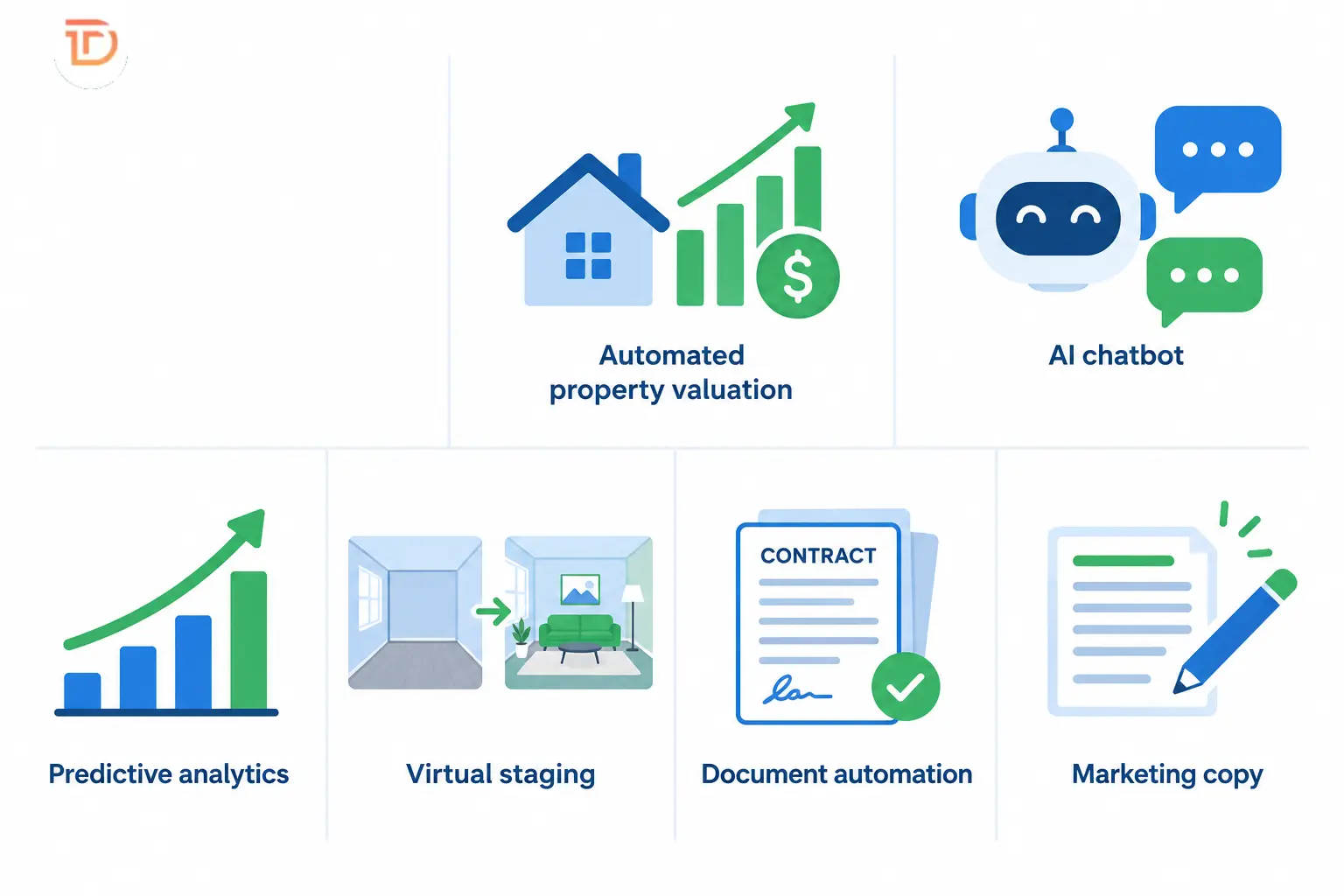
- Automated Property Valuation Models (AVMs). These tools pull from millions of data points, comparable sales, tax records, and local trends, to produce a property valuation in seconds instead of days. Agents use them as a starting point, then adjust for factors a model can’t see, like a renovated kitchen.
- AI Chatbots. Chatbots now qualify leads around the clock, asking about budget, timeline, and property type before a human ever joins the conversation. Response times that used to take hours now take seconds, which matters because slow follow-up is one of the biggest reasons leads go cold.
- Predictive Analytics. These tools scan historical sales, demographic shifts, and development activity to flag emerging neighborhoods before prices catch up. Investors use this to spot undervalued areas, while agents use it to advise sellers on timing.
- Virtual Staging. Instead of renting furniture and paying movers, AI generates realistic staged interiors from empty-room photos. It cuts staging costs and lets one listing show multiple design styles to different buyer types.
- Document Automation. Contracts, disclosures, and lease agreements get drafted and checked for missing clauses automatically. This doesn’t replace legal review, but it cuts the hours spent on repetitive paperwork.
- AI-Generated Marketing Copy. From social captions to email campaigns, AI drafts marketing content based on property details and target audience, giving marketing teams a usable first draft instead of a blank page.
How Generative AI Automates Property Descriptions and Listings
Writing a property listing used to eat up thirty minutes per property: describing square footage, listing amenities, and trying to make a three-bedroom colonial sound different from the last ten you wrote about. Generative AI tools like ChatGPT or Claude cut that time down to under five minutes, turning basic property details into a usable first draft almost instantly.
The process is straightforward. You feed the tool square footage, bedroom and bathroom count, key amenities, and neighborhood highlights, and it hands back a structured description that hits the standard listing format buyers expect. The output isn’t perfect on the first pass, and it shouldn’t be treated that way.
Quality control is still your job. The best workflow looks like this: generate a draft, review it for accuracy, add the personal details that make a listing memorable (a specific view, a renovation story), then publish. Skip that review step and mistakes slip through, like AI describing a feature the property doesn’t actually have.
The time saved isn’t the real win here. The real win is that agents can now produce consistent, professional listing copy for every property, not just the ones they have time to write carefully.
AI-Powered Lead Generation and Client Matching in Real Estate
Every agent has felt the sting of a lead going cold because nobody followed up fast enough. AI-powered lead scoring tools like Follow Up Boss and Lofty solve that by evaluating budget, timeline, location preference, and property type the moment a lead comes in, then routing it to the right agent automatically.
What makes this different from a basic contact form? Consistency. A human following up late after a long day might miss details a lead mentioned, but an AI system scores every lead the same way, every time, without fatigue. Response times that used to take hours now happen in seconds, and that speed alone improves conversion because buyers tend to work with whoever answers first.
Matching goes further than speed, too. These systems can match a client’s profile to an agent’s specialization, past transaction history, or even their success rate with a specific property type, so a first-time buyer doesn’t end up with an agent who mostly handles luxury listings. They plug directly into existing CRM platforms, so you see AI-generated leads inside the same dashboard you already use.
The automation handles qualification, not relationship building. AI can tell you a lead is ready to talk, but it still takes a human agent to close the deal, answer the nuanced questions, and build the trust that gets a buyer to sign.
Predictive Analytics and Market Analysis with Generative AI
Pricing a property right the first time matters more than most sellers realize, because a listing that sits too long signals to buyers that something’s wrong. Predictive analytics tools like SmartZip, PropStream, and Likely.AI help agents and investors get ahead of that problem by forecasting price trends and flagging markets before they heat up.
These tools pull from historical sales data, neighborhood demographics, economic indicators, and development patterns, like new transit lines or zoning changes, to build a picture of where demand is headed. You can use this data to recommend the right listing window instead of guessing based on last year’s market. Investors use the same data to spot undervalued properties in areas about to see a demand spike.
But none of this replaces local knowledge. A predictive model can tell you a zip code is trending upward, but it won’t know that a specific street has drainage issues or that a nearby development got stalled in permitting. The accuracy of these tools depends heavily on data quality, and gaps in local records can throw off a forecast.
Treat predictive analytics as a second opinion, not a verdict. The agents getting the most value combine the model’s output with what they already know about the neighborhood, not instead of it.
Implementation Challenges and Best Practices for Real Estate AI
Most AI adoption failures in real estate have nothing to do with the technology itself. They come from messy property data, legacy systems that don’t talk to new tools, agents who resist change because the last software rollout wasted their time, and upfront costs approved without a clear plan for measuring return.
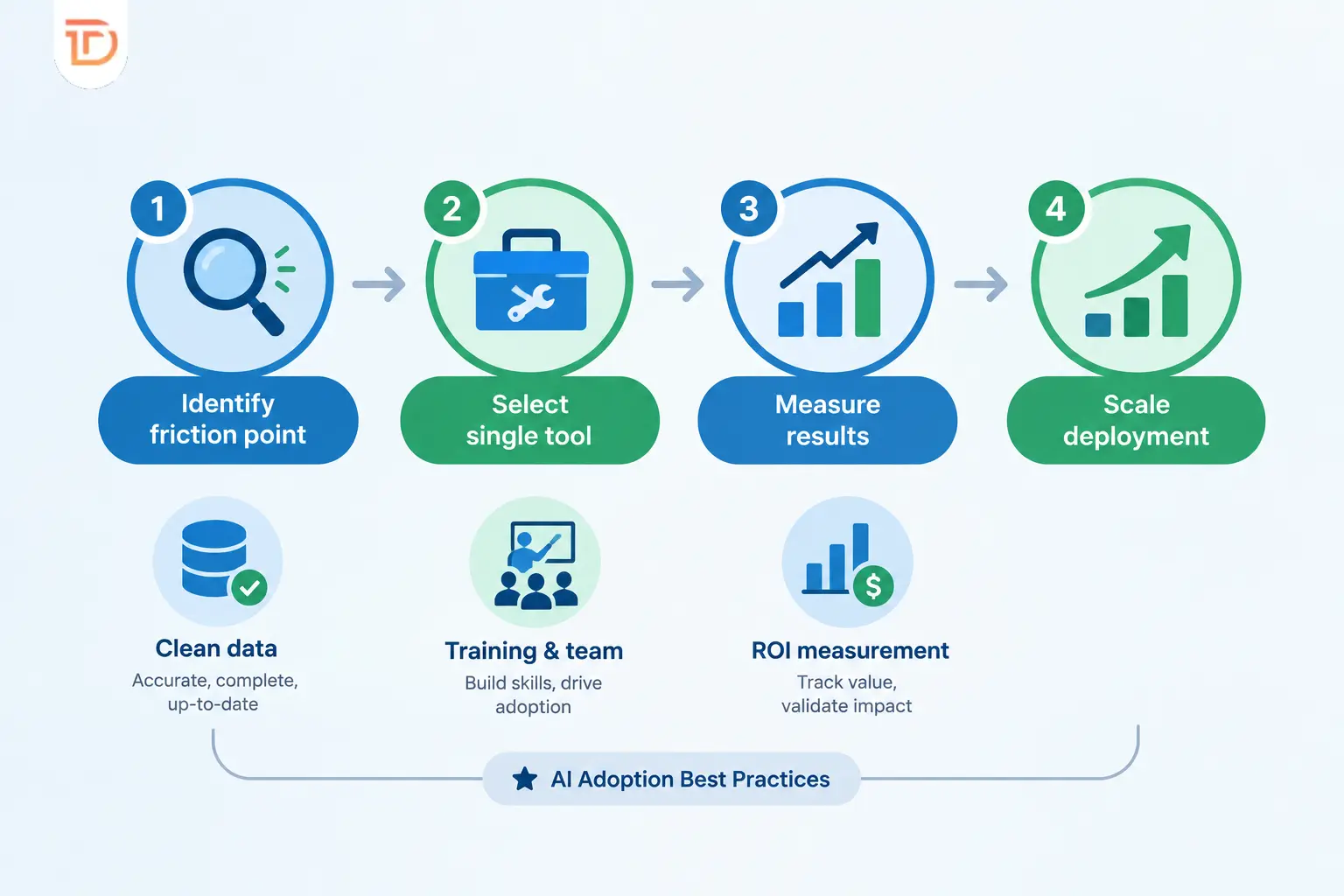
The fix isn’t more tools. It’s a narrower start. Agencies that try to adopt several AI tools at once typically see poor adoption and tools get abandoned within months. A better approach is picking the one task causing the most friction, maybe slow lead response, maybe inconsistent listing copy, rolling out a single tool against it, and measuring the ROI before expanding further.
Change management matters as much as the software choice. Your team needs real training, not a ten-minute demo, and leadership needs to set expectations that early results will be mixed. Celebrating small wins, like a chatbot cutting response time in half, builds the buy-in needed for the next phase of rollout.
None of this works without clean data. Property records with inconsistent formatting, missing fields, or outdated information will produce AI outputs that are only as reliable as the data feeding them, so data governance and privacy compliance need attention before scaling.
Tool selection should come last, not first. Evaluate vendor support, ease of use, and total cost against the specific problem you’re solving, not against which tool has the most features.
How Dreamer Technoland Helps Real Estate Companies Deploy Generative AI Solutions
Deciding where to start with AI can feel overwhelming when you’re running a real estate business, not a software company. Integrating artificial intelligence development, generative ai development services into daily workflows takes both technical skill and a real understanding of how brokerages, property managers, and construction firms actually operate.
Dreamer Technoland brings both. Our team builds AI solutions with real estate workflows in mind, not generic software adapted after the fact, which means less time lost to tools that don’t fit how your agents actually work.
That shows up in specific ways: custom property description generators built around your listing format, lead scoring workflows tuned to your market, market analytics dashboards that pull from the data sources you already trust, and integration with the CRM platform your team already uses. We translate the friction point you’re dealing with (slow leads, inconsistent valuations, overloaded marketing teams) into an AI system built to fix that exact problem.
Contact Dreamer Technoland today for a free AI strategy session.
FAQ Section
Q. What is generative AI in real estate and how does it differ from traditional software?
Traditional real estate software follows fixed rules; generative AI creates new content, like listing descriptions, valuations, or market forecasts, based on patterns learned from data. It adapts to new property details automatically instead of requiring manual rules for every scenario.
Q. How much does it cost to implement AI in a real estate business?
Costs vary widely based on scope. A single chatbot or listing tool might run a few hundred dollars monthly, while custom-built AI systems integrated with CRM and analytics platforms cost more. Start with one tool, measure ROI, then scale spending based on results.
Q. Can AI replace real estate agents?
No. AI handles repetitive tasks like lead qualification, valuations, and listing copy, but it can’t negotiate, build trust, or read a buyer’s unspoken concerns. Agents who use AI to handle admin work free up time for the relationship-building that actually closes deals.
Q. What are the biggest risks of using AI in real estate?
Poor data quality leading to inaccurate valuations, over-reliance on automated outputs without human review, and compliance gaps around fair housing or privacy rules. The biggest risk is treating AI output as final instead of a draft that still needs professional judgment.
Q. How long does it take to see ROI from AI implementation?
Most agencies see measurable results within three to six months when they start with one focused tool, like a chatbot or listing generator. Full-scale ROI across multiple workflows typically takes longer and depends on how well the team adopts the new process.