

Most people haven’t walked into a bank branch in over a year. Not because branches disappeared, but because nobody needed one. People paid rent from a train platform. A kid’s allowance moved between accounts during a commercial break. A small business owner approved payroll from a hospital waiting room without missing the appointment.
None of that felt remarkable to the people doing it. That’s the bar now: an app boring enough to trust with money without a second thought.
Get that wrong, and customers don’t complain. They just quietly download a different app and never come back. Get it right, and the app becomes the bank, more than any branch or call center ever was.
This guide covers exactly how to develop a mobile banking app that clears that bar: the features worth paying for, real development costs, the security regulators demand, and the full process from first sketch to launch.
Quick Overview on How To Develop a Mobile Banking App
Here’s the short version before we go deep: mobile banking apps have moved from “nice to have” to the primary way people manage money, and that shift is exactly why demand for mobile banking app development services keeps climbing. Building one well means balancing airtight security, the right mobile banking app features, smart use of AI, and a realistic budget. Below, we’ll walk through the market, the features, the mobile banking app development process, and the exact steps behind how to develop a mobile banking app that people keep coming back to.
Market Overview
The numbers behind mobile banking aren’t small, and they explain why mobile banking app development services are in higher demand than ever. Digital and transaction-based channels have quietly become the real engine of bank profitability; these categories now make up 47 percent of revenues and 57 percent of profits industry-wide, according to McKinsey’s Global Banking Annual Review.
The image becomes larger as you zoom out further. The global fintech market, valued at roughly USD 257 billion in 2022, is projected to reach USD 882 billion by 2030. Every dollar of that growth is being fought over by banks, neobanks, and providers of fintech app development services racing to win the same customer’s home screen.
The takeaway for any bank, credit union, or fintech founder: mobile banking application development isn’t a project you finish once. It’s an ongoing investment, and it’s exactly why fintech app development services exist as a category of their own.
What is a Mobile Banking App?
A mobile banking app is a dedicated application that lets customers access banking services directly from their phone, checking balances, moving money, paying bills, and managing accounts without stepping into a branch or logging into a desktop portal.
It’s different from plain online banking in one key way: mobile apps are built mobile-first, using device capabilities like biometrics, push notifications, and camera-based check deposits. This distinction matters when scoping mobile banking app development services, since a mobile-first build demands a different architecture than a responsive website.
Types of Mobile Banking Apps
Not all banking apps are designed for the same functions. Here’s how they typically break down:
| App Type | Best For | Core Focus |
|---|---|---|
| Retail/Consumer Banking | Everyday customers | Balances, transfers, bill pay |
| Digital-Only / Neobank | Tech-first, branchless banks | Fast onboarding, low fees |
| Digital Wallet Apps | Frequent digital payments | QR pay, P2P transfers |
| Business/Corporate Banking | SMEs and enterprises | Payroll, multi-user access, treasury |
| Investment & Wealth Apps | Savers and investors | Robo-advisory, portfolio tracking |
Choosing the right type early saves months of rework later, and it’s usually the first thing a good mobile banking app development services partner will ask about before writing a single line of code.
Benefits of Mobile Banking App Development Services
The benefits of mobile banking apps go both ways, for the customer paying the bills and for the institution funding the build. Here’s what each one actually delivers:
- Round-the-clock access
Customers check balances, move money, and pay bills at 2 AM or during a layover, without waiting for branch hours or a call center queue to open.
- Lower operational cost
Every transaction handled in-app is one less branch visit or support call, which cuts staffing and overhead costs as adoption grows, often offsetting the original fintech app development cost within a year or two.
- Faster transactions
Transfers and payments settle in seconds instead of the one-to-three business days a manual or branch-based process usually takes.
- Stronger customer retention
A smooth, reliable app gives customers one less reason to shop around, since switching banks now means switching apps they’ve grown used to.
- Real-time financial insights
Spending breakdowns, balance alerts, and low-fund warnings show up the moment they’re relevant, powered by the same AI in mobile banking apps that flags fraud in the background.
- Higher security confidence
Biometric login and encryption give users visible proof their money is protected, which builds trust faster than a privacy policy ever could.
- Improved cross-sell opportunities
In-app nudges for savings accounts, loans, or credit products reach customers exactly when their transaction history shows they’re ready for them.
- Better data for decision-making
Every login and transaction feeds analytics that help banks spot churn risk, fraud patterns, and product gaps long before quarterly reports would.
For banks specifically, these benefits of mobile banking apps translate directly into measurable KPIs: digital adoption rate, cost per transaction, and customer lifetime value. Few investments in mobile banking app development services pay back this visibly, this fast.
Use Cases of Banking Apps
Beyond the basics, mobile banking apps quietly solve everyday financial headaches. Here’s where the mobile banking app features covered earlier actually earn their keep in the real world:
Instant P2P transfers
Splitting a dinner bill or paying a roommate back happens in the time it takes to unlock a phone- no cash, no “I’ll Venmo you later” that never happens.
Digital onboarding
New customers open an account, verify identity, and start using the app in minutes, without printing a document or visiting a branch once.
SME payroll and vendor payments
A small business owner approves payroll or pays a supplier from a job site or a waiting room, keeping operations running without a desktop or an office visit.
Budgeting nudges
The app flags unusual spending or a low balance before it turns into an overdraft fee; this is AI in mobile banking apps working quietly in the background, days ahead of a monthly statement.
Mobile check deposit
Freelancers and gig workers snap a photo of a check between jobs instead of finding a branch or an ATM that still accepts deposits.
Fraud and anomaly alerts
A card swipe in an unfamiliar city triggers an instant notification, letting the customer confirm or freeze the card before real damage is done.
Cross-border remittances
Migrant workers and international students send money home in a few taps, relying on the same API integration for banking apps that powers domestic transfers, at a fraction of the cost of a traditional wire.
Investment and savings automation
Round-up savings and robo-advisory tools quietly grow a user’s balance in the background, without requiring a single manual transfer.
Must-Have Features for Mobile Banking Apps
Every serious mobile banking app needs a foundation of non-negotiable mobile banking app features. Here’s what each one does and why skipping it isn’t an option:
Account Management
Gives users real-time visibility into balances, transaction history, and statements, so they never have to guess what’s actually in their account.
Fund Transfers
Let users move money instantly between their own accounts or to others, domestic or international, which is usually the single most-used feature in any mobile banking app.
Bill Payments
Schedules and tracks recurring payments with auto-reminders, cutting down missed due dates and late fees that used to require a manual calendar entry.
Push Notifications & Alerts
Flags transactions, low balances, and security events the moment they happen, keeping users engaged with the app instead of checking in once a month.
Biometric Login & 2FA
Replaces easily guessed passwords with fingerprint, face ID, or one-time codes, making this one of the mobile banking app features users notice and trust first.
Mobile Check Deposit
Lets users photograph and submit a check from anywhere, removing the need for a branch visit or ATM for something as routine as a paycheck.
In-App Customer Support
Resolves issues through live chat or AI chatbots inside the app itself, so users aren’t stuck on hold for a question that takes thirty seconds to answer.
Budgeting Tools
Categorizes spending and tracks progress against savings goals, turning the app into something people open daily instead of only when something’s wrong.
Skip any of these mobile banking app features, and the app feels incomplete compared to what users already experience with their current bank.
Advanced Features of Mobile Banking Apps
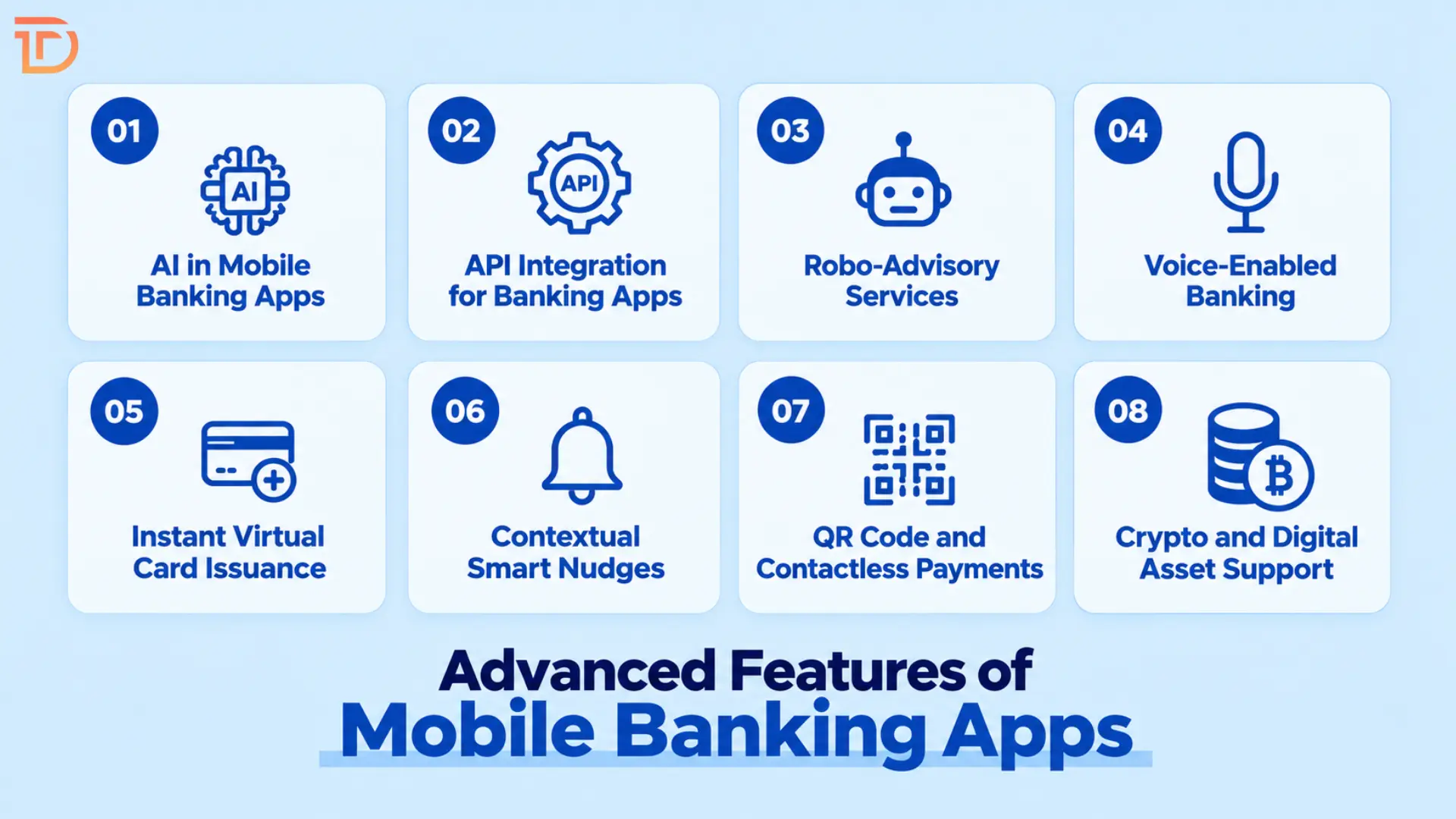
Once the basics are covered, this is where a bank differentiates itself with advanced mobile banking app features that go beyond what’s expected:
AI in Mobile Banking Apps
Analyzes spending patterns to deliver personalized insights, smarter nudges, and fraud detection that improves the more the app is used; this is the single biggest differentiator in the market right now.
API Integration for Banking Apps
Connects the app to payment gateways, credit bureaus, and third-party finance tools, turning it into a financial hub instead of an isolated tool for just checking balances.
Robo-Advisory Services
Offers automated, algorithm-driven investment guidance based on a user’s risk profile, making investing approachable for people who’d otherwise never open a brokerage account.
Voice-Enabled Banking
Lets users check balances or make payments hands-free, which matters more than it sounds for accessibility and for anyone juggling a phone one-handed.
Instant Virtual Card Issuance
Generates a usable digital card the moment an account is approved, so customers can spend online before the physical card even ships.
Contextual Smart Nudges
Uses AI in mobile banking apps to prompt timely actions, like moving idle cash into savings or warning about an upcoming overdraft, based on real account behavior rather than generic reminders.
QR Code and Contactless Payments
Turns a phone camera into a payment terminal, letting users pay merchants instantly without pulling out a card at all.
Crypto and Digital Asset Support
Allows users to buy, hold, or pay with crypto directly inside the banking app, meeting demand from a growing segment that wants everything in one place.
AI in mobile banking apps isn’t a gimmick anymore. It’s quickly becoming the feature that decides whether users trust the app enough to make it their primary bank, and it depends entirely on solid API integration for banking apps working quietly in the background. Our team has broken down how this plays out operationally in business intelligence for financial services, where data and AI convert raw transaction history into decisions banks can act on.
Security and Compliance Essential for Mobile Banking App Development Services
Security isn’t a feature. It’s the entire foundation, and no amount of AI in mobile banking apps or slick design matters if this layer is weak. Every serious mobile banking app development effort needs:
- End-to-end encryption for data in transit and at rest
- Multi-factor authentication combining biometrics and OTPs
- Compliance with global standards like PCI DSS and GDPR
- Regular penetration testing to catch vulnerabilities before attackers do
- Secure API integration for banking apps, since every third-party connection is a potential entry point
- Audit trails for every transaction, for regulatory reporting
Skipping any of this isn’t just risky. In regulated markets, it can delay or block your launch entirely, no matter how strong the rest of the mobile banking app development process was.
Cost Involved in Building a Mobile Banking App
This is usually the first question, and the honest answer is, “It depends on scope.” Here’s a realistic breakdown of fintech app development cost by tier:
| App Complexity | Core Scope | Estimated Cost |
|---|---|---|
| Basic | Account overview, transfers, notifications | $30,000 – $70,000 |
| Standard | Bill pay, QR payments, card controls | $70,000 – $150,000 |
| Advanced | AI insights, biometrics, investment tools | $150,000 – $350,000 |
| Enterprise | Multi-bank integration, open banking APIs, fraud AI | $350,000+ |
Fintech app development cost swings widely based on compliance scope, integrations, and platform choice. AI in mobile banking apps and deep API integration for banking apps are usually the two line items that push fintech app development cost up the fastest. For a full breakdown of what drives fintech app development cost, our detailed guide on fintech app development cost walks through every line item.
How to Develop a Mobile Banking App?
Here’s the actual mobile banking app development process, step by step, for anyone wondering how to develop a mobile banking app the right way:
Requirement Gathering and Analysis
Define user roles, compliance scope like KYC and AML, and the must-have mobile banking app features before any design work starts, since scope changes here are cheap and scope changes later aren’t.
UI/UX Design and Wireframing
Map the full user journey and build wireframes that keep navigation simple, since a confusing flow is one of the fastest ways to lose a user’s trust in a banking app.
Platform and Tech Stack Selection
Decide between native development, like our iOS application development services, or cross-platform frameworks such as Flutter, covered in the benefits of Flutter app development, based on budget, timeline, and target platforms.
Backend Development and API Integration
Build the server-side logic and handle API integration for banking apps, connecting payment gateways, credit bureaus, and core banking systems so data flows smoothly between them.
Security Implementation
Layer in encryption, biometric authentication, and fraud detection before testing begins, not after, since retrofitting security into a finished app is slower and riskier than building it in from day one.
Compliance and Legal Review
Work with legal and compliance teams to meet standards like PCI DSS and GDPR, since a security gap that fails an audit can delay launch by months.
Quality Assurance and Testing
Test functionality, performance, and security under real-world conditions, catching the kind of vulnerabilities that only show up under actual transaction load.
Launch and Post-Launch Support
Roll out in stages, gather user feedback, and keep shipping updates, since the mobile banking app development process doesn’t really end at launch; it just shifts into maintenance mode.
If you’re still figuring out how to develop a mobile banking app for your specific market, picking the right technical team matters more than picking the right framework. Our guide on how to choose the right financial software development partner covers exactly what to vet before signing a contract for mobile banking app development services.
Top Banking App Trends in The Market
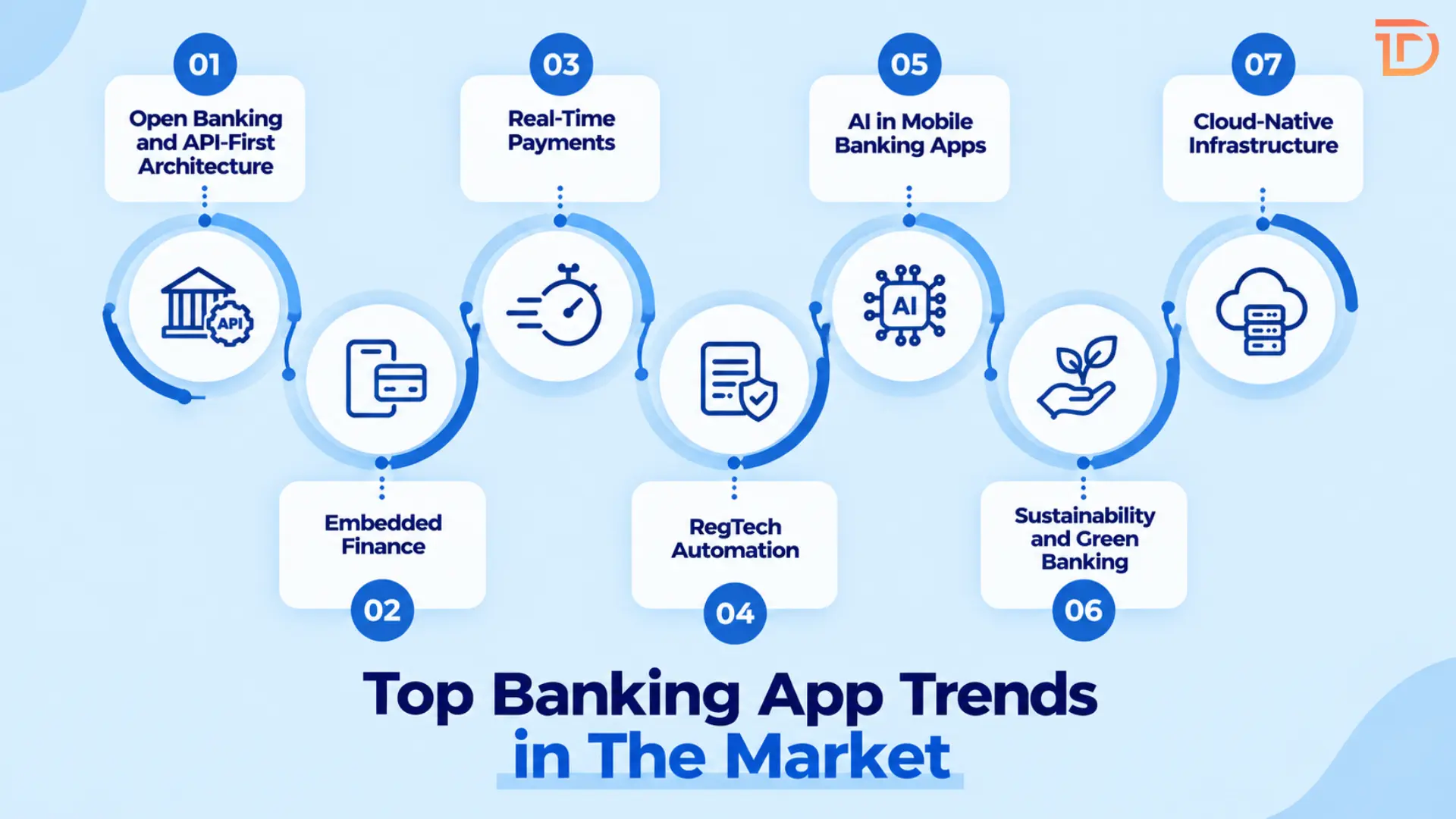
The mobile banking app development process keeps evolving alongside these trends, and ignoring them is how banks lose ground to faster-moving competitors:
Open Banking and API-First Architecture
API integration for banking apps is becoming the default way banks build, not an afterthought, letting third-party developers create new financial products on top of core banking data securely.
Embedded Finance
Loans, insurance, and payment options now show up inside non-banking apps, meaning banks compete for attention in places that aren’t their own app anymore.
Real-Time Payments
Instant settlement is replacing the old one-to-three-day transfer window, especially for cross-border and business-to-business payments where delays used to be the norm.
RegTech Automation
Automated KYC and AML checks handle compliance work that used to require manual review, cutting onboarding time from days to minutes without cutting corners on regulation.
AI in Mobile Banking Apps
Personalization now touches every stage, from onboarding flows that adapt to the user to support chatbots that resolve issues without a human ever getting involved.
Sustainability and Green Banking
Carbon footprint tracking and green investment options are showing up in banking apps, reflecting growing customer demand for eco-conscious financial tools.
Cloud-Native Infrastructure
Banks are shifting core systems to the cloud for scalability and faster updates, making it easier to ship new mobile banking app features without a full infrastructure overhaul.
Banks that treat these as “future” trends rather than current requirements are the ones losing customers to nimbler fintech app development services competitors today.
Why Choose Dreamer Technoland for Mobile Banking App Development Services?
We’ve walked through what it takes to build a mobile banking app that people actually use. Now the real question is who builds it with you. At Dreamer Technoland, our mobile banking app development services cover the full lifecycle: strategy, design, secure development, API integration for banking apps, and post-launch support.
We work as an extension of your team, not a black-box vendor, meaning you get visibility into every sprint, every security decision, and every dollar spent against your fintech app development cost. Whether you’re a bank modernizing a legacy app or a fintech founder still working out how to develop a mobile banking app from scratch, our fintech app development services are built to get you to market without cutting corners on compliance, security, or the mobile banking app features that actually matter.
Ready to build a mobile banking app your customers actually trust? Get in touch with our team and let’s scope your project.
FAQs on How to Develop a Mobile Banking App?
Q. How can you ensure the security of your banking app?
We build with end-to-end encryption, biometric authentication, and multi-factor login from day one, not bolted on later. Every build goes through penetration testing and is designed to meet PCI DSS and GDPR compliance standards before launch.
Q. How much does it cost to build a mobile banking application?
Costs typically range from $30,000 for a basic app to $350,000+ for an enterprise-grade platform with AI in mobile banking apps and open banking APIs. The exact fintech app development cost depends on features, compliance scope, and platform choice. See our detailed fintech app development cost guide for a full breakdown.
Q. How to develop a mobile banking app?
Start with requirement gathering and compliance scoping, move into UI/UX design, then development with secure API integration for banking apps, followed by rigorous QA and a phased launch. Choosing an experienced mobile banking app development services partner early makes every later step faster.
Q. How does AI in mobile apps help in personalizing services?
AI in mobile banking apps analyzes spending patterns to offer personalized budgeting tips, detect fraud in real time, and send contextual nudges, like flagging an unusual purchase or suggesting a savings transfer before payday.
Q. Is building a Minimum Viable Product (MVP) recommended before launching a full-scale banking platform?
Yes. An MVP with core mobile banking app features, account management, transfers, and secure login lets you validate demand and gather real user feedback before investing in advanced features like AI in mobile banking apps or open banking integrations.