


Many businesses focus on fintech app development costs and timelines when selecting a software partner. However, choosing the wrong team can create long-term problems that are expensive to fix later. Since financial applications handle sensitive customer information and critical transactions, they require a much higher level of expertise than standard business software.
Financial Software Market Research
According to the Financial Stability Board (FSB), cyber incidents continue to be one of the most significant operational risks facing financial institutions worldwide. As financial services become increasingly digital, organizations face growing pressure to protect sensitive customer data, maintain regulatory compliance, and ensure uninterrupted service delivery.
This growing complexity means financial software projects require more than technical expertise alone. Businesses need development partners that understand security requirements, industry regulations, scalability challenges, and the unique demands of the financial sector.
Why Financial Software Development Is Different From Regular Software Development
Many business applications focus primarily on functionality and user experience. Financial software, on the other hand, must balance functionality with security, compliance, accuracy, and reliability.
A financial application often deals with:
- Digital payments
- Online banking
- Investment management
- Loan processing
- Insurance operations
- Financial reporting
- Fraud detection
- Customer identity verification
Unlike standard software, financial platforms must comply with industry regulations and security frameworks. They also require advanced encryption, audit trails, transaction monitoring, and robust access controls.
For example, a retail business may tolerate a short service interruption. However, if a banking application becomes unavailable during critical transactions, it can impact customer trust and potentially lead to financial and legal consequences.
This is why businesses often prefer custom financial software development solutions tailored to their operational needs rather than relying solely on generic software products.
Types of Financial Software Development Services to Know First
Before selecting a financial software development company, it is important to understand the different categories of financial software solutions available.
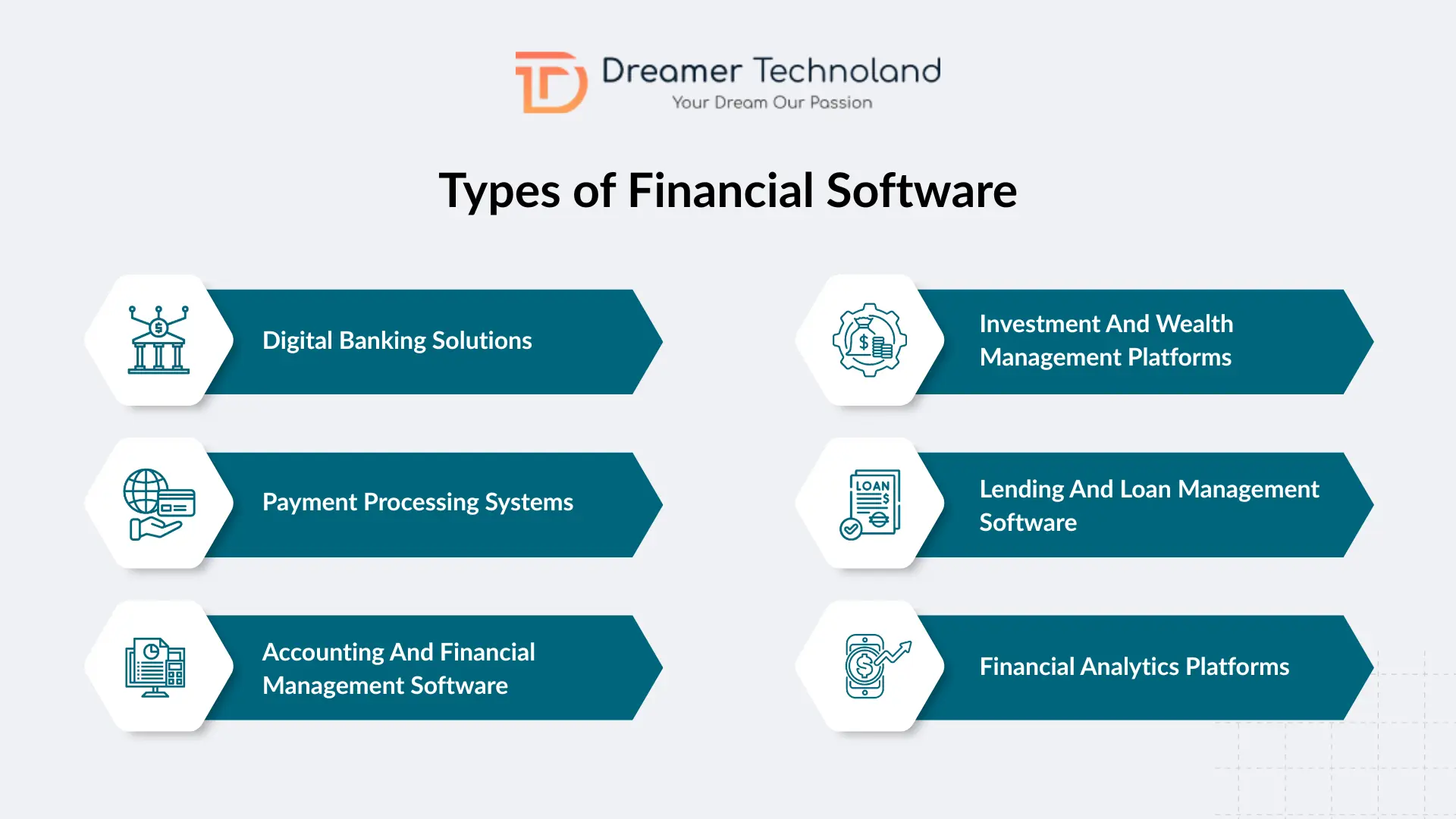
- Digital Banking Solutions
These platforms enable customers to manage accounts, transfer funds, pay bills, and access banking services through web and mobile applications.
- Payment Processing Systems
Payment platforms facilitate secure transactions between customers, merchants, and financial institutions while ensuring transaction accuracy and compliance.
- Investment And Wealth Management Platforms
These solutions help users manage portfolios, track investments, analyze performance, and make informed financial decisions.
- Lending And Loan Management Software
Loan management systems automate loan applications, approval workflows, risk assessments, and repayment tracking.
- Insurance Technology Solutions
Insurance companies use digital platforms to streamline policy management, claims processing, customer onboarding, and reporting.
- Accounting And Financial Management Software
Organizations rely on these systems for budgeting, forecasting, expense tracking, and financial reporting.
- Financial Analytics Platforms
Advanced analytics solutions help businesses gain insights from financial data, identify trends, and improve decision-making.
7 Things To Look For When Choosing A Financial Software Development Partner
- Industry-Specific Financial Experience
Experience within the financial sector should be a top priority.
Ask for:
- Relevant case studies
- Client references
- Industry-specific projects
- Demonstrated knowledge of financial workflows
- Strong Security Expertise
Security is non-negotiable in financial software development.
Your development team should understand:
- Data encryption
- Multi-factor authentication
- Secure APIs
- Access management
- Fraud prevention mechanisms
- Regulatory Compliance Knowledge
Financial applications often operate under strict regulatory requirements.
Compliance Area Purpose PCI DSS Protect payment card data GDPR Protect customer privacy AML Regulations Prevent money laundering KYC Requirements Verify customer identities - Technical Expertise And Scalability
The development company should be capable of designing scalable architectures that support:
- Growing user bases
- Increased transaction volumes
- Third-party integrations
- Cloud deployment
- Real-time processing
- Transparent Development Process
Look for companies that provide:
- Clear project timelines
- Regular progress updates
- Dedicated communication channels
- Sprint reviews
- Risk assessments
- Quality Assurance And Testing Capabilities
- Functional testing
- Security testing
- Performance testing
- Integration testing
- User acceptance testing
- Long-Term Support And Maintenance
Choose a partner that offers:
- Continuous monitoring
- Technical support
- Feature enhancements
- Security updates
- Performance optimization
Warning Signs of a Poor Financial Software Development Partner
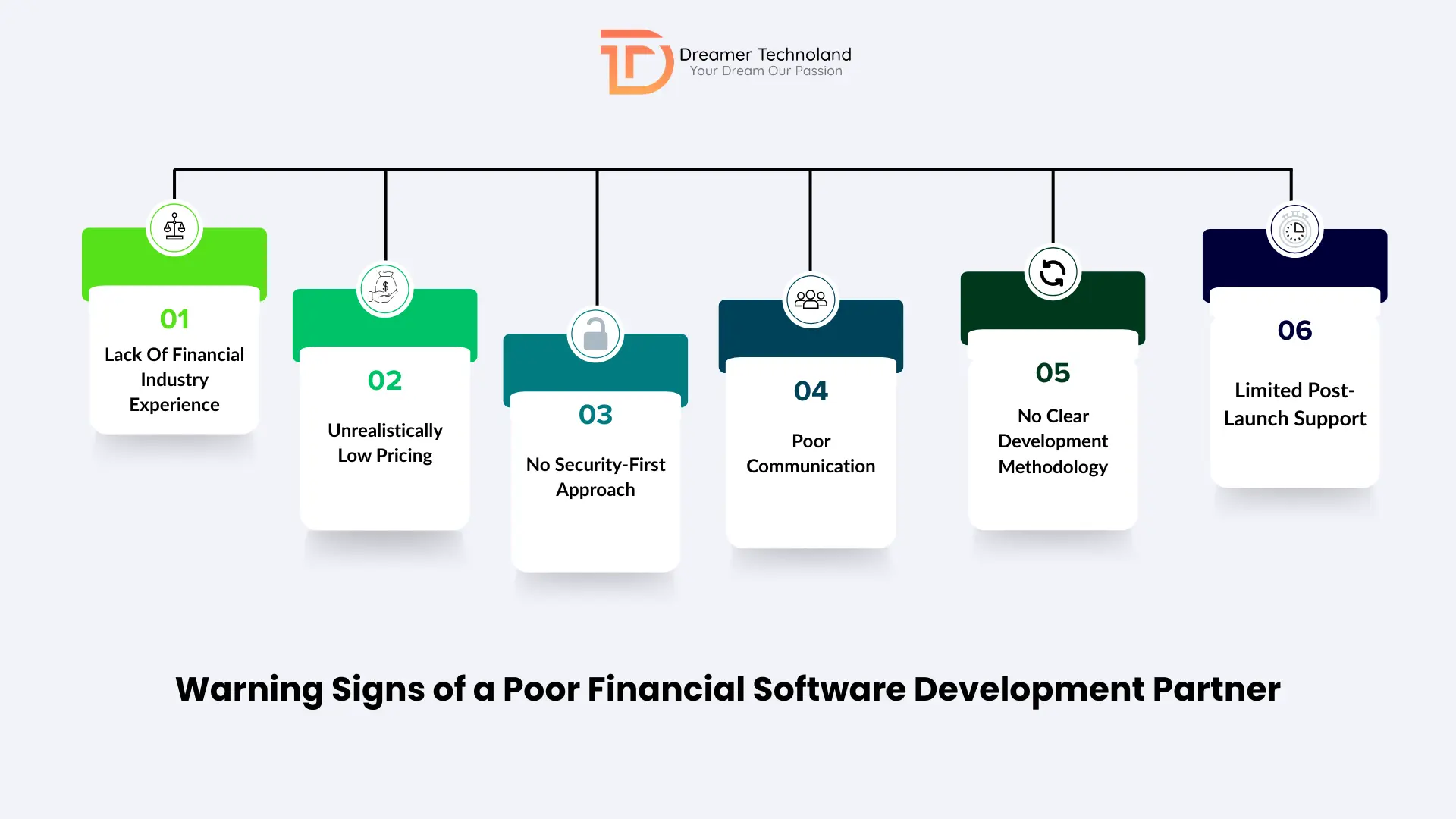
- Lack Of Financial Industry Experience: If a company cannot demonstrate successful financial projects, they may struggle to understand industry complexities.
- Unrealistically Low Pricing: Extremely low-cost proposals often result in compromised quality, limited support, or hidden expenses later in the project.
- No Security-First Approach: Security should never be treated as an afterthought.
- Poor Communication: Delayed responses, vague answers, and inconsistent communication can create major project management issues.
- No Clear Development Methodology: A professional fintech software development company should clearly explain its process, delivery model, testing strategy, and governance structure.
- Limited Post-Launch Support: A vendor that disappears after deployment may leave your business exposed to technical and security risks.
Questions To Ask In Your First Discovery Call
- What financial software projects have you completed recently?
- How do you approach security and compliance requirements?
- What technologies do you recommend for our project and why?
- How do you handle project communication and reporting?
- What testing procedures do you follow before launch?
- How do you manage software maintenance after deployment?
- Can you share relevant client references or case studies?
- What is your experience with PCI DSS software development requirements?
- How do you estimate project timelines and budgets?
Onshore Vs Offshore Financial Software Development: What To Consider
Also Read: Offshore Software Development: Trends, Benefits & Best Practices in 2026
Onshore Development
Benefits include:
- Similar time zones
- Easier communication
- Strong local market understanding
Challenges include:
- Higher development costs
- Limited talent availability
Offshore Development
Benefits include:
- Cost efficiency
- Access to global talent
- Faster team scaling
Challenges include:
- Time zone differences
- Cultural variations
- Communication management
Why The Right Partner Feels Like An Extension Of Your Team
The best development partnerships go beyond vendor-client relationships. A strong partner actively contributes ideas, identifies risks, recommends improvements, and aligns technology decisions with business objectives.
Instead of simply writing code, they become invested in your success.
Conclusion
Choosing the right software development partner can significantly influence the success of your financial platform.
Rather than focusing solely on cost, evaluate potential partners based on industry expertise, security capabilities, regulatory knowledge, development processes, and long-term support.
The right team will not simply build software. They will help you navigate challenges, reduce risk, accelerate innovation, and create a platform capable of supporting your business growth for years to come.
Frequently Asked Questions
Q. Why is financial software development more complex than regular software development?
A. Financial software must meet strict security, compliance, and reliability requirements while handling sensitive customer data and financial transactions.
Q. What should I look for in a financial software development company?
A. Focus on financial industry experience, security expertise, compliance knowledge, technical capabilities, communication processes, and long-term support services.
Q. How important is compliance in financial software projects?
A. Compliance is critical because failure to meet regulatory requirements can result in legal penalties, security risks, and reputational damage.
Q. Should I choose an offshore or onshore development team?
A. The right choice depends on your budget, communication preferences, project complexity, and access to specialized talent.
Q. What are the benefits of custom financial software development?
A. Custom solutions provide greater flexibility, improved scalability, stronger security controls, easier integrations, and functionality tailored specifically to business requirements.