

Building a mobile app today is no longer just about choosing iOS or Android. Businesses want applications that work seamlessly across multiple platforms while reducing development costs and time. This is exactly where Flutter app development has become the preferred choice for startups, enterprises, and growing businesses.
According to Statista’s 2024 Developer Survey, Flutter is the world’s most popular cross-platform framework, chosen by nearly half of mobile developers worldwide. Instead of maintaining separate codebases for Android and iOS, Flutter enables developers to build one application that runs everywhere with excellent performance and a consistent user experience.
In this guide, you’ll learn why Flutter has become the leading framework for cross-platform app development, how it compares with React Native, and whether it is the right choice for your next project.
What Exactly Is Flutter and Why Does Google Back It?
Flutter is Google’s open-source UI toolkit designed for building high-performance applications from a single codebase. Since its launch in 2018, Flutter has gained massive popularity among developers and businesses because it allows apps to run on iOS, Android, Web, Windows, macOS, and Linux without requiring separate development for each platform.
Flutter uses the Dart programming language, also developed by Google. Dart compiles directly into native code, allowing Flutter applications to deliver smooth animations, faster execution, and near-native performance.
Google itself uses Flutter in several products, including Google Pay, demonstrating the framework’s reliability, scalability, and long-term support.
Why Businesses Are Moving Away from Building Two Separate Apps?
Traditionally, companies needed separate teams to develop applications for Android and iOS. Each platform required different programming languages, separate maintenance, independent testing, and duplicate feature development.
This approach significantly increased development costs and project timelines.
Flutter solved this challenge by introducing a single codebase that works across multiple platforms. Businesses can now launch faster, reduce maintenance costs, and provide a consistent user experience without compromising quality.
For startups and growing businesses, this means faster product launches, lower investment, and better scalability.
Why Flutter App Development Is the Best Choice for Cross-Platform Apps?
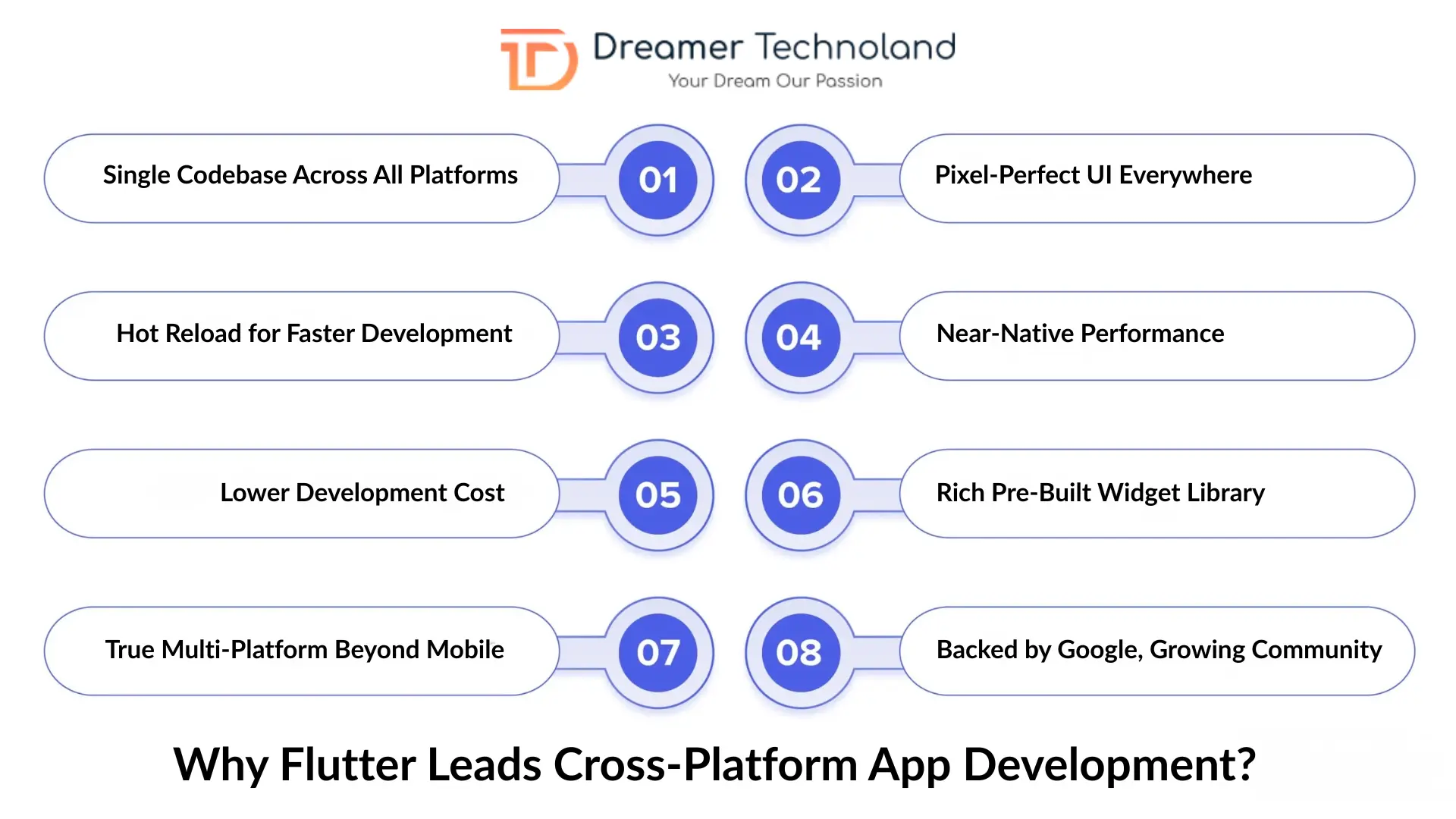
- Single Codebase Across Multiple Platforms
Flutter allows developers to write code once and deploy it across Android, iOS, Web, Windows, macOS, and Linux. This eliminates duplicate development efforts while making future updates significantly easier.
- Pixel-Perfect User Interface
Unlike many frameworks that rely on native UI components, Flutter uses its own rendering engine called Skia. This enables developers to create visually identical interfaces across every device and operating system.
- Faster Development with Hot Reload
Flutter’s Hot Reload feature allows developers to instantly view code changes without restarting the application. This dramatically speeds up development, testing, debugging, and UI refinement.
- Near-Native Performance
Flutter applications compile directly into native ARM code instead of relying on a JavaScript bridge. This delivers faster startup times, smoother animations, and highly responsive user experiences comparable to native applications.
- Lower Development Cost
A single development team managing one codebase significantly reduces project costs. Businesses can save approximately 30–50% compared to developing separate native applications for Android and iOS.
- Rich Widget Library
Flutter provides hundreds of built-in Material Design and Cupertino widgets that help developers build attractive, responsive, and feature-rich applications quickly without creating every UI component from scratch.
- True Multi-Platform Support
Flutter extends beyond mobile development by supporting Web, Windows, macOS, and Linux from the same codebase. Businesses planning future expansion can reuse existing code instead of rebuilding applications.
- Backed by Google and a Growing Community
Flutter enjoys continuous investment from Google and is supported by one of the fastest- growing developer communities worldwide. Thousands of plugins, packages, and learning resources make Flutter a reliable long-term technology choice.
There are several cross-platform frameworks available today, but Flutter has consistently pulled ahead of the competition. Here is why businesses and developers keep choosing it:
Flutter vs React Native: A Straight-Up Comparison
React Native is Flutter’s closest competitor and remains a solid choice for many projects. However, when businesses compare both frameworks side by side, Flutter consistently stands out in terms of performance, UI consistency, and long-term scalability.
| Feature | Flutter | React Native |
|---|---|---|
| Backed By | Meta (Facebook) | |
| Programming Language | Dart | JavaScript |
| Performance | Near-Native (Compiled) | Good (JavaScript Bridge) |
| UI Rendering | Own Rendering Engine (Skia) | Native Components |
| Platform Support | iOS, Android, Web, Windows, macOS, Linux | iOS, Android, Web |
| Hot Reload | Yes | Yes |
| UI Consistency | 100% Consistent | Platform Dependent |
| Community Growth | Fastest Growing | Established |
| Development Cost | Lower | Moderate |
React Native is an excellent framework for teams already invested in JavaScript. However, businesses looking for better UI consistency, near-native performance, broader platform support, and lower long-term maintenance costs often choose Flutter.
Is Flutter the Right Fit for Your Business?
Flutter is a versatile framework that works well for businesses of all sizes. It is particularly beneficial for organizations looking to build high-quality applications quickly while keeping development costs under control.
- Startups and Early-Stage Businesses
Launch your product on both Android and iOS with a single development team, reducing time-to-market and maximizing your startup budget.
- Businesses Building an MVP
Flutter enables rapid MVP development with attractive interfaces, allowing businesses to validate ideas faster before investing in large-scale development.
- E-commerce and Retail Brands
Flutter supports smooth animations, responsive product catalogs, and seamless checkout experiences that improve customer engagement.
- Companies with Budget Constraints
Managing a single codebase instead of two separate native applications significantly reduces development and maintenance expenses.
- Businesses Planning Multi-Platform Expansion
If your roadmap includes mobile, web, and desktop applications, Flutter allows you to build and maintain everything from one unified codebase.
Big Names That Bet on Flutter and Won
Flutter is trusted by some of the world’s largest organizations to power high-performance applications used by millions of customers every day.
| Company | Industry | Why They Chose Flutter |
|---|---|---|
| Google Pay | FinTech | Consistent user experience across multiple platforms. |
| BMW | Automotive | Single codebase for its connected driver application. |
| Alibaba Xianyu | E-commerce | Fast feature delivery with excellent performance. |
| eBay Motors | Marketplace | Rapid deployment and consistent visual experience. |
| Nubank | Banking | Scalable architecture for millions of active users. |
| Dream11 | Fantasy Sports | Real-time performance during heavy user traffic. |
These companies rely on Flutter for production-grade applications serving millions of users worldwide, proving the framework’s scalability, reliability, and enterprise readiness.
Three Flutter Myths Worth Clearing Up
Despite Flutter’s popularity, a few misconceptions continue to circulate. Here are the most common ones and the reality behind each:
- Flutter Apps Don’t Feel Native
Modern Flutter applications provide smooth animations, responsive interactions, and native-like performance. Most users cannot distinguish a well-built Flutter application from a native app.
- Dart Is Difficult to Learn
Dart is simple, modern, and easy to understand. Developers familiar with JavaScript, Java, or Kotlin can become productive with Dart in just a few days.
- Flutter Is Only for Mobile Apps
Flutter supports Android, iOS, Web, Windows, macOS, and Linux, making it one of the most complete multi-platform development frameworks available today.
Why Dreamer Technoland Is the Right Flutter Development Partner?
Choosing the right development company is just as important as choosing the right framework. At Dreamer Technoland, we combine technical expertise, user-focused design, and agile development practices to build Flutter applications that are scalable, secure, and built for long-term success.
- Experienced Flutter Developers
Our team has successfully delivered Flutter applications for startups, enterprises, fintech, healthcare, logistics, education, and eCommerce businesses across the globe.
- Design-First Development Approach
We create intuitive, visually appealing interfaces that improve user engagement while taking full advantage of Flutter’s powerful UI capabilities.
- End-to-End Development Services
From UI/UX design and Flutter development to backend APIs, Firebase integration, cloud deployment, testing, and maintenance, we handle the complete development lifecycle.
- Transparent Development Process
We work in agile sprints with regular project updates, milestone reviews, and continuous communication, ensuring complete transparency throughout the project.
- Ongoing Support & Maintenance
Our partnership continues after launch with performance monitoring, feature enhancements, bug fixes, security updates, and long-term application support.
The Bottom Line
Flutter has established itself as the leading framework for cross-platform app development. By enabling developers to build a single application for multiple platforms, Flutter helps businesses reduce development costs, accelerate product launches, and deliver a consistent user experience across devices.
Looking for reliable Flutter mobile app development services? Partner with Dreamer Technoland to build fast, scalable, and feature-rich applications for Android, iOS, Web, and Desktop. Our experienced Flutter developers transform your ideas into high-performing digital products.
Frequently Asked Questions
Q. Is Flutter better than React Native for cross-platform app development?
A. Both frameworks are excellent choices, but Flutter offers better UI consistency, near-native performance, and broader platform support. Its own rendering engine ensures a consistent experience across devices, making it a preferred choice for many businesses.
Q. How long does it take to build a Flutter application?
A. Development timelines depend on project complexity. A basic Flutter app typically takes 4–6 weeks, medium-sized applications require 8–12 weeks, and enterprise solutions may take several months.
Q. Can Flutter apps be published on both the App Store and Google Play?
A. Yes. Flutter allows developers to build a single application that can be deployed to both Apple App Store and Google Play Store while also supporting Web, Windows, macOS, and Linux.
Q. Is Flutter suitable for enterprise applications?
A. Absolutely. Flutter powers enterprise applications used by companies like Google, BMW, Nubank, and Alibaba. It supports secure APIs, scalable architecture, role-based access, and enterprise-grade performance.
Q. What is the difference between Flutter and native app development?
A. Native development requires separate applications for Android and iOS using different programming languages. Flutter uses a single codebase that works across multiple platforms, reducing development time and cost while delivering excellent performance.