


Healthcare organizations generate and manage thousands of patient records every day. From medical history and prescriptions to lab reports and insurance information, handling this data manually is no longer practical. As healthcare providers continue to embrace digital transformation, Electronic Health Records (EHRs) have become an essential part of delivering faster, safer, and more personalized care.
According to Grand View Research, the global Electronic Health Records (EHR) market was valued at USD 35.9 billion in 2025 and is projected to reach USD 53.1 billion by 2033, growing at a CAGR of 5.1%. The market’s growth is driven by increasing demand for interoperability, the integration of clinical decision support and analytics tools, and government-led digital health initiatives promoting EHR adoption worldwide. These trends highlight the growing importance of digital health records in improving patient care, streamlining clinical workflows, and enhancing healthcare efficiency.
If you’re planning to digitize healthcare operations, investing in custom EHR software development can help you build a solution that matches your clinical workflows, compliance requirements, and future scalability goals. Unlike off-the-shelf platforms, custom-built EHR systems offer greater flexibility, seamless integrations, and complete ownership of your healthcare software.
In this guide, we’ll explore what an EHR is, how it works, its key features, benefits, different types, and the software development process involved in building a modern EHR solution.
What Is an Electronic Health Record (EHR) System?
An Electronic Health Record is a digital version of a patient’s complete medical history that can be securely accessed and updated by authorized healthcare professionals. Unlike traditional paper files, an EHR stores information in a centralized database, allowing providers to access accurate patient information whenever and wherever it is needed.
An EHR typically contains:
- Patient demographics
- Medical history
- Diagnoses
- Allergies
- Medications
- Laboratory reports
- Radiology images
- Vaccination records
- Treatment plans
- Clinical notes
- Billing and insurance details
The biggest advantage of an EHR is that it allows multiple healthcare providers to collaborate using the same up-to-date patient information, leading to better care coordination and fewer medical errors.
How Does an EHR System Work in Healthcare?
An EHR System in Healthcare acts as a centralized digital platform where patient information is collected, updated, and securely shared among authorized medical professionals. Instead of maintaining separate paper files across different departments, every interaction with the patient is recorded in one integrated system.
The workflow generally follows these steps:
Patient Registration
The process begins when a patient visits a healthcare facility. Basic details such as name, contact information, insurance details, and previous medical records are entered into the system.
Medical Consultation
Doctors review the patient’s previous medical history before the consultation. During the appointment, they add diagnoses, symptoms, medications, and treatment recommendations directly into the system.
Diagnostic Testing
Laboratories and imaging centers upload test reports directly to the patient’s record. This allows physicians to access results without waiting for physical reports.
Prescription Management
Doctors generate electronic prescriptions that can be securely shared with pharmacies, reducing handwriting-related errors and improving medication accuracy.
Follow-up Care
During future visits, healthcare providers can quickly review previous treatments, monitor patient progress, and make informed clinical decisions without repeating unnecessary tests.
Data Sharing
When patients visit another authorized specialist or hospital, relevant health records can be shared securely, ensuring continuity of care.
Types of EHR Systems
Not every healthcare organization has the same operational needs. Therefore, EHR solutions are available in different deployment models depending on factors such as organization size, security requirements, scalability, and budget.
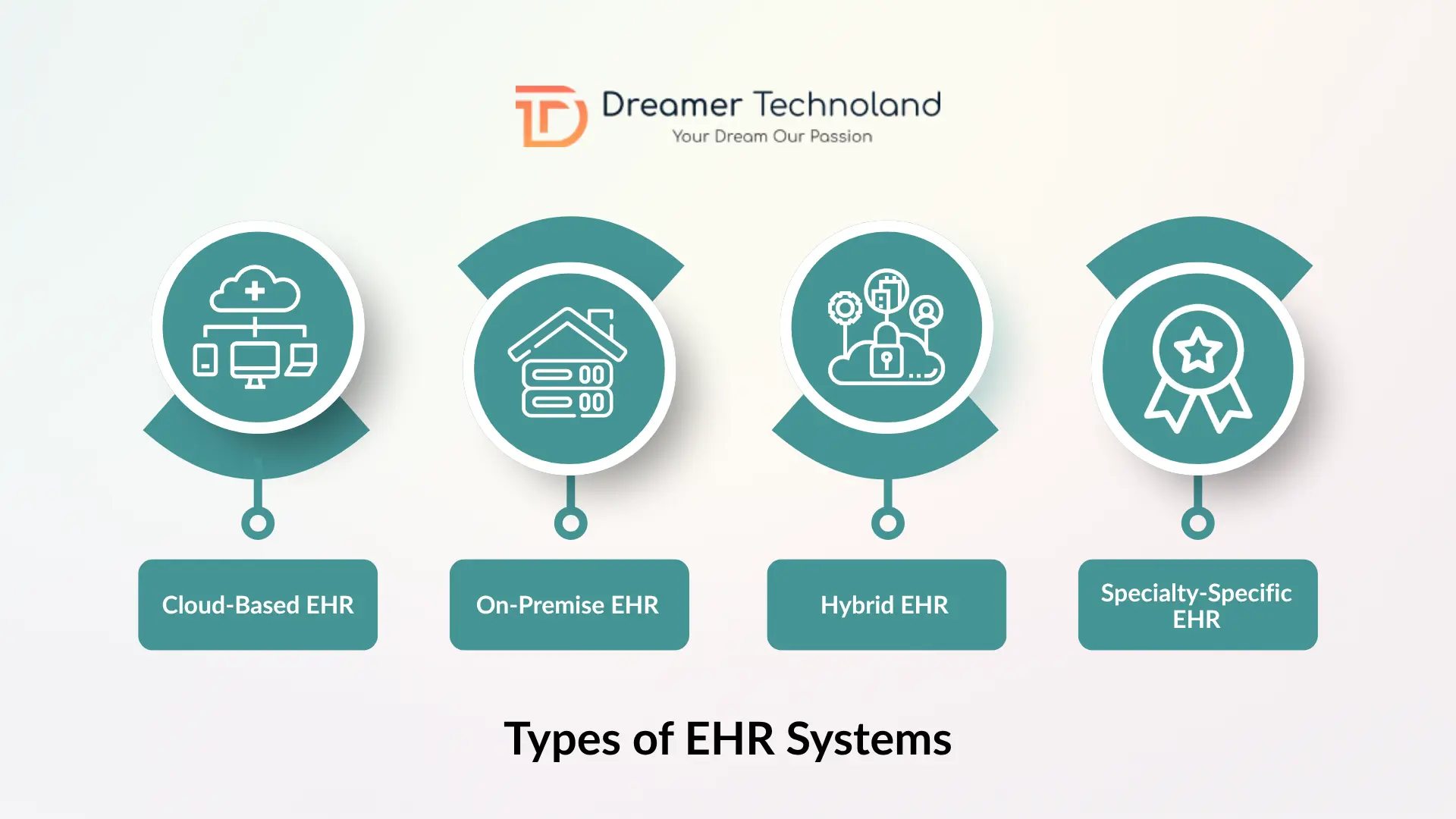
Cloud-Based EHR
Cloud-based systems are hosted on remote servers and accessed through the internet.
Best suited for:
- Small clinics
- Telemedicine providers
- Multi-location healthcare practices
Advantages
- Lower upfront investment
- Automatic software updates
- Easy remote accessibility
- High scalability
- Reduced IT maintenance
On-Premise EHR
These systems are installed on the healthcare organization’s own servers and managed internally.
Best suited for:
- Large hospitals
- Government healthcare organizations
- Institutions with strict compliance requirements
Advantages
- Greater control over data
- Custom security policies
- No dependency on internet availability
- Higher customization options
Hybrid EHR
Hybrid solutions combine cloud infrastructure with on-premise deployment to balance flexibility and security.
Best suited for:
- Enterprise healthcare networks
- Multi-specialty hospitals
- Organizations with evolving digital strategies
Advantages
- Improved disaster recovery
- Flexible data storage
- Better scalability
- Enhanced business continuity
Specialty-Specific EHR
Some healthcare providers require customized workflows based on their medical specialty. Specialty-specific systems include tailored templates, reporting tools, and treatment workflows.
Common specialties include:
- Cardiology
- Dermatology
- Orthopedics
- Pediatrics
- Oncology
- Mental health
- Dentistry
- Ophthalmology
These systems help healthcare professionals document patient information more efficiently while supporting specialty-specific treatment protocols.
Features of EHR Software
An effective EHR platform goes far beyond storing patient records. It connects clinical, administrative, and financial operations into one centralized system, enabling healthcare providers to deliver more efficient and accurate care.
Some of the most valuable features include:
Patient Record Management
A centralized dashboard stores complete patient information, including medical history, prescriptions, allergies, laboratory reports, imaging results, and physician notes.
Appointment Scheduling
Integrated scheduling tools simplify appointment booking, reduce administrative workload, and automatically send reminders to patients, helping minimize missed appointments.
Clinical Documentation
Healthcare professionals can create digital consultation notes, treatment plans, and progress reports using structured templates, improving documentation accuracy and consistency.
E-Prescription Management
Electronic prescribing allows physicians to send prescriptions directly to pharmacies, reducing medication errors and improving prescription tracking.
Laboratory and Imaging Integration
The system connects with diagnostic laboratories and imaging centers, enabling healthcare providers to access test results within the patient’s record without manual data entry.
Billing and Insurance Management
Integrated billing features help streamline insurance claims, payment tracking, invoice generation, and reimbursement processes while reducing administrative errors.
Reporting and Analytics
Advanced dashboards provide valuable insights into patient outcomes, operational efficiency, financial performance, and resource utilization, supporting data-driven decision-making.
Role-Based Access Control
Different user roles, such as physicians, nurses, administrators, and billing staff, receive access only to the information necessary for their responsibilities, strengthening data security and regulatory compliance.
Benefits of the EHR System for Hospitals
Hospitals today manage thousands of patient interactions every day, making speed, accuracy, and coordination essential. A well-designed EHR System for Hospitals simplifies clinical and administrative processes while improving the quality of patient care. Instead of relying on disconnected systems or paper records, healthcare providers can access complete patient information from a single platform.
Here are some of the biggest benefits:
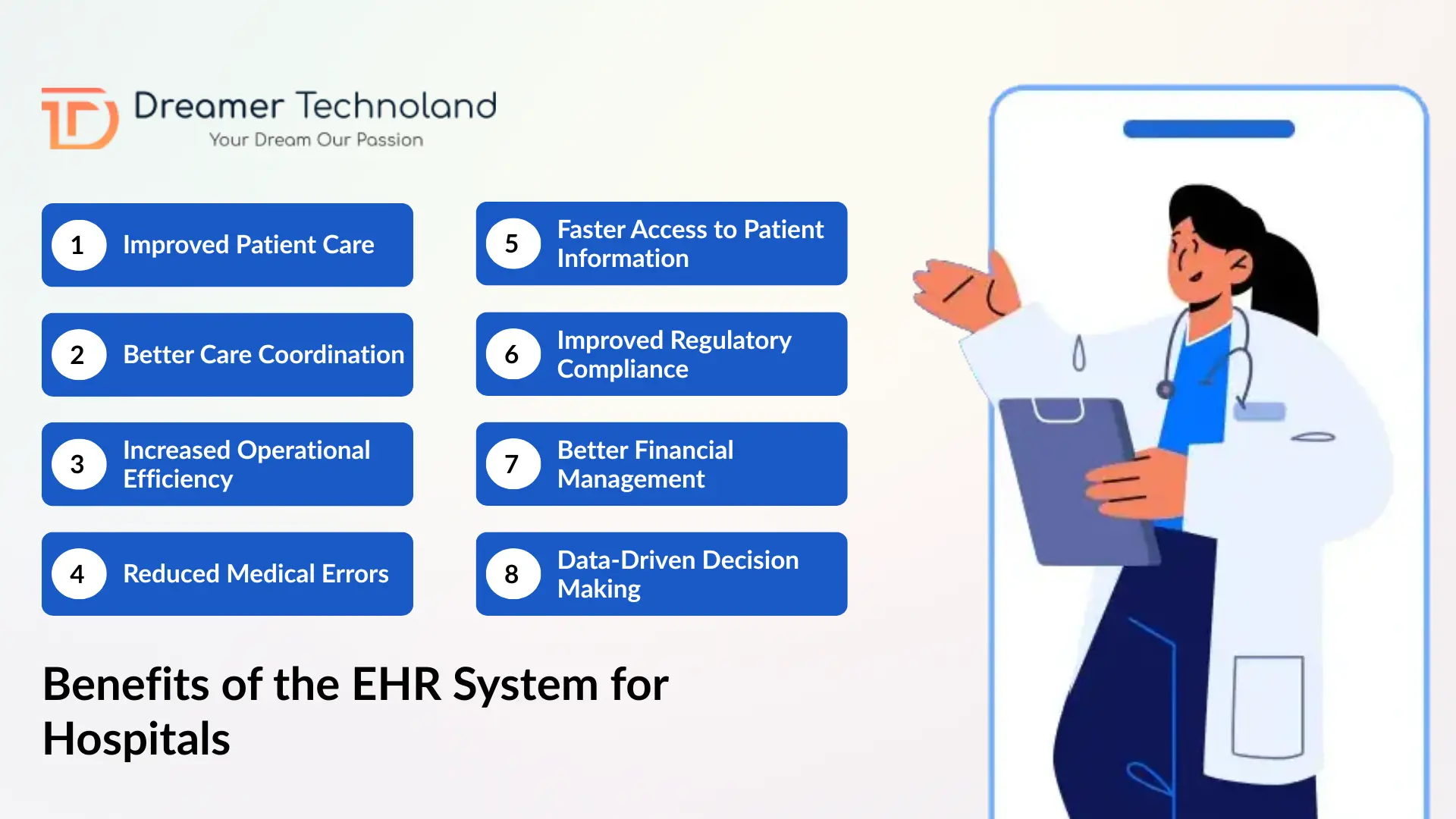
Improved Patient Care
Doctors and nurses have instant access to a patient’s complete medical history, medications, allergies, and previous treatments. This helps them make faster and more informed clinical decisions while reducing the chances of medical errors.
Better Care Coordination
Patients often consult multiple specialists during treatment. An EHR enables authorized healthcare professionals to access the same patient information, ensuring everyone works with accurate and updated records.
Increased Operational Efficiency
Routine administrative tasks such as appointment scheduling, documentation, billing, and report generation become automated, allowing healthcare staff to spend more time on patient care.
Reduced Medical Errors
Medication conflicts, duplicate tests, and incorrect diagnoses can be minimized because physicians have access to comprehensive patient data before making treatment decisions.
Faster Access to Patient Information
Instead of searching through paper files, healthcare providers can retrieve patient records within seconds, which is especially valuable during emergencies.
Improved Regulatory Compliance
Healthcare organizations must comply with data privacy regulations such as HIPAA, GDPR, or local healthcare laws. Modern EHR platforms include audit trails, access controls, and encryption to support compliance requirements.
Better Financial Management
Integrated billing, insurance verification, and payment tracking reduce administrative delays while improving revenue cycle management.
Data-Driven Decision Making
Hospitals can analyze patient trends, disease patterns, resource utilization, and operational performance through built-in reporting dashboards, enabling better planning and improved healthcare outcomes.
Electronic Health Record System Examples
Different healthcare organizations have different operational requirements, which is why many EHR platforms are available in the market. Some solutions are designed for hospitals, while others focus on clinics, specialty practices, or telemedicine providers.
Here are some widely used EHR platforms:
| EHR Platform | Best For | Key Strength |
|---|---|---|
| Epic | Large hospitals and health systems | Enterprise-scale interoperability |
| Oracle Health (formerly Cerner) | Hospitals and healthcare networks | Comprehensive clinical workflows |
| athenahealth | Small to medium-sized practices | Cloud-based practice management |
| eClinicalWorks | Clinics and physician practices | Integrated patient engagement tools |
| NextGen Healthcare | Specialty medical practices | Customizable specialty workflows |
These platforms demonstrate how healthcare software can be tailored to different organizational needs. However, many healthcare providers choose custom-built EHR solutions when they require unique workflows, third-party integrations, or specialized patient management features.
EHR Software Development Step-by-Step Process
Developing an EHR solution requires careful planning, regulatory compliance, and a deep understanding of healthcare workflows. The goal is to create software that improves efficiency while protecting sensitive patient information.
Step 1: Requirement Analysis
The development process begins by identifying business objectives, user roles, workflow requirements, compliance needs, and integration requirements.
Typical stakeholders include:
- Doctors
- Nurses
- Hospital administrators
- Billing teams
- Laboratory staff
- IT managers
Step 2: Planning and System Architecture
Once the requirements are finalized, developers create the software architecture, database structure, API strategy, security framework, and scalability plan.
This stage also defines whether the solution will be cloud-based, on-premise, or hybrid.
Step 3: UI/UX Design
Healthcare professionals work in fast-paced environments. Therefore, the interface should be clean, intuitive, and easy to navigate.
Good UI design helps reduce training time while improving productivity for doctors, nurses, and administrative staff.
Step 4: EHR Software Development
During the EHR software development phase, developers build the platform’s core modules, integrate healthcare systems, implement security protocols, and optimize performance to ensure a reliable and scalable healthcare solution.
Security measures such as encryption, multi-factor authentication, and role-based permissions are implemented during development.
Step 5: Third-Party Integrations
Modern healthcare platforms often integrate with:
- Laboratory Information Systems (LIS)
- Pharmacy management software
- Medical imaging systems
- Insurance providers
- Telemedicine platforms
- Wearable healthcare devices
- Payment gateways
These integrations create a unified healthcare ecosystem and eliminate manual data transfers.
Step 6: Testing and Quality Assurance
Before deployment, the software undergoes extensive testing, including:
- Functional testing
- Security testing
- Performance testing
- Integration testing
- Usability testing
- Compliance validation
This ensures the platform performs reliably in real-world healthcare environments.
Step 7: Deployment and Training
Once testing is complete, the system is deployed, existing patient records are migrated, and healthcare staff receive training on using the platform effectively.
Step 8: Ongoing Maintenance and Updates
Healthcare technology continues to evolve. Regular software updates introduce new features, improve security, fix bugs, and ensure ongoing compliance with changing healthcare regulations.
Common Challenges in EHR Implementation
Although EHR systems provide significant benefits, successful implementation requires careful planning. Some common challenges include:
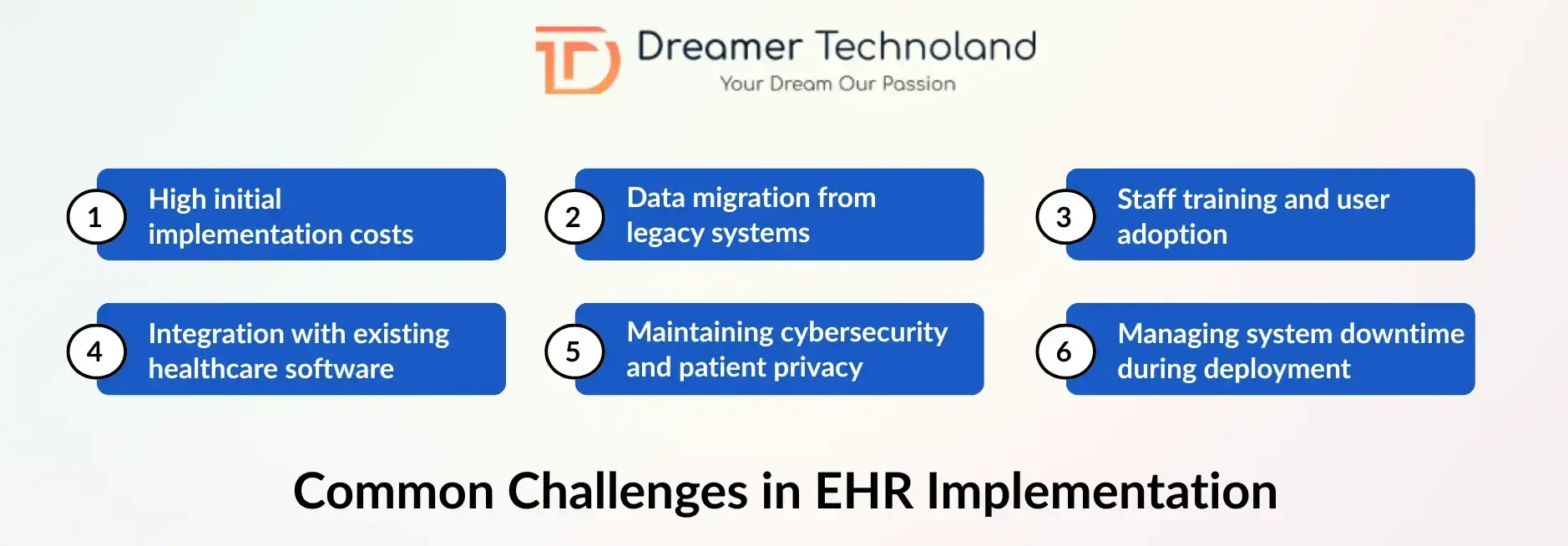
- High initial implementation costs
- Data migration from legacy systems
- Staff training and user adoption
- Integration with existing healthcare software
- Maintaining cybersecurity and patient privacy
- Managing system downtime during deployment
These challenges can be minimized by choosing experienced healthcare software development partners and following a structured implementation roadmap.
Future Trends in EHR Technology
Healthcare technology continues to evolve rapidly, and EHR platforms are becoming more intelligent and connected. Some emerging trends include:
Artificial Intelligence Integration
AI is helping healthcare providers automate documentation, support clinical decision-making, identify health risks, and improve diagnostic accuracy.
Predictive Analytics
Healthcare organizations are increasingly using predictive analytics to identify high-risk patients, improve preventive care, and optimize resource allocation.
Telemedicine Integration
As virtual healthcare services grow, EHR systems are integrating video consultations, remote patient monitoring, and digital prescriptions into a unified platform.
Mobile Accessibility
Healthcare professionals increasingly rely on mobile applications to access patient information securely from smartphones and tablets, enabling faster decision-making.
Enhanced Interoperability
Future EHR platforms will focus on seamless data exchange between hospitals, clinics, laboratories, pharmacies, and wearable devices, creating a more connected healthcare ecosystem.
Modern EHR platforms are increasingly integrated with wearable devices and IoT-enabled healthcare solutions that continuously collect patient health data. These integrations enable physicians to monitor patients remotely and deliver proactive care. Discover how this technology works in our blog on Remote Health Monitoring.
Why Choose Custom EHR Software Development?
While ready-made EHR platforms work well for many healthcare providers, they may not meet the unique operational needs of every organization. Hospitals, specialty clinics, diagnostic centers, and telemedicine providers often require customized workflows, advanced integrations, and industry-specific features that generic software cannot provide.
Choosing custom EHR software development allows healthcare organizations to build software tailored to their exact requirements instead of adapting their processes to fit a standard solution.
Benefits of Custom Development
- Personalized workflows for different medical specialties
- Integration with existing hospital systems
- Higher scalability for future growth
- Better data security and compliance
- Custom reporting and analytics
- Improved user experience
- Complete ownership of the software
- Easier feature expansion
Conclusion
Electronic Health Records have transformed the way healthcare organizations manage patient information and deliver care. By replacing paper-based processes with secure, centralized digital records, EHR systems improve clinical efficiency, enhance patient safety, and support better collaboration among healthcare professionals.
As healthcare organizations continue to embrace digital transformation, investing in a scalable and secure EHR solution has become a strategic necessity rather than an operational upgrade. Whether you are building a new healthcare platform or modernizing an existing system, choosing the right technology and development approach can significantly improve patient outcomes and operational performance.
At Dreamer Technoland, we provide EHR software development services for hospitals, clinics, diagnostic centers, and healthcare startups. Whether you need a custom patient management platform, telemedicine integration, or a fully scalable Electronic Health Record solution, our experienced healthcare developers build secure, compliant, and future-ready software tailored to your business needs.
Frequently Asked Questions
Q. What is an Electronic Health Record system?
An Electronic Health Record system is a digital platform that securely stores and manages a patient’s complete medical history, including diagnoses, medications, allergies, laboratory reports, treatment plans, and clinical notes, allowing authorized healthcare providers to access updated information in real time.
3. Why are EHR systems important for hospitals?
EHR systems help hospitals improve patient safety, reduce administrative workload, streamline clinical workflows, minimize medical errors, enhance care coordination, and support compliance with healthcare regulations.
Q. How long does it take to develop custom EHR software?
The development timeline depends on the project’s complexity, required features, integrations, and compliance requirements. A basic EHR platform may take several months, while enterprise-grade healthcare systems with advanced capabilities can require significantly more development time.
Q. What security features should an EHR system include?
A secure EHR solution should include data encryption, role-based access control, multi-factor authentication, audit logs, automated backups, secure APIs, and compliance with applicable healthcare data privacy regulations to protect sensitive patient information.
Q. What is the difference Different Type of Software Used in Healthcare Industry?
An EHR platform is only one part of a modern healthcare ecosystem. Hospitals also rely on various specialized software solutions for diagnostics, pharmacy management, laboratory operations, billing, telemedicine, and patient engagement. Learn more in our detailed guide on 15 Different Types of Software Used in the Healthcare Industry.