

The real estate industry has changed dramatically over the last few years. Buyers no longer wait for newspaper listings or visit multiple properties before making a decision. Today, they expect to browse homes, compare prices, schedule property visits, and even take virtual tours directly from their smartphones. This shift has made mobile applications one of the most valuable tools for real estate businesses.
According to the National Association of REALTORS, 97% of home buyers used the internet during their home search, highlighting how digital platforms have become the primary way people discover properties. This growing reliance on mobile technology makes investing in a high-quality real estate app more important than ever.
However, building separate applications for Android and iOS can significantly increase both development costs and project timelines. That is why more real estate companies are choosing custom React Native app development services to create feature-rich applications that work seamlessly across multiple platforms without compromising performance.
The Growing Demand for Mobile Apps in Real Estate
The way people search for properties has evolved significantly. Whether someone is buying a house, renting an apartment, or investing in commercial property, the journey usually starts on a mobile device.
Today’s users expect applications that allow them to:
- Search thousands of property listings instantly
- View clear images and videos
- Schedule appointments with agents
- Receive personalized property recommendations
- Save favorite properties
- Communicate directly with property owners
- Access mortgage calculators
- Explore neighborhoods through interactive maps
Without these features, businesses risk losing potential customers to competitors offering a better digital experience.
This growing demand is exactly why businesses are now investing in custom mobile applications built on modern frameworks that reduce development costs while delivering exceptional user experiences.
Why React Native Has Become a Preferred Choice
React Native is an open-source framework created by Facebook that allows teams to build mobile applications for Android and iOS from a single codebase.
Instead of maintaining two separate teams for native development, businesses can build one application that runs smoothly across both platforms. This approach improves efficiency while reducing overall project complexity.
Among the reasons why React Native remains in high demand are:
- Quicker development process
- Lower development costs
- Excellent UI performance
- Large developer community
- Easier maintenance
- Code reusability
- Regular framework updates
For industries like real estate, where speed and customer experience directly impact business growth, React Native offers a practical solution.
Why Real Estate Companies Need Custom Applications
Some real estate businesses focus on residential property sales, while others specialize in rentals, commercial properties, luxury homes, or property management. Because every business has different workflows and customer expectations, off-the-shelf applications often fail to meet long-term requirements.
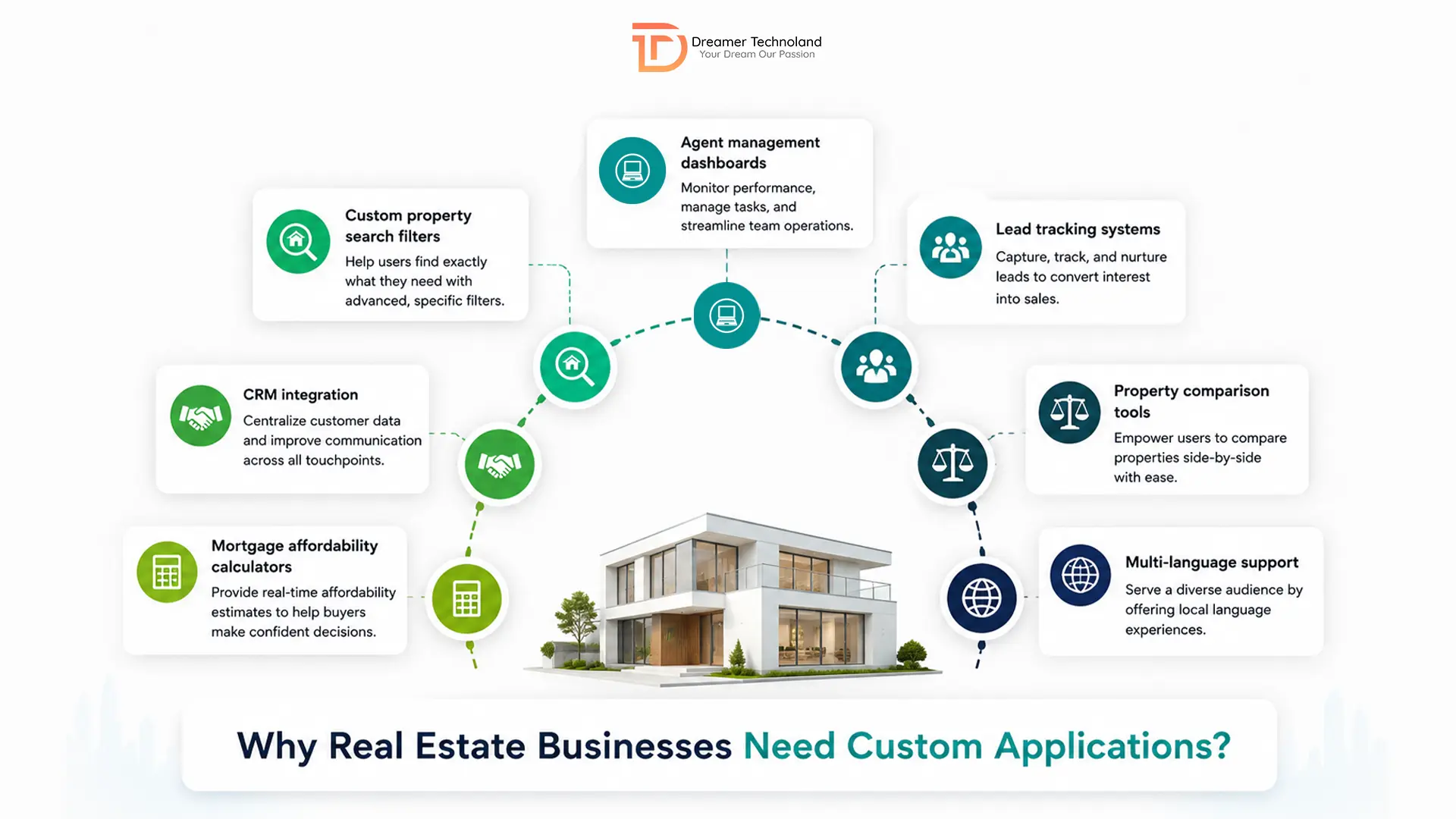
A custom application allows businesses to create features specifically designed for their audience.
These may include:
- Custom property search filters
- Agent management dashboards
- Lead generation system
- Property comparison tools
- CRM integration
- AI-powered recommendations
- Mortgage affordability calculators
- Multi-language support
Unlike generic solutions, custom applications grow alongside your business.
Benefits of Choosing React Native for Real Estate Apps
Many companies researching the benefits of React Native for real estate apps discover that the framework delivers an ideal balance of performance, flexibility, and cost efficiency.
Let’s consider all of them in more detail below.
Faster Time to Market
Launching quickly is essential in today’s competitive market.
Since React Native uses a shared codebase for Android and iOS, developers spend less time writing duplicate code. This significantly reduces the development timeline.
A faster launch allows businesses to:
- Reach customers sooner
- Validate business ideas faster
- Generate revenue earlier
- Respond quickly to market changes
Cost-Effective Development
Developing native applications separately often requires different development teams, larger budgets, and additional maintenance expenses.
React Native minimizes these costs because much of the application is shared across platforms.
Businesses benefit from:
- Reduced development expenses
- Lower maintenance costs
- Faster updates
- Simplified testing process
For startups and growing agencies, this can make a substantial financial difference.
Consistent User Experience Across Platforms
Users expect the same quality experience regardless of whether they use Android or iPhone.
React Native helps businesses maintain:
- Consistent navigation
- Similar design language
- Smooth animations
- Uniform functionality
This consistency strengthens brand identity while improving customer satisfaction.
Easy Integration with Third-Party Services
Modern real estate applications depend on multiple external services.
React Native integrates easily with:
- Google Maps
- Payment gateways
- CRM platforms
- Calendar systems
- Push notification services
- Cloud storage
- AI recommendation engines
- Analytics platforms
These integrations help businesses create a complete digital ecosystem rather than a simple property listing application.
Essential Features Every Modern Real Estate App Should Include
Building an attractive application is only one part of success.
The real value comes from offering features that simplify the buying, selling, or renting process.
| Feature | Business Benefit |
|---|---|
| Smart Property Search | Helps users find relevant properties quickly |
| Interactive Maps | Improves location-based property discovery |
| Advanced Filters | Saves users time during property searches |
| Virtual Property Tours | Enhances customer engagement |
| Push Notifications | Keeps users informed about new listings |
| Appointment Booking | Simplifies agent scheduling |
| Secure Login | Protects customer information |
| Favorite Listings | Encourages repeat engagement |
| Mortgage Calculator | Supports informed buying decisions |
| In-App Chat | Enables faster communication between buyers and agents |
These features improve customer satisfaction while increasing user retention.
Scalability Matters as Your Business Grows
Real estate businesses rarely remain the same for long.
As customer numbers increase, businesses often expand into new cities, introduce additional property categories, or launch premium services.
React Native provides a scalable foundation that supports future growth without requiring businesses to rebuild their application from scratch.
Developers can continuously introduce new modules, improve existing features, and integrate advanced technologies while maintaining application stability.
How to Build a Real Estate App with React Native
Many businesses ask how to build a real estate app with React Native that delivers an excellent user experience while staying within budget. Although every project has unique requirements, following a structured development process helps ensure a successful outcome.
- Identify Your Business Goals
The first step is to identify the purpose of the application.
Ask questions such as:
- Who is your target audience?
- Will the app focus on buying, renting, or selling properties?
- Do you want to serve residential, commercial, or luxury markets?
- Which features are essential for launching?
Clear business objectives help define the app’s functionality and development roadmap.
- Conduct Market Research
Before writing a single line of code, analyze your competitors and identify opportunities to stand out.
Focus on:
- Popular features users expect
- What common issues customers face
- User interface trends
- Pricing models
- Customer engagement strategies
This research helps create a product that offers real value instead of simply replicating existing apps.
- Design an Intuitive User Experience
A real estate application should be easy and enjoyable.
An effective design includes:
- Easy navigation
- Clean property listing pages
- Fast search functionality
- Interactive maps
- Simple contact options
- Attractive image galleries
A well-designed interface encourages users to spend more time exploring listings.
- Build Core Features
After finalizing the design, developers begin implementing the application’s primary functionality.
Typical features include:
- User registration and login
- Property listings
- Advanced search filters
- Interactive maps
- Mortgage calculator
- Push notifications
- Appointment scheduling
- Chat functionality
- Payment integration
- Admin dashboard
The feature set should align with your business objectives rather than adding unnecessary complexity.
- Test Across Devices
Testing ensures that the application performs consistently on different devices and operating systems.
Quality assurance typically covers:
- Functional testing
- UI testing
- Performance testing
- Security testing
- Compatibility testing
- User acceptance testing
Identifying issues before launch helps deliver a reliable experience for end users.
- Launch and Continuously Improve
Launching the app is only the beginning.
Successful businesses regularly:
- Monitor user feedback
- Fix bugs
- Improve performance
- Add new features
- Strengthen security
- Release updates
Continuous improvement helps maintain user satisfaction and long-term engagement.
Common Challenges in Real Estate App Development
Developing a real estate application comes with several technical and business challenges. Fortunately, these can be addressed with the right planning and technology.
| Challenge | Solution |
|---|---|
| Large property database | Use scalable cloud infrastructure |
| Slow property search | Optimize search algorithms and indexing |
| Frequent listing updates | Enable real-time data synchronization |
| Security concerns | Implement encryption and secure authentication |
| Multiple device compatibility | Use React Native’s shared codebase |
| High maintenance costs | Build modular and reusable components |
Planning these challenges early helps reduce future development risks.
React Native vs Native Development
Choosing the right framework is an important decision for any real estate business.
| Feature | React Native | Native Development |
|---|---|---|
| Development Time | Faster | Longer |
| Development Cost | Lower | Higher |
| Code Reusability | High | None |
| Maintenance | Easier | More Complex |
| Performance | Excellent for most business apps | Best for highly graphics-intensive apps |
| Simultaneous Android & iOS Launch | Yes | No |
For most real estate applications, React Native provides the right balance between cost, speed, and performance.
Future Trends Shaping Real Estate Mobile Apps
The real estate industry continues to adopt innovative technologies that improve customer experience.
Some of the most promising trends include:
- Artificial Intelligence: AI helps recommend properties based on user preferences, browsing history, and budget.
- Virtual Reality Property Tours: Buyers can explore properties remotely without scheduling physical visits.
- Augmented Reality: Users can visualize furniture placement and interior layouts before purchasing a property.
- Blockchain: Blockchain technology improves transparency in property transactions and document verification.
- Internet of Things (IoT): Smart home integrations allow users to monitor connected devices directly from mobile applications.
Businesses that embrace these technologies today are better positioned for future growth.
Choosing the Right Development Partner
Technology alone does not guarantee success.
The expertise of your development team plays a major role in building a secure, scalable, and user-friendly application.
When selecting a custom mobile application development company, consider the following:
- Experience in real estate projects
- Expertise in React Native development
- Strong UI/UX design capabilities
- Transparent communication
- Agile development process
- Post-launch maintenance and support
- Client testimonials and portfolio
A reliable technology partner will not only develop your application but also help it evolve as your business grows.
Conclusion
The real estate industry is becoming increasingly digital, and mobile applications have become an essential part of delivering exceptional customer experiences. Buyers and renters expect fast property searches, virtual tours, secure communication, and personalized recommendations, all within a single app.
Choosing custom React Native app development services enables businesses to build scalable, high-performing applications for both Android and iOS while reducing development costs and accelerating time to market. Whether you are launching a property marketplace, rental platform, or property management solution, React Native provides the flexibility and performance needed to support long-term growth.
As customer expectations continue to evolve, investing in a modern mobile application can help your business attract more users, improve engagement, and stay ahead in a competitive real estate market.
Frequently Asked Questions
Q. Why is React Native a good choice for real estate app development?
A. React Native allows developers to build Android and iOS applications from a single codebase, reducing development time and costs while delivering a consistent user experience across platforms.
Q. How long does it take to develop a real estate app with React Native?
A. The timeline depends on the app’s complexity, required features, and integrations. A basic application may take three to four months, while larger enterprise solutions typically require more time.
Q. Can React Native support advanced real estate app features?
A. Yes, React Native supports advanced capabilities such as GPS-based property search, virtual tours, chat systems, push notifications, payment gateways, cloud integration, and AI-powered property recommendations.
Q. Is React Native suitable for property management applications?
A. Yes, It is an excellent choice for property management app development, offering scalability, easy maintenance, and cross-platform compatibility for property owners, managers, and tenants.
Q. Can React Native be used for enterprise-level real estate applications?
A. Absolutely, With proper architecture and cloud infrastructure, React Native supports cross-platform real estate app development for startups, agencies, and large enterprises, making it suitable for applications with thousands of users and extensive property listings.