

Most businesses moved to the cloud to save money and gain flexibility. But a growing number of engineering teams have taken that logic one step further. They are no longer managing servers, configuring virtual machines, or worrying about capacity planning. They simply write code, deploy it, and let the cloud handle everything else. This approach is called serverless architecture, and it is changing the economics of software development in ways that are hard to ignore.
The numbers make the case clearly. According to MarketsandMarkets, the global serverless architecture market was valued at USD 9.1 billion in 2023 and is projected to reach USD 36.8 billion by 2028, growing at a compound annual growth rate of 32.4%. That kind of sustained momentum reflects real-world adoption, not just industry enthusiasm.
Whether you are a startup evaluating how to build your first product, a CTO mapping out your infrastructure roadmap, or a business exploring smarter ways to run your web application, this blog covers everything you need. From how serverless actually works and what the real benefits of serverless architecture are, to how to build serverless architecture step by step and where this technology is heading next.
What is the True Meaning of Serverless Does Not Mean No Servers?
The name is genuinely confusing. Servers absolutely exist in a serverless model. The difference is that you, as the developer or business owner, never have to think about them. In a traditional cloud setup, you rent virtual machines, configure them, manage scaling policies, and keep everything updated. In a serverless model, you write a function that performs a specific task, define what event should trigger it, and deploy it. The cloud services provider handles everything in between, including provisioning, scaling, and shutting down resources when they are no longer needed.
The pricing follows this model perfectly. Instead of paying for servers that run around the clock regardless of usage, you pay only for the exact milliseconds of compute time your functions consume. For most applications, this means significantly lower infrastructure costs compared to traditional approaches.
Think of traditional cloud computing as renting an apartment you pay for every month whether you are home or not. Serverless is like staying in a hotel where you only pay for the nights you actually use.
How can a Serverless Architecture be Built?
Understanding how to build serverless architecture does not require a deep background in infrastructure engineering. The mental model is straightforward once you break it down into its core components.
The foundation of any serverless system is the concept of a function. Rather than building one large monolithic application that handles everything, serverless development encourages you to break your application logic into small, focused functions, each of which does one specific thing well. These functions are stateless, meaning they do not retain information between executions, and they are triggered by events rather than running continuously.
The Core Components Every Serverless System Needs
Before writing your first serverless function, it helps to understand what you are actually working with. A properly built serverless architecture rests on three essential components that work together seamlessly.
- Functions as a Service (FaaS): This is the heart of serverless computing. FaaS platforms like AWS Lambda, Google Cloud Functions, and Azure Functions allow developers to deploy individual functions that execute in response to specific triggers. Each function runs in its own isolated environment and scales automatically based on demand.
- Backend as a Service (BaaS): BaaS handles the services your application needs beyond compute, including databases, authentication, file storage, and push notifications. Firebase, Auth0, and AWS S3 are common examples. By combining FaaS with BaaS, you can build fully functional applications without managing any backend infrastructure.
- Event-Driven Execution Model: Every serverless function needs a trigger. Common triggers include HTTP requests through an API Gateway, file uploads to cloud storage, database changes, scheduled timers, and messages from queuing services. The event-driven model means your infrastructure scales precisely with demand rather than sitting idle waiting for work.
Step-by-Step Serverless Architecture Build Process
Building a serverless application for the first time follows a logical sequence that most development teams find more straightforward than setting up traditional cloud infrastructure.
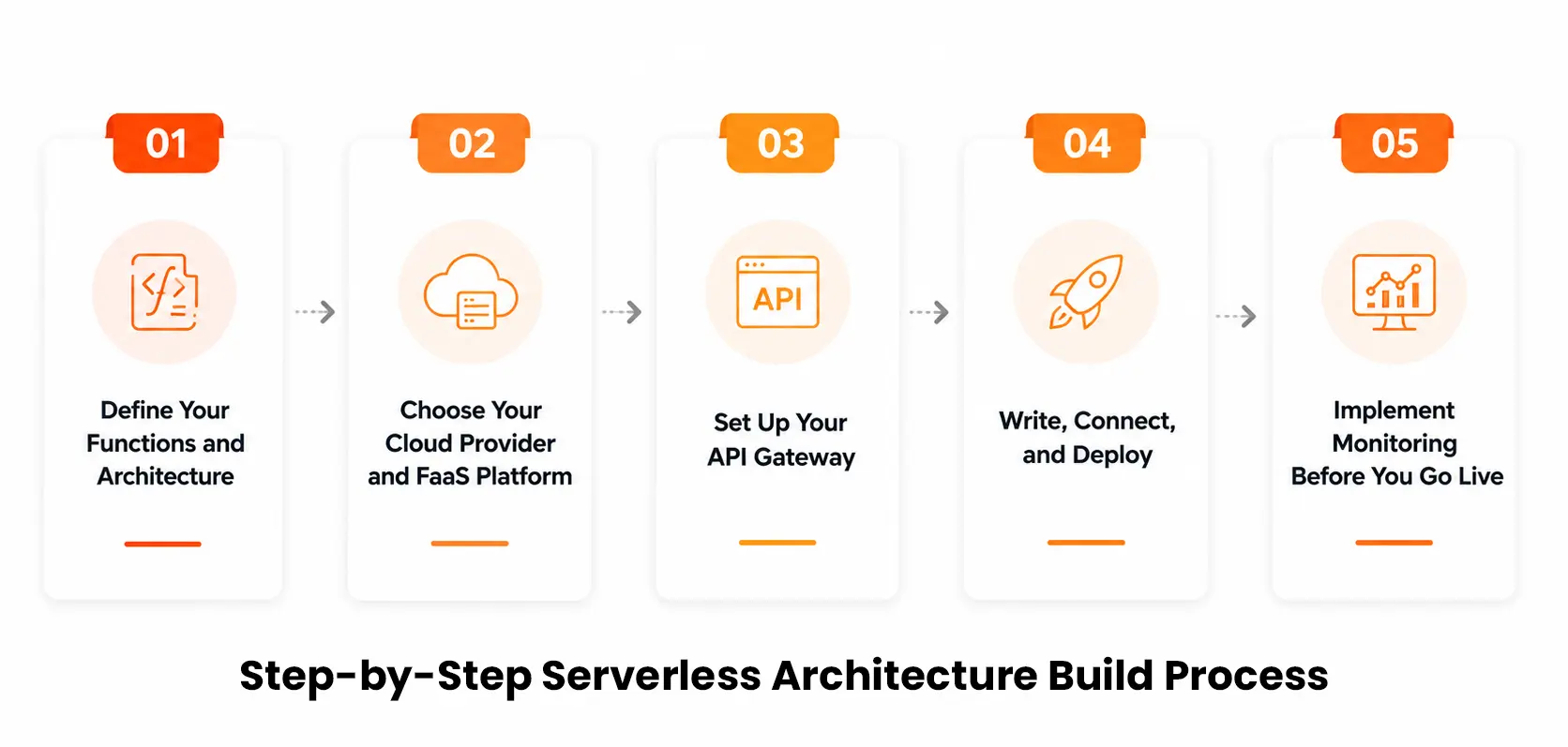
Start by deploying one isolated feature or a new workflow as a serverless function before migrating your entire application. This approach builds team confidence and expertise without putting your core system at risk. Bellow are the folloing points for serverless architecture build process:
- Define Your Functions and Architecture
Break your application logic into small, focused functions where each one does a single specific thing. This step prevents the common mistake of building serverless monoliths that lose most of the model’s advantages.
- Choose Your Cloud Provider and FaaS Platform
AWS Lambda is the most mature option with the largest ecosystem. Google Cloud Functions offer strong performance for AI integration and data processing workloads. Azure Functions are the natural choice for Microsoft-centric organizations. Your existing infrastructure and team expertise should guide this decision.
- Set Up Your API Gateway
For any web application or mobile-facing functions, an API Gateway routes incoming requests to the appropriate serverless functions. It also handles authentication, rate limiting, and request routing from a single entry point.
- Write, Connect, and Deploy
Write your function code in your preferred language, connect it to a managed database service such as AWS DynamoDB or Google Firestore, configure your event triggers, and deploy. Most FaaS platforms support Node.js, Python, Go, and Java among other languages.
- Implement Monitoring Before You Go Live
Because serverless functions are ephemeral and distributed, monitoring requires centralized structured logging and distributed tracing. Set up tools like AWS CloudWatch or Datadog before launch so you have full visibility into performance from day one.
The Benefits of Serverless Architecture That Change How Businesses Operate
The case for serverless goes well beyond technical elegance. Here are the benefits that businesses actually experience when they make the transition.
- Dramatically Lower Infrastructure Costs
The pay-per-execution model means you pay nothing when your application receives no traffic and scale automatically during spikes. Postlight reduced their monthly infrastructure costs from over ten thousand dollars to approximately three hundred and seventy dollars after switching to serverless. This is not unusual.
- Faster Development and Shorter Time to Market
With no servers to configure and no capacity planning to run, development teams can focus entirely on writing business logic. For any custom mobile app development services provider, this translates directly into shorter project timelines and more competitive delivery for clients.
- Automatic Scaling Without Manual Intervention
Whether your application receives one request per day or one million per minute, serverless functions handle the load automatically. There is no need to predict traffic in advance or provision capacity for worst-case scenarios that may never materialize.
- A Smaller Security Attack Surface
With no persistent servers to patch and no long-running processes for attackers to exploit over time, many common vulnerability categories simply disappear. For any cloud solution provider serving clients in regulated industries, this is a significant advantage.
- Developer Productivity Focused Entirely on Business Value
Engineering talent is expensive. Every hour a developer spends on infrastructure management is an hour not spent building features that differentiate your product. Serverless removes infrastructure concerns from the development workflow entirely, which is especially impactful for a mobile app development firm where developer time directly affects project economics.
Why the Best Serverless Architecture for Cloud-Based AI Makes Perfect Sense?
The intersection of AI integration and serverless computing is one of the most important developments happening in cloud technology right now. AI inference workloads, which involve running a trained model against new input data, are inherently event-driven. A user submits a request, the model processes it, and a result is returned. The traffic is unpredictable, the compute demand varies throughout the day, and the cost of running GPU instances continuously to serve occasional requests is difficult to justify.
This is precisely where the best serverless architecture for cloud-based AI delivers its greatest value. AWS Lambda, Google Cloud Functions, and Azure Functions all now support GPU-backed execution environments designed specifically for AI workloads. Businesses building AI-powered features into their web application or mobile products can deploy inference functions serverlessly, paying only for the compute consumed by actual user requests rather than maintaining expensive dedicated hardware around the clock.
Serverless vs Traditional Infrastructure: The Honest Comparison
Understanding where serverless wins and where it requires careful consideration helps you make better architectural decisions for your specific application.
| Factor | Traditional Server | Serverless |
|---|---|---|
| Cost Model | Fixed monthly regardless of usage | Pay only per execution |
| Infrastructure Management | Full team responsibility | Completely provider-managed |
| Scalability | Manual or pre-scheduled | Automatic and immediate |
| Idle Cost | Full price at all times | Zero cost at zero traffic |
| Deployment Speed | Hours to days | Minutes |
| Developer Focus | Split between code and operations | 100% on business logic |
| Best Suited For | Constant high-load workloads | Variable and event-driven apps |
For most modern applications with variable traffic patterns, serverless delivers the best combination of cost, speed, and operational simplicity. Applications with sustained constant high-volume loads may find that a hybrid approach combining serverless functions with reserved compute capacity produces the most economical outcome overall.
How the Serverless Architecture Market will Look Like in 2028 and Beyond
The serverless architecture market is evolving rapidly, and several trends are expanding what this technology can do across a wider range of use cases.
- WebAssembly Is Solving the Cold Start Problem
WebAssembly runtime environments are enabling serverless functions to initialize in microseconds rather than the hundreds of milliseconds associated with traditional cold starts. This development opens serverless to a much broader range of latency-sensitive applications.
- Serverless Databases Are Maturing
Platforms like Amazon Aurora Serverless and PlanetScale extend the pay-per-use model to data persistence, creating a fully serverless architecture from front-end to database without any infrastructure management required.
- AI-Native Serverless Functions Are Arriving
The next generation of FaaS platforms will include built-in AI capabilities at the function level, allowing developers to incorporate machine learning inference directly into serverless functions without managing separate infrastructure.
- Enterprise Security Tooling Is Catching Up
Purpose-built security monitoring and compliance validation tools designed specifically for serverless environments are now commercially available, removing one of the remaining barriers to enterprise adoption in regulated industries.
AWS Lambda vs Google Cloud Functions vs Azure Functions: Find Your Best Fit
Choosing the right FaaS platform is one of the most consequential decisions in building a serverless architecture. Each of the three major platforms has genuine strengths that make it the natural choice for specific contexts.
| Feature | AWS Lambda | Google Cloud Functions | Azure Functions |
|---|---|---|---|
| Provider | Amazon Web Services | Google Cloud | Microsoft Azure |
| Maximum Execution Time | 15 minutes | 60 minutes | Unlimited (Premium plan) |
| Cold Start Performance | Fast | Very Fast | Moderate |
| Free Tier | 1M requests per month | 2M requests per month | 1M requests per month |
| AI/ML Integration | Strong via SageMaker | Excellent via Vertex AI | Good via Azure AI |
| Best Ecosystem Fit | General purpose AWS | AI and data workloads | Microsoft tech stack |
| Edge Deployment | Lambda@Edge | Cloud Run | Azure Static Web Apps |
| Language Support | Broad (13+ languages) | Node, Python, Go, Java | Broad (8+ languages) |
For teams without a strong existing cloud provider relationship, AWS Lambda offers the most mature ecosystem and the widest range of integration options. The organizations with significant AI integration requirements or Google Workspace dependencies, Google Cloud Functions provide superior performance. Meanwhile, enterprises already using Microsoft 365 or Azure Active Directory, Azure Functions integrate most naturally into the existing technology stack.
Build Your Serverless Future with Dreamer Technoland
Making the transition to serverless architecture requires more than understanding the technology. It requires experienced professionals who have navigated the practical challenges of designing, building, and operating serverless systems in production environments across different industries and use cases.
At Dreamer Technoland, we provide end-to-end cloud solution provider services that include full-stack serverless development across AWS Lambda, Google Cloud Functions, and Azure Functions. As a web app development services company with expertise spanning mobile, enterprise, and custom software, our team designs serverless architectures that are cost-efficient from day one, secure by design, and built to scale alongside your business goals rather than constrain them.
Dreamer Technoland does not apply serverless as a one-size-fits-all answer. We help you identify exactly where serverless creates genuine value for your specific workloads and design a strategy that maximizes those benefits while managing the trade-offs intelligently.
Serverless Is Not the Future. For Many Businesses, It Is Already the Present.
The serverless architecture market growing from USD 9.1 billion toward USD 36.8 billion in five years reflects something straightforward: businesses that have tried serverless are not going back. Lower costs, faster shipping, automatic scaling, and a reduced operational burden are not theoretical benefits. They are real outcomes that thousands of organizations are experiencing in production today.
The businesses building on serverless now are setting themselves up for a compounding advantage over time. More budget for product development, more features reaching customers sooner, and infrastructure that never becomes the bottleneck during your most important growth moments. The question for most organizations is no longer whether to adopt serverless, but how to make the transition thoughtfully and effectively.
Ready to build smarter on the cloud? Contact Dreamer Technoland today for a free consultation on your serverless architecture project.
Frequently Asked Questions
Q. What is the difference between serverless architecture and microservices?
A. Microservices divide an application into independent services, while serverless is a cloud execution model where the provider manages the infrastructure. You can build microservices using serverless functions, but they are different architectural concepts.
Q. How serious is the cold start problem in serverless, and can it be solved?
A. Cold starts can add a short delay, usually a few hundred milliseconds to a couple of seconds. They can be reduced using provisioned concurrency, lightweight runtimes like Node.js or Go, and optimized application design.
Q. Is serverless architecture secure enough for applications handling sensitive data?
A. Yes. Major cloud providers offer enterprise-grade security and compliance, including SOC 2, HIPAA, and PCI DSS. Since there are no persistent servers, serverless also reduces many traditional security risks.
Q. Can existing applications be migrated to serverless, or is it only for new projects?
A. Existing applications can be migrated gradually. Start with components like background jobs, APIs, or scheduled tasks, then move more complex workloads after evaluating their architecture.
Q. How does serverless architecture support AI integration in business applications?
A. Serverless is ideal for AI workloads because it scales automatically and charges only for actual usage. It enables businesses to deploy AI-powered features without managing dedicated infrastructure, helping reduce costs and simplify operations.