



Every time you unlock your phone with a glance, check in at an airport kiosk without touching a screen, or get flagged by a banking app before a suspicious transaction goes through, you are interacting with AI-powered face recognition software. What used to feel like science fiction is now a quietly running layer of intelligence embedded into the systems businesses rely on every day.
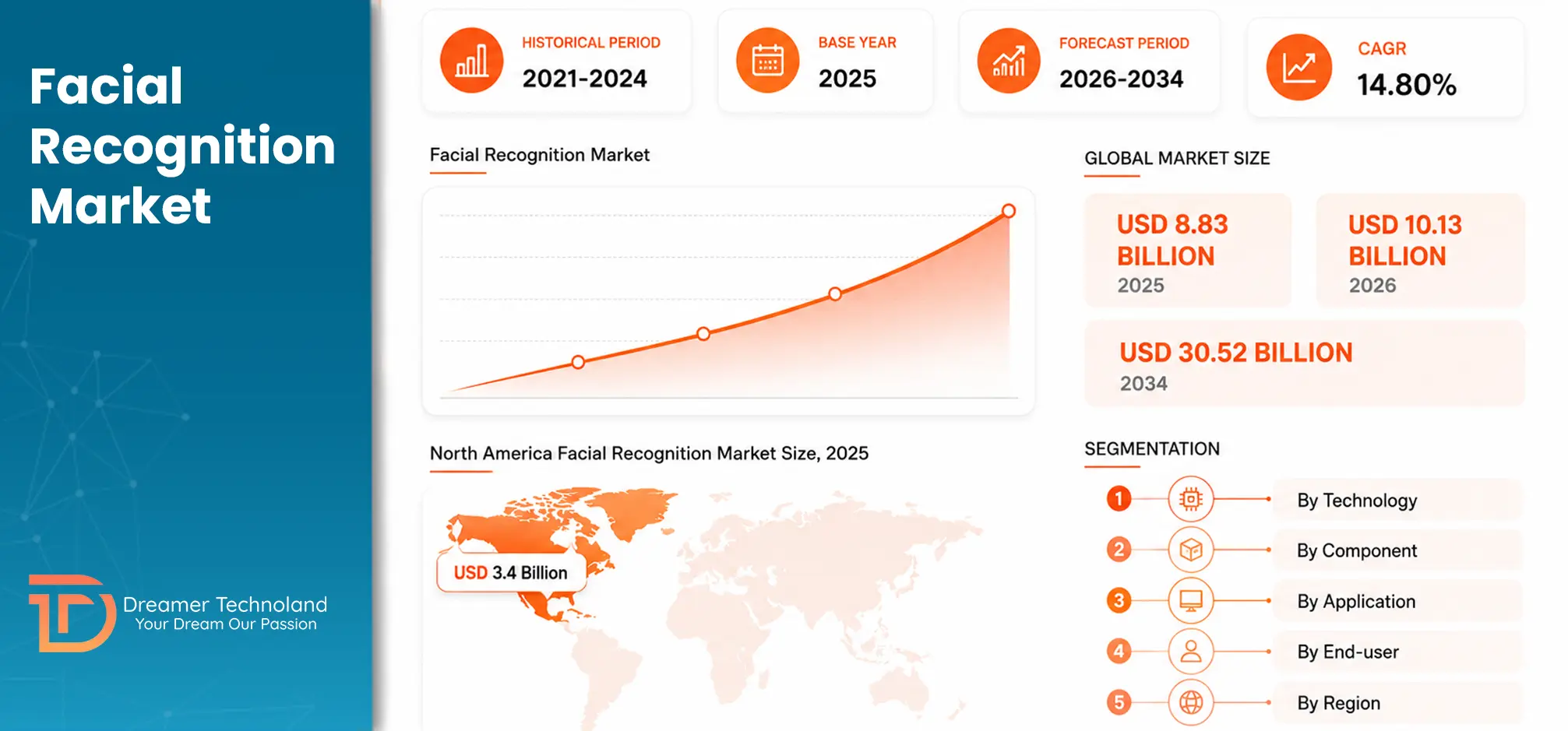
The growth behind this technology reflects genuine, widespread adoption rather than speculative investment. According to Fortune Business Insights, the global facial recognition market was valued at approximately USD 8.7 billion in 2026 and is projected to grow at a compound annual growth rate of 17.8% through 2032, driven primarily by rising demand in banking, retail, travel, and government identity programs. Software solutions currently represent the largest share of that market, overtaking hardware as the dominant spend category.
Whether you are a CTO evaluating this technology for your product, a business owner trying to understand the cost and feasibility, or a developer looking for a clear technical walkthrough, this guide covers everything worth knowing. From how the pipeline actually works and what it costs to build, to which industries are using it most effectively and what compliance challenges you need to plan for before writing a single line of code.
Face Recognition Technology in Plain Language: What It Actually Does
AI-powered face recognition software is a computer vision technology that identifies or verifies a person based on the unique geometric patterns of their face. The system reads characteristics like the distance between the eyes, the shape of the jawline, the depth of the eye sockets, and the contour of the cheekbones, then converts those measurements into a mathematical representation called a face embedding or faceprint. That faceprint is what gets compared, stored, and matched, not a photograph of the person’s face.
This distinction matters more than it might initially seem, both for understanding how the technology works and for navigating the compliance and consent requirements that apply in most jurisdictions. The system is not saving a picture of you. It is saving a numerical vector, which is a string of numbers that represents the unique spatial relationship between your facial features.
There is also an important functional distinction between two modes of operation that are frequently confused with each other:
- Face Verification (1:1 Matching): The system answers the question: does this face match the face on file for this specific person? This mode is used for unlocking devices, authorizing payments, and confirming identity at a checkpoint. It is a comparison between one live capture and one stored reference.
- Face Identification (1:N Matching): The system answers the question: who is this person among everyone in the database? This mode searches across potentially thousands or millions of stored profiles to find a match. It is used in surveillance, fraud investigation, missing person searches, and large-scale access control environments.
Understanding which mode your use case requires is one of the first and most consequential decisions in any face recognition development project, because it affects the technical architecture, the database design, the matching speed requirements, and the applicable regulatory framework significantly.
How Face Recognition Software Works Step by Step?
Regardless of which vendor, framework, or deployment environment you are working with, every AI-powered face recognition system follows the same fundamental five-stage processing pipeline. Understanding each stage is important not just for technical clarity but because each one represents a decision point where your development team will need to make deliberate choices about technology, accuracy trade-offs, and computational cost.
| Stage | What Happens | Common Technologies Used |
|---|---|---|
| Face Detection | The system scans an image or video frame and identifies the location of human faces, drawing a bounding box around each one it finds. | MTCNN, YOLO-based face detectors, Haar Cascades (legacy systems) |
| Face Alignment | The detected face is normalized to reduce variation caused by different head angles, lighting conditions, or camera positions. | Facial landmark detection targeting eyes, nose tip, and mouth corners |
| Feature Extraction | The aligned face is converted into a numerical face embedding that captures the unique spatial characteristics of that person’s facial structure. | Convolutional Neural Networks such as FaceNet, ArcFace, DeepFace, or custom-trained models |
| Face Matching | The generated embedding is compared against stored embeddings in the database to calculate a similarity score. | Cosine Similarity, Euclidean Distance, Vector Search databases |
| Decision and Action | If the similarity score crosses the predefined threshold, the system performs the configured action. | Business logic layer: grant access, trigger alert, log attendance, flag for review |
One of the most significant differences between today’s face recognition systems and earlier generations is the shift from rule-based pattern recognition to deep learning. Earlier systems required engineers to manually define what constituted a distinguishing facial feature. Modern convolutional neural networks learn those features directly from millions of training images, which is the primary reason that accuracy has improved so dramatically over the past five years. Additionally, modern models are now optimized to perform the full matching pipeline within fractions of a second, even on edge devices like phones and kiosk cameras, enabling the real-time experiences that users now expect at payment terminals, airport gates, and mobile banking applications.
Why 2026 Is a Smart Time to Build in This Space
The facial recognition market in 2026 is no longer in an early-adopter phase. It is a maturing, commercially validated technology with a well-established vendor landscape, a growing regulatory framework, and clear evidence of return on investment across multiple industries. The timing question is therefore less about whether to invest and more about how to enter the market in a way that is technically sound, compliant, and positioned for the growth that the projections consistently support.
| Metric | 2026 Estimate | Direction |
|---|---|---|
| Global market value | USD 8 to 10 billion (multiple research estimates) | Consistent upward trajectory across all major reports |
| Projected CAGR through early 2030s | Mid-teens to mid-twenties percent | Driven by fintech, retail, travel, and government programs |
| Software share of total market spend | 50 percent and growing | Growing faster than hardware infrastructure spend |
| Fastest-growing use case | Payments and contactless authentication | Rising demand from fintech and retail sectors |
| Fastest-growing region | Middle East and parts of Asia-Pacific | Driven by national ID and digital travel programs |
| Regulatory pressure | Increasing globally | EU AI Act and U.S. state privacy laws driving demand for privacy-by-design solutions |
The regulatory environment is tightening globally, but this is creating an opportunity rather than just a constraint. Businesses that build compliance into their face recognition systems from the start are better positioned than those retrofitting it later under pressure.
Which Industries Are Getting the Most Value From Face Recognition Right Now
The practical applications of face recognition technology span far more industries than the surveillance use cases that tend to dominate public conversation. The following overview covers the primary use cases by sector and why they create measurable business value.
| Industry | Primary Use Cases | Why It Matters |
|---|---|---|
| Banking and Fintech | Customer onboarding (KYC), identity verification, secure login | Reduces identity fraud while delivering faster and more secure authentication experiences for customers |
| Retail and E-Commerce | Loss prevention, customer recognition, personalized shopping | Reduces theft, improves customer engagement, and enables tailored product recommendations at scale |
| Travel and Aviation | Biometric check-in, security screening, boarding | Speeds up passenger processing, reduces queue times, and strengthens airport security protocols |
| Healthcare | Patient identification, EHR access, appointment check-in | Prevents patient record mismatches, improves data accuracy, and streamlines clinical workflows |
| Education | Automated attendance tracking, campus access control | Reduces manual administrative workload while improving campus safety and operational efficiency |
| Corporate Security | Employee authentication, visitor management, access control | Replaces physical ID cards with secure contactless access to offices and restricted areas |
| Government and Public Services | National ID programs, border control, benefits fraud prevention | Enables large-scale identity verification, strengthens security, and improves public service delivery |
How to Build Face Recognition Software?
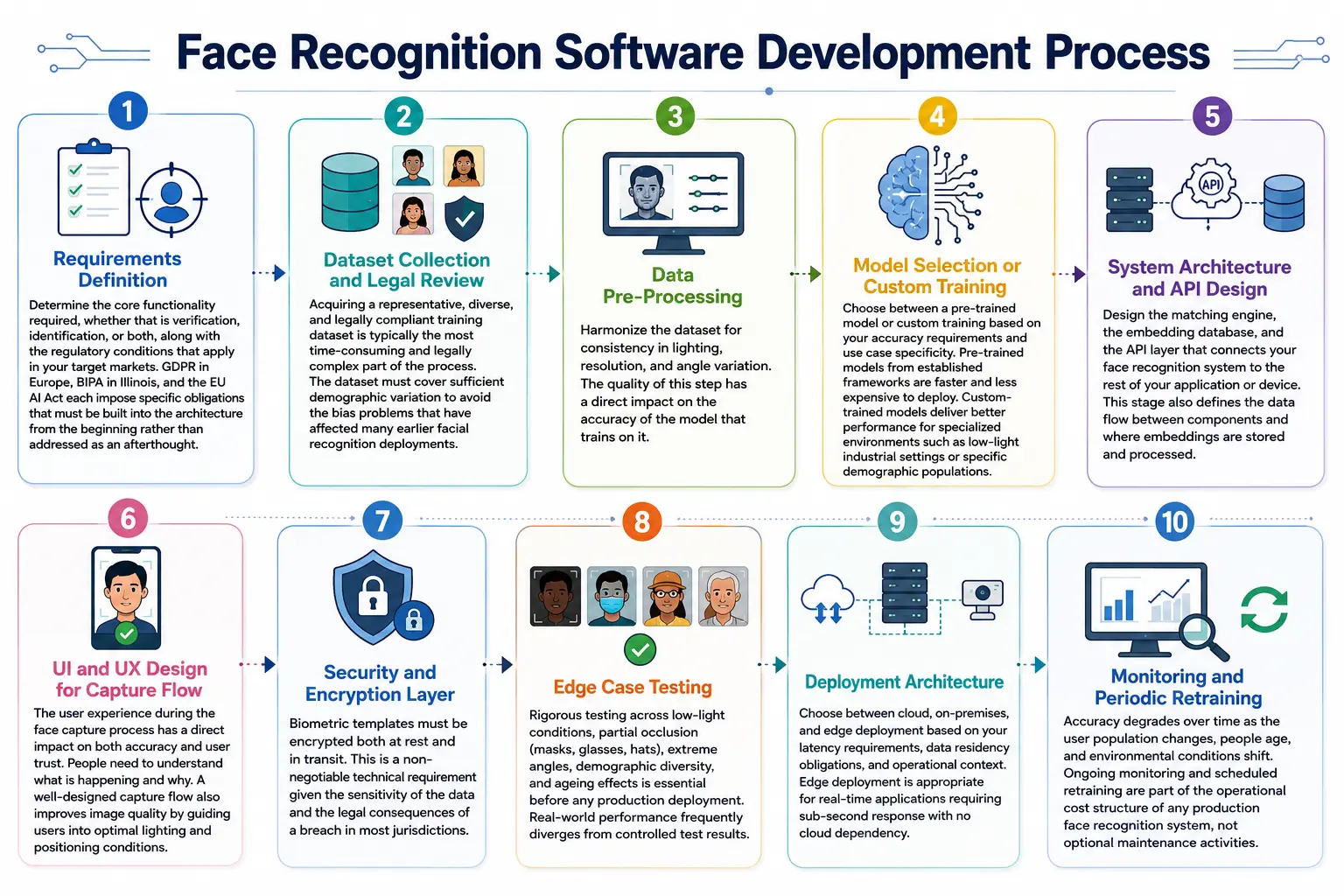
Building a production-ready face recognition system involves considerably more than connecting to an off-the-shelf API. The following process reflects what a well-structured development engagement actually looks like from initial scoping through to post-deployment monitoring.
Build From Scratch, Customize an SDK, or Use a Pre-Built API: Which Path Is Right for You?
The development approach you choose has a significant impact on your time to market, your total cost, and the level of control you retain over accuracy tuning and data handling. The following comparison covers the three primary options that businesses typically evaluate.
| Approach | Best For | Typical Cost Range | Key Trade-Off |
|---|---|---|---|
| Pre-built API (cloud vision APIs) | Startups and MVPs needing fast time-to-market | USD 0 to USD 25,000 (usage-based pricing) | Limited control over accuracy tuning and data residency |
| Customized platform on top of existing SDKs | Mid-sized businesses with specific workflows | USD 30,000 to USD 120,000 | Faster than a full custom build but still has some flexibility constraints |
| Fully custom-built system | Enterprises with unique accuracy, compliance, or scalability needs | USD 120,000 to USD 300,000+ | Highest upfront cost, but full control over data, model, and intellectual property |
Most businesses start with a pre-built API for their MVP to validate the use case and user experience before committing to custom model training. This staged approach reduces early-stage risk and gives the team real-world data to inform the more expensive custom development that follows.
What Does It Actually Cost to Build Face Recognition Software in 2026?
Development cost in this space is determined by a combination of model complexity, the volume and diversity of training data required, the breadth of integrations needed, and the compliance tooling the deployment environment demands. The following ranges reflect typical project scopes observed across the industry in 2026.
| Project Complexity | Core Features | Estimated Timeline | Estimated Cost |
|---|---|---|---|
| Basic | Single-purpose verification such as app login or door access | 2 to 4 months | USD 25,000 to USD 50,000 |
| Mid-Tier | Multi-use verification and identification, dashboard, real-time alerts, and reporting | 4 to 8 months | USD 50,000 to USD 130,000 |
| Enterprise | Custom-trained models, multi-site deployment, compliance tooling, liveness detection, and advanced analytics | 8 to 14 months | USD 130,000 to USD 300,000+ |
It is worth noting that the ongoing operational cost of monitoring, retraining, and maintaining a production face recognition system is a significant line item that many project budgets underestimate at the planning stage. Building a realistic long-term cost model that includes these activities from the beginning leads to better budgeting decisions and fewer unpleasant surprises after launch.
The Four Challenges That Can Derail a Face Recognition Project If You Ignore Them
Face recognition development has a set of recurring challenges that have caused real-world failures across commercial and government deployments alike. Each of them is solvable with the right planning, but none of them can be retrofitted easily once a system is in production.
| Challenge | Risk If Ignored | Recommended Solution |
|---|---|---|
| Demographic bias | Higher error rates for underrepresented groups and potential legal exposure under anti-discrimination regulations | Train models on diverse datasets and conduct regular bias audits across demographic segments throughout the product lifecycle |
| Spoofing attacks | Photos, printed images, videos, or silicone masks used to deceive the system and bypass authentication | Implement liveness detection methods such as blink detection, 3D depth sensing, and infrared verification to confirm the face is real |
| Data privacy violations | Regulatory penalties, reputational damage, and permanent loss of user trust | Encrypt biometric templates at rest and in transit, minimize data retention periods, and obtain explicit informed user consent before capture |
| Regulatory fragmentation | Compliance issues across different states, countries, and legal frameworks simultaneously | Build a compliance framework that adapts to regional requirements from the beginning, covering GDPR, BIPA, and the EU AI Act as a minimum baseline |
| Accuracy drift over time | Reduced recognition performance as the user population ages and environmental conditions shift | Schedule periodic model retraining and performance evaluation as a standard operational activity rather than an exception |
The Short Version: What This Guide Comes Down To
Face recognition technology has matured to the point where the core question for most businesses is no longer whether the technology works. It demonstrably does, across a wide range of environments and use cases. The more important questions are whether your specific deployment is built correctly, whether it handles the compliance requirements of your markets, and whether your team has planned for the ongoing operational investment that keeping it accurate over time requires.
- The system does not store your face: It stores a mathematical faceprint, a vector of numbers representing facial geometry. Understanding this distinction matters for both technical architecture and regulatory communication.
- Verification and identification are different problems: Matching one face against one stored reference is architecturally different from searching one face across millions. Choosing the wrong approach for your use case creates avoidable technical and compliance problems.
- Cost ranges from USD 25,000 to USD 300,000+: The right starting point depends on your use case, accuracy requirements, and compliance obligations. Most businesses benefit from beginning with a pre-built API and scaling to custom development as requirements become clearer.
- Bias, spoofing, and compliance are not edge cases: They are the three most common reasons face recognition projects face legal challenges or public backlash. Addressing them from the beginning of the development process is significantly less expensive than fixing them after deployment.
- Ongoing retraining is part of the cost structure: A face recognition system that is not monitored and periodically retrained will degrade in accuracy as the world changes around it. Budget for this as an operational line item from day one.
Building Your Face Recognition Solution with Dreamer Technoland
At Dreamer Technoland, we bring deep expertise in AI-powered software development, computer vision, and biometric system design to every face recognition project we take on. Our team understands both the technical complexity of building accurate, production-grade recognition pipelines and the regulatory landscape that any commercially deployed biometric system must navigate.
We work with businesses across banking, retail, healthcare, and enterprise security to design and build face recognition solutions that are accurate, compliant, and built for the real-world conditions their users operate in. Whether you are starting with an MVP to validate a concept or building a full-scale enterprise deployment with custom model training and multi-site infrastructure, we design an approach that fits your timeline, your budget, and your long-term roadmap.
Every face recognition project we deliver starts with a clear compliance review, because the most expensive problems in biometric software development are the ones that show up after launch.
Face Recognition Is Not the Future of Identity. It Is Already the Present.
The businesses building on face recognition technology today are not early adopters taking a speculative bet. They are responding to a clear market shift in how identity verification, access control, and personalized service delivery are expected to work. The technology is proven, the market is growing, and the regulatory frameworks, while still evolving, are becoming clearer rather than more ambiguous.
What separates the successful deployments from the ones that run into problems is almost always a question of planning rather than technology. The systems that work well in production are the ones that addressed demographic bias in training, implemented liveness detection from the start, built compliance into the architecture rather than bolting it on later, and budgeted for ongoing monitoring and retraining as a normal operational cost.
If you are considering a face recognition development project and want to understand what the right approach looks like for your specific use case and market, the conversation is worth having before the development starts rather than after.
Frequently Asked Questions
Q. How accurate is AI face recognition software in 2026?
The best commercial solutions currently offer accuracies of less than 1% in good light and optimal conditions, but their accuracy suffers if the lighting is poor or the angle is extreme, or the camera quality is bad, which is why real-world tests are more important than lab tests.
Q. Is facial recognition software legal for businesses to use?
This varies depending on the location. In jurisdictions such as the EU AI Act and various U.S. states, there are strict consent and data handling requirements, and so legal analysis should precede the development process rather than follow it.
Q. How long does it take to build a facial recognition system?
For simple, single-purpose solutions, the time required is 2-4 months. For enterprise-level solutions with custom training, compliance tools, etc., it can be 8 to 14 months or more.
Q. Do I need to train a custom AI model, or can I use an existing one?
Businesses usually begin by using pre-trained models or APIs and switch to custom training if they require better accuracy for their specific application.
Q. What’s the difference between face detection and face recognition?
Detection simply detects the presence of a face in a picture/frame. Recognition takes it to the next level, identifying whose face it is by comparison with other information.