


A business can collect millions of customer records and still struggle to answer one simple question: who should we target next? That is where a DMP data management platform earns its place. Instead of leaving audience data scattered across websites, apps, CRM systems, ad platforms, and partner sources, a DMP brings it together, cleans it, segments it, and makes it usable for campaigns.
But building a data management platform (DMP) in 2026 is not just about collecting more data. Privacy, identity changes, data quality, integrations, and real-time activation now shape the entire architecture. A well-designed platform must turn fragmented signals into useful audience intelligence without creating another data silo.
In this guide, we explain how data management platform development works, what features matter, how businesses can implement one, and where modern DMPs are heading. We’ll also cover practical use cases, benefits, challenges, and the role of custom development today.
Quick overview
A DMP collects data from multiple sources, organizes it into audience segments, analyzes those segments, and activates them across advertising channels. A modern DMP can help advertisers, publishers, marketers, and agencies improve targeting, personalization, campaign measurement, and ROI.
The core flow is simple:
Collect → Clean → Segment → Analyze → Activate → Measure
For businesses needing richer reporting, DMP data can also feed Data Visualization Services and interactive dashboards.
What is a DMP (Data Management Platform)?
A data management platform is software that collects, stores, and organizes audience data from multiple sources, then turns that raw information into usable segments. Unlike a CRM that stores known customer records, a DMP data management platform mostly handles anonymous, cookie- and device-based data used for advertising and targeting. According to Wikipedia’s overview of data management platforms, DMPs emerged specifically to help advertisers unify fragmented audience data for better ad targeting. Today, businesses also lean on a cloud data management platform for flexible storage and a master data management platform to keep records consistent across every department.
Different Types of Data Management Platforms (DMPs)
Take a look at these:
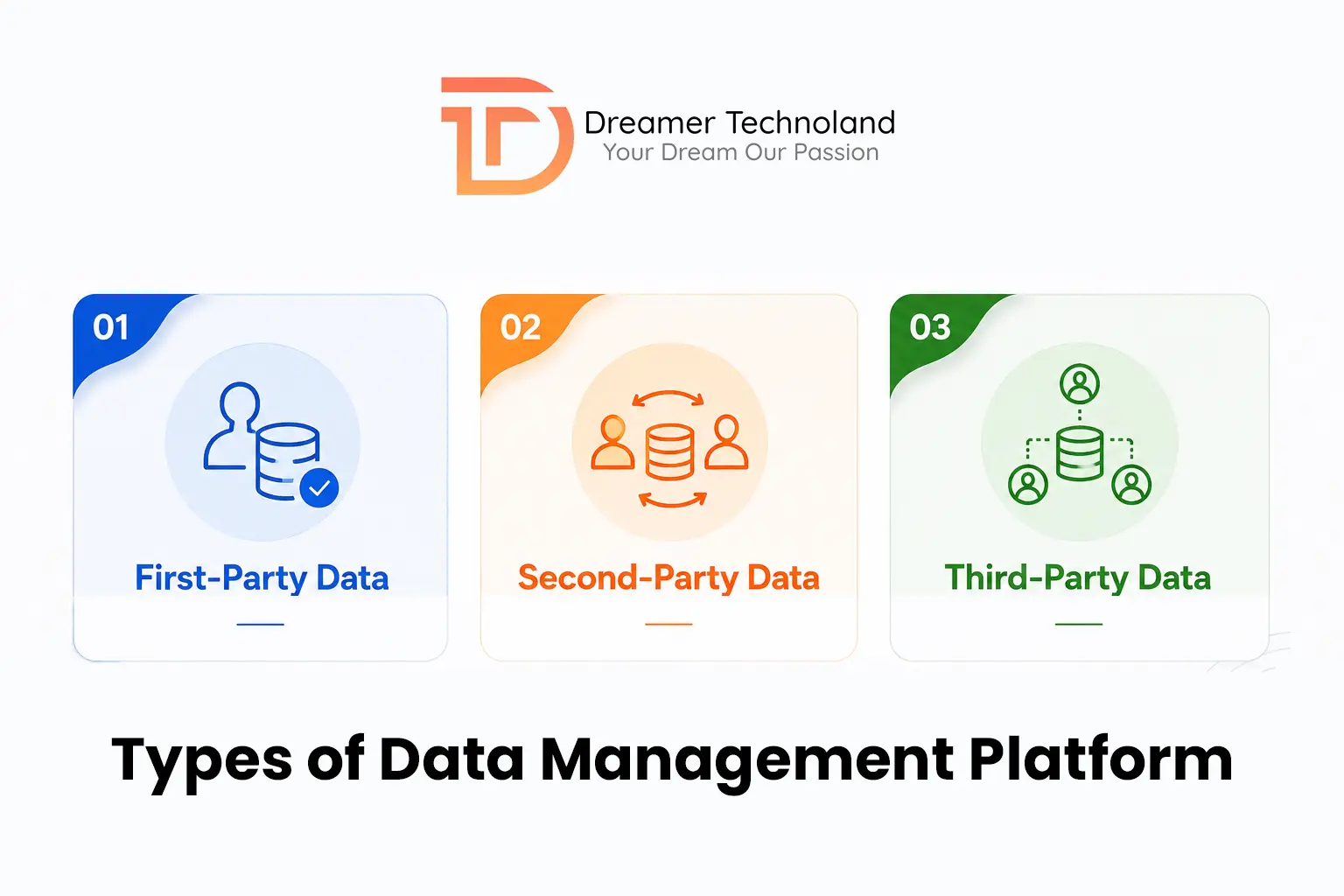
First-Party Data
Collected directly from your own websites, apps, CRM, transactions, subscriptions, and other owned channels. It is usually the most valuable data because you control its collection and context.
Second-Party Data
Another organization shares its first-party data with you under an agreed relationship. It can help expand audience understanding while maintaining a defined data-sharing arrangement.
Third-Party Data
Collected and supplied by external providers or aggregators. Its role is becoming more challenging as privacy requirements and signal loss reshape digital advertising. First-party data is therefore becoming increasingly important.
A strong custom DMP data management platform blends all three, so campaigns are both precise and wide-reaching.
How Does a Data Management Platform Work?
A typical DMP follows four connected stages:
| Stage | What happens |
|---|---|
| Data Collection | Data enters through websites, apps, CRM systems, APIs, pixels, feeds, and partner sources. |
| Data Segmentation | Users are grouped according to behavior, interests, demographics, purchase patterns, or campaign criteria. |
| Data Analysis/Processing | Analytics and machine learning identify patterns and improve audience definitions. |
| Data Sharing/Distribution | Approved segments are activated across advertising and marketing channels. |
This pipeline turns raw information into actionable audience intelligence.
Excellent Features of Data Management Platforms
A custom DMP data management platform should include the following:
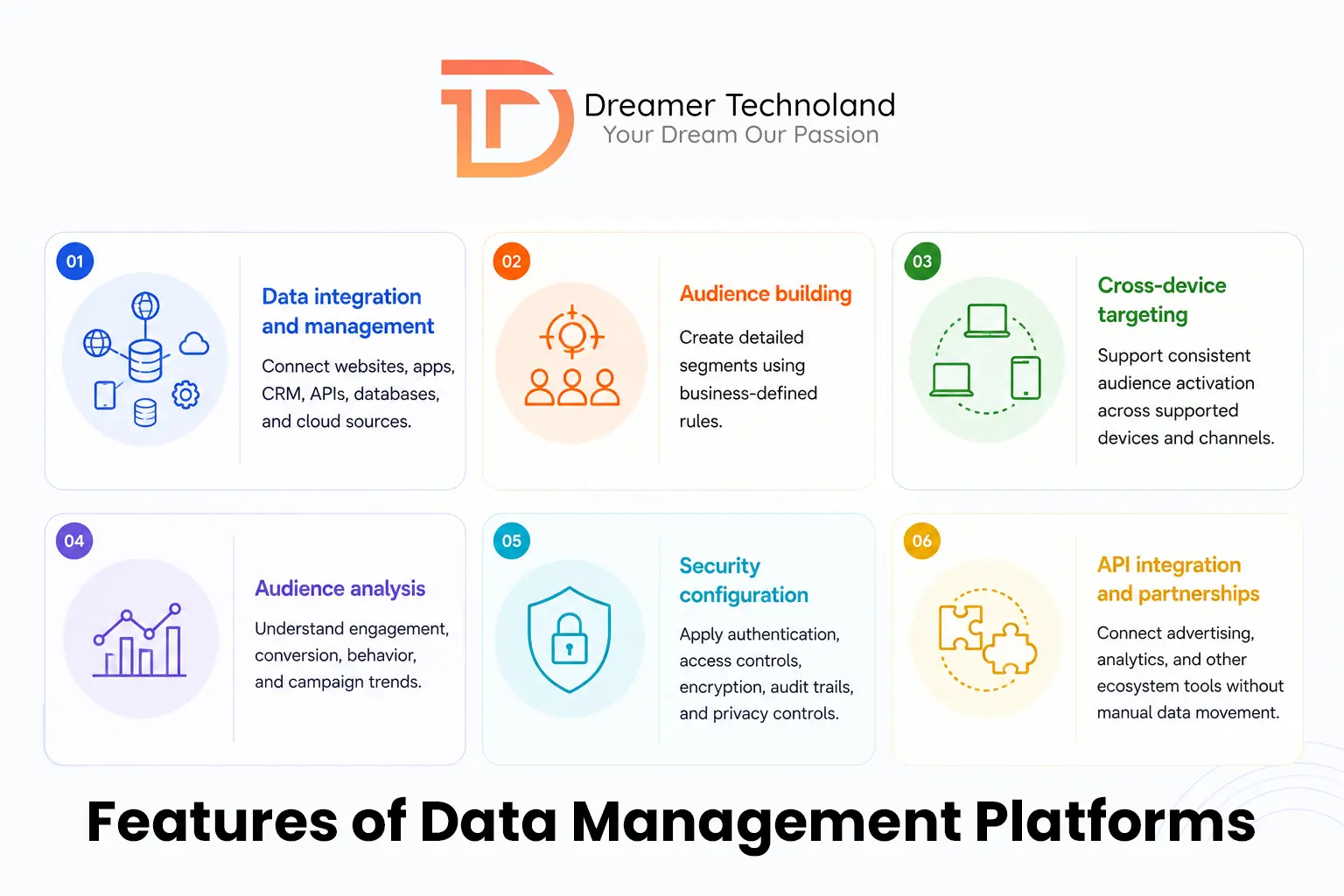
- Data integration and management: Connect websites, apps, CRM, APIs, databases, and cloud sources.
- Audience building: Create detailed segments using business-defined rules.
- Cross-device targeting: Support consistent audience activation across supported devices and channels.
- Audience analysis: Understand engagement, conversion, behavior, and campaign trends.
- Security configuration: Apply authentication, access controls, encryption, audit trails, and privacy controls.
- API integration and partnerships: Connect advertising, analytics, and other ecosystem tools without manual data movement.
For complex reporting requirements, Custom Power BI Dashboard Development Services can turn DMP outputs into interactive performance dashboards.
What can you do with a DMP?
A custom data management platform can support the following:
- Audience segmentation: Build focused groups around behavior and characteristics.
- Cross-channel customization: Deliver more relevant experiences across channels.
- Retargeting and suppression: Re-engage selected audiences while excluding converted users.
- Lookalike modeling: Find audiences with characteristics similar to high-value segments.
- Campaign optimization: Identify which audiences, channels, and campaigns perform best.
- Compliance and governance: Control how data is collected, accessed, shared, and retained.
Who Can Benefit from DMPs?
DMPS are often used for:
- Advertisers looking to improve targeting and media efficiency.
- Publishers seeking stronger audience intelligence and monetization.
- Marketing teams building personalized campaigns.
- Ad agencies managing data-driven campaigns for multiple clients.
The biggest benefits are straightforward: streamlined data management, deeper audience understanding, better customization, and stronger campaign performance.
Top Benefits of DMP Data Management Platform
- Streamlining Data Management: One system instead of scattered spreadsheets
- Improved Understanding: Clear picture of who your audience really is
- Enhanced Customization: Messaging tailored to real behaviour, not guesswork
- Better Campaign Performance: Higher engagement, lower wasted ad spend
It’s worth noting how data visualization helps businesses make better decisions; a DMP’s real value shows up only when insights are presented clearly to decision-makers.
Important Processes in a Data Management Platform (DMP)
A custom data management platform is all about revolving data and performing several major processes on raw data to create useful insights. So, below is a list of processes it includes:
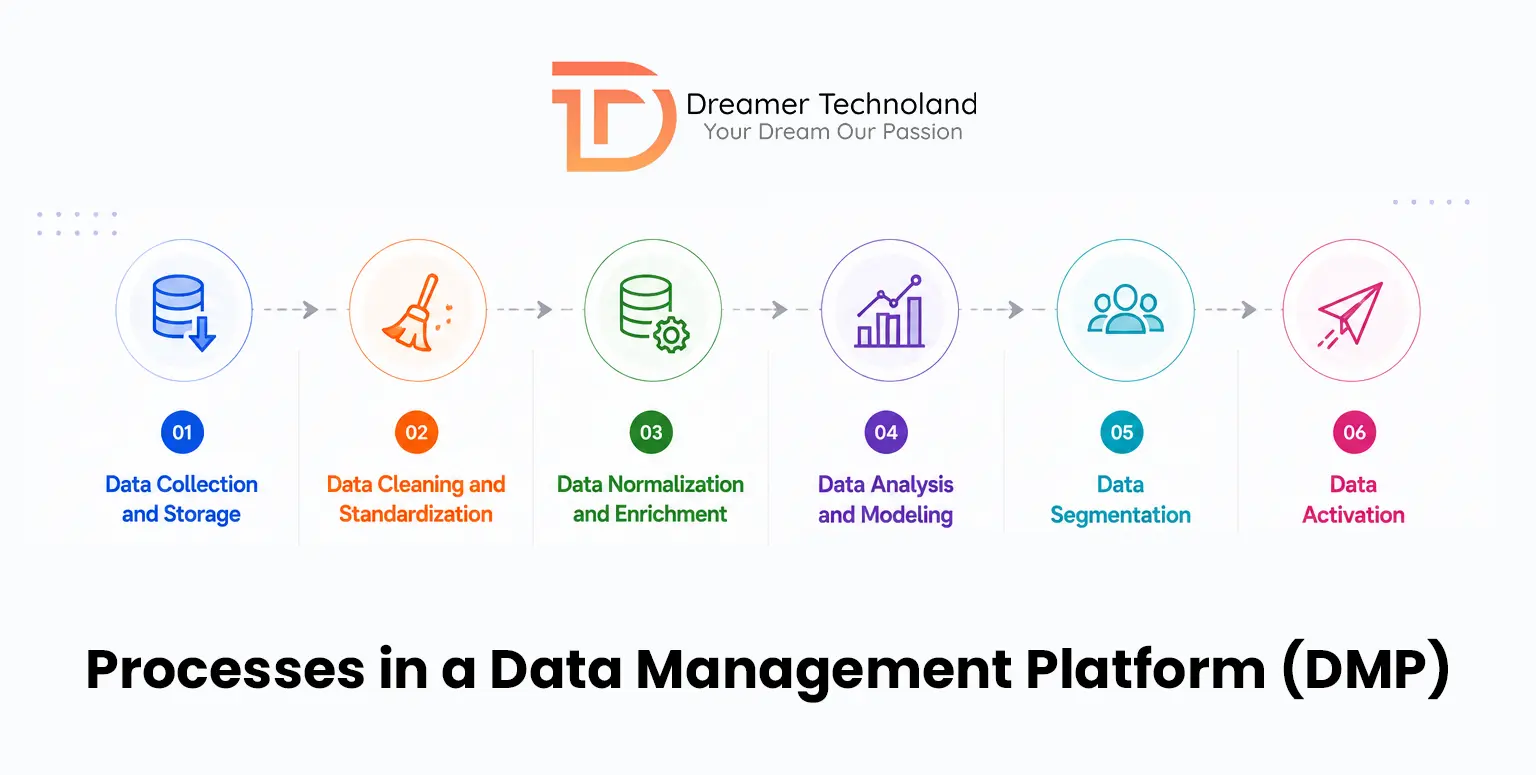
Data Collection and Storage
This involves sourcing, extracting, and importing data, such as collecting from different sources and then loading it into the DMP.
Data Cleaning and Standardization
For quality purposes, a DMP in advertising has three major aspects, i.e validation, cleansing, and standardization.
Data Normalization and Enrichment
Normalizing data formats, structuring information effectively, and enriching profiles with third-party insights allows a DMP to build precise and comprehensive audience profiles.
Data Analysis and Modeling
This phase is about getting insights & predictions from data, so DMPs can understand patterns, trends, and relationships between data.
Data Segmentation
It includes dividing data into different groups based on defined criteria, including audience interest, purchase history, preference, and other factors.
Data Activation
This is the stage where refined data is finally created for some actionable outcomes in advertising.
How To Implement a Data Management System in Your Ad Business?
- Define Objectives and Requirements: Start with the business problem. Decide whether the priority is targeting, audience insights, personalization, campaign optimization, or measurement.
- Choose the Right Data Management Platform or Tech Partner: Evaluate scalability, integrations, privacy controls, analytics capabilities, APIs, and total ownership cost. For a highly specialized workflow, custom data management platform development may provide more flexibility than an off-the-shelf solution.
- Create an Implementation Plan: Map data sources, audience rules, integrations, user roles, security requirements, and activation channels before development begins.
- System Integration and Configuration: Connect the DMP with CRM, websites, apps, analytics platforms, advertising systems, and other required data sources.
- Training and Onboarding: Give marketing and analytics teams clear workflows for creating segments, reviewing insights, activating audiences, and managing permissions.
- Launch and Monitor: Start with controlled use cases. Monitor data quality, segment performance, system health, consent signals, and campaign outcomes before expanding.
Top Strategies for Effective Data Management
The strongest DMP implementations usually follow a few principles:
- Make first-party data the foundation.
- Build privacy and consent controls into the architecture.
- Standardize data before segmentation.
- Keep audience definitions tied to measurable business goals.
- Use APIs for reliable data movement.
- Monitor data quality continuously.
- Connect DMP insights with analytics and visualization.
- Review audience segments regularly instead of treating them as permanent.
Modern data strategies are increasingly moving toward privacy-safe collaboration and stronger first-party data practices.
Challenges and limitations of Data Management Platforms in 2026
DMPs are useful, but they are not magic solutions.
Privacy is the biggest consideration. Online advertising that involves tracking, storage, or profiling can trigger consent and data-protection obligations, depending on the jurisdiction.
Other challenges include:
- Fragmented and inconsistent source data
- Reduced availability of user-level signals
- Complex identity resolution
- Integration and interoperability issues
- Increasing compliance requirements
- High data storage and processing costs
- Difficulty proving campaign-level ROI
For these reasons, modern DMP architecture should prioritize first-party data, privacy-by-design, strong governance, and flexible integrations.
Why Choose Dreamer Technoland for Custom Data Management Platform Development?
Dreamer Technoland builds custom data solutions around your business model rather than forcing your workflow into a fixed template. Our team can help with data integration, audience management, analytics, dashboards, APIs, security, and scalable cloud architecture.
We also pair DMP builds with custom Power BI dashboard development services, so every segment and campaign metric turns into a dashboard your leadership can act on instantly. Connect with us for a complete DMP management platform development; we can design the architecture around your data sources, users, and growth plans.
Key Takeaways
- A DMP data management platform unifies first-, second-, and third-party data.
- It works through collection, segmentation, analysis, and distribution.
- Businesses use DMPs for targeting, retargeting, and campaign optimization.
- Cloud and master data management platforms extend a DMP’s reach and consistency.
- Choosing the right development partner determines long-term ROI.
A DMP data management platform helps businesses turn fragmented audience data into usable intelligence. Its value comes from more than collection. The real advantage comes from cleaning, segmentation, analysis, activation, and continuous measurement.
In 2026 and beyond, successful DMP development also needs privacy, first-party data strategies, reliable integrations, and flexible architecture. Build those foundations correctly, and your DMP can become a practical engine for better targeting and smarter advertising.
Frequently Asked Questions
Q. What is the difference between DMP and CDP?
A DMP is traditionally focused on audience data, segmentation, and advertising activation, while a CDP generally builds persistent customer profiles using identifiable first-party data across customer touchpoints. The right choice depends on your data strategy and use case.
Q. What are the use cases of DMP in advertising?
DMPs power audience targeting, retargeting, lookalike modeling, frequency capping, and cross-channel campaign optimization.
Q. Is a DMP still relevant with cookies going away?
Yes, DMPs are shifting focus towards first-party data collection and contextual targeting. This makes a well-suited DMP data management platform even more valuable.
Q. How long does data management platform development take?
Timelines vary per your scope; however, a custom build may take a few weeks to a few months, depending on integrations and data volumes.