


Selecting the right AI agent for your business isn’t just a technical decision—it’s a strategic investment that directly impacts your operational efficiency and bottom line. According to McKinsey & Company’s 2024 AI adoption survey, organizations implementing specialized AI agents report productivity improvements of 20-35%. Yet, many enterprises struggle to identify which type of agent best suits their specific needs.
The landscape of different types of AI agents has expanded dramatically over the past few years, ranging from simple reflex-based systems to sophisticated hierarchical agents capable of handling complex decision-making scenarios. This diversity creates both opportunity and confusion. Be prepared for significant cost variations when implementing various AI agent types, with solutions spanning anywhere from $50,000 for basic deployments to over $2 million for enterprise-grade systems with custom integrations.
The challenge lies not in finding an AI agent solution, but in matching the right agent architecture to your environmental constraints and task requirements. Whether you need a reactive system that responds to immediate inputs or a planning-based agent that anticipates future scenarios, understanding the distinct characteristics of each type becomes essential.
What Actually Makes Something an AI Agent?
An AI agent represents a fundamental shift in how machines interact with the world around them. At its core, an AI agent is an autonomous system designed to perceive its environment, process information, and take purposeful actions to achieve specific goals without constant human direction. Unlike traditional software that follows pre-programmed scripts, these intelligent systems can learn from their surroundings and adapt their behavior accordingly.
According to recent research from McKinsey & Company, the enterprise AI agent market is projected to reach $15.7 billion by 2027, reflecting the growing importance of these autonomous systems across industries. This explosive growth underscores why understanding AI agents has become essential for businesses and technology leaders alike.
The key distinction between a standard program and an AI agent lies in autonomy and decision-making capability. Simple reflex agents, for instance, react directly to current input without memory or complex reasoning. In contrast, more sophisticated AI agents integrate perception, planning, and execution to navigate complex environments. Whether managing customer service inquiries, optimizing supply chains, or analyzing data patterns, different types of intelligent agents in AI serve specific purposes tailored to organizational needs.
This is why choosing the right AI agent solution requires understanding how these systems function and what capabilities they bring to your specific challenge. The foundation you build here determines success in implementing enterprise AI agents effectively.
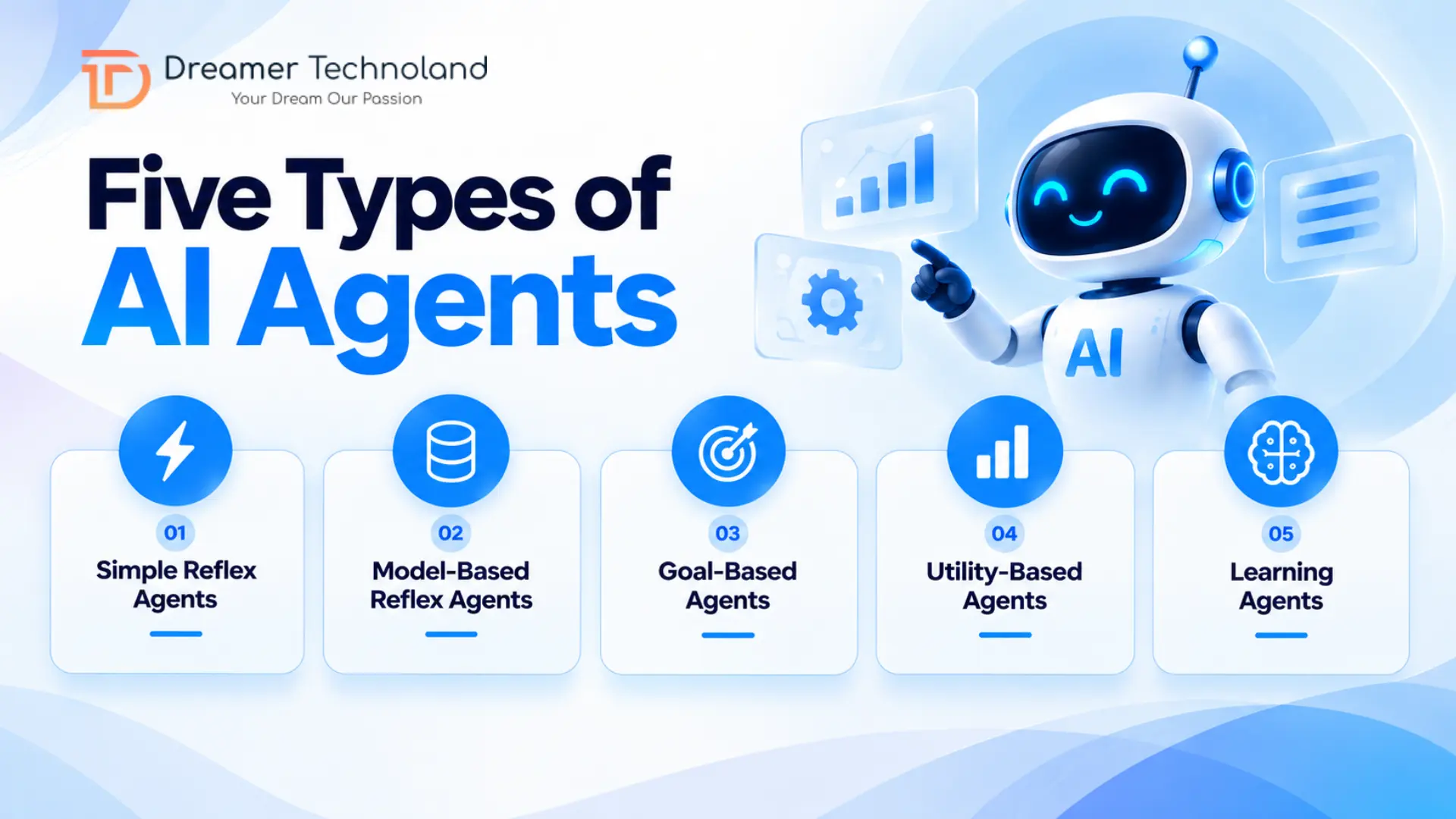
Five Main Types of AI Agents
Understanding the different types of AI agents in AI is essential for organizations planning to implement intelligent automation solutions. Research from McKinsey indicates that companies utilizing specialized AI agent types report a 35-40% improvement in operational efficiency compared to those using generic AI systems. Each category of AI agent serves distinct purposes and operates under different environmental conditions, making it crucial to grasp their core characteristics before deployment.
- Simple Reflex Agents
Simple reflex agents represent the most straightforward form of intelligent agent systems. These agents operate by directly mapping current input to specific actions without considering any history or future consequences. They work exceptionally well in environments with clear cause-and-effect relationships where immediate response is preferable to deliberation.
Consider a customer service chatbot that responds to specific keywords with predetermined answers. When a customer types “refund,” the system immediately provides refund policy information without analyzing previous interactions or contextual nuances. Simple reflex agents excel in rule-based scenarios where the problem space is well-defined, and responses are deterministic. Their primary advantage lies in speed and simplicity, though they struggle in complex environments requiring context awareness or strategic thinking.
- Model-Based Reflex Agents
Model-based reflex agents work in partially observable environments where agents cannot see the complete state of the world at any given moment. These intelligent agents maintain an internal model of their environment, updating this representation as new information arrives through sensors or data inputs.
Think of an autonomous vehicle navigating city streets. The vehicle’s sensors cannot capture every detail, so the AI agent builds and maintains a mental model of road conditions, traffic patterns, and nearby obstacles. As the vehicle moves forward, it continuously updates this internal representation based on new sensor data. This approach enables more sophisticated decision-making than simple reflex agents because the system can reason about hidden information and predict future states. Model-based reflex agents demonstrate superior performance when dealing with incomplete information, making them invaluable for real-world applications where perfect visibility is impossible.
- Goal-Based Agents
Goal-based agents operate with explicit objectives, performing strategic planning to achieve predetermined outcomes. Unlike reflex agents that simply react to stimuli, these agents formulate plans by considering various action sequences and selecting paths most likely to reach their goals.
A project management AI system exemplifies this category. Rather than merely responding to task assignments, the agent considers project deadlines, resource availability, team capabilities, and dependency chains to construct optimal project schedules. These agents excel in scenarios requiring planning and consideration of multiple future possibilities. They’re particularly valuable for supply chain optimization, financial planning, and resource allocation tasks where immediate reactions prove insufficient.
- Utility-Based Agents
Utility-based agents elevate decision-making complexity by handling multiple, sometimes conflicting criteria simultaneously. Rather than pursuing a single goal, these agents evaluate outcomes using a utility function that quantifies preference levels across various objectives.
Imagine an e-commerce recommendation engine balancing customer satisfaction, profit margins, and inventory turnover. A utility-based agent calculates the overall value of recommending specific products by weighing these competing interests. This category of AI agent types proves essential when organizations must navigate trade-offs between contradictory objectives. Insurance claim processing systems use utility-based approaches to balance claim payout amounts against fraud risk and customer retention considerations.
- Learning Agents
Learning agents represent the most advanced category among different types of AI agents. These systems improve performance through experience and adaptation, continuously refining their decision-making processes based on outcomes and feedback loops. Learning agents combine elements from all previous categories while adding machine learning capabilities.
An email filtering system exemplifies this approach. Initially, the agent uses simple rules to classify messages, but as users mark emails as spam or legitimate, the system learns and updates its classification model. Over time, accuracy improves dramatically as the agent discovers patterns humans might overlook. Learning agents demonstrate particular value in dynamic environments where conditions change constantly, making predetermined rules obsolete. They’re fundamental to enterprise AI agents that must adapt to evolving business requirements and market conditions.
Selecting the appropriate AI agent type fundamentally depends on your specific operational requirements, environmental characteristics, and performance objectives. Simple reflex agents suit highly structured, repetitive tasks demanding rapid responses. Model-based systems prove necessary when working with incomplete information. Goal-based and utility-based agents become essential for complex planning scenarios with multiple variables. Learning agents provide long-term value in dynamic environments requiring continuous improvement.
Keep in mind that many real-world applications combine multiple agent types working in coordination. Your choice should align with your organization’s current capabilities, budget constraints, and long-term strategic vision for AI implementation. Understanding these distinctions enables more informed decision-making when evaluating AI agent solutions and planning enterprise AI agent deployments.
All Five Types Side by Side: A Reference You Can Actually Use
| Agent Type | Environment Type | Complexity Level | Primary Use Cases | Scalability |
|---|---|---|---|---|
| Simple Reflex | Fully Observable | Low | Rule-based tasks, straightforward responses | Limited |
| Model-Based Reflex | Partially Observable | Medium | Navigation, sensor-based decisions | Moderate |
| Goal-Based | Dynamic & Complex | Medium-High | Strategic planning, multi-step problem solving | Good |
| Utility-Based | Multi-criteria Scenarios | High | Optimization, trade-off management | Excellent |
| Learning Agents | Evolving Environments | Very High | Adaptive systems, continuous improvement | Excellent |
Understanding the Selection Framework
Choosing the right AI agent type depends directly on your environment’s characteristics and operational requirements. Simple reflex agents excel in fully observable, predictable environments where rules-based responses suffice without complex decision-making. However, if your environment is partially observable or constantly changing, model-based agents become necessary because they maintain internal representations of the world state.
How to Choose the Right AI Agent
Choosing the right AI agent for your organization requires a strategic approach that considers multiple dimensions of your operational environment. It depends on understanding not just what different types of intelligent agents in AI can do, but what your specific business needs demand from them.
Start by evaluating your operational environment’s characteristics. Surprises do not usually happen because you’ve planned for the obvious factors. Instead, focus on assessing whether your environment is fully observable or partially observable, whether conditions remain stable or constantly change, and what level of complexity your decision-making processes involve.
Consider How Well-Defined the Task Is
Simple reflex agents work exceptionally well when you operate in fully observable, predictable environments where cause-and-effect relationships are straightforward. These agents perform best for routine automation tasks where rules remain consistent and inputs are always clear.
Determine Whether the Agent Needs Context
Model-based agents become necessary when your business operates in partially observable or changing environments. These agents maintain internal representations of how your system works, allowing them to handle incomplete information and adapt when circumstances shift. This is why many enterprises implementing custom software product development prioritize model-based approaches.
Identify the Primary Business Goal
Goal-based agents suit situations requiring strategic planning and forward-looking decision-making. When your organization needs to think several steps ahead and work toward specific objectives, these agents provide the necessary framework for multi-stage problem solving.
Evaluate Competing Priorities and Trade-Offs
Utility-based agents excel in scenarios involving multiple competing priorities and trade-offs. Be prepared for environments where no single solution perfectly satisfies all requirements, and you need systems that can balance various criteria intelligently.
Key Factors for Your Selection Process
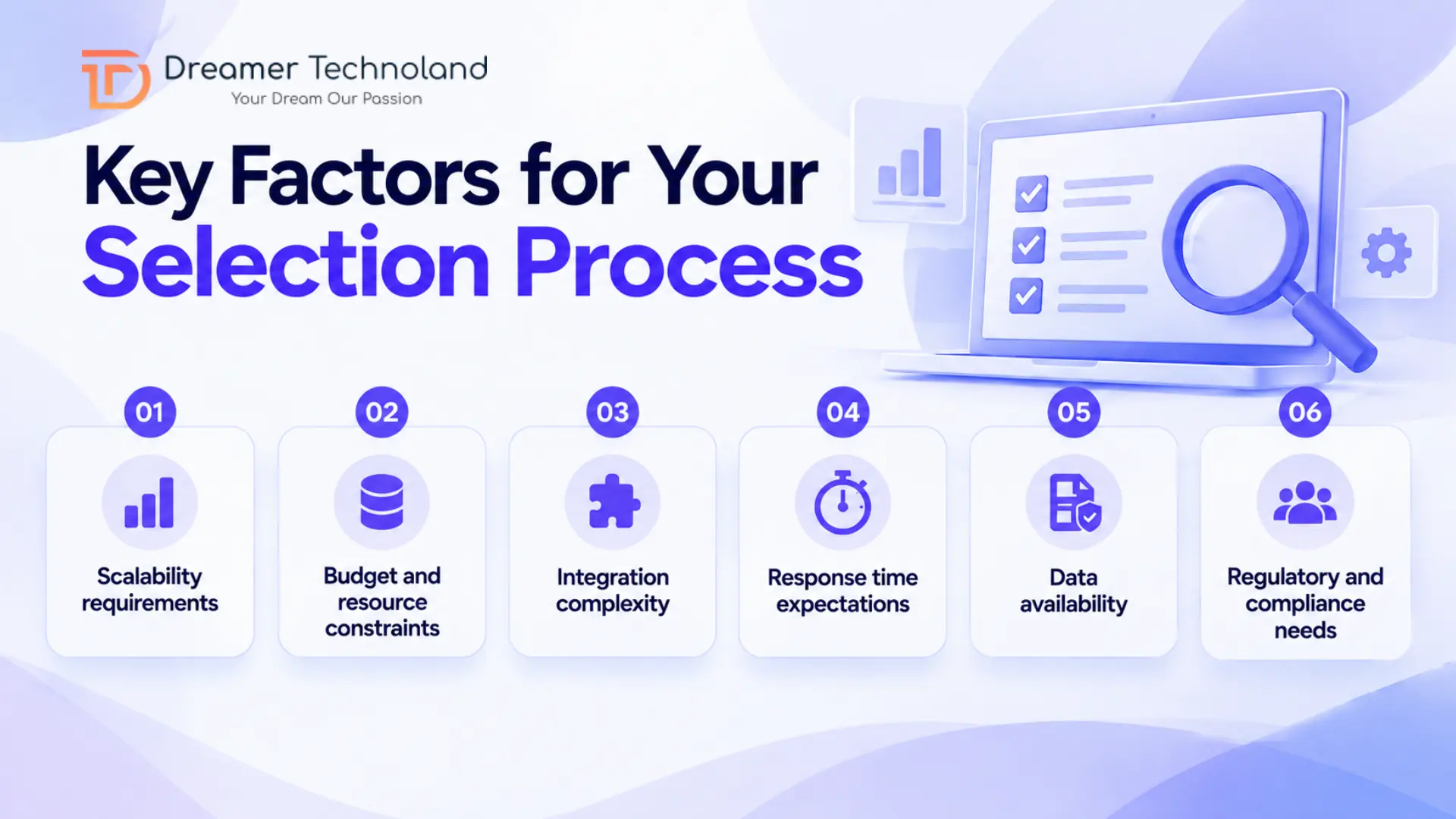
- Scalability requirements: Will your solution need to handle growth from dozens to thousands of transactions daily?
- Budget and resource constraints: Keep in mind that enterprise AI agents and comprehensive AI agent solutions vary significantly in implementation costs and ongoing maintenance needs.
- Integration complexity: Assess whether your existing systems require simple API integration services or comprehensive machine learning development services to connect with new agents.
- Response time expectations: Determine whether real-time decisions matter or batch processing suffices for your use cases.
- Data availability: Evaluate how much historical data and contextual information your agents will access.
- Regulatory and compliance needs: Consider industry-specific requirements that might restrict certain agent types or deployment approaches.
Planning for successful AI agent implementation means being honest about your technical capabilities and resource availability. The bottom line is that different types of AI agents serve different purposes, and selecting wrongly creates downstream problems that become expensive to fix.
You’ll need to pilot different approaches before full-scale deployment. Consider working with experienced partners offering AI development services to validate your assumptions and avoid costly mistakes during the selection and implementation phases.
What Different Industries Are Actually Doing With AI Agents Right Now
Different types of AI agents are transforming how organizations operate across virtually every sector. The key to maximizing their impact lies in understanding which agent types align best with your specific industry challenges and operational goals.
- Financial Services and Risk Management
In banking and finance, reactive agents handle real-time transaction monitoring to detect fraudulent activities instantly. These agents process incoming data streams and respond to suspicious patterns without requiring human intervention. Utility-based agents prove invaluable in portfolio management, where they must balance competing objectives like maximizing returns while minimizing risk exposure. This type of AI agent solution evaluates multiple criteria simultaneously, making nuanced decisions that protect institutional assets while optimizing performance.
- Healthcare and Diagnostics
Multi-agent systems in healthcare enable distributed problem-solving across departments. One agent might analyze patient data, another reviews treatment protocols, and a third coordinates with pharmacy systems. This collaborative approach accelerates diagnosis and treatment planning while reducing errors that could impact patient outcomes.
- Manufacturing and Supply Chain
Goal-based agents streamline inventory management by working toward specific objectives like maintaining optimal stock levels. They automatically trigger orders when thresholds are reached, preventing both shortages and overstock situations. Enterprises implementing these AI agents report significant cost reductions and improved supply chain visibility.
- Retail and Customer Service
Knowledge-based agents deliver personalized product recommendations by understanding customer preferences and purchase history. They handle routine inquiries efficiently, freeing human representatives for complex problems requiring personal judgment and empathy.
This is why selecting the right agent type transforms industry applications from theoretical possibilities into measurable competitive advantages.
Three Mistakes That Make AI Agent Implementations Fail Before They Start
Choosing the right AI agent type is only half the decision. How you approach that choice matters just as much as what you choose. A significant number of organizations invest in AI agent implementations that underperform not because the technology failed them, but because the selection process skipped steps it should not have skipped.
Choosing Based on Trends Rather Than Task Requirements
The most common mistake is selecting an AI agent type because a vendor is promoting it aggressively or because it appears frequently in industry conversations. Reactive, deliberative, and hybrid agent architectures serve fundamentally different operational needs. Applying a deliberative planning agent to a simple rule-based task adds cost and complexity without adding value. Applying a reactive reflex agent to a multi-step planning problem produces consistent underperformance. The starting point for any selection decision should be a clear description of the task, the environment it operates in, and the outputs it needs to produce.
Underestimating Integration Complexity
Enterprise AI agents do not operate in isolation. They need to connect with existing systems, APIs, databases, and workflows that were built at different times and in different technical environments. Organizations that select an agent type without mapping those integration requirements in advance consistently run into bottlenecks after development begins. Connectivity should be evaluated as part of the selection criteria, not treated as an implementation detail to be resolved later.
Failing to Define Performance Metrics Before Implementation Begins
Without clear, measurable success indicators tied to specific business objectives, there is no reliable way to evaluate whether a selected agent type is delivering value. Many organizations discover this problem only after deployment, when they cannot demonstrate return on investment or identify why performance is below expectation. Defining what good looks like before the agent is built makes evaluation possible and keeps the implementation team aligned throughout the project.
Why Dreamer Technoland for AI Agent Development
Dreamer Technoland brings specialized expertise in navigating the complex landscape of AI agent selection and deployment across enterprise environments. With extensive experience in delivering tailored AI development services, we understand that choosing the right type of intelligent agent depends entirely on your organizational goals, technical infrastructure, and operational requirements. Our team of seasoned professionals recognizes that different types of AI agents serve distinct purposes, and implementing the wrong solution can lead to wasted resources and missed opportunities.
Through our custom machine learning development services and generative AI development expertise, we’ve helped numerous organizations identify and deploy the most suitable AI agent solutions for their specific challenges. We don’t believe in one-size-fits-all approaches. Instead, we focus on a comprehensive assessment of your business needs, existing systems, and long-term vision. This is why our consulting process begins with understanding your unique position within the market and your technical maturity level.
Conclusion
Selecting the right type of AI agent for your organization isn’t a one-size-fits-all decision. The bottom line is that your choice depends directly on your environmental characteristics, organizational goals, and the specific problems you’re trying to solve. Each agent type brings distinct strengths, whether you’re deploying reactive agents for straightforward tasks, deliberative agents for complex decision-making, or multi-agent systems for distributed challenges.
Keep in mind that successful implementation requires more than just understanding theoretical differences. You’ll need expertise in AI development services and custom solutions tailored to your business requirements. This is why planning for proper technical support and strategic guidance matters from the beginning.
Frequently Asked Questions
Q. How do I know which AI agent type suits my business needs?
It depends on your specific operational environment and the complexity of tasks you need to automate. Start by evaluating whether your challenges require reactive responses to immediate inputs or if they demand learning capabilities that improve over time. Simple, rule-based tasks align well with reactive agents, while evolving business problems benefit from learning agents that adapt through experience. Consider also whether you need a single intelligent solution or a distributed approach using multi-agent systems for collaborative problem-solving.
Q. What’s the main difference between learning agents and other types of intelligent agents?
Learning agents distinguish themselves through their ability to improve performance based on past interactions and feedback. Unlike their counterparts, these agents don’t operate on static programming alone. Instead, they analyze outcomes, identify patterns, and adjust their decision-making strategies accordingly. This capability makes them particularly valuable for enterprise environments where conditions constantly shift and historical data holds significant predictive value.
Q. Can I implement multiple agent types simultaneously in one system?
Absolutely. Many sophisticated solutions combine different types of intelligent agents in AI to handle varied aspects of your operations. This hybrid approach, often called multi-agent systems, enables distributed problem-solving where each agent specializes in specific domains. You’ll need robust integration architecture and clear communication protocols between agents, but the payoff involves improved efficiency and more nuanced problem resolution across complex business processes.
Q. What implementation challenges should I prepare for when deploying AI agents?
Be prepared for integration complexity, data quality requirements, and the need for ongoing monitoring. Keep in mind that agent performance heavily depends on the quality and relevance of training data. You’ll also need to establish clear performance metrics, ensure transparent decision-making processes for compliance purposes, and plan for continuous refinement as your business environment evolves and generates new operational patterns.