

Starting an online store sounds exciting in the beginning. You have products to sell, a market to target, and a clear vision of how your business should grow. But very quickly, one important question starts creating confusion: who should build your eCommerce platform? This decision is much bigger than simply hiring developers. The company you choose will directly affect customer experience, website speed, sales conversions, and even your long-term growth. A beautiful website that loads slowly can hurt sales just as much as a fast website with a confusing checkout process.
Your eCommerce Success Starts with the Right Development Partner
That is exactly why choosing the right development partner should never be rushed. According to a report by Forrester, a strong user interface can improve conversion rates by up to 200%, while better UX design can improve conversions by up to 400%. This clearly proves that success in eCommerce is not only about what you sell, but also about how customers experience your store. So before hiring any agency, it is important to understand what truly matters and how to make the right decision from the start.
Why Should You Define Your Business Requirements First?
Before searching for any development company, the smartest step is understanding your own business properly. Many companies skip this stage because they want to launch quickly, but that usually creates expensive problems later.
That is why Define Your Business Requirements First is one of the most important parts of the entire process.
- Understand type of eCommerce store
Not every business needs a large and highly customized platform. Some stores only need product pages, secure checkout, and order management. Others may require subscription systems, multi-vendor functionality, or international selling support. When your needs are clear from the beginning, you avoid paying for unnecessary features that look impressive but do not help your business grow.
- Identify how customers shop
Your platform should be designed around real customer behavior, not assumptions. Some customers buy mainly from mobile devices, while others expect fast repeat ordering or personalized product suggestions. Knowing this early helps shape design decisions, payment flow, and even which platform is the right fit.
- Think about long-term growth
Many businesses only focus on going live quickly, but growth starts after launch. If your platform cannot handle scaling, future success becomes difficult. Planning for future growth from the beginning saves time, money, and frustration later.
How Can You Be Sure of a Company’s Technical & Platform Expertise?
Once your requirements are clear, the next step is making sure the company can actually deliver what you need. This is where businesses must carefully Check Technical Expertise & Platform Experience instead of trusting only sales promises. A good presentation can sound impressive, but real technical skill shows in execution.
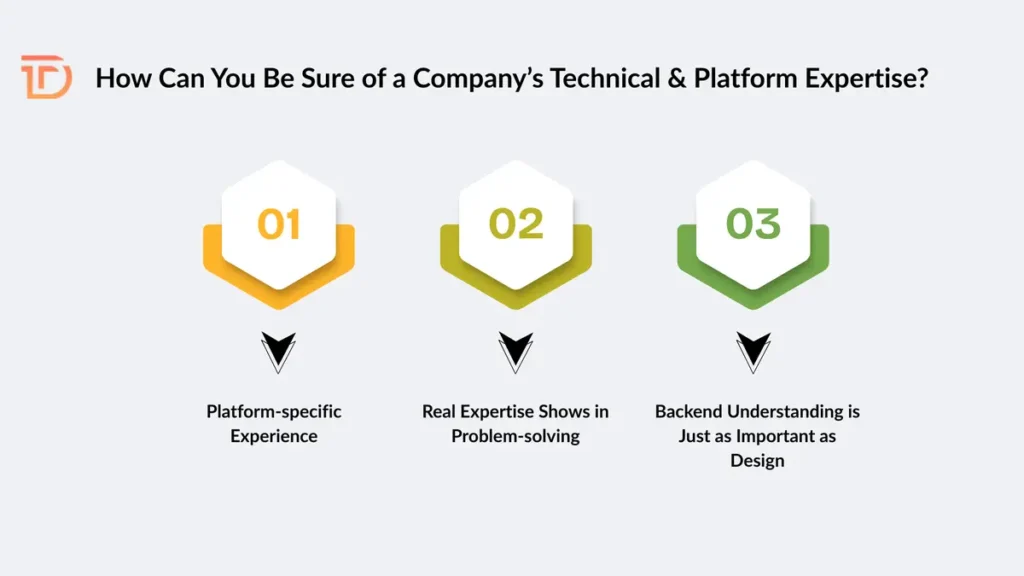
- Platform-specific experience
Shopify, Magento, WooCommerce, and custom frameworks all require different expertise. A company that is excellent with one platform may not be the best fit for another. That is why you should always ask which platforms they specialize in and what kind of projects they have completed using them.
- Realexpertiseshows in problem-solving
Many agencies say they can build everything, but the real question is how they handle slow performance, traffic spikes, payment failures, and security risks. In 2026, customers expect websites to work perfectly every time, so technical reliability matters much more than attractive presentations.
- Backend understanding is just as important as design
An eCommerce store is much more than a product page. It often connects with CRM systems, payment gateways, shipping tools, and inventory management platforms. A team with strong backend knowledge prevents major operational problems later.
Why Should You Review Portfolio & Past Projects Before Hiring?
A portfolio shows what sales conversations cannot. This is why businesses should always Review Portfolio & Past Projects before making a final decision. Looking at previous work helps you understand not just what the company can build, but how they solve real business problems.
- Look for projectssimilar toyour business model
If you run a fashion store, experience in healthcare software will not help much. What matters most is whether they understand customer expectations in your industry. Relevant experience usually means better recommendations, fewer mistakes, and smoother development planning.
- Do not judge only by appearance
Many websites look beautiful in portfolios, but real performance matters more. The platform should load quickly, work smoothly, and make shopping feel simple. A store that looks attractive but creates checkout frustration will always lose customers.
- Proof of actual business results
This is where one of the most important hiring questions becomes powerful: Can you share similar project examples? If they can explain how their work improved conversion rates, reduced abandoned carts, or increased repeat purchases, that shows real expertise instead of just visual design ability.
Why Should You Evaluate UI/UX Design Capabilities Seriously?
Many businesses think design is only about making the website look modern, but in eCommerce, design directly affects revenue. That is why you must carefully Evaluate UI/UX Design Capabilities before choosing a development company. A customer should never feel confused while shopping. The moment confusion starts, sales start dropping.
- First impressions
Customers judge your store within seconds. If the homepage feels messy, navigation is confusing, or trust signals are missing, people leave quickly. In simple words, people buy faster when the shopping experience feels easy and safe.
- Checkout flow
Many businesses lose sales during checkout because the process feels difficult. Long forms, unclear payment options, or confusing shipping steps create frustration. A strong UI/UX team knows how to remove these small problems that quietly reduce conversions.
- Mobile-first design
Most customers now shop from mobile devices. If your store performs poorly on smaller screens, your conversions drop immediately. Today, mobile performance is often more important than desktop design.
How Can You Understand Their Development Process Before Signing?
Even talented developers can create problems if the process is unclear. That is why businesses should always Understand Their Development Process before signing any agreement. A clear process creates confidence because it shows how your project will move from idea to launch.
- Requirement gathering should happen before coding starts
Professional teams never begin with immediate coding. They first understand your goals, customer expectations, and business priorities. This planning stage protects your budget and prevents expensive mistakes later.
- Milestones should be clear
You should always know what stage the project is in and what comes next. Clear milestone tracking keeps both sides aligned and removes uncertainty. This also builds trust because progress becomes visible instead of unclear.
- Testing should never be treated like a final quick step
Testing includes security checks, speed optimization, checkout verification, and mobile performance reviews. It should be a major stage, not a last-minute task. Most expensive post-launch problems happen because testing was rushed.
Why Should You Compare Pricing & Value Instead of Only Looking at Cost?
This is where many businesses make their biggest mistake. They compare quotes, choose the cheapest option, and believe they made a smart financial decision. Later, they realize the actual cost became much higher. That is why you must Compare Pricing & Value (Not Just Cost) instead of focusing only on the lowest number.
| Decision Type | Short-Term Result | Long-Term Impact |
|---|---|---|
| Lowest Price Option | Saves money initially | More fixes and weaker stability |
| Balanced Value Option | Moderate investment | Better performance and long-term support |
| Strategic Premium Partner | Higher starting cost | Stronger ROI and scalability |
For example, a low-cost website that crashes during festive traffic can create bigger business losses than a stronger initial investment ever would.
This is also where businesses think about eCommerce Development cost, and the smartest decision usually comes from understanding long-term return instead of short-term savings.
What Red Flags Should You Watch Before Hiring?
This is one of the most searched but least discussed parts of the hiring process. Knowing warning signs early can save businesses from major losses later.
- Unrealistic promises
If someone promises a highly complex store in a very short time for a very low cost, that is usually a warning sign. Good development takes planning, and serious professionals do not make impossible promises just to close a deal.
- No clear communication
If the company avoids direct answers or struggles to explain their process, problems usually appear later. Strong communication is one of the biggest signs of a reliable development partner.
- No post-launch support plan
Some agencies disappear after launch. This creates major issues when updates, fixes, or urgent support are needed. A good company always plans for long-term support.
Should You Hire an Agency, Freelancer, or In-House Team?
Many businesses ask this before starting, and the answer depends on goals, budget, and project size.
| Option | Best For | Key Benefits | Limitations | When to Choose |
|---|---|---|---|---|
| Freelancer | Small projects, limited budget | Cost-effective, flexible, quick to hire | Hard to manage multiple freelancers, limited scalability | When your project is simple and complexity is low |
| Agency | Medium to large projects, business growth | Full team (developers, designers, testers), structured process, reliable delivery | Higher cost than freelancers | When you need a complete solution with quality and scalability |
| In-House Team | Large businesses, long-term development | Full control, dedicated team, deep business understanding | High hiring and management cost, time-consuming setup | When you have continuous development needs and strong budget |
What Budget Should You Expect for eCommerce Development?
Many business owners ask this question early, and the honest answer depends on complexity. A simple store may cost a few thousand dollars, while a custom enterprise-level platform can require a much larger investment. Features like advanced inventory systems, CRM integration, automation, and multi-vendor functionality increase cost significantly.
Think about it this way: the goal should not be the cheapest platform. The goal should be the right platform that supports growth and prevents expensive rebuilding later. Good development is an investment, not just an expense.
What Questions Should You Ask Before Hiring an eCommerce Development Company?
A strong hiring decision depends on asking the right questions. Many businesses ask only general questions and miss the details that actually matter. That is why Questions to Ask Before Hiring should always be part of your process.
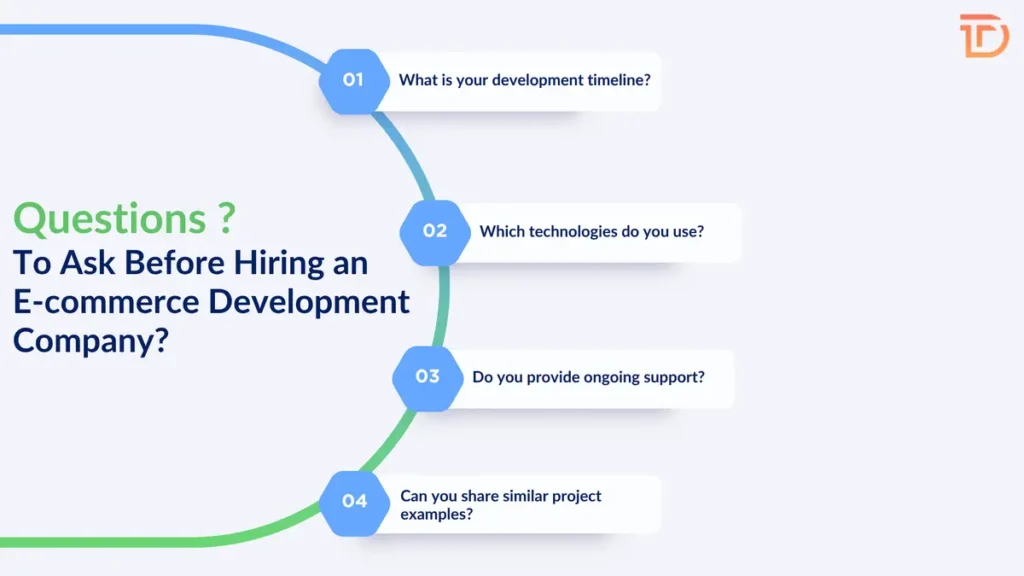
- What is your development timeline?
This helps you understand how they plan work, not just how quickly they want to sell. A realistic timeline shows professionalism, while unrealistic promises usually create future problems. This also helps you plan your own business launch more confidently.
- Which technologies do you use?
Technology choices affect performance, security, flexibility, and future scaling. Modern and scalable technologies are always a better long-term investment. This answer tells you whether they think strategically or only focus on fast delivery.
- Do you provide ongoing support?
Launching the website is only the beginning. Updates, bug fixes, and performance improvements continue long after launch. Without support, even a good platform becomes difficult to maintain.
- Can you share similar project examples?
This helps verify whether they truly understand your business type. Real examples always matter more than general promises. Past success in similar projects builds real confidence.
Why Choose Dreamer Technoland for eCommerce Development?
Choosing the right eCommerce partner is not only about technical skills. It is also about working with a team that understands your business goals, customer expectations, and long-term growth plans. Dreamer Technoland specializes in delivering ecommerce app development services along with robust web solutions tailored to modern business needs.
They combine user-friendly design with strong technical performance, ensuring your customers get a smooth shopping experience while your business gets a secure and scalable system. Even after launch, Dreamer Technoland provides support for updates, optimization, and future improvements, helping your store grow smoothly over time. With broader product development servicess, they help businesses move from idea to execution with clarity and confidence.
Conclusion
Choosing the right eCommerce development partner is not a small technical decision. It is a major business decision that affects customer trust, sales performance, and long-term growth. From defining your business requirements to reviewing portfolios, checking technical expertise, evaluating design quality, and asking the right questions, every step matters.
The best company is rarely the cheapest one. It is the one that understands your business, builds for long-term success, and supports you after launch. In 2026, customers expect much more than just an online store. They expect speed, trust, and a smooth buying experience from the first click to the final checkout. Choosing the right development partner is how you deliver that experience.
FAQs
Q. How do I choose the right eCommerce development company?
A. Start by understanding your business needs first, then evaluate technical expertise, platform experience, portfolio quality, UI/UX capability, pricing value, and post-launch support before making a final decision.
Q. What is the ideal development timeline for an eCommerce website?
A. The timeline depends on project complexity. A simple store may take a few weeks, while advanced eCommerce platforms with custom integrations can take several months.
Q. Why is UI/UX important in eCommerce development?
A. Good UI/UX improves navigation, customer trust, and checkout flow. This directly increases conversion rates, reduces cart abandonment, and improves customer retention.
Q. Should I choose the cheapest eCommerce development company?
A. Not always. A low-cost option may lead to poor quality, weak performance, and expensive fixes later. Value and long-term reliability matter more than the cheapest quote.
Q. Does an eCommerce development company provide support after launch?
A. A strong development company should always provide ongoing support for updates, maintenance, security improvements, and future platform scaling.