


Mobile apps today do much more than perform simple tasks. They recommend products, predict user behavior, improve customer support, track health data, and personalize user experiences in real time. Behind all these smart features, one thing plays the biggest role: data. This is where Kaggle becomes highly useful, giving developers access to thousands of real-world datasets across industries like healthcare, finance, retail, education, and customer analytics.
According to Statista, the global big data analytics market is expected to exceed $103 billion by 2027, showing how strongly businesses are investing in data-driven decision-making. For modern app development, Kaggle is not just a learning platform; it has become a practical resource for faster development, better testing, stronger AI models, and improved user experience.
What Makes Kaggle a Valuable Resource for Developers?
Kaggle gives direct access to thousands of public datasets that can be used for mobile app testing, machine learning training, feature planning, predictive analysis, and customer behavior studies. Instead of spending months collecting raw information from scratch, developers can start with structured datasets that are already available — saving time, reducing development cost, and helping businesses move faster.
Key reasons developers rely on Kaggle include:
- Access to real-world datasets
Kaggle offers datasets from healthcare, ecommerce, education, finance, and retail. An ecommerce app can use customer purchase datasets to test recommendation engines, while a healthcare app can use patient behavior data to improve prediction systems.
-
Faster experimentation and testing
When sample data is already available, developers can build prototypes much faster. This is especially useful for startups working on MVP products where speed matters most.
-
Community-driven learning and support
Kaggle also provides notebooks, public code examples, and shared solutions from experienced professionals — helping developers understand how others solve similar problems and apply better methods.
What Is the Role of Data in Modern Mobile App Development?
User expectations have changed completely. People no longer want apps that only perform simple tasks — they expect applications to understand preferences, predict needs, and create personalized experiences automatically. Whether it is a shopping app recommending products, a learning app suggesting the next lesson, or a finance app identifying unusual transactions, data drives the entire experience.
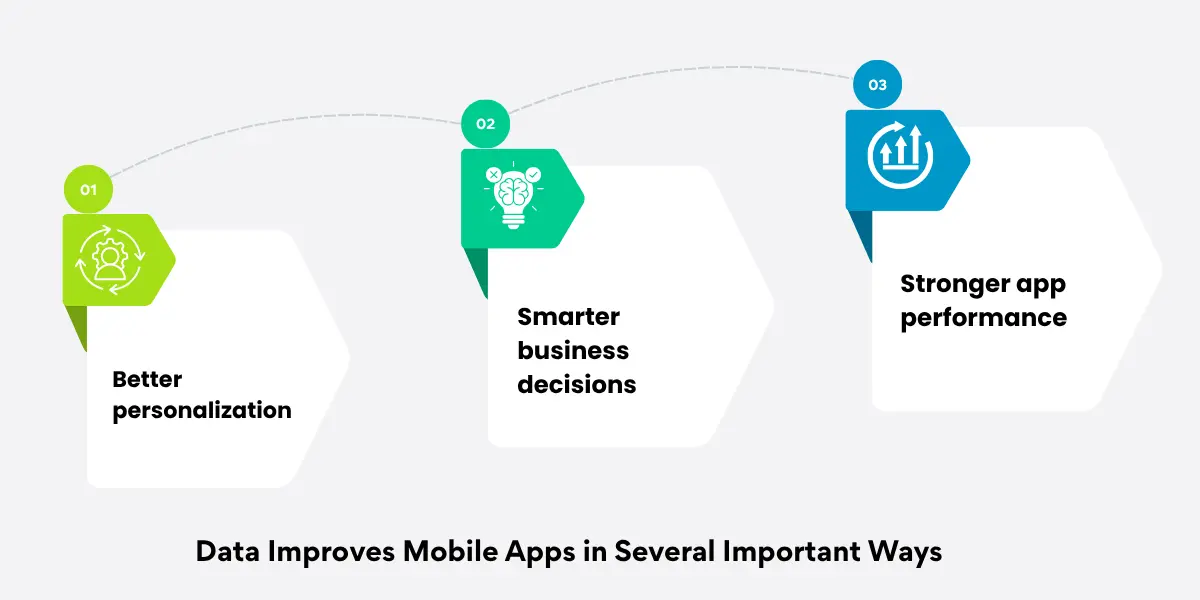
- Better personalization
Data helps applications recommend relevant products, services, notifications, and content based on browsing history, purchase behavior, and usage patterns. Users feel the app is designed around their needs.
- Smarter business decisions
Businesses use app data to understand what customers like, where they leave the app, and which features perform best, helping product teams improve important areas instead of making assumptions.
- Stronger app performance
Usage data helps developers identify slow sections, technical issues, and weak navigation flows, improving app stability and creating smoother customer experiences.
How Do Kaggle Datasets Accelerate App Development Processes?
Collecting original datasets requires time, budget, technical effort, and business validation. For many startups and growing businesses, this becomes a major delay. Kaggle helps remove that delay by offering ready-to-use datasets that developers can test immediately.
- Faster prototype building
When sample data is already available, developers can create prototypes and MVP versions much faster. A recommendation engine can be tested using existing purchase behavior datasets instead of waiting months for customer activity.
- Better testing environments
Apps perform better when tested with realistic datasets instead of random dummy values. Real-world testing helps identify weak prediction models, broken filters, and poor recommendation systems early.
- Lower development cost
Original data collection can be expensive, especially for startups. Using Kaggle datasets lowers early costs and allows businesses to validate ideas before spending larger budgets.
How Can Developers Use Kaggle Data for AI and Machine Learning Integration?
Without strong training data, machine learning systems become weak and inaccurate. Kaggle provides ready datasets that make AI integration faster and more practical across different app categories.
| AI Feature | Example in Mobile Apps |
|---|---|
| Recommendation Engine | Product suggestions in shopping apps |
| Fraud Detection | Payment security alerts |
| Chatbots | Smart customer support |
| Predictive Analysis | User behavior forecasting |
Real-World Use Cases of Kaggle Datasets in Mobile Applications
Businesses use these datasets to improve customer experiences, strengthen decision-making, and create smarter operational systems across almost every major industry.
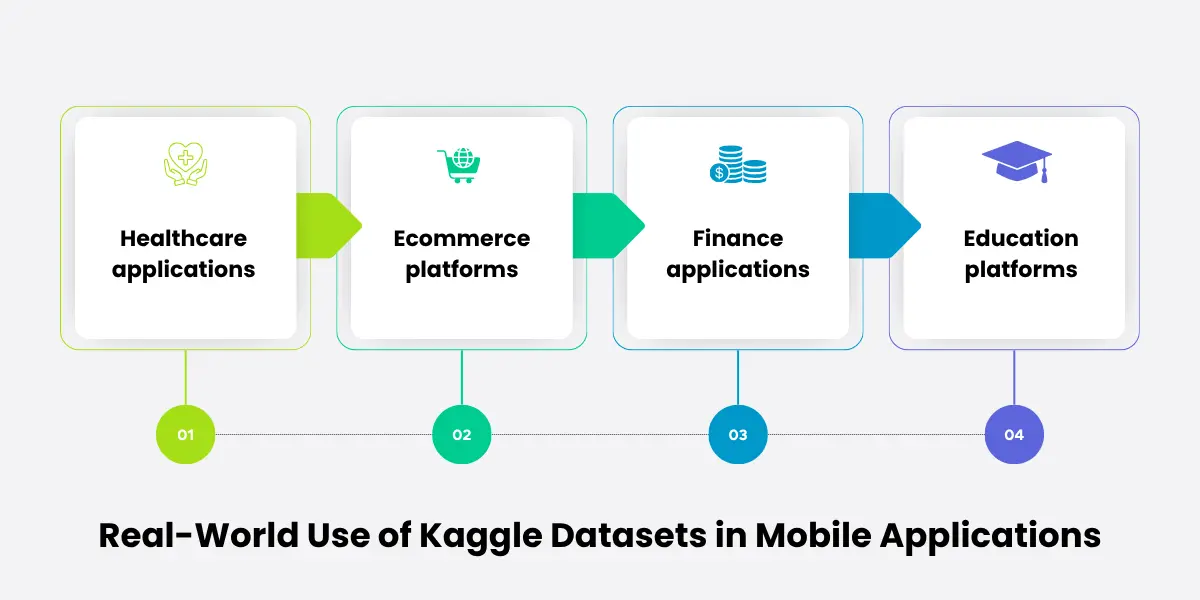
- Healthcare applications
Patient behavior datasets improve symptom tracking, preventive care systems, appointment scheduling, and health prediction models, creating more proactive healthcare experiences.
- Ecommerce platforms
Customer purchase datasets improve product recommendations, abandoned cart recovery, pricing strategies, and demand forecasting.
- Finance applications
Fraud detection datasets help strengthen transaction monitoring, payment security, and risk management systems, making finance apps safer and more trusted.
- Education platforms
Student learning pattern datasets help improve personalized learning paths, engagement tracking, and performance prediction — creating better educational outcomes.
What Are the Cost and Time Benefits of Using Kaggle Datasets?
These benefits are especially valuable for startups and businesses building MVP products, where data collection is often one of the slowest and most expensive parts of development.
- Lower Research Cost
Businesses do not need to spend heavily on early data collection during proof-of-concept stages. This makes idea validation faster and more affordable.
- Faster Market Entry
Ready datasets reduce development delays and help businesses launch products faster. Speed creates competitive advantage in fast-moving industries.
- Better Decision-Making
Testing with real data reduces wrong assumptions and lowers the chances of expensive strategic mistakes. Businesses make stronger product decisions based on evidence.
Best Practices for Selecting the Right Dataset from Kaggle
Not every dataset is useful for every application. Choosing the wrong one can create poor model performance, weak business decisions, and unnecessary delays. Developers should focus on quality, relevance, and reliability.
- Relevance to the business problem
The dataset should match the app’s actual use case. A healthcare app should not depend on unrelated ecommerce behavior patterns, because business relevance should always come first.
- Data freshness
Outdated datasets can produce weak results, especially in industries like fintech, retail, and customer behavior analysis where market patterns change quickly.
- Data completeness
Missing values, poor labels, and broken formatting create extra work and reduce final model performance. A cleaner dataset improves both speed and reliability.
- Source credibility
Reliable sources improve trust and reduce implementation risk. Public data should still be checked carefully before becoming part of business decisions.
Challenges and Limitations of Kaggle Datasets
Public datasets are not perfect. Some may be outdated, incomplete, or too general for specific business needs. Others may require heavy cleaning before they become useful for real development work. There can also be privacy concerns depending on the source of the data — public availability does not always mean business-ready compliance.
This is why Kaggle should support business decisions, not fully replace original validation, compliance checks, and long-term customer data strategies. Developers must treat public datasets as helpful tools, not final answers.
How to Ensure Data Quality and Security in Mobile Apps
Poor-quality data leads to wrong decisions, and weak security creates trust issues and legal risks. Developers should first check for missing values, duplicate records, wrong labels, and incorrect formatting before using any dataset.
Sensitive data should be encrypted and stored safely from the beginning. Only authorized team members should have access to important datasets and customer details. Developers should also follow privacy rules like GDPR and other industry standards to protect user trust and avoid legal problems.
Tools and Technologies to Work with Kaggle Data
| Tool | Main Use |
|---|---|
| Python | Data cleaning and machine learning |
| SQL | Database handling |
| Jupyter Notebook | Testing and experimentation |
| TensorFlow | AI model building |
| Power BI | Visual reporting and analytics |
Python is widely used for data cleaning and machine learning workflows, while SQL helps manage structured database operations. Many businesses also use Power BI dashboards to convert raw insights into visual decision-making systems for managers and stakeholders.
Future Trends: Data-Driven Mobile Apps and Kaggle’s Role
Mobile applications will become even more intelligent, predictive, and personalized. Apps are moving beyond simple functions into recommendation systems, automation, fraud prevention, and advanced personalization. Kaggle will continue playing an important role because developers need practical training data to build these systems faster.
Businesses that understand how to use data early will create stronger competitive advantages because data-driven development is no longer optional. It is becoming the standard for modern mobile applications.
Why Choose Dreamer Technoland for Data-Driven Mobile App Development?
Building modern mobile applications requires reliable data strategy, secure development, machine learning readiness, and scalable architecture. Dreamer Technoland helps startups, growing businesses, and enterprises build secure, intelligent, and scalable mobile applications based on real business goals, from data integration and AI-ready app development to analytics planning and backend architecture.
Conclusion
Kaggle datasets have become an important part of modern mobile app development because they help businesses build faster, smarter, and more reliable apps. They save time, reduce costs, and improve decision-making by giving developers access to useful real-world data. As mobile apps continue becoming more data-driven, platforms like Kaggle will remain valuable for both startups and large businesses. Using the right data with the right development strategy helps create stronger apps and better long-term growth.
Frequently Asked Questions
Q. Why are Kaggle datasets useful for mobile app development?
A.They provide ready-to-use real-world data that helps developers test features, train AI models, improve app performance, and reduce development time.
Q.Can Kaggle datasets be used for machine learning apps?
A. Yes, Kaggle is widely used for training machine learning models in recommendation systems, fraud detection, predictive analysis, and customer behavior tracking.
Q. Are all Kaggle datasets safe for business use?
A. Not always. Developers should check data quality, licensing, freshness, and privacy compliance before using any public dataset for commercial applications.
Q. Which industries benefit most from Kaggle datasets?
A. Healthcare, ecommerce, finance, education, and retail benefit most because they rely heavily on predictive insights and user behavior analysis.
Q. Do businesses still need custom data if they use Kaggle?
A. Yes. Kaggle helps with testing and early development, but businesses still need their own real customer data for long-term optimization and production-level accuracy.