



The manufacturing industry is evolving faster than ever. Smart factories, connected machines, cloud computing, and Industrial Internet of Things (IIoT) technologies are transforming how manufacturers operate. However, as technology becomes more advanced, managing IT infrastructure also becomes more complex. From preventing costly downtime to protecting sensitive production data, manufacturers need reliable IT support to keep operations running smoothly.
According to the Deloitte 2025 Manufacturing Industry Outlook, manufacturers continue to prioritize digital transformation, cybersecurity, and smart factory investments to improve operational efficiency and remain competitive in a rapidly changing market. This growing focus highlights the need for reliable IT management and proactive technology support across manufacturing operations.
Whether you run a small production facility or a global manufacturing enterprise, managed IT services can help you optimize technology, reduce operational risks, and improve productivity without the expense of maintaining a large in-house IT team.
What Are Managed IT Services for Manufacturing?
Managed IT services for manufacturing refer to outsourcing the management, monitoring, maintenance, and support of IT systems to a specialized Managed Service Provider (MSP). Instead of reacting to technical issues after they occur, MSPs proactively monitor your systems to identify and resolve problems before they disrupt production.
Manufacturing environments rely on multiple technologies working together, including Enterprise Resource Planning (ERP) systems, Manufacturing Execution Systems (MES), industrial networks, IoT devices, production equipment, cloud applications, and employee workstations. Managing these technologies requires specialized expertise that many manufacturers struggle to maintain internally.
A managed IT service provider acts as an extension of your business by handling day-to-day IT operations while your team focuses on manufacturing, product quality, and customer satisfaction.
Unlike traditional break-fix IT support, managed IT services follow a proactive approach. Continuous monitoring, regular maintenance, automated updates, and security assessments help reduce unexpected downtime and improve overall system reliability.
Why Modern Manufacturers Need Managed IT Services?
Technology has become the backbone of modern manufacturing. Production scheduling, inventory management, quality control, supplier communication, and customer service all depend on reliable IT systems. Even a short system outage can delay production and result in significant financial losses.
Here are the primary reasons manufacturers are investing in managed IT services.
Minimize Production Downtime
Downtime is one of the biggest challenges for manufacturers. Server failures, network issues, software crashes, or cyberattacks can halt production lines and affect delivery schedules.
Managed IT providers continuously monitor infrastructure around the clock to detect performance issues before they become major problems. Preventive maintenance and rapid incident response help keep production running without interruptions.
Strengthen Cybersecurity
Manufacturing companies are increasingly targeted by ransomware, phishing attacks, and industrial cyber threats because they manage valuable intellectual property and operational data.
Managed IT services help strengthen cybersecurity through:
- Multi-layer security monitoring
- Endpoint protection
- Firewall management
- Network security
- Email security
- Employee security awareness
- Vulnerability assessments
- Security patch management
- Data encryption
This proactive approach significantly reduces security risks while helping organizations meet compliance requirements.
Support Smart Manufacturing
Industry 4.0 technologies continue to reshape manufacturing operations. Connected machines, IoT sensors, robotics, predictive maintenance, and AI-driven analytics all depend on stable and secure IT infrastructure.
Managed IT providers ensure these technologies operate efficiently by maintaining reliable connectivity, monitoring performance, and quickly resolving technical issues.
This allows manufacturers to confidently adopt automation without increasing IT complexity.
Improve Business Continuity
Unexpected disasters such as hardware failures, cyberattacks, natural disasters, or accidental data deletion can severely impact manufacturing operations.
Managed IT providers implement business continuity strategies that include:
- Automated backups
- Disaster recovery planning
- Cloud replication
- System redundancy
- Rapid recovery procedures
These measures help manufacturers resume operations quickly with minimal disruption.
Reduce Overall IT Costs
Hiring and maintaining an experienced in-house IT department can be expensive, especially for small and mid-sized manufacturers.
Managed IT services provide access to experienced professionals for a predictable monthly cost. This helps organizations:
- Reduce hiring expenses
- Lower infrastructure maintenance costs
- Avoid unexpected repair bills
- Improve technology planning
- Maximize return on IT investments
Instead of reacting to expensive emergencies, manufacturers benefit from proactive IT management that keeps systems running efficiently.
Key Managed IT Services Every Manufacturer Should Consider
Not every manufacturer has the same technology requirements. However, several managed IT services provide value across nearly every manufacturing environment.
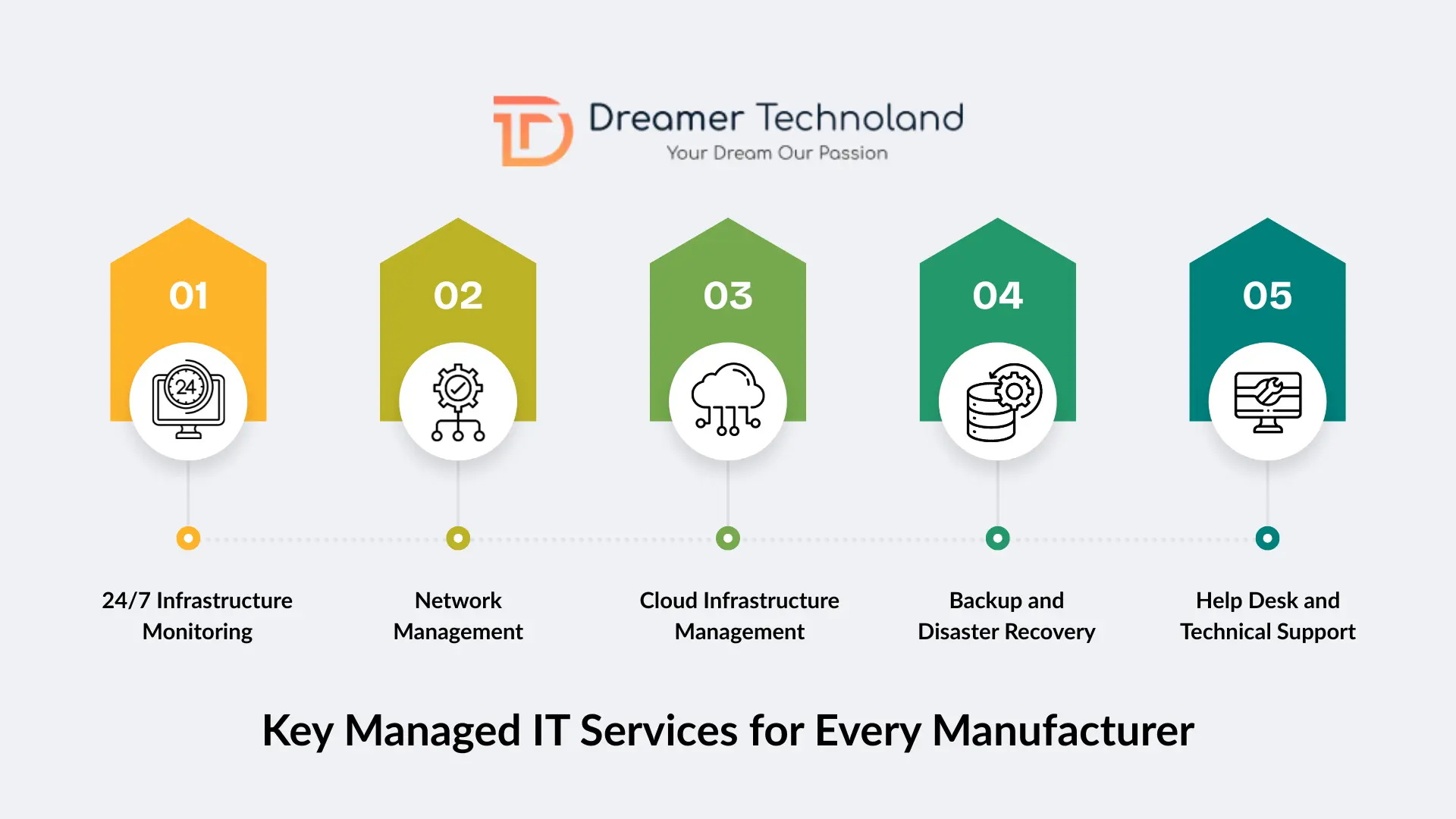
24/7 Infrastructure Monitoring
Continuous monitoring allows IT teams to detect hardware failures, network congestion, storage issues, and performance bottlenecks before they impact production.
Real-time alerts enable faster issue resolution and minimize costly downtime.
Network Management
Manufacturing facilities depend on stable, high-speed networks that connect production equipment, employees, suppliers, and cloud applications.
Managed network services include:
- Network optimization
- Switch management
- Router configuration
- Wi-Fi management
- Bandwidth monitoring
- VPN management
- Network security
A reliable network keeps production systems connected and operating efficiently.
Cloud Infrastructure Management
Many manufacturers are moving ERP systems, file storage, collaboration tools, and business applications to the cloud.
Managed cloud services include:
- Cloud migration
- Infrastructure management
- Cloud security
- Backup management
- Performance optimization
- Cost monitoring
Cloud solutions improve flexibility while reducing dependence on on-premise infrastructure.
Cybersecurity Management
Cybersecurity is no longer optional in manufacturing.
A managed security service typically includes:
- Security monitoring
- Threat detection
- Firewall management
- Endpoint security
- Identity and access management
- Compliance support
- Incident response
These services help manufacturers protect valuable production systems and sensitive business information.
Backup and Disaster Recovery
Reliable backup solutions ensure manufacturing data remains available even after unexpected incidents.
Modern backup strategies include:
- Automated backups
- Cloud backups
- Incremental backups
- Disaster recovery testing
- Fast system restoration
This minimizes downtime and protects business continuity.
Help Desk and Technical Support
Employees need immediate technical assistance when software or hardware problems occur.
Managed help desk services provide:
- Remote support
- On-site assistance
- Software troubleshooting
- Device configuration
- User account management
Fast support improves employee productivity and reduces operational delays.
Benefits of Managed IT Services for Manufacturers
Manufacturing companies operate in a highly competitive environment where even minor technology issues can impact production schedules, customer satisfaction, and profitability. Managed IT services help manufacturers build a reliable, secure, and scalable IT environment that supports long-term business growth.
Here are some of the key benefits.
Increased Operational Efficiency
Reliable IT systems keep production lines, ERP software, inventory management, and communication tools running without interruptions. Managed IT providers proactively monitor systems, resolve issues early, and optimize performance, allowing employees to focus on production rather than troubleshooting technical problems.
Reduced Downtime
Unexpected downtime can delay production, increase labor costs, and affect customer deliveries. Managed IT services use continuous monitoring and preventive maintenance to identify potential issues before they become critical failures.
This proactive approach helps manufacturers maintain smooth operations while minimizing costly disruptions.
Stronger Cybersecurity
Manufacturing companies manage valuable intellectual property, production data, financial records, and customer information. These assets make them attractive targets for cybercriminals.
Managed IT providers strengthen cybersecurity by implementing:
- Advanced threat monitoring
- Endpoint protection
- Firewall management
- Multi-factor authentication
- Security awareness training
- Regular vulnerability assessments
These measures significantly reduce security risks while improving compliance with industry standards.
Predictable IT Costs
Instead of dealing with unexpected repair expenses or emergency support charges, manufacturers pay a fixed monthly fee for ongoing IT management.
This predictable pricing helps businesses:
- Plan annual IT budgets
- Reduce maintenance costs
- Avoid unexpected infrastructure expenses
- Improve return on technology investments
Improved Scalability
As manufacturing businesses expand, their technology requirements also grow. New production facilities, additional employees, cloud applications, and connected devices all require scalable IT infrastructure.
Managed IT providers help businesses expand their technology environment without major disruptions or expensive hardware investments.
Better Compliance
Many manufacturing businesses must comply with industry regulations and customer security requirements.
Managed IT providers help organizations maintain compliance through:
- Security audits
- Documentation
- Access controls
- Data protection policies
- Backup management
- Regular software updates
This reduces compliance risks and improves customer confidence.
Common IT Challenges in the Manufacturing Industry
Despite increasing investments in digital transformation, many manufacturers continue to face technology-related challenges that affect productivity and profitability.
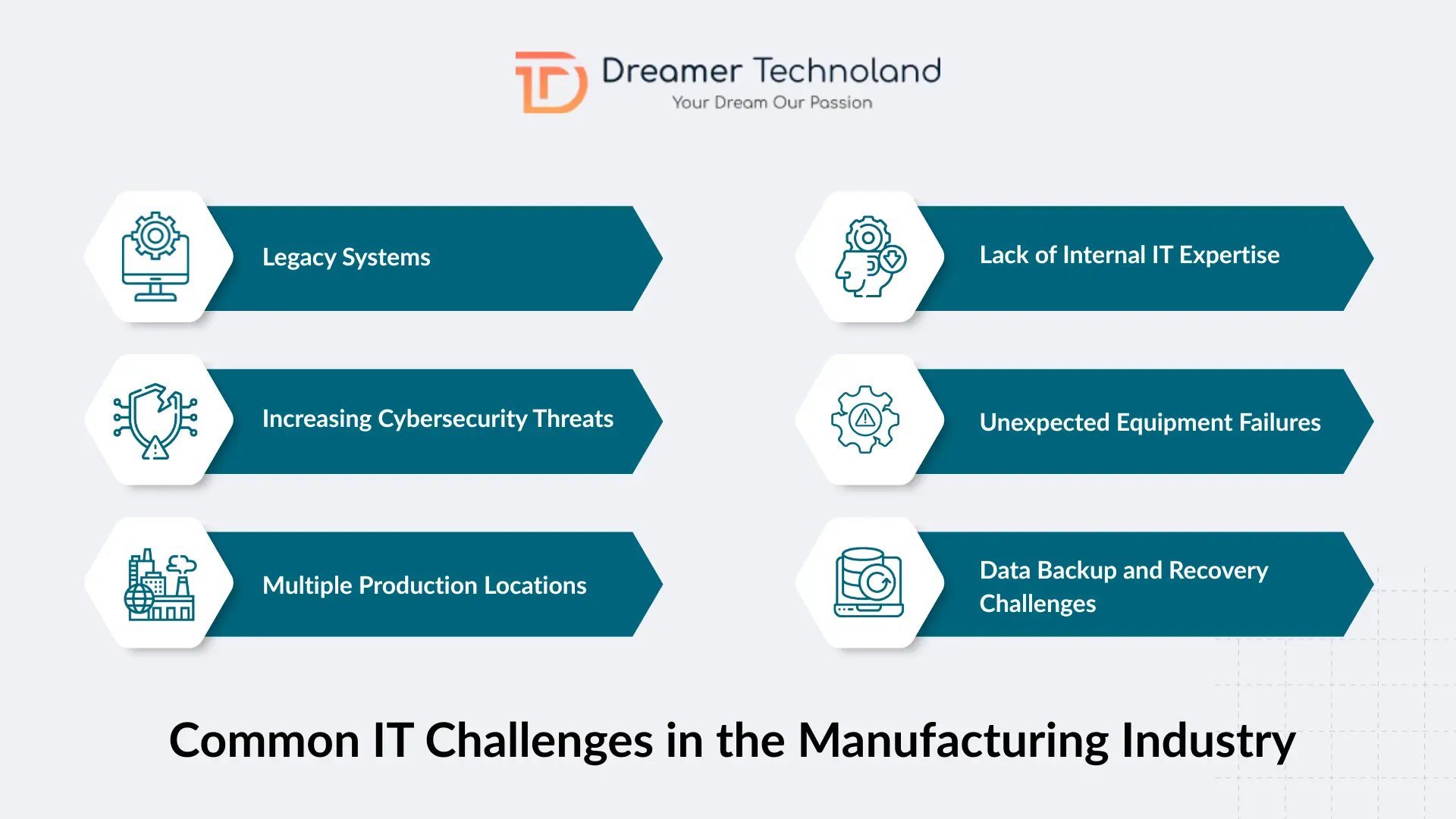
Legacy Systems
Many production facilities still rely on outdated software and hardware that are difficult to maintain and integrate with modern technologies.
Older systems often create compatibility issues, security vulnerabilities, and higher maintenance costs.
Increasing Cybersecurity Threats
Ransomware attacks against manufacturers have become increasingly common in recent years. A successful cyberattack can stop production, compromise sensitive data, and result in significant financial losses.
Manufacturers require continuous monitoring and rapid incident response to protect critical systems.
Multiple Production Locations
Manufacturers operating across multiple plants or warehouses often struggle to maintain consistent IT performance across locations.
Managed IT providers centralize monitoring and management, ensuring every facility receives the same level of support and security.
Lack of Internal IT Expertise
Hiring experienced IT professionals can be expensive, and many manufacturers struggle to recruit specialists in cybersecurity, cloud computing, networking, and infrastructure management.
Managed IT services provide access to a team of experts without increasing payroll costs.
Unexpected Equipment Failures
Servers, storage devices, networking equipment, and production systems require regular maintenance. Without proactive monitoring, hardware failures can disrupt production and delay customer orders.
Preventive maintenance significantly reduces these risks.
Data Backup and Recovery Challenges
Manufacturing businesses generate large amounts of production, inventory, engineering, and customer data every day.
Without reliable backup solutions, recovering from accidental deletion, hardware failure, or cyberattacks can be difficult and expensive.
Managed backup and disaster recovery services ensure business-critical information remains protected.
In-house IT vs. Managed IT Services
| Feature | In-House IT Team | Managed IT Services |
|---|---|---|
| Cost | High salaries and infrastructure costs | Predictable monthly pricing |
| Availability | Limited business hours | 24/7 monitoring and support |
| Cybersecurity Expertise | Depends on team size | Dedicated security specialists |
| Scalability | Requires additional hiring | Easily scales with business growth |
| Technology Updates | May be delayed | Regular updates and proactive maintenance |
| Disaster Recovery | Often limited | Comprehensive backup and recovery solutions |
| Access to Specialists | Limited | Team of experienced IT professionals |
| Business Focus | Split between operations and support | Allows internal teams to focus on production |
For many manufacturers, partnering with a managed IT service provider delivers greater value by combining specialized expertise, proactive support, and predictable costs.
Real-World Use Cases of Managed IT Services in Manufacturing
Managed IT services support a wide range of manufacturing sectors by improving productivity, security, and operational efficiency.
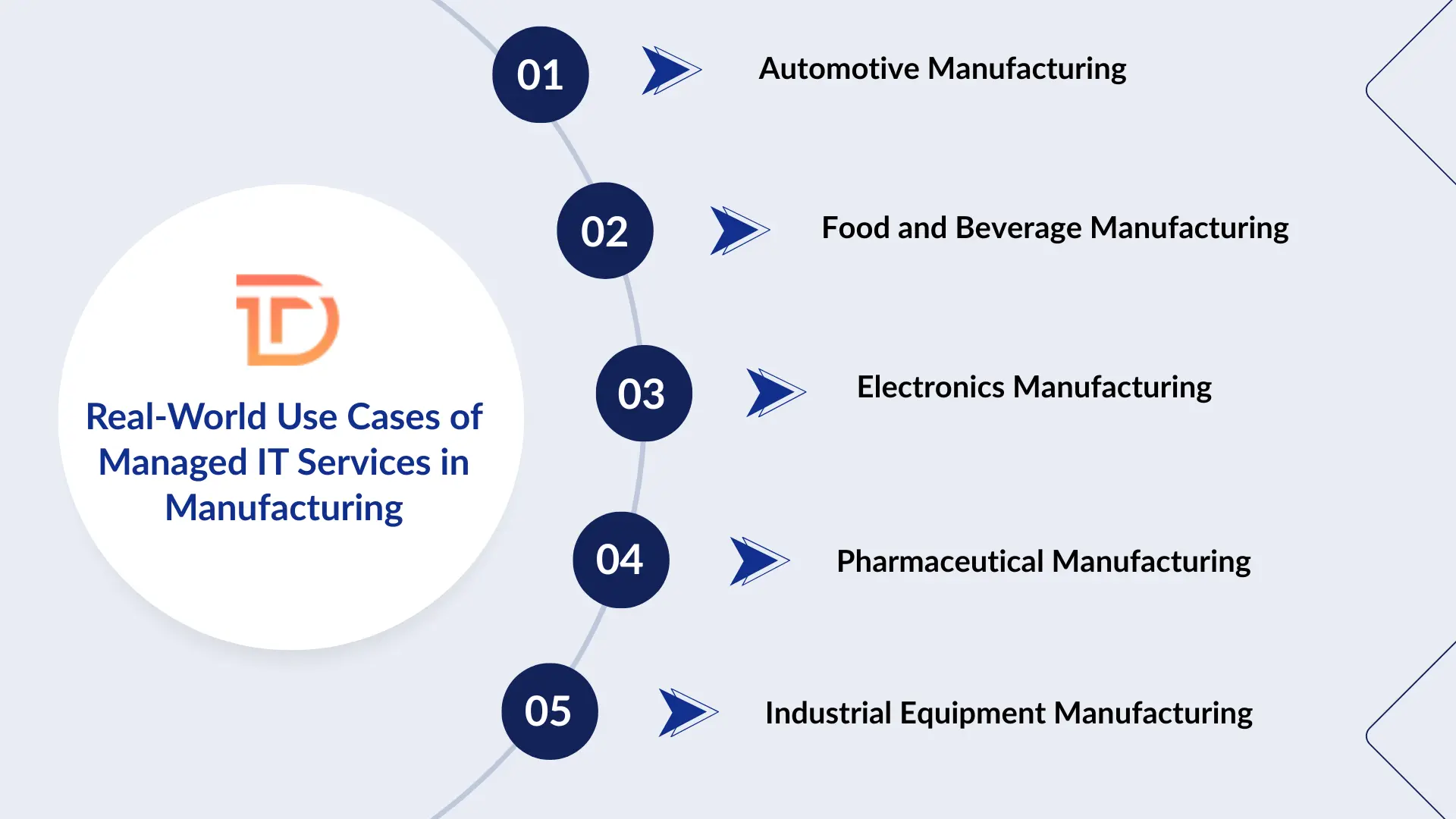
Automotive Manufacturing
Automotive manufacturers depend on connected production lines, robotics, ERP systems, and supplier networks.
Managed IT providers ensure these systems remain secure, highly available, and optimized for continuous production.
Food and Beverage Manufacturing
Food manufacturers require reliable IT systems to support inventory management, production scheduling, quality control, and regulatory compliance.
Managed IT services help maintain system uptime while protecting sensitive production and customer data.
Electronics Manufacturing
Electronics manufacturers manage complex supply chains and precision manufacturing equipment.
Managed IT services improve network reliability, secure engineering data, and support advanced manufacturing technologies.
Pharmaceutical Manufacturing
Pharmaceutical companies must maintain strict regulatory compliance while protecting sensitive research and production information.
Managed IT providers assist with secure infrastructure, compliance support, backup management, and disaster recovery planning.
Industrial Equipment Manufacturing
Manufacturers producing heavy machinery often operate multiple production sites with connected equipment and remote engineering teams.
Managed IT services provide centralized monitoring, cloud collaboration, secure remote access, and network optimization across all locations.
Best Practices for Implementing Managed IT Services
To maximize the value of managed IT services, manufacturers should follow these best practices:
- Assess your current IT infrastructure and identify performance gaps.
- Prioritize cybersecurity across all production systems and endpoints.
- Choose a provider with proven experience in the manufacturing industry.
- Define clear Service Level Agreements (SLAs) for response times and system availability.
- Schedule regular infrastructure reviews and security assessments.
- Develop a comprehensive backup and disaster recovery strategy.
- Train employees on cybersecurity awareness and safe technology practices.
- Continuously review IT performance to support future business growth.
By following these practices, manufacturers can build a resilient IT environment that supports innovation, minimizes downtime, and improves long-term operational efficiency.
Future Trends Shaping Managed IT Services in Manufacturing
Technology continues to transform the manufacturing sector. Managed IT service providers are evolving their offerings to help businesses stay competitive in an increasingly connected and data-driven environment.
AI-Driven IT Operations
Artificial Intelligence is improving IT management by automating routine tasks, detecting anomalies, and predicting system failures before they occur. AI-powered monitoring enables faster issue resolution while reducing operational risks.
Predictive Maintenance
Manufacturers are using sensors and data analytics to monitor equipment health in real time. Managed IT providers help maintain the infrastructure that supports predictive maintenance systems, reducing unexpected equipment failures and improving production efficiency.
Industrial Internet of Things (IIoT)
Connected machines and smart sensors generate valuable operational data. Managed IT services ensure these devices remain secure, connected, and properly integrated with business applications, enabling manufacturers to make more informed decisions.
Edge Computing
As manufacturing operations generate larger volumes of real-time data, edge computing allows information to be processed closer to production equipment rather than relying entirely on cloud infrastructure. This improves response times and supports time-sensitive manufacturing processes.
Zero Trust Security
Traditional network security models are being replaced by Zero Trust frameworks, where every user, device, and application must be continuously verified before accessing business resources. Managed IT providers are increasingly implementing Zero Trust strategies to strengthen cybersecurity.
Sustainable IT Infrastructure
Many manufacturers are investing in energy-efficient technologies to support sustainability goals. Managed IT providers help optimize cloud resources, improve hardware utilization, and reduce unnecessary energy consumption through efficient infrastructure management.
Why Choose Dreamer Technoland for Managed IT Services?
At Dreamer Technoland, we help manufacturing businesses build secure, scalable, and future-ready IT environments that support continuous growth. Our team combines technical expertise with a deep understanding of modern manufacturing technologies to deliver reliable managed IT solutions tailored to your operational needs.
Our managed IT services include:
- 24/7 infrastructure monitoring and proactive maintenance
- Cloud migration and cloud infrastructure management
- Network design, optimization, and management
- Advanced cybersecurity solutions
- Backup and disaster recovery planning
- ERP and business application support
- IT consulting and digital transformation services
- AI-powered automation solutions
- Dedicated technical support from experienced professionals
Whether you are modernizing legacy systems, expanding production facilities, or adopting Industry 4.0 technologies, we provide the expertise and support needed to keep your business running efficiently.
Conclusion
Technology has become an essential part of modern manufacturing, supporting everything from production planning and inventory management to quality control and customer service. However, managing complex IT infrastructure while maintaining smooth production can be challenging for many manufacturers.
Managed IT services provide a practical solution by delivering proactive monitoring, enhanced cybersecurity, reliable technical support, cloud management, and disaster recovery planning. Instead of reacting to problems after they occur, manufacturers can prevent disruptions, improve operational efficiency, and focus on innovation and business growth.
As smart manufacturing and digital transformation continue to reshape the industry, partnering with an experienced managed IT service provider can help your business remain secure, productive, and competitive. Investing in the right IT strategy today will prepare your manufacturing operations for the challenges and opportunities of tomorrow.
Frequently Asked Questions
Q. How do managed IT services reduce manufacturing downtime?
Managed IT providers continuously monitor IT infrastructure, perform preventive maintenance, install security updates, and resolve issues before they affect production. This proactive approach minimizes unexpected disruptions and keeps manufacturing operations running smoothly.
Q. What cybersecurity services are included in managed IT services?
Most managed IT providers offer firewall management, endpoint protection, threat detection, vulnerability assessments, email security, backup solutions, incident response, and employee cybersecurity awareness training to protect manufacturing systems from cyber threats.
Q. Can managed IT services support ERP and manufacturing software?
Yes. Managed IT providers can manage, maintain, and optimize ERP platforms such as SAP, Oracle NetSuite, Microsoft Dynamics 365, and other manufacturing software. They also ensure these applications remain secure, updated, and integrated with your IT infrastructure.
Q. How do I choose the best managed IT service provider for my manufacturing business?
Look for a provider with manufacturing industry experience, 24/7 support, strong cybersecurity expertise, cloud capabilities, scalable solutions, transparent Service Level Agreements (SLAs), and a proven track record of supporting businesses with similar operational requirements.