

Building a SaaS product from scratch involves validating your idea, selecting a business model, building an MVP, choosing the right technology stack, and launching the product. Depending on its complexity, the process typically takes 4–9 months. SaaS has become one of the most popular approaches for building and delivering software products. Businesses use SaaS solutions for project management, CRM, analytics, communication, and industry-specific applications because they offer scalability, subscription-based revenue, and easy accessibility.
The global SaaS market is projected to grow from USD 530.0 billion in 2026 to USD 1,109.2 billion by 2033, reflecting an 11.1% CAGR.
SaaS Product Development: What It Really Involves
The full form of SaaS is Software as a Service. It is a method of a cloud computing solution that allows people to access software through a website or a mobile app rather than having it installed.Customers typically pay a recurring subscription fee to access the software instead of purchasing a one-time license.
| Aspect | Summary |
|---|---|
| Development Time | 4–9 months |
| MVP Timeline | 2–6 months |
| Common Pricing Models | Freemium, Tiered, Usage-Based |
| Popular Tech Stack | React, Node.js, PostgreSQL, AWS |
| Architecture | Multi-Tenant (most common) |
| Key Success Metrics | MRR, CAC, LTV, Churn |
SaaS has become popular because cloud technology allows businesses to deliver software to many users from a centrally managed platform.
Validate Your SaaS Idea Before Writing Code
Prior to coding anything, make sure that your idea is a solution to an actual problem. Before starting SaaS application development, consider the following:
- Find a problem to solve: The most successful SaaS applications originate from a particular and pressing problem rather than from a general desire of “wouldn’t it be nice if.” You know the pain points and current solutions of your potential users.
- Analyse the market and competition: Study SaaS applications in your niche. What are their strong sides and weaknesses? The flaws in competitors’ solutions could very well become your competitive advantage.
- Validate demand: Even without a working product, a simple landing page or just some customer interviews can help you understand if there’s any demand for what you’re going to offer.
Turn Your SaaS Idea Into a Practical Development Plan
Once your idea is validated, it’s time to plan the SaaS development process itself.
SaaS Development Stages and Timeline
Below are the points that you should know to plan your SaaS development process:
| Stage | Activities | Estimated Time |
|---|---|---|
| Idea Validation | Market research, customer interviews | 1–2 weeks |
| Planning | Business model, roadmap, tech stack | 2–3 weeks |
| UI/UX Design | Wireframes, prototypes | 2–4 weeks |
| MVP Development | Core feature development | 8–16 weeks |
| Testing | QA, bug fixes, beta testing | 2–4 weeks |
| Launch | Deployment, monitoring | 1 week |
Choosing the Right SaaS Pricing Model
In most cases, SaaS companies will use tiered subscriptions, a freemium model, or usage-based pricing. The right pricing model depends on how customers use your product and how they receive value from it.
| Pricing Model | Best For | Example |
|---|---|---|
| Freemium | Startups | Canva |
| Tiered Pricing | B2B SaaS | HubSpot |
| Per-User Pricing | Team collaboration | Slack |
| Usage-Based | Infrastructure | AWS |
| Flat Rate | Simple SaaS | Basecamp |
Develop and Validate Your MVP
The MVP building process starts by defining the basic features required to solve the key problems of the first customers. You shouldn’t hurry with the implementation of every feature in one go. A well-built MVP can successfully bring your product to the market more quickly.
What Does It Cost to Build a SaaS Product?
Choosing your technology stack for SaaS is a pivotal decision that can influence the speed of development, scalability, and cost of maintenance. Technologically speaking, you will have to make decisions about front-end technology, back-end technology, and database technology.
| Layer | Popular Technologies |
|---|---|
| Frontend | React, Vue.js, Angular |
| Backend | Node.js, Django, FastAPI, Ruby on Rails |
| Database | PostgreSQL, MySQL, MongoDB |
| Authentication | Auth0, Firebase Auth |
| Cloud | AWS, Google Cloud, Azure |
| CI/CD | GitHub Actions, GitLab CI |
| Containerization | Docker, Kubernetes |
Common SaaS setups use front-end frameworks such as React or Vue, while the back end can be built with technologies such as Node.js, Python frameworks like Django or FastAPI, or Ruby on Rails. The development team also needs to choose a database to store and manage application data. PostgreSQL and MongoDB are two popular options, and the right choice depends on the type of data, application requirements, and expected scalability.
When it comes to cloud computing, pay attention to the services of such providers as AWS, GCP, and Vercel.
Understand SaaS Product Development Cost
The cost of SaaS product development may vary greatly depending on many criteria. The main aspects are:
- Build Team: Whether your team consists of employees, freelancers, or a custom software development services vendor.
- Infrastructure expenses: Hosting and payment processing, analytics, etc., also have associated costs.
SaaS Type Typical Scope Estimated Cost Basic MVP Core features, simple user management, basic dashboard $15,000–$40,000 Mid-Level SaaS Multiple features, integrations, advanced dashboards, stronger scalability $40,000–$100,000 Enterprise SaaS Complex workflows, advanced integrations, high scalability, enhanced security $100,000+ - Complexity of features: The implementation of real-time capabilities, integrations, and custom architecture takes time and money.
- In-house development vs outsourcing: In-house development gives you more direct control, but it also requires you to hire and manage a dedicated development team. The process of outsourcing custom software development can be quicker and less expensive.
From Prototype to Launch: The Core SaaS Development Stages
The process of building, testing, and refining is what makes the difference between well-launched SaaS products and those that never leave the development stage. Once developers have planned things and chosen a stack, the actual building process follows what one might call a predictable order:
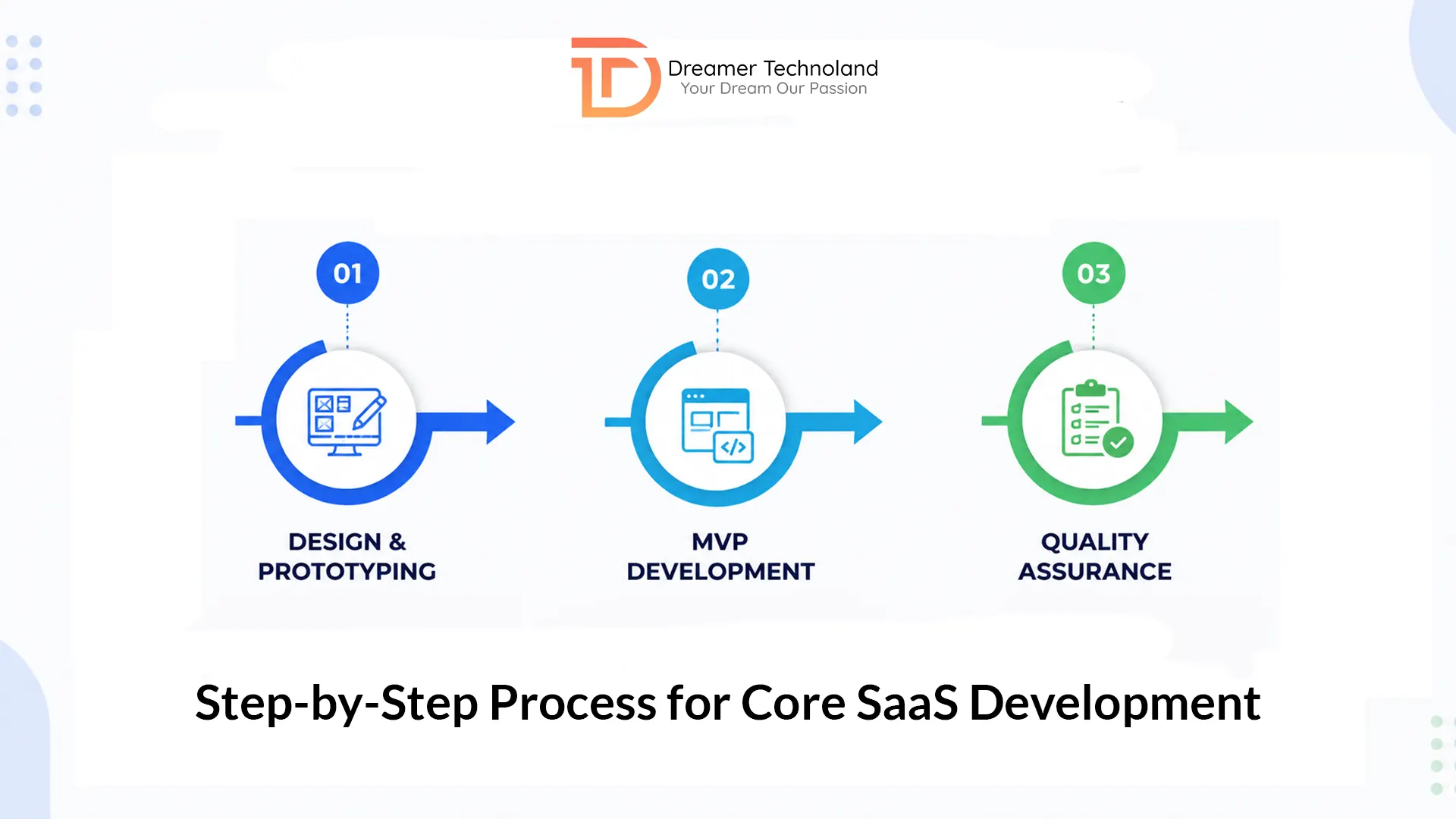
- Design and prototyping: Wireframes are created along with working prototypes that demonstrate the user experience before the work of coding is started.
- MVP development: The main features that give value to the product are developed and connected.
- Quality assurance: All parts of the product are tested one by one, then connected, and finally given to beta testers.
Mistakes to Avoid During SaaS Product Development
There are many common mistakes when you build a SaaS product. In the table below, you can see the mistakes, the reason of happening, and a better approach:
| Mistake | Why It Happens | Better Approach |
|---|---|---|
| Building too many features | Trying to satisfy every user | Start with an MVP |
| Skipping validation | Assuming demand exists | Interview potential users |
| Choosing the wrong architecture | Focusing only on initial cost | Plan for scalability |
| Ignoring security | Prioritizing speed | Build security from the beginning |
| Not tracking metrics | Focusing only on users | Monitor MRR, CAC, LTV, and churn |
Why Partner with Dreamer Technoland for Software Development?
Not every business has the resources to build an in-house development team from day one, and many founders lack extensive engineering expertise. Partnering with an experienced software development company like Dreamer Technoland can help you accelerate your time to market through proven architectural practices, scalable cloud solutions, and efficient development processes.
If you’re looking for a custom software or mobile app development company in India, Dreamer Technoland offers expertise in building scalable, multi-tenant SaaS applications, transparent pricing, and a proven track record of delivering reliable digital solutions tailored to business needs.
Final Thoughts
Developing SaaS products from scratch is a process that includes validation, planning, development, and scaling, with each step building upon the previous one. No matter whether you do it yourself or get some help from a custom software development company, the key ingredients of success will be solving a real problem, selecting the right SaaS stack, and always listening to your customers. Make sure to keep it simple and validate quickly.
Frequently Asked Questions
Q. How long does it take to build a Saas product?
To build a SaaS product, it generally takes 4 to 9 months, whereas an MVP can often launch between 2 and 6 months, depending on the complexity, feature scope, and team size.
Q. Should I use no-code tools or write custom code?
For an early-stage MVP, no-code or low-code tools can help you validate your idea quickly and with less upfront investment. However, custom development is usually a better choice when you need advanced functionality, integrations, scalability, or greater control over the product.
Q. What key metrics should I track post-launch?
Track metrics such as MRR, CAC, LTV, churn rate, activation rate, and customer retention. These metrics help you understand whether users are adopting your product and whether the SaaS business is growing sustainably.
Q. How do I know if my SaaS idea is worth building?
You can validate your SaaS idea by researching your target market, identifying a real customer problem, analyzing competitors, and talking to potential users. Building a simple MVP and testing whether users are willing to pay is one of the best ways to confirm demand before making a larger investment.
Q. What is an MVP, and how simple should it be?
- A critical aspect: Focus on creating only the key function that addresses the primary issue.
- Avoid extras: Hold off on unnecessary features like advanced dashboards and complicated settings for subsequent releases.
Quick timeline: Try to roll out the MVP within 2 to 6 months.