


In many growing businesses today, something feels off even when everything seems organized on the surface. Teams are using multiple tools, reports are being generated, and systems are in place. Yet, work still feels slower than it should be.If you look closely, you will notice a common pattern. Teams are switching between different platforms, data does not always match, and simple tasks require more steps than necessary. It is not because people are not working hard. It is because the tools are not built for how the business operates.
This is where many companies reach a turning point.According to a report by McKinsey, businesses that adopt well-aligned digital solutions can improve operational efficiency by 20 to 30 percent. This is one of the main reasons why companies in 2026 are moving away from generic tools and choosing software that fits their exact needs.Let’s understand what is really driving this shift.
What Are the Limitations of Off-the-Shelf Software in Real Business Scenarios?
At the beginning, ready-made tools seem like the easiest choice. They are quick to set up and require very little effort to get started. However, as businesses grow, the limitations of Off-the-Shelf Software start becoming more visible in everyday work.
- Workflows feel restricted instead of smooth
These tools are built for general use, which means they follow a fixed structure. Over time, your team starts adjusting their work to fit the software instead of working naturally.
This may not seem like a big issue at first, but gradually it slows down operations and reduces overall efficiency. - Important features are missing while unnecessary ones are included
Many tools offer a long list of features, but not all of them are useful for your business. At the same time, some critical features may not be available at all.
This creates a situation where you are paying for things you do not use while still struggling with important gaps. - Data gets scattered across different systems
When tools do not connect properly, information is stored in different places. Teams then rely on manual updates or repeated data entry.
This increases the chances of mistakes and makes it difficult to get a clear view of business performance. - Scaling becomes more complex and expensive over time
As your business grows, you need more users, better performance, and additional features. Most ready-made tools charge more for upgrades.
Even after paying more, they may still not fully support your advanced requirements.
What Are the Key Reasons Businesses Prefer Custom Software Today?
Once these challenges become clear, businesses begin to explore better options. This is where the Key Reasons Businesses Prefer Custom Software become easy to understand.
- The system works according to the business, not the other way around
Custom software is designed based on your workflows. This means your team can work naturally without adjusting to a rigid system.
As a result, tasks become faster, smoother, and more efficient. - The software grows as the business grows
Instead of replacing systems every few years, custom solutions can be expanded with new features whenever needed.
This allows businesses to scale without disruption or major changes. - Better control over data and security
With custom systems, businesses have full control over how their data is stored and used.
This reduces dependency on third-party tools and improves overall security. - More value in the long run despite higher initial cost
While the upfront investment is higher, businesses save money over time by avoiding recurring subscriptions.
More importantly, they gain efficiency, which directly impacts productivity and growth.
Why Are Businesses Choosing Custom Software in 2026 More Than Ever?
Now, let’s look at what is different in 2026.Businesses today are not just looking for tools. They are looking for systems that can adapt, automate, and provide real-time insights. Technologies like AI, automation, and data analytics are becoming part of everyday operations.
However, most generic tools are not designed to support these advanced needs.At the same time, customer expectations have increased. People expect faster services, personalized experiences, and seamless interactions. Meeting these expectations with standard tools is difficult.
Another important factor is competition. In 2026, businesses are competing on efficiency and experience, not just on products. Custom software allows companies to build unique systems that give them a strong advantage.Because of these changes, custom solutions are no longer optional for many businesses. They are becoming essential.
What Does a Real Business Example of Custom Software Look Like?
To make this more practical, let’s look at a simple example.Imagine a growing eCommerce company managing orders, inventory, and customer support using different tools. At first, this setup works. But as orders increase, problems start appearing. Inventory updates get delayed, customer data is not synced properly, and the support team struggles to respond quickly.
Now, instead of adding more tools, the company builds a custom system that connects everything in one place. Orders, inventory, and customer data are all managed through a single platform.As a result, operations become faster, errors are reduced, and the team can focus on improving customer experience.This is how custom software creates real impact.
What Challenges Do Businesses Face When Building Custom Software?
While the benefits are clear, it is also important to understand the Challenges of Custom Software Development before making a decision.
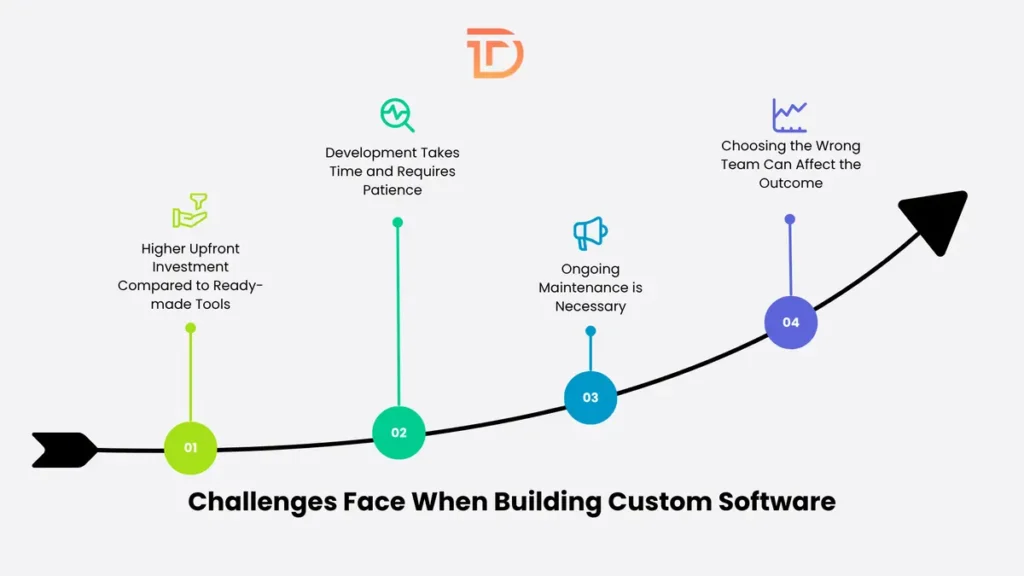
- Higher upfront investment compared to ready-made tools
Building software from scratch requires planning, time, and skilled developers. This increases the initial cost.
However, this investment often delivers better long-term value if managed properly. - Development takes time and requires patience
Custom solutions are not instantly available. They need to be designed, developed, and tested step by step.
This means businesses must be prepared for a longer timeline. - Ongoing maintenance is necessary
Software needs updates, improvements, and bug fixes to stay relevant.
Without proper maintenance, even a good system can become outdated. - Choosing the wrong team can affect the outcome
The success of the project depends on the development team.
Working with inexperienced teams can lead to delays and poor results.
When Should a Business Choose Custom Software Instead of Standard Tools?
Not every business needs custom software immediately. Understanding When Should a Business Choose Custom Software? helps in making the right decision.
- When daily operations feel slow or inefficient
If your team spends more time managing tools than doing actual work, it is a sign that your system is not working properly.
This is often the point where businesses start considering custom solutions. - When your processes are unique and cannot be handled by generic tools
Every business is different. If your workflows are not supported by ready-made tools, it becomes difficult to operate efficiently.
Custom software allows you to build a system that fits your exact needs. - When integration between tools becomes a major issue
If your tools do not connect properly, it creates confusion and delays.
A custom solution can bring everything together in one place. - When long-term costs keep increasing without real value
Paying more for subscriptions without getting better results is a clear sign.
In such cases, custom software becomes a smarter investment.
How Does Custom Software Deliver Real Return on Investment Over Time?
Many businesses hesitate because of the initial cost. However, the real value comes from what happens after the system is implemented. When processes become faster, teams save time. When errors are reduced, productivity improves. When systems are connected, decision-making becomes easier. Over time, these improvements create measurable results. Businesses can handle more work with the same team, respond faster to customers, and make better decisions. This is why many companies see custom software not as a cost, but as an investment that delivers long-term returns.
What Are the Best Practices Before Investing in Custom Software?
Before moving forward, following the Best Practices Before Investing in Custom Software can make the entire process smoother.
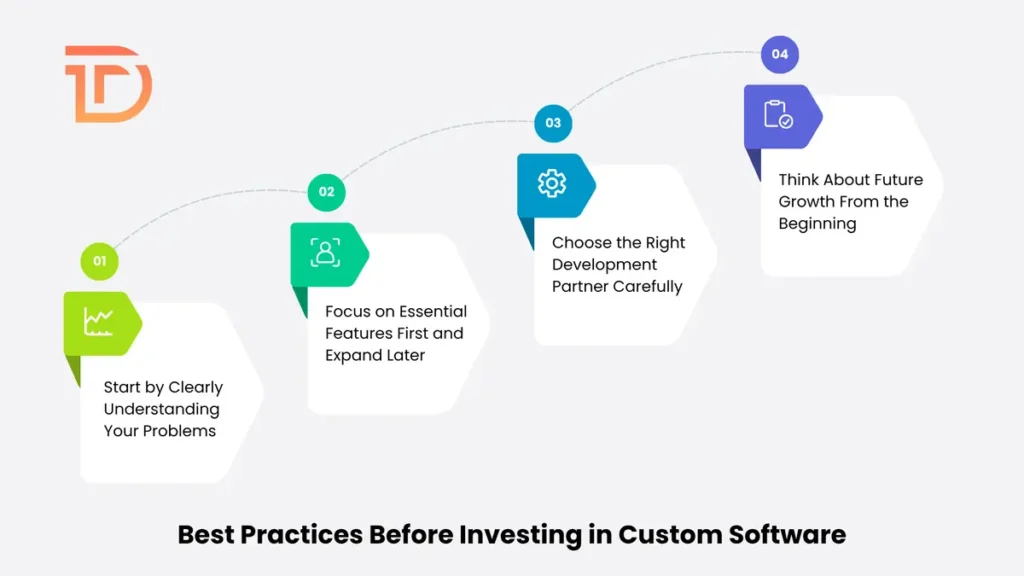
- Start by clearly understanding your problems
Before building anything, identify what is not working in your current setup.
This ensures that your software solves real issues instead of adding complexity. - Focus on essential features first and expand later
Building everything at once increases cost and risk. Starting small allows you to test and improve.
This approach makes the process more practical and manageable. - Choose the right development partner carefully
Working with experienced Custom Software Development Services providers improves planning and execution.
This reduces mistakes and ensures better results. - Think about future growth from the beginning
Your system should be able to handle increased demand and new features.
Planning for scalability avoids costly changes later.
How Can Dreamer Technoland Help You Build the Right Custom Software Solution?
Choosing the right partner can make a big difference in how your project turns out.
Dreamer Technoland focuses on building solutions that match real business needs instead of adding unnecessary complexity.
- They help you decide what is actually needed
Instead of building too many features, they guide you to focus on what matters most.
This helps you save time and avoid unnecessary costs. - They use efficient and practical development methods
The right approach ensures faster development without compromising quality.
This makes the process smooth and reliable. - They build systems that can grow with your business
Your software is designed to handle future expansion and new requirements.
This reduces long-term challenges. - They provide support even after launch
Continuous updates and improvements keep your system effective.
This helps your business stay competitive.
For businesses exploring global expertise, working with a software development company Australia or similar partners can also add value.
Conclusion
If you look at how businesses operate today, the shift toward custom software makes complete sense.Generic tools may work in the beginning, but as complexity increases, they start creating limitations. Custom software, on the other hand, gives businesses the flexibility and control they need to grow.From understanding the limitations of Off-the-Shelf Software to exploring long-term benefits, it becomes clear why this change is happening.In 2026, businesses are not just adopting technology. They are building systems that truly support how they work.
FAQs
Q. Why are businesses moving toward custom software solutions?
A. Because they need flexibility, better integration, and systems that match their workflows.
Q. Is custom softwarea good investment?
A. Yes, it improves efficiency, reduces long-term costs, and supports business growth.
Q. When should a business switch to custom software?
A. When existing tools become inefficient, expensive, or difficult to manage.
Q. What are the main challenges of custom software development?
A. Higher upfront cost, longer development time, and ongoing maintenance.
Q. How can businesses ensure success with custom software?
A. By planning clearly, focusing on real needs, and choosing the right development partner.