



For thousands of sellers operating on Amazon, Flipkart, Meesho, and Myntra, this situation is more common than they realise. As businesses expand across multiple marketplaces, financial operations become increasingly complicated. Many sellers who recently launched their online stores quickly discover that managing marketplace finances is far more complex than setting up a storefront. If you’re just getting started, check out our guide on How to Start an Online Store Today.
Every platform has its own commission structures, settlement cycles, return policies, advertising deductions, and tax calculations. While sales continue growing, many sellers struggle to determine whether they are receiving the correct payments for every order.
According to a report by the Indian Brand Equity Foundation (IBEF), India’s e-commerce market is expected to reach $325 billion by 2030, driven by increasing digital adoption and marketplace expansion. As sellers process larger order volumes across multiple channels, maintaining financial accuracy becomes more critical than ever.
This is where Automated Marketplace Reconciliation comes into the picture.
Marketplace reconciliation helps sellers compare orders, settlements, deductions, returns, and taxes against actual payments received. More importantly, automation eliminates the manual effort required to verify thousands of transactions every month.
What Is Marketplace Reconciliation?
Marketplace reconciliation is the process of matching marketplace transactions with the actual payments received in your bank account.
In simple terms, it answers one critical question:
“Did I receive the correct payment for every order I sold?”
For sellers operating on Amazon, Flipkart, Meesho, and Myntra, reconciliation involves comparing multiple financial records, including:
- Orders placed by customers
- Marketplace settlement reports
- Actual bank deposits
- Platform commissions and fees
- Returns and refunds
- Promotional deductions
- GST and TDS deductions
- Advertising expenses
- Reimbursements and claims
A single marketplace order can involve multiple financial events before the final payment reaches your account. There may be commissions, shipping charges, return deductions, promotional adjustments, taxes, and reimbursements attached to that order.
Without proper reconciliation, it becomes extremely difficult to know whether the final settlement amount is accurate.
The Revenue Leakage Most Sellers Never Notice
Most marketplace sellers assume that if an order is delivered, the payment must be correct.
Unfortunately, reality is much more complicated.
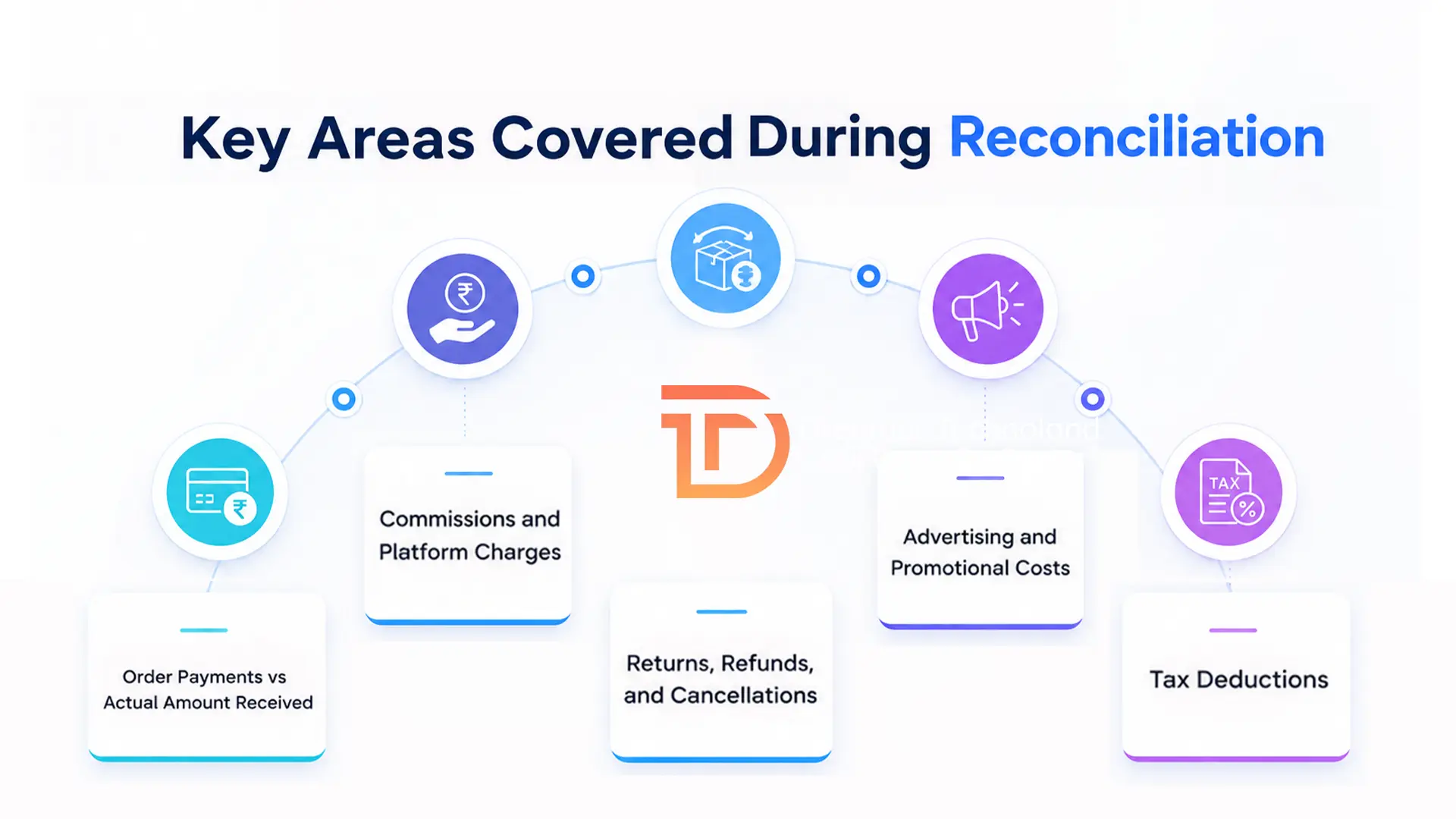
Marketplace settlements involve thousands of transactions, multiple fee calculations, tax deductions, and return adjustments. Even small discrepancies can accumulate into significant financial losses over time.
Most Common Profit Leaks Include
- Higher Marketplace Commissions
Sometimes deductions differ from the agreed commission structures due to category-mapping issues or platform calculation errors.
- Incorrect Return Settlements
Products may be returned, partially refunded, or adjusted incorrectly, resulting in lower credits than expected.
- Duplicate Deductions
The same charge may occasionally appear multiple times across settlement reports.
- Missing Settlement Payments
Delayed or unreleased settlements often remain unnoticed when sellers process large transaction volumes.
- Excess Promotional Charges
Campaign fees, visibility charges, and promotional deductions may exceed expected amounts.
- Unreconciled Tax Deductions
Incorrect TDS or GST entries can affect both cash flow and compliance.
Consider a seller processing 500 orders every month. If discrepancies average only ₹30 to ₹80 per order, the business could lose between ₹15,000 and ₹40,000 every month without realizing it.
Over a year, that translates into lakhs of rupees in lost revenue.
The biggest challenge is that these discrepancies rarely appear obvious. Sellers often trust marketplace reports without independently validating the numbers.
Why Every E-Commerce Seller Needs Marketplace Reconciliation
Once sellers understand how easily revenue leakage occurs, the importance of reconciliation becomes obvious. As online businesses scale across multiple sales channels and marketplace ecosystems, understanding the different types of eCommerce applications can help sellers build a stronger technology foundation for growth.
- Complete Financial Visibility
Marketplace reconciliation provides a clear picture of earnings, deductions, and pending recoveries across all selling channels.
- Accurate Profitability Tracking
Many sellers calculate profits based only on sales revenue. Reconciliation reveals actual profitability after accounting for fees, returns, taxes, and advertising expenses.
- Faster Revenue Recovery
Identifying discrepancies early increases the likelihood of recovering lost funds before dispute windows close.
- Better GST and TDS Compliance
Proper reconciliation helps ensure accurate tax reporting and reduces compliance risks during audits.
- Improved Cash Flow Forecasting
Knowing when payments are due and identifying pending recoveries allows better financial planning.
- Greater Stakeholder Confidence
Investors, lenders, and stakeholders prefer businesses with transparent and well-managed financial records.
As e-commerce businesses scale, reconciliation becomes one of the most important processes supporting sustainable growth.
Why Spreadsheet-Based Reconciliation Breaks at Scale
Many sellers still rely on Excel spreadsheets for reconciliation.
While spreadsheets may work for small transaction volumes, they quickly become ineffective as businesses grow.
If you are still reconciling marketplace payments manually, you are probably spending significant time while still missing important discrepancies.
- Transaction Volume Becomes Unmanageable
A seller handling hundreds of daily orders can generate thousands of settlement records every month.
Matching these records manually becomes extremely difficult.
- Finance Teams Lose Valuable Time
Downloading reports, cleaning data, organizing spreadsheets, and validating settlements can consume 40 to 60 hours every month.
That time could be invested in business growth initiatives instead.
- Human Errors Are Inevitable
Manual reconciliation increases the risk of missed discrepancies, duplicate entries, and incorrect calculations.
- No Real-Time Visibility
By the time discrepancies are discovered, marketplace dispute deadlines may already have passed.
- Every Marketplace Uses Different Formats
Amazon, Flipkart, Meesho, and Myntra all provide settlement reports in different structures and formats.
Manually standardizing this information creates additional complexity.
- Missed Recovery Opportunities
Unidentified discrepancies eventually become permanent financial losses.
The larger the business becomes, the more expensive manual reconciliation becomes.
Marketplace Reconciliation Challenges by Platform
Although reconciliation is important across all marketplaces, every platform introduces unique challenges that sellers must manage carefully.
Amazon Seller Reconciliation Challenges
For many businesses, Amazon generates a significant share of online revenue. However, it also has one of the most complex settlement structures.
Common Challenges Include
- Referral fees, closing fees, and fulfillment fees applied across different product categories
- Reconciling FBA inventory losses and damage reimbursements
- Tracking A-to-Z claims and chargebacks
- Validating return-related deductions
- Matching Amazon Ads spending with actual campaign performance
Because multiple financial events can affect a single order, identifying discrepancies manually becomes increasingly difficult as order volume grows.
Flipkart Seller Reconciliation Challenges
Flipkart sellers often face challenges related to multiple settlement cycles and deduction structures.
Key Reconciliation Issues Include
- Tracking payments across varying settlement timelines
- Reconciling Flipkart Assured and non-Assured orders
- Managing return and replacement adjustments
- Validating promotional participation charges
- Monitoring visibility fee deductions
Without systematic reconciliation, many sellers struggle to understand how specific deductions affect profitability.
Meesho Seller Reconciliation Challenges
Meesho follows a different business model than most marketplaces, which creates unique reconciliation requirements.
Common Challenges Include
- Tracking shipping fee deductions accurately
- Matching COD remittances against actual settlements
- Reconciling return shipping charges
- Handling panel payment cycles that differ from order dates
- Validating deductions under the platform’s pricing structure
Many sellers underestimate the complexity of Meesho settlements until transaction volumes increase.
Myntra Seller Reconciliation Challenges
Fashion and lifestyle marketplaces create additional financial complexity because of higher return rates.
Common Myntra Reconciliation Challenges Include
- Tracking return-related credit notes
- Managing category-specific commission structures
- Reconciling end-of-season sale deductions
- Monitoring promotional campaign costs
- Handling different payment workflows across order types
As return volumes increase, maintaining accurate financial records becomes significantly more challenging.
The Role of Reconciliation in E-commerce Profitability
Many businesses view reconciliation as a finance function. In reality, it directly impacts profitability, pricing decisions, and business growth.
Improves Net Margins
Every recovered discrepancy contributes directly to profit.
Unlike increasing sales, recovering settlement errors does not require additional marketing spend, inventory investment, or operational costs.
Identifies Your Most Profitable Marketplace
Not all platforms generate the same returns.
Reconciliation helps Sellers Compare
- Platform-wise profitability
- Product-wise margins
- Return-related losses
- Advertising performance
- Settlement efficiency
This visibility allows businesses to focus resources on the channels that generate the strongest returns.
Supports Smarter Pricing Decisions
Accurate reconciliation provides a clear picture of actual costs.
Businesses can adjust pricing strategies based on:
- Marketplace commissions
- Shipping expenses
- Return rates
- Promotional costs
- Advertising spend
Enables Sustainable Scaling
As businesses grow, financial accuracy becomes increasingly important.
Clean financial records support expansion planning, inventory forecasting, investor reporting, financial audits, and funding opportunities.
- Expansion planning
- Inventory forecasting
- Investor reporting
- Financial audits
- Funding opportunities
Simplifies Tax Compliance
Proper reconciliation ensures accurate GST and TDS reporting while reducing compliance risks.
Builds Investor Confidence
Investors and acquirers often examine financial accuracy during due diligence.
Well-maintained reconciliation records demonstrate operational maturity and financial discipline.
How Does Marketplace Reconciliation Software Work?
As transaction volumes increase, automation becomes the only practical solution.
Modern Marketplace Reconciliation Software replaces the traditional download-match-verify process with intelligent automation. However, reconciliation software performs best when supported by a fast and efficient online store infrastructure. Businesses looking to improve overall marketplace performance should also follow these performance optimization tips for faster eCommerce sites.
Instead of manually comparing spreadsheets, software continuously validates transactions across marketplaces.
Key Capabilities Include
- Automated Data Collection
The system automatically imports settlement reports from Amazon, Flipkart, Meesho, Myntra, and other connected platforms.
- Intelligent Transaction Matching
Orders, settlements, commissions, fees, refunds, and deductions are automatically matched against expected values.
- Discrepancy Detection
The software identifies:
- Missing payments
- Short settlements
- Duplicate deductions
- Incorrect commissions
- Tax inconsistencies
- Dispute Management
Automated workflows help finance teams track recovery opportunities before dispute deadlines expire.
- Real-Time Dashboards
Users gain instant visibility into reconciliation status across all marketplaces.
- GST and TDS Reporting
Many systems also automate tax calculations and reporting processes.
Instead of spending days reviewing spreadsheets, businesses can identify issues within minutes.
How Do E-commerce Sellers Recover Lost Revenue Through Reconciliation?
One of the biggest advantages of reconciliation is revenue recovery.
Many sellers are surprised by how much recoverable revenue exists within their marketplace accounts.
Common recovery opportunities include:
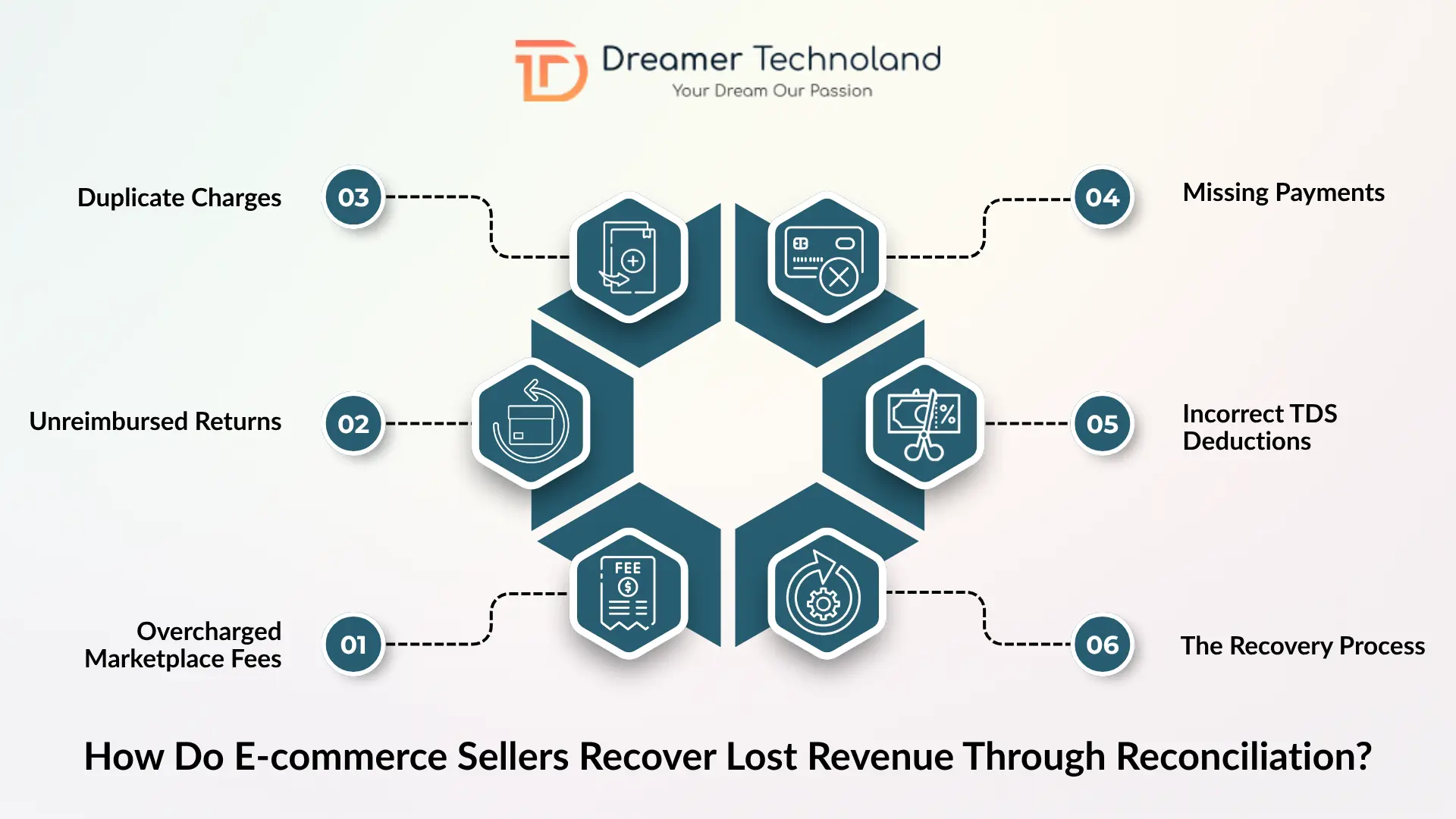
- Overcharged Marketplace Fees
Incorrect commission deductions are more common than many sellers realize.
- Unreimbursed Returns
Products may be returned without corresponding reimbursements.
- Duplicate Charges
Repeated deductions often go unnoticed in large settlement files.
- Missing Payments
Delayed or incomplete settlements can remain undetected without verification.
- Incorrect TDS Deductions
Tax-related discrepancies may affect both cash flow and compliance.
- The Recovery Process
Most recovery workflows follow these steps:
- Identify the discrepancy
- Gather supporting evidence
- Raise a marketplace dispute
- Track dispute progress
- Receive reimbursement or correction
Although individual recoveries may appear small, the cumulative impact can be substantial.
Recovering just ₹20,000 every month results in ₹2.4 lakh annually. For larger sellers, recovery opportunities can be significantly higher.
Build Custom Marketplace Reconciliation Software With Dreamer Technoland
Off-the-shelf tools often provide generic reconciliation capabilities. However, every marketplace operates differently, and every seller has unique workflows.
At Dreamer Technoland, we build custom reconciliation solutions designed specifically for growing e-commerce businesses. Our expertise extends beyond reconciliation systems to complete eCommerce app development services, helping businesses create scalable platforms that support growth across multiple sales channels.
Our solutions include:
- Multi-marketplace reconciliation dashboards
- Automated settlement data ingestion
- Amazon, Flipkart, Meesho, and Myntra integrations
- Intelligent discrepancy detection
- Automated dispute management workflows
- GST and TDS reporting modules
- Financial analytics and profitability reporting
- Scalable architecture for high-volume sellers
The development process begins with understanding your current operations, settlement workflows, reporting requirements, and recovery objectives. If you are evaluating technology partners for your next marketplace solution, our guide on how to choose the right eCommerce development company can help you make an informed decision.
For businesses planning long-term marketplace growth, custom reconciliation software provides significantly greater flexibility and scalability than generic tools.
Conclusion
Marketplace growth creates significant opportunities for sellers, but it also brings financial complexity. Every order involves commissions, deductions, returns, taxes, and settlement adjustments that can impact profitability if left unchecked.
Without proper reconciliation, small discrepancies can accumulate over time and lead to substantial revenue loss. While manual processes may work for smaller operations, they become increasingly inefficient as order volumes grow. Automated reconciliation helps sellers identify payment gaps, recover lost revenue, maintain compliance, and gain complete visibility into their marketplace finances.
Most importantly, reconciliation provides the financial clarity needed to make smarter business decisions and support long-term growth.
Every unreconciled payment is revenue your business has already earned. Contact Dreamer Technoland today to build a custom reconciliation solution that helps you protect profits and scale with confidence.
Frequently Asked Questions
Q. What is automated marketplace reconciliation and how does it work?
A. It is a software-driven process that automatically matches orders, settlements, deductions, taxes, and bank deposits to identify discrepancies and ensure financial accuracy.
Q. Which marketplaces does your reconciliation software support?
A. Our custom solutions can integrate with Amazon, Flipkart, Meesho, Myntra, and other marketplaces based on your business requirements.
Q. How much revenue can sellers typically recover through reconciliation?
A. Recovery amounts vary by transaction volume and discrepancy rates. Many sellers discover significant recoverable amounts that previously went unnoticed.
Q. How long does it take to build a custom reconciliation solution?
A. Development timelines depend on complexity, integrations, and reporting requirements. Most projects are completed within a few weeks to a few months.
Q. Can the software integrate with our existing accounting or ERP system?
A. Yes. Custom reconciliation solutions can be integrated with accounting platforms, ERP systems, inventory software, and financial reporting tools.
Q. Is your reconciliation solution suitable for small sellers or only large businesses?
A. The solution is designed for businesses of all sizes, from growing marketplace sellers to large-scale e-commerce enterprises managing high transaction volumes.