



Cloud migration in 2026 isn’t the same conversation IT leaders were having five years ago. It’s no longer just about moving servers out of a data center. Gartner forecasts worldwide end-user spending on public cloud services to reach $723.4 billion in 2025, up from $595.7 billion in 2024, a 21.5% increase. Gartner attributes this growth partly to expanding AI use cases and organizations’ efforts to integrate cloud infrastructure into their GenAI strategies.
Here’s the catch: the same research shows wasted cloud spend is climbing too, and it usually comes down to one mistake: treating migration cost and ongoing cloud operating cost as if they’re the same number. They’re not, and that gap is exactly why so many teams get blindsided mid-project.
So if you’re asking how much does cloud migration costs, the honest answer depends on your applications, your data, and how much AI infrastructure you’re planning around. Here, we will discuss the real cloud migration pricing for 2026, the biggest cost drivers, and a method to build your own number instead of trusting a vendor’s ballpark. By the end, you’ll know exactly how much will cloud migration cost in 2026 for a business like yours.
A Quick Summary on How Much Does Cloud Migration Cost?
Most cloud migration services cost somewhere between $50,000 for a small, single-application move and $10 million or more for a full enterprise portfolio. The average cloud migration cost for a mid-sized business typically lands between $150,000 and $1.5 million once you count assessment, data transfer, application changes, testing, and a few months of parallel running. The real number depends on your applications, your data, your compliance load, and how much modernization you want along the way. We’ll unpack every layer of that number below.
What Actually Do Cloud Migration Services Cost Include?
Many quotes cover only the visible part of the job: servers, storage, and a migration team’s timesheet. That’s why the final bill so often surprises people. A proper cloud migration services cost breaks into two very different buckets.
- One-time migration costs
This covers:
- Infrastructure and application discovery
- Cloud readiness assessment and architecture design
- Data extraction, cleansing, and transfer
- Application rehosting, replatforming, or refactoring
- Security, identity, and compliance setup
- Testing, cutover planning, and staff training
- Recurring cloud costs
Once you’ve gone live, include:
- Compute, storage, and networking consumption
- Managed databases and backup services
- Monitoring, logging, and security tooling
- Licensing, support plans, and cloud operations staff
Here’s the mistake almost every organization makes: treating these as one number. They’re not. The one-time project fee tells you what it costs to move. The recurring bill tells you what it costs to stay. Any custom software development work needed to modernize a legacy app during migration also belongs in the first bucket, not buried inside “infrastructure cost.”
How Much Does Cloud Migration Cost: A Comprehensive Breakdown
No single figure fits every company, but planning bands help you anchor a conversation with finance. Here’s how average cloud migration cost typically breaks down by business size:
| Business Size | Applications | Typical One-Time Migration Cost | Monthly Cloud Bill After Go-Live |
|---|---|---|---|
| Small business | 1–5 apps | $50,000 – $150,000 | $2,000 – $15,000 |
| Mid-market | 5–30 apps | $150,000 – $750,000 | $15,000 – $120,000 |
| Enterprise | 30+ apps | $750,000 – $5 million+ | $120,000 – $1.5 million+ |
So, How Much Does Cloud Migration Cost Per Application?
On average, expect $50,000 to $150,000 per application for a straightforward rehost, and $200,000 to $500,000+ per application if it needs a full refactor into cloud-native architecture.
Provider choice also shifts the number. AWS cloud migration cost tends to run slightly leaner for compute-heavy workloads thanks to flexible pricing models like Savings Plans and Spot Instances, which can cut bills by up to 72% and 90%, respectively, for the right workload. Azure cloud migration costs often come out competitive for businesses already running Microsoft licensing, and you can model it directly using the Azure pricing calculator. Google Cloud migration costs are frequently the sharpest option for data-heavy and AI workloads; run your own numbers through the Google Cloud pricing calculator before committing to a platform.
Top Factors Affecting Cloud Migration Costs
Among all factors affecting cloud migration costs, a handful move the needle more than the rest:
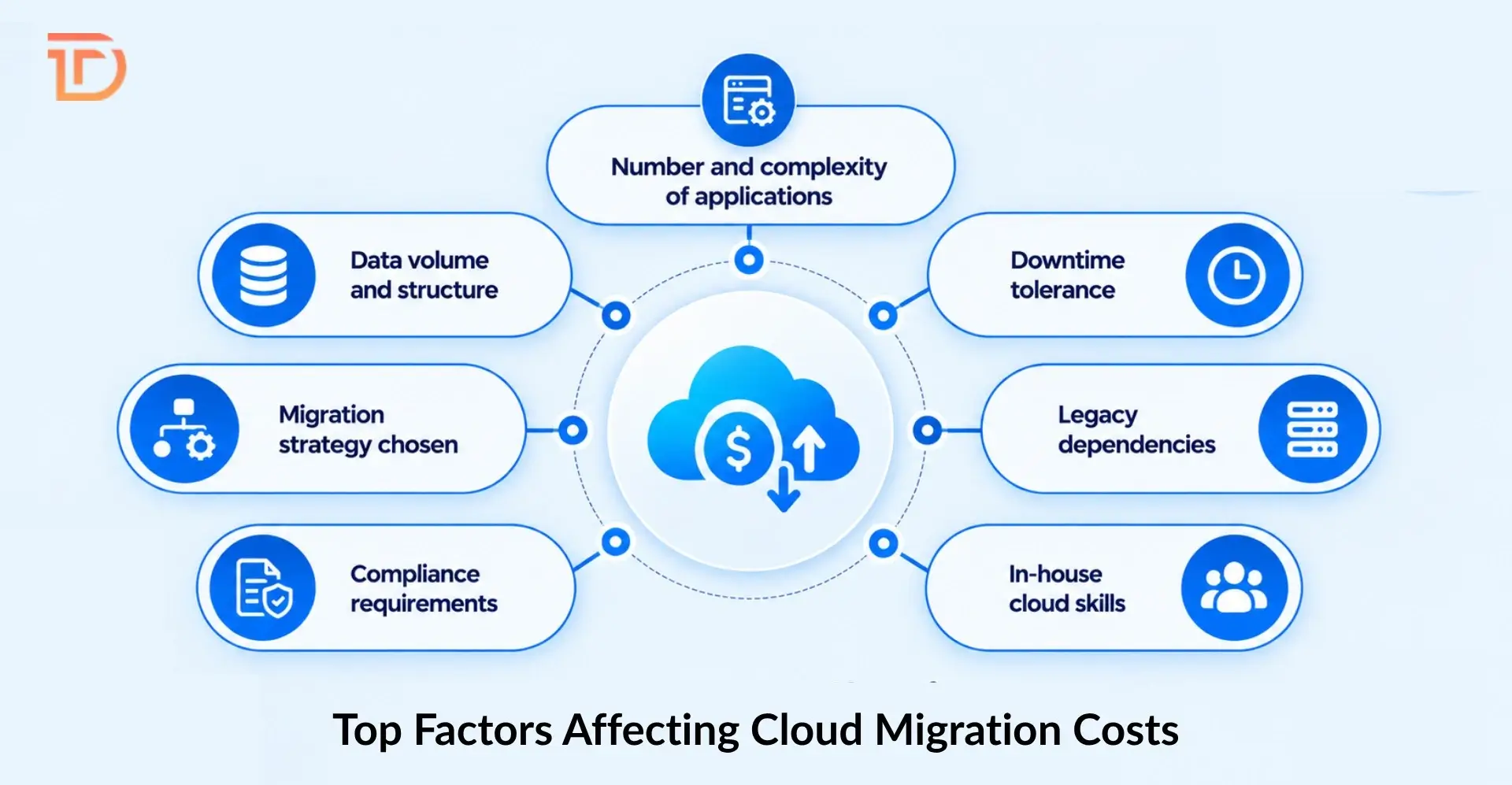
- Number and complexity of applications
Every additional application adds its own discovery, testing, and validation work, so a portfolio of 30 apps costs far more than a simple multiple of a five-app migration.
- Data volume and structure
A few hundred gigabytes move in hours, but hundreds of terabytes across multiple databases need staged transfers, validation, and extra bandwidth planning that all add to the bill.
- Migration strategy chosen
Rehosting keeps upfront spending low because you’re moving apps largely as-is, while refactoring costs more today but usually lowers your recurring cloud bill for years afterward.
- Compliance requirements
Regulations like HIPAA, GDPR, or PCI DSS demand encryption, access controls, and audit trails that need to be built into the architecture, not bolted on after go-live.
- Downtime tolerance
A business that can’t afford even a few minutes of downtime needs parallel-running environments and extensive rollback testing, both of which add engineering hours and cost.
- Legacy dependencies
Old applications often connect to undocumented databases, file shares, or authentication systems, and untangling these hidden links is one of the most common reasons budgets run over.
- In-house cloud skills
If your team hasn’t run a large-scale migration before, you’ll lean more heavily on a cloud migration company for architecture decisions, execution, and post-launch support.
If your applications need architectural changes as part of the move, it’s worth reading about why serverless architecture is reshaping cloud application design; it changes both your migration cost and your long-term operating bill.
How Can You Budget for AI-Ready Infrastructure?
In 2026, “cloud migration” rarely means just moving servers anymore. Most businesses are also preparing for AI workloads: vector databases, model inference endpoints, and retrieval pipelines. That changes your cloud migration pricing models significantly.
Budget separately for:
- Data foundation: storage, cataloging, and governance
- Model and inference layer: hosted APIs or dedicated GPU endpoints
- Vector search and retrieval: embeddings and semantic indexing
- Observability and guardrails: logging, monitoring, and content controls
A low-traffic AI feature can often run on a managed model API for a few hundred dollars a month. A high-volume, latency-sensitive one may need dedicated GPU capacity, which changes the math entirely. If AI is part of your roadmap, our AI development services team can help scope this layer before it becomes a surprise line item.
How To Calculate The Accurate Cloud Migration Services Cost
Use this six-step method given below:
- Inventory everything
List every application, database, data volume, and integration point before you estimate a single dollar. Skipping this step is the most common reason budgets fall apart later.
- Classify each workload
Sort applications into simple, moderately complex, or heavily regulated groups, since each category carries its own cost profile and testing effort.
- Pick a migration strategy per app
Decide whether each workload should be rehosted, replatformed, refactored, repurchased, retained, or retired. Mixing strategies across a portfolio is normal and usually cheaper than forcing one approach on everything.
- Add platform costs
Include landing zone setup, security architecture, networking, and governance frameworks. These apply across the entire portfolio, not just to one application.
- Model three scenarios
Build a low, expected, and high case for both the migration itself and the cloud bill that follows, so leadership sees a realistic range instead of one fragile number.
- Validate with a pilot
Migrate one representative workload first and measure the real cost and performance before committing the full budget to the rest of the portfolio.
This same logic applies whether you are working through cloud migration cost estimation for infrastructure or scoping something adjacent, like our breakdown of AI app development cost. Bottom-up, workload-by-workload numbers always beat a flat industry average.
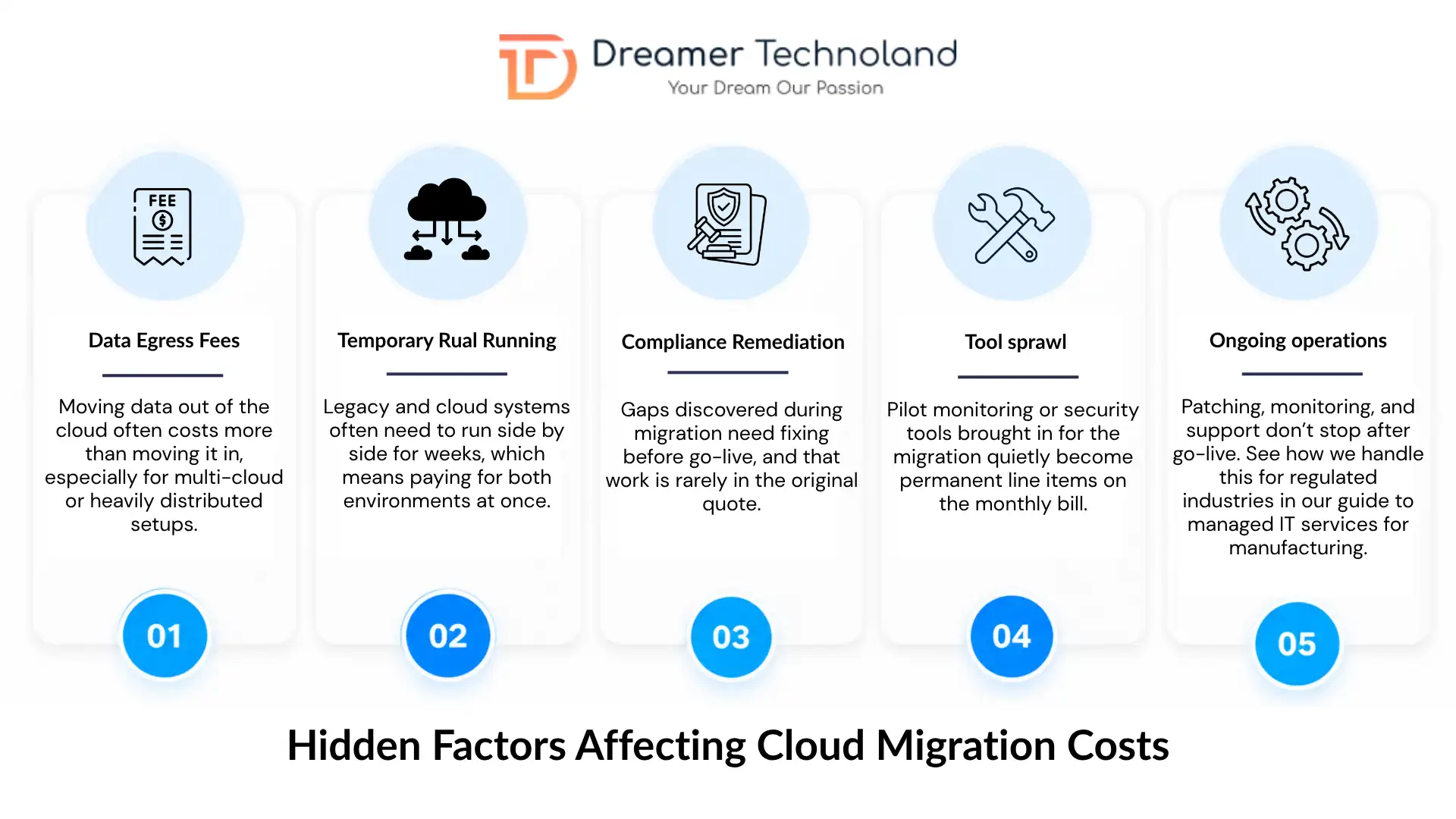
Hidden Factors Affecting Cloud Migration Costs
These rarely show up in the first quote, but they show up on the invoice:
Top Budgeting Mistakes To Avoid
Take a look at these to budget wisely:
- Treating migration cost and operating cost as one number
They run on different timelines and deserve separate budgets.
- Skipping discovery to save time upfront
Rushed discovery almost always resurfaces later as unplanned work.
- Ignoring data egress and cross-region transfer fees
Providers charge to move data out, and this gets missed most often.
- Buying long-term commitments before usage patterns stabilize
Locking in discounts too early wastes budget if plans change.
- Leaving security and compliance out of the initial budget
Treating it as an add-on instead of a core requirement gets expensive fast.
- Assuming every application needs the same migration strategy
Most portfolios need a mix of approaches, not one blanket plan.
A 90-Day Budgeting Roadmap
You don’t need six months of planning to get a real number. Here’s how to turn guesswork into a solid budget in three sprints.
- Days 1–30
Inventory applications, data, and dependencies. Baseline current usage and identify compliance requirements.
- Days 31–60
Design the target architecture. Model compute, storage, and AI costs across low, expected, and high scenarios.
- Days 61–90
Run a pilot migration on one representative workload. Measure real performance and cost, then finalize the budget for wave one.
Smart Ways to Manage Cloud Migration Cost Estimation
Here is how you can reduce cloud migration pricing:
- Tag every resource by team, environment, and business unit from day one
- Set spending alerts before usage spikes, not after
- Right-size resources only once production traffic patterns are clear
- Automate scaling and shutdown for non-production environments, which our automation services team builds as a standard workflow
- Review commitment discounts quarterly, not once and forget
- Follow a structured framework like the FinOps Foundation’s model of Inform, Optimize, and Operate
Cloud spend is only getting harder to predict. Gartner projects global IT spending will keep climbing through 2026 and beyond, and Flexera’s latest research found wasted cloud spend is rising too. Planning your cloud migration cost breakdown properly from day one is the best defense against both trends.
How Can Dreamer Technoland Help?
We don’t sell generic migration packages. As a cloud migration company, we start with your actual applications, your actual data, and your actual compliance needs, then build a cost model around that. Our cloud migration and solutions services cover everything from readiness assessment to zero-downtime cutover to post-launch cost optimization.
If you’re still asking how much will cloud migration cost in 2026 for your specific setup, that’s exactly the conversation we start every engagement with: no guesswork, no inflated quotes, just a number tied to your environment. So, if you are also wondering, how much does cloud migration cost? Connect with our cloud engineers for a realistic migration budget.
Key Takeaways
- Cloud migration services cost ranges from $50,000 for small moves to $10 million+ for enterprise portfolios
- Migration cost and recurring cloud cost are two separate budgets. Never model them as one
- AWS, Azure, and Google Cloud migration costs all vary by workload type and provider pricing model
- AI-ready infrastructure adds a new, separate cost layer most 2026 budgets need to plan for
- A bottom-up, workload-level estimate always beats a flat industry average
- Working with an experienced cloud migration consulting services partner reduces both cost surprises and project risk
FAQs On How Much Does Cloud Migration Cost?
Q. How long does it take for cloud migration?
A small migration with a handful of applications can wrap up in 6 to 12 weeks. Mid-market portfolios typically take 4 to 9 months, while large enterprise migrations with complex dependencies and compliance needs often run 12 to 24 months or more.
Q. Is it possible to migrate everything at the same time?
Technically yes, but it’s rarely wise. A phased approach lets you test your process on smaller workloads before touching business-critical systems.
Q. How much will cloud migration cost in 2026?
For most mid-sized businesses, expect $150,000 to $1.5 million for the migration itself, plus a separate recurring cloud bill. Enterprise portfolios with AI workloads should budget significantly higher.
Q. Is the cost of all cloud migrations the same?
No. Rehosting is the cheapest upfront option. Refactoring costs more initially but usually pays off through better performance and lower long-term operating costs.
Q. How to reduce cloud migration costs?
Retire unused applications before migrating, choose the right migration strategy per app, use commitment discounts only after usage stabilizes, and automate scaling wherever possible.