

Every founder asks the same question before writing a single line of code: what’s this going to cost? If you’re weighing React Native against a native build, you’ve probably already seen three different numbers from three different sources, and none of them agree. That’s not because anyone’s lying to you. React Native app development cost depends on app complexity, feature count, design depth, and where your developers sit, and those variables swing the final number by six figures. Whether you’re comparing React Native mobile app development services from a handful of vendors or trying to scope a budget on your own, this guide breaks down what actually drives React Native app development cost in 2026, where the framework holds up, where it doesn’t, and the problems teams run into once development is underway. If you’re trying to budget a real project rather than guess at one, this is the version with the numbers attached.
How Much Does React Native App Development Cost
| Question | Short Answer |
|---|---|
| Typical cost range | $12,000 to $250,000+, depending on complexity |
| Simple app timeline | 2–4 months |
| Complex/enterprise timeline | 7–14+ months |
| India hourly rate | $20–$45/hour |
| US/UK hourly rate | $60–$150/hour |
| Best for | MVPs, business apps, apps sharing a React web codebase |
| Not ideal for | Heavy 3D/AR apps needing absolute peak native performance |
What is React Native?
React Native is an open-source framework, originally built by Meta, that lets developers write one JavaScript/TypeScript codebase and ship it to both iOS and Android. Unlike WebView-based tools, it renders to real native UI components, so a button in a React Native app is the same native button an iOS or Android developer would use directly. Developers write the logic once in React; the framework translates that into native platform calls at runtime. That’s the core trade-off worth understanding before you look at cost: you’re not getting a web app wrapped in a shell; you’re getting one shared logic layer driving two native front ends.
Market Overview
React Native isn’t a niche choice. Industry surveys attributed to Statista put React Native at roughly 35% of cross-platform developer usage in 2026, with Flutter slightly ahead at around 46%. The two frameworks together account for most new cross-platform builds, and React Native’s share has held steady rather than collapsed, despite Flutter’s growth. That stability is part of why demand for React Native development services hasn’t slowed down even as newer frameworks enter the market.
The maintenance activity backs that up. The framework’s own GitHub repository, facebook/react-native, currently sits at over 126,000 stars and more than 25,000 forks, with commits landing multiple times a week. That’s not a side project; it’s an actively developed framework with a large contributor base, which matters when you’re betting a multi-year product on it.
Who Uses React Native?
React Native shows up across very different kinds of companies, not just startups cutting corners on budget.
- Startups validating an idea before committing to two native teams
- Mid-sized businesses building internal tools or customer-facing apps where speed to market matters more than squeezing out the last 5% of performance
- Enterprises with existing React web apps that want to share logic, types, and sometimes components between web and mobile
- Consumer apps with moderate complexity: e-commerce, booking, social, on-demand services, and dashboards
The brand list backs this up. Shopify runs its core mobile app and point-of-sale app on React Native and has become one of the framework’s most active open-source contributors. Discord uses it for mobile messaging at a real-time scale. Instagram, Facebook, and Microsoft Office run React Native in front of hundreds of millions of users. Bloomberg rebuilt its market data app on it, and Walmart has reported sharing roughly 95% of its codebase between Android and iOS through the framework. Coinbase and Tesla also run production features on React Native, which matters if you were assuming the framework can’t handle financial data or demanding UI.
None of these companies chose React Native because they couldn’t afford native development. They chose it because, for the kind of apps they’re running, one codebase moving fast beat two codebases moving carefully. It’s not the right call for everything (more on that below), but “toy framework” isn’t an accurate label for it anymore. This is also why so many businesses now turn to React Native development services; instead of building separate native teams from scratch, the framework has earned that trust at scale.
How Much React Native App Development Cost
This is the part most guides either oversimplify or avoid. Here’s a realistic 2026 breakdown by complexity.
| App Complexity | What’s Included | Timeline | Cost Range |
|---|---|---|---|
| Simple | 5–10 screens, basic UI, minimal backend | 2–4 months | $12,000–$30,000 |
| Medium | Auth, payments, push notifications, moderate backend | 4–7 months | $30,000–$70,000 |
| Complex | Real-time features, heavy integrations, custom animations | 7–10 months | $70,000–$140,000 |
| Enterprise | Multi-role access, compliance needs, legacy system integration | 10–14+ months | $140,000–$250,000+ |
React Native app development costs in India tend to run lower because of hourly rate differences rather than lower-quality output. Here’s how that breaks down by region:
| Region | Hourly Rate |
|---|---|
| India | $20–$45/hour |
| Eastern Europe | $30–$70/hour |
| Western Europe | $55–$120/hour |
| United States | $60–$150/hour |
A medium-complexity app that costs $70,000 built by a US-based team might land closer to 30,000–40,000 with an India-based React Native development services provider, assuming similar scope and quality standards. The gap isn’t magic; it’s labor cost, and it’s one reason React Native app development cost in India remain lower while still meeting the same engineering standards, making outsourcing a common choice for custom React Native app development services.
What moves the number inside each tier:
- Backend complexity: a simple REST API costs far less than real-time sync with WebSockets
- Third-party integrations: payment gateways, maps, and analytics each add 1,000–6,000
- Design depth: custom animations and bespoke UI cost more than using standard components
- Native modules: anything requiring custom native code (not pure JavaScript) adds development and testing time
Budget separately for post-launch maintenance, typically 15–20% of initial development cost annually, and app store fees ($99/year for Apple, $25 one-time for Google).
Top Benefits of React Native Development
There are many advantages of react native mobile app development services; some of these are listed below:
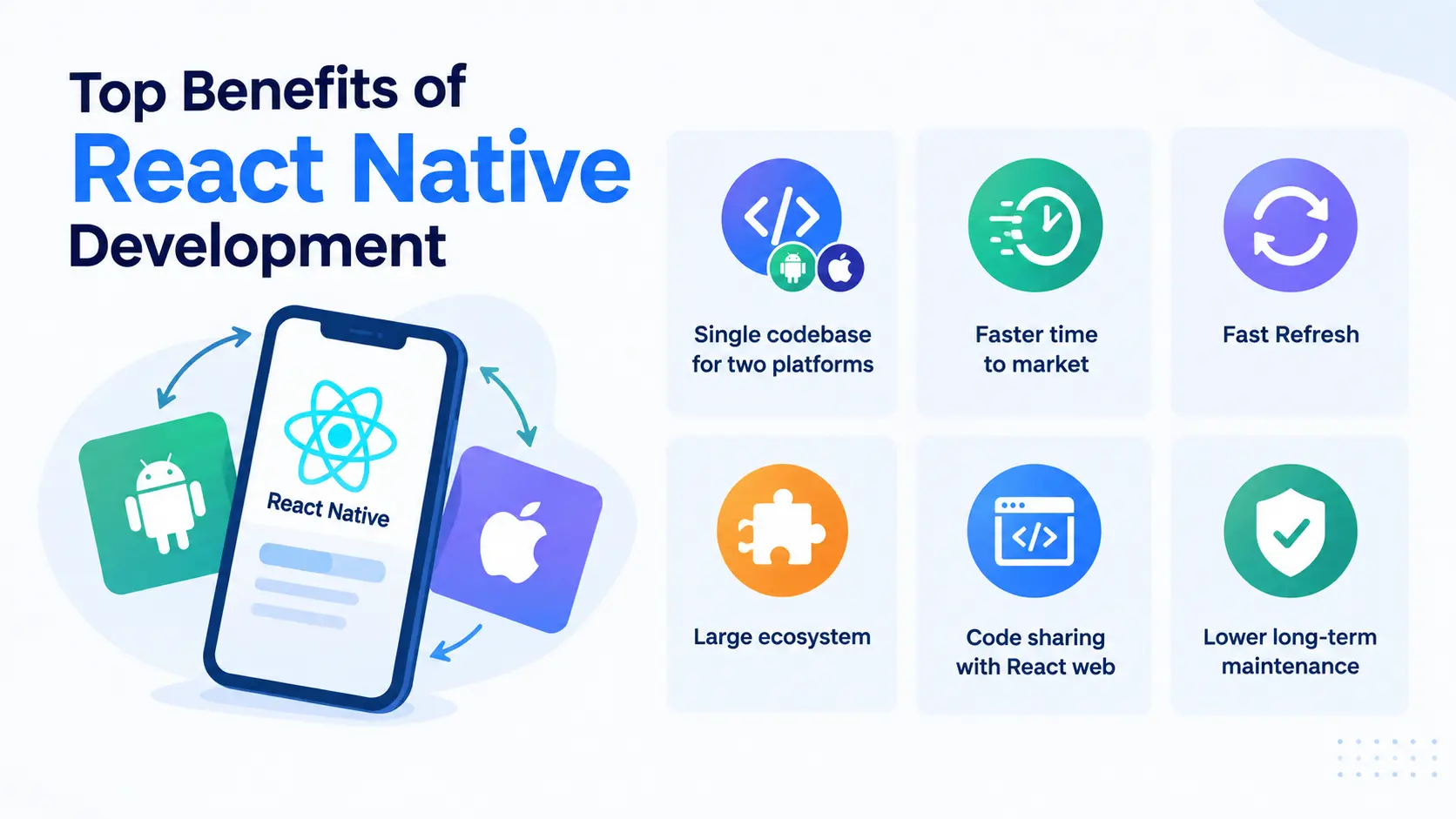
- Single codebase for two platforms
Up to 90% of code can be shared between iOS and Android, which is the main reason React Native app development costs run lower than parallel native builds.
- Faster time to market
One team, one codebase, one release cadence, rather than coordinating two separate engineering tracks.
-
Fast Refresh
Developers see code changes reflected almost instantly without a full rebuild, which speeds up iteration during development.
-
Large ecosystem
Thousands of maintained libraries exist for navigation, state management, and common UI patterns, so teams aren’t building everything from scratch.
-
Code sharing with React web
If your product already has a React web app, logic, types, and business rules can often be reused in the mobile build.
-
Lower long-term maintenance
One codebase means one place to fix bugs and ship features, instead of patching two.
Disadvantages of React Native Development
Take a look at these:
-
Performance ceiling for heavy workloads
Apps with intensive 3D rendering, complex animations, or games still perform better built natively.
-
Native modules still require native developers
When a feature needs direct access to device hardware that no existing library covers, you need someone who can write Swift or Kotlin, which partially offsets the “one team” advantage.
-
Bridge/JSI overhead on older architecture
Apps built before the New Architecture (JSI and Fabric) could suffer from the old bridge’s serialization overhead on heavy data flows; this is largely resolved on current versions, but older apps may still carry the problem.
-
Dependency on third-party libraries
Teams often rely on community-maintained packages, and an abandoned or poorly maintained library can become a liability during an OS upgrade cycle.
-
App size
React Native apps tend to be larger than equivalent native apps because they bundle the JavaScript runtime.
Challenges in React Native App Development
These are the practical problems teams hit mid-project, separate from the general pros and cons above.
-
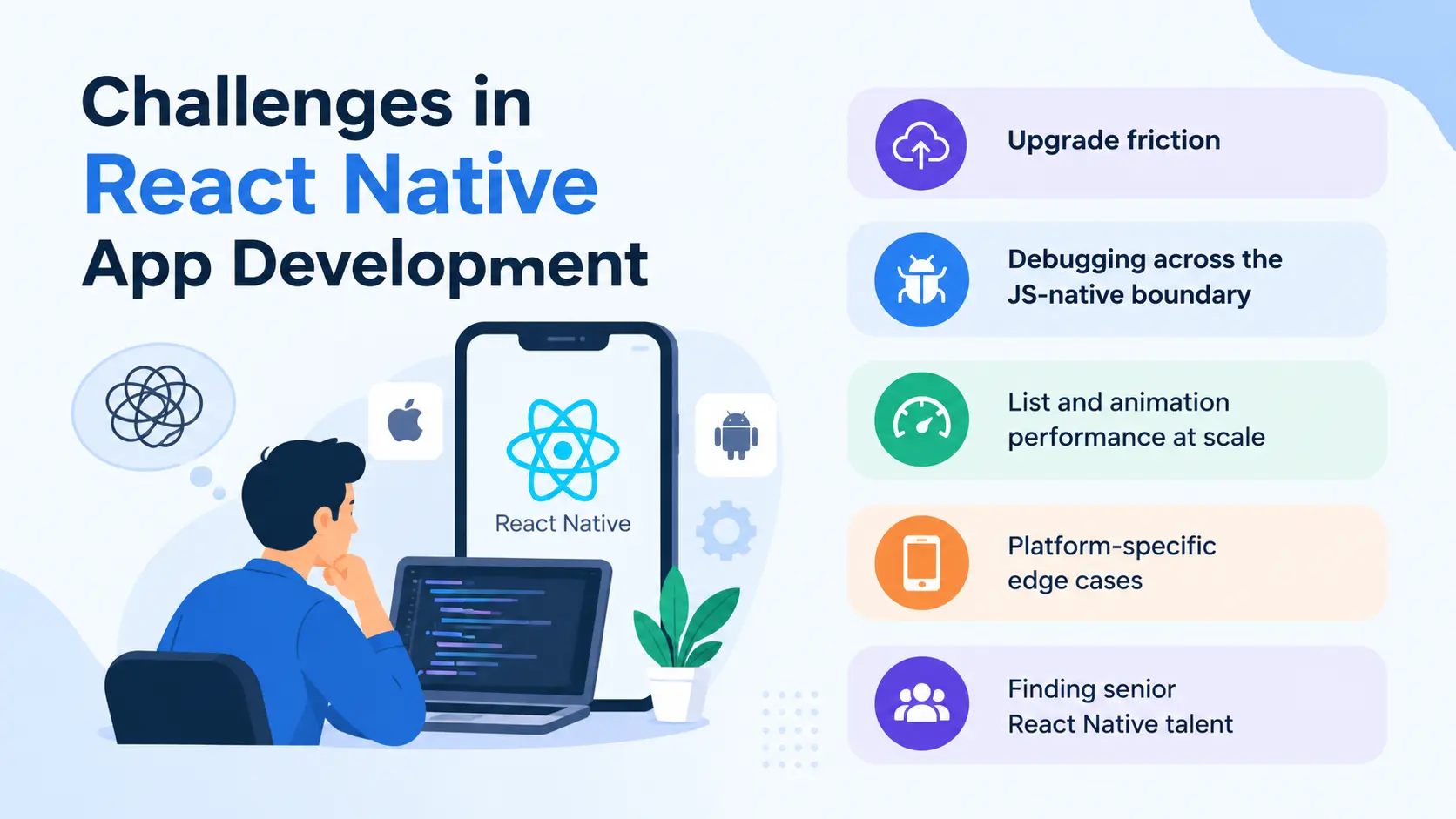
Upgrade friction
Moving between major React Native versions can break native modules, especially ones that haven’t been updated to match. Teams sometimes delay upgrades for months because of this, which creates its own security and compatibility risk.
-
Debugging across the JS-native boundary
When a bug sits at the handoff between JavaScript and native code, it’s harder to trace than a bug that lives entirely in one layer.
-
List and animation performance at scale
Long scrolling lists with complex items or heavy custom animations can drop frames if not optimized carefully.
-
Platform-specific edge cases
“Write once” doesn’t mean “it looks and behaves identically everywhere.” iOS and Android still diverge on things like keyboard handling, permissions flows, and navigation gestures.
-
Finding senior React Native talent
Mid-level React Native developers are easy to find. Developers who understand native modules, performance profiling, and the New Architecture well enough to debug deep issues are a smaller pool.
How to Handle Common Issues in React Native Apps?
Below are some practical ways to handle challenges in react native development:
| Problem | Practical Fix |
|---|---|
| Upgrade breaks native modules | Pin dependency versions, test upgrades on a branch before merging, and favor actively maintained libraries |
| Slow list rendering | Use FlashList or FlatList with proper keyExtractor and windowing instead of rendering full lists |
| Janky animations | Move animations to the UI thread with react-native-reanimated instead of driving them from JavaScript |
| Slow app startup | Enable the Hermes JavaScript engine, which reduces parse and startup time compared to JSC |
| Hard-to-trace native crashes | Use native crash reporting (Sentry or Firebase Crashlytics) alongside JS-level error boundaries |
| Platform inconsistency | Test on real devices for both platforms early, not just at the end of the sprint |
None of these are exotic fixes. They’re known patterns, which is part of why a team that’s hit them before moves faster than one encountering them for the first time.
Why Choose Dreamer Technoland for React Native Mobile App Development Services
We provide React Native mobile app development services end to end: architecture, UI, native module integration where needed, testing, and deployment. A few things about how we work:
- You own the code. No vendor lock-in, no conditions on handover.
- We’ve built across SaaS, e-commerce, and on-demand products, so we’re not learning React Native’s edge cases on your project.
- We scope realistically. If your idea fits better as an MVP first, we’ll say so rather than quoting a full build you don’t need yet.
- We work across time zones, having delivered projects for clients in the USA, UK, Germany, Saudi Arabia, the UAE, and Australia.
If your product needs custom workflows rather than a standard build, our custom software development services cover how we approach that kind of work.
Key Takeaways: Is React Native the Right Option for You?
React Native makes sense if you need iOS and Android apps built faster and cheaper than two native builds, your app doesn’t depend on heavy 3D or hardware-intensive performance, and you want one team maintaining one codebase long-term. It’s a weaker fit if your product is built around complex 3D, AR, or games, or if you need platform-specific behavior down to the pixel with no compromise anywhere.
For most business apps, SaaS products, and MVPs, React Native app development cost and timeline advantages outweigh the trade-offs, which is why it remains one of the two dominant cross-platform frameworks in 2026.
Have a project in mind? Talk to our React Native team, and we’ll give you a scoped estimate, not a guess.
FAQs on React Native App Development Cost
Q. How much does React Native app development cost in India?
In India, React Native development services typically run 20–45 per hour. A medium-complexity app that might cost 30,000–70,000 at US rates often lands around 12,000–30,000 when built by an India-based team at similar scope and quality.
Q. How much time does it take to build a React Native app?
Simple apps take 2–4 months, medium-complexity apps take 4–7 months, and complex or enterprise apps typically run 7–14+ months, depending on backend complexity, integrations, and compliance requirements.
Q. What are the pros and cons of React Native?
The main advantages are a shared codebase, faster development, and lower long-term maintenance. The main drawbacks are a performance ceiling for very demanding apps, occasional need for native developers, and dependency on third-party libraries that may not always be well maintained.
Q. Is React Native still good in 2026?
Yes. It holds roughly 35% of cross-platform developer usage according to Statista-attributed data, its GitHub repository remains one of the most active in the framework space, and companies like Microsoft run production apps on it at scale. For most business and consumer apps, it remains a sound choice.