

A mid-sized staffing firm came to us managing 40 open requisitions with a recruiting team of six people. At roughly 250 applications per posting, that’s 10,000 resumes sitting in an inbox and two recruiters spending entire days just skimming PDFs before a single interview got scheduled. They weren’t losing candidates to weak offers. They were losing them to slowness. By the time someone finally opened a resume, the best applicant had already accepted a job somewhere faster.
That’s the problem we were hired to fix, not with another spreadsheet wearing a chatbot, but with a real AI recruitment platform built to parse, score, and rank candidates before a human ever touches the pile. This build log walks through exactly how we built an AI-powered recruitment platform, the stack, the tradeoffs, and much more.
Quick Overview
We shipped a system with four working parts: a resume parser that turns messy PDFs into clean, structured data; a semantic matching engine that scores candidates against job requirements without relying on exact keywords; a bias-monitoring layer that runs quietly in the background; and a dashboard that hands recruiters a ranked, explainable shortlist instead of a raw applicant pile.
We built an AI-powered recruitment platform in 14 weeks, and the total cost was between $50,000 and $70,000; remember, the cost can increase if you add more features or customization. Screening time dropped by roughly 65%. Here’s how each piece of our AI-powered recruitment actually came together.
What We Built First: Scoping the AI Hiring Software
We didn’t try to build sourcing, screening, scheduling, and analytics all at once. Teams that attempt every module in parallel usually ship nothing well. So we split this AI hiring software into two phases:
- Phase 1: Covered resume parsing, candidate profiles, semantic matching, and a single ATS integration over eight weeks.
- Phase 2: This spread across the following six weeks, adding bias auditing, a recruiter scorecard, and a second ATS connector.
This is the same approach we use across most of our product development: start with whichever module removes the most manual labor, validate it against real usage, then expand from there. When we built an AI-powered recruitment platform for this client, resume screening was that first module. Nothing else in their funnel was eating more recruiter hours
The Architecture Behind AI Recruitment Platform
Resumes are chaos by design; no two candidates format their experience the same way, so every layer of this AI recruitment software had to hold up against that inconsistency.
Here’s what powered each piece of this AI recruitment solution:
| Layer | What We Used | Why |
|---|---|---|
| Text extraction | PyMuPDF (text PDFs), Tesseract OCR (scanned uploads) | ~15% of resumes still arrive as flattened phone-camera images and need OCR, not just text parsing |
| Structured extraction | GPT-4o with a JSON schema (name, work history, education, skills, certifications) | Replaced regex/section-header rules and took field accuracy from ~78% to 96% at ~$0.02/resume |
| Candidate & job embeddings | OpenAI text-embedding-3-large | Matches on meaning, not exact keywords, catches “K8s” as equivalent to “Kubernetes” |
| Vector storage | pgvector inside PostgreSQL, HNSW indexing | Handled this client’s volume without the overhead of a separate vector database |
| Scoring logic | Composite score: skill match, experience relevance, seniority alignment, location fit | Hard requirements act as gates, not soft nudges, surfacing ~20% more qualified candidates than keyword filtering |
| Backend services | FastAPI (Python) for ML, Node.js for coordination/webhooks | Let ML and platform engineering work in separate stacks without stepping on each other |
| Caching & queuing | Redis, BullMQ | Caches parsed resumes, handles async parsing jobs |
Note: That split between Python for ML and Node for orchestration is a pattern we reuse across most of our custom software development projects whenever a build needs both inference and real-time coordination without forcing one engineering team into the other’s stack. It’s the same underlying discipline behind broader artificial intelligence development work, separating the inference layer from the application layer so each piece scales independently, whether that’s a matching engine or something like AI-Powered Face Recognition Software Development for identity verification during onboarding.
Steps We Followed to Build an AI-Powered Recruitment Platform
There’s a well-known case in which a major tech company scrapped an internal hiring algorithm after it began penalizing resumes that contained the word “women.” That story shaped how we approached this AI recruitment solution from the first week, not as an afterthought bolted on before the launch. Here’s the sequence we followed:
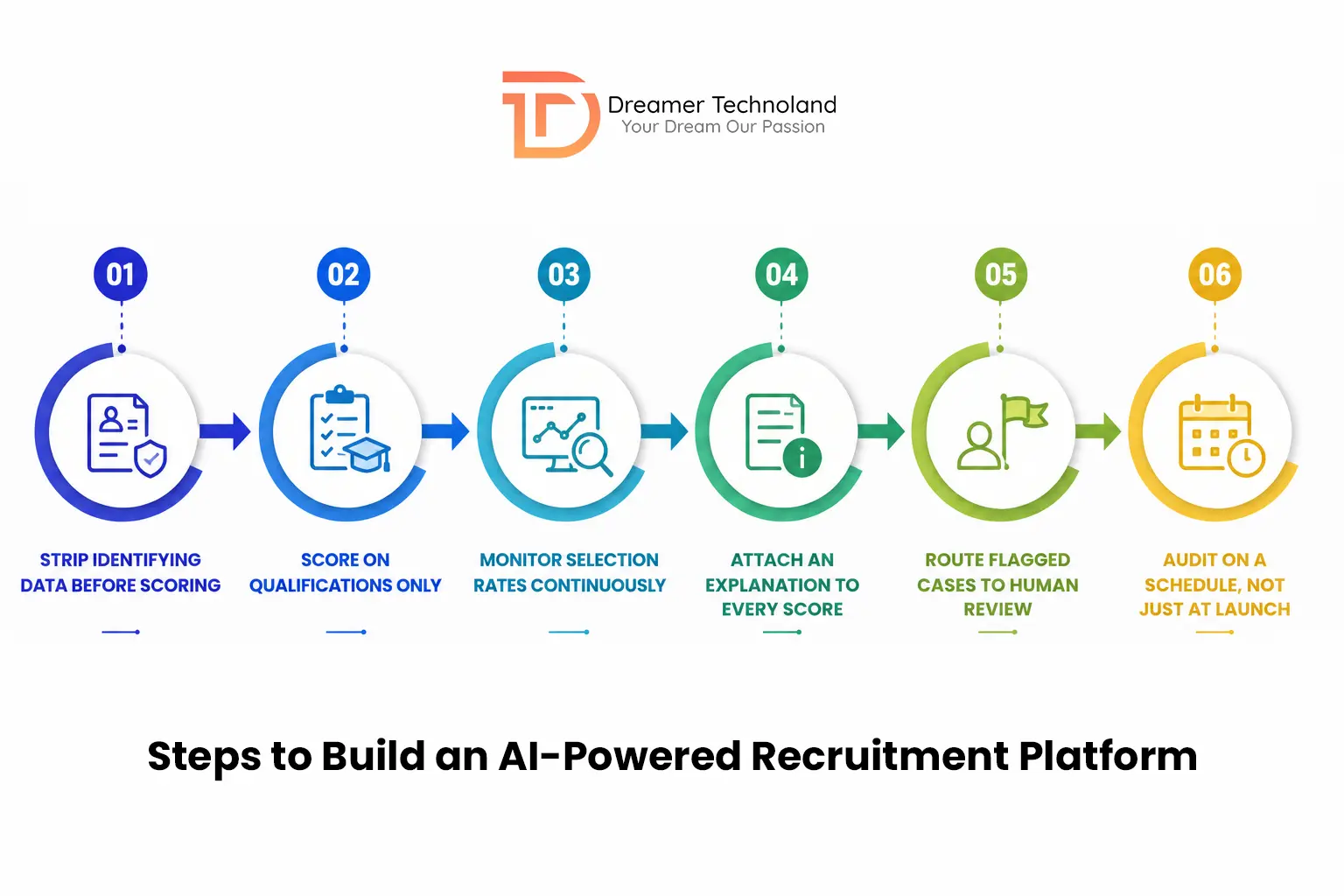
Strip identifying data before scoring
Names, photos, graduation dates, and home addresses are removed before a candidate profile ever reaches the matching engine. Scoring runs purely on skills and experience.
Score on qualifications only
The matching engine never sees demographic signals, just the structured data pulled from the resume parser.
Monitor selection rates continuously
We track advancement rates at every funnel stage against the EEOC’s four-fifths rule. If any group’s rate drops below 80% of the most-selected group’s rate, it flags automatically.
Attach an explanation to every score
Recruiters see exactly which skills, experience, and requirements drove a candidate’s ranking; there are no black-box numbers they have to take on faith.
Route flagged cases to human review
Anything the monitoring layer surfaces goes to a recruiter for manual investigation before it affects a live requisition.
Audit on a schedule, not just at launch
Selection-rate reports run monthly, so drift is caught early rather than showing up in a compliance review a year later.
A system recruiters don’t trust is a system they’ll quietly route around, so this sequence had to run before the matching engine shipped, not after.
According to SHRM’s 2026 Recruiting Benchmarking Report, median non-executive time-to-fill now sits at 39 days nationally, and organizations with the most effective recruiting practices, largely the ones running AI-assisted screening, fill roles about five days faster than everyone else. Fair and fast aren’t a tradeoff here. It’s the same system doing both jobs simultaneously.
Timeline, Team, and What It Actually Cost to Build AI Recruitment Software
Here is how we built an AI-powered recruitment platform:
| Phase | Timeline | Key Deliverables | Cost | Team |
|---|---|---|---|---|
| Phase 1 | 8 weeks | Resume parsing, candidate matching, and first ATS integration | ~$20,000 | 2 Backend Engineers, 1 ML Engineer, 1 Frontend Developer, Part-time Project Lead |
| Phase 2 | 6 weeks | Bias dashboard, recruiter scorecard, and second ATS connector | $30,000–$50,000 | Same core team |
| Total | 14 weeks | Complete AI-powered recruitment platform | $50,000–$70,000 | 2 Backend Engineers, 1 ML Engineer, 1 Frontend Developer, Part-time Project Lead |
Note: The above-given cost is based on a typical two-phase AI-recruitment build. But the cost can increase based on your specific requirements.
From Manual to AI-Powered Screening
Traditional resume screening puts recruiters in the middle of almost every repetitive step, from collecting applications and entering candidate details to reviewing resumes and deciding which candidates move forward.
This process becomes difficult to scale when hundreds or thousands of applications arrive for a single role.
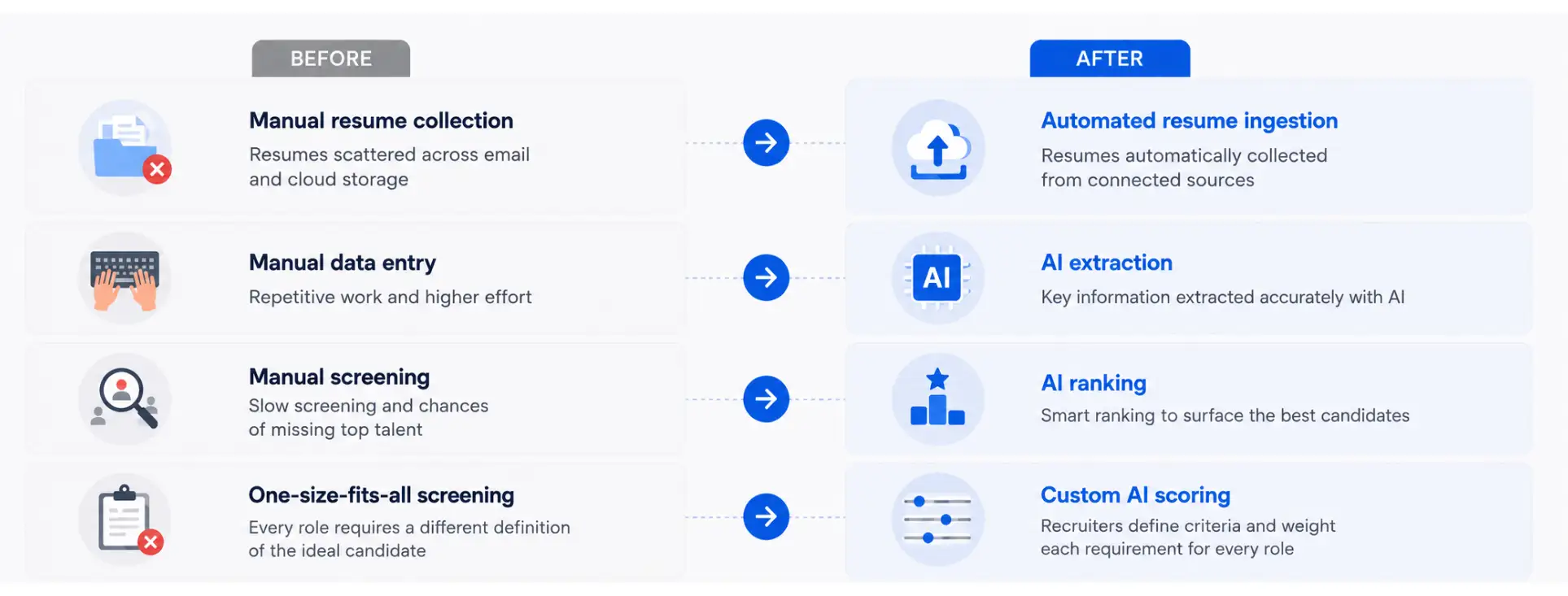
When we built an AI-powered recruitment platform, our focus was to remove these bottlenecks while keeping recruiters in control of the final evaluation.
Manual Resume Collection → Automated Resume Ingestion
Instead of gathering resumes from scattered emails and storage locations, the platform automatically collects resumes from connected sources and brings them into a centralized workflow.
Manual Data Entry → AI Extraction
Recruiters no longer need to manually enter candidate information. The AI recruitment platform extracts relevant details, including skills, experience, education, and certifications, and converts them into structured candidate profiles.
Manual Screening → AI Ranking
Rather than reviewing every resume from scratch, the semantic matching engine evaluates candidates against job requirements and ranks the strongest matches for recruiter review.
One-Size-Fits-All Screening → Custom AI Scoring
Different roles require different hiring criteria. Recruiters can define the skills, experience, seniority, location, and other requirements that matter for each position. The scoring model then weighs these criteria accordingly.
The Result
The platform is not designed to replace recruiters. Instead, it removes repetitive screening work so recruiters can spend more time evaluating qualified candidates, communicating with applicants, and making informed hiring decisions.
What Changed After Launch
| Metric | Before | After |
|---|---|---|
| Recruiter hours on screening/week | ~20 hours | ~7 hours |
| Field extraction accuracy | Manual entry | 96% |
| Qualified candidates surfaced vs. keyword search | Baseline | +20% |
The recruiting team didn’t shrink after launch; their job shifted. Less time skimming PDFs, more time actually talking to candidates who were already pre-qualified before the call started.
How Do Dreamer Technoland Build It Differently?
We at Dreamer Technoland designed AI recruitment platforms for the specific volume, compliance requirements, and hiring workflows of the organizations we work with. Our team had delivered AI hiring software for staffing firms, healthcare recruiters and tech companies, combining deep engineering capability with a real understanding of how recruiting teams actually work day to day.
So, no matter whether your organization needs a resume-screening engine to replace manual review, a custom matching system built around your specific job architecture, or bias-auditing layer that keeps your hiring process compliant, we design and build AI solutions that fit your ATS and your volume rather than forcing you into a generic template.
Building something similar for your hiring team? We’ve built an AI-powered recruitment platform for HR tech clients across different ATS stacks, and our engineers can scope yours against your actual applicant volume.
Frequently Asked Questions
Q. How much does it cost to build an AI recruitment resume screening platform?
A resume parsing and matching MVP typically costs around $50,000 and takes 12 to 14 weeks to develop. Adding features such as bias auditing, scheduling, and a second ATS integration can increase the total cost to approximately $50,000-$70,000.
Q. How accurate is AI resume screening compared to manual screening?
LLM-based structured extraction runs 94–97% field-level accuracy, well above rules-based parsers, and semantic matching surfaces roughly 15–20% more qualified candidates than keyword search alone.
Q. Can an AI hiring platform integrate with our existing ATS?
Yes, most major ATS platforms offer REST APIs and webhook support, though enterprise systems can require partner certification that adds several weeks.
Q. How long does it take to build an AI-powered recruitment platform?
A focused MVP can be developed and launched in approximately 12 to 14 weeks. A full platform with bias tooling, scheduling, and analytics typically runs 5–6 months.